Albania Off the Beaten Path: Where to Go Beyond the Tourist Trail
Albania’s standard tourist circuit — Tirana, Berat, Gjirokastra, the Riviera, the Albanian Alps — is excellent. These are the famous destinations for good reason. But Albania is a larger and more varied country than the standard circuit covers, and the destinations that lie beyond it are often the ones that experienced travellers mention first when asked what surprised them.
This guide is for travellers who have either done the highlights already or who want to design an itinerary that deliberately sidesteps the main tourist routes. Some of these destinations are genuinely remote; others are simply overlooked despite being easy to reach. All of them reward the effort.
| Where | Permet, Korce, Pogradec, Osum Canyon, Shala River, Vuno |
| Getting there | Rental car recommended; limited furgon coverage |
| Best months | May-June and September-October |
| Booking | Ahead for Permet, Pogradec, Korce in summer |
| English level | Lower than the main tourist circuit |
Permet: Albania’s Best Off-Piste Town
Permet is the entry point for almost everyone who goes off the beaten path in Albania, and it is impossible to overstate how good it is. The town sits in the deep south, in a valley where the Vjosa and Lengarica rivers meet below mountains that shelter Byzantine churches and Ottoman fortresses. It is the production centre of Albania’s finest honey and raki, the gateway to the Benja thermal baths, and the base for rafting the Vjosa — one of Europe’s last wild rivers.
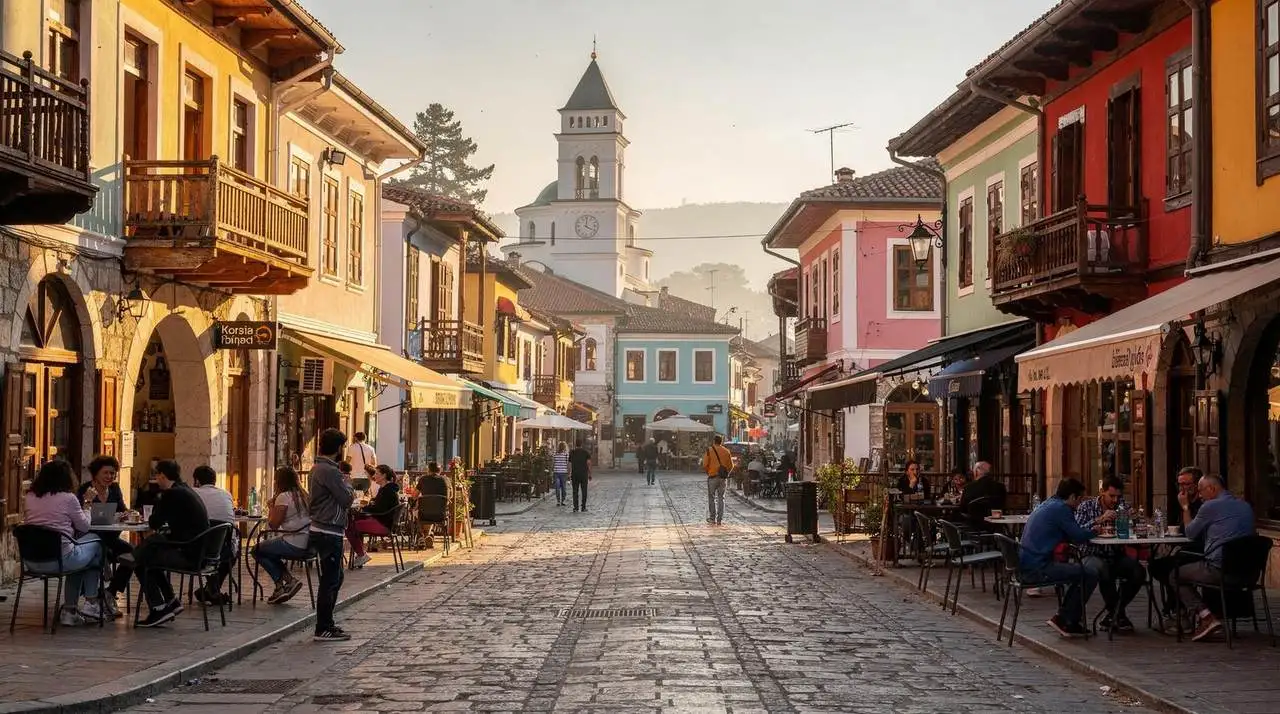
What makes Permet different from the tourist-circuit towns is its atmosphere. This is a place with an intellectual self-consciousness — Albania’s writers and artists have historically found creative inspiration here — and a civic pride that expresses itself in a well-maintained old bazaar, good restaurants that cater to Albanians rather than tourists, and a local population that is genuinely pleased when foreign visitors arrive and engage.
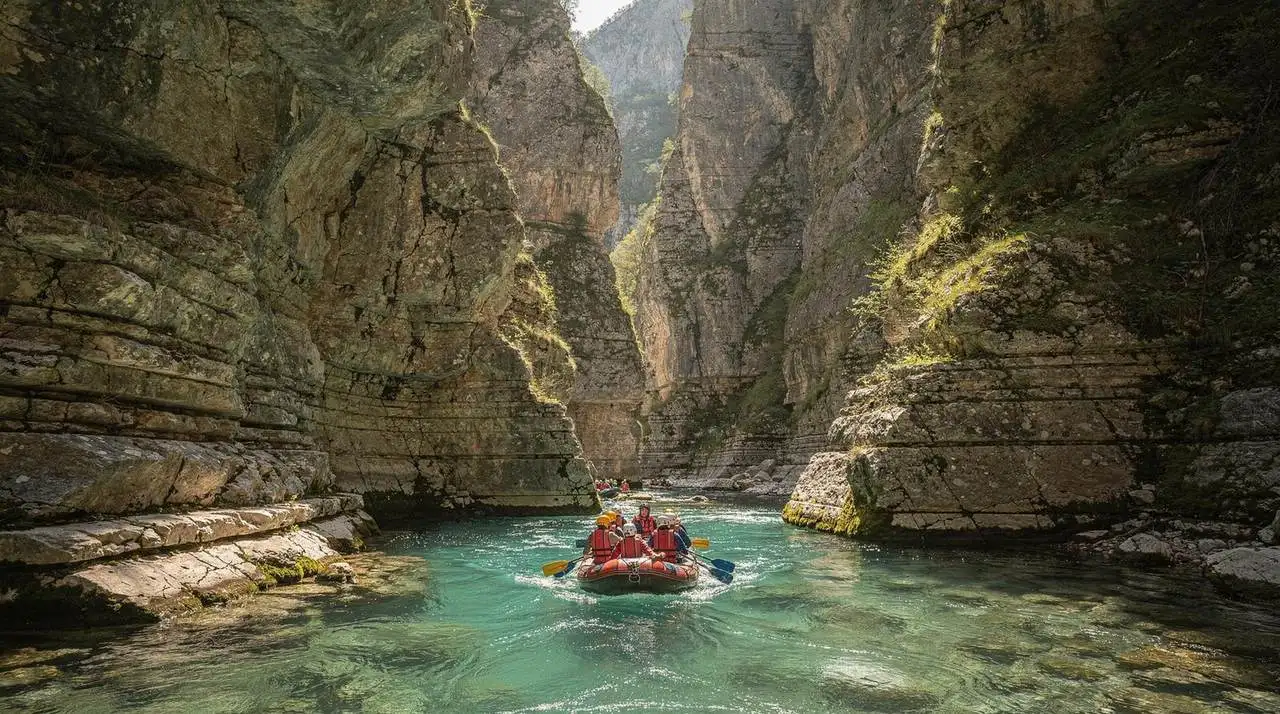
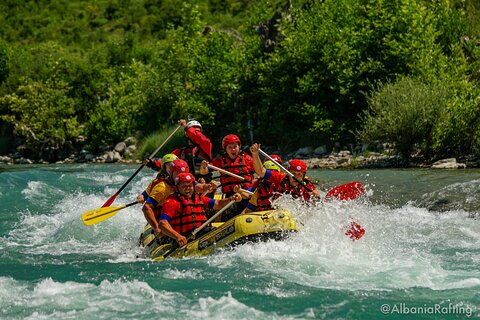
The Vjosa rafting here is serious and exhilarating. This rafting experience on the Vjosa River near Permet runs in spring and early summer when the water is high and the canyon is at its most dramatic — a grade III-IV descent through one of Europe’s finest wild river sections. The rafting season runs from March through June, with prices typically EUR 30-50 per person for a half-day on the water.
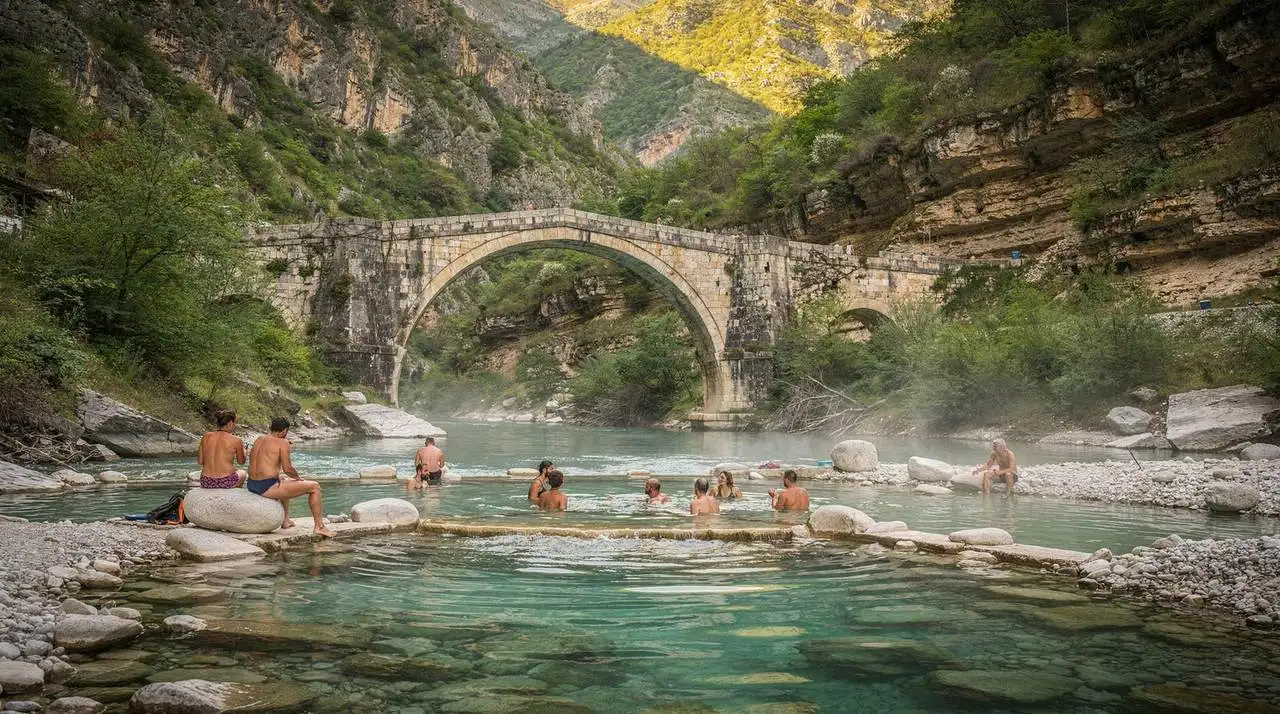
The Benja thermal baths, a twenty-minute drive from Permet, are one of the most remarkable natural attractions in southern Albania. Hot springs at 29-32°C emerge from the Lengarica riverbank within a dramatic gorge; a natural stone arch spans the canyon above. This guided thermal baths visit from Permet includes the canyon walk and the context that transforms the experience from a pleasant soak into a genuine understanding of the landscape. Entry to the pools costs EUR 1-3 per person; the guided experience adds transport and interpretation.
Beyond the natural highlights, the area around Permet contains some extraordinary archaeology. The ancient Greek city of Antigonea, near Gjirokastra on the route south, is rarely visited but contains a remarkable intact urban plan visible from the hilltop site. The Byzantine castle of Petro above the Lengarica Valley can be reached on foot from the thermal baths area — a two-hour round trip through Mediterranean scrubland.
Osum Canyon: Albania’s Undiscovered Grand Canyon
Osum Canyon near Skrapar is one of the most dramatic natural features in Albania and one of its least visited. The Osum River has cut a gorge 26 kilometres long and up to 80 metres deep through orange-red limestone, producing walls of sheer rock that dwarf the river below.
Visiting the canyon requires planning — the access is from Corovode, the nearest town, and reaching the best sections requires walking (or rafting in spring) through the canyon floor. The absence of tourist infrastructure is precisely what makes it rewarding: you are likely to have the canyon entirely to yourself.
Canyon trekking in the Osum is excellent in spring when the river is low enough to wade sections but the canyon walls are freshened by winter water. By July, the canyon floor traps heat and the experience becomes more arduous. The best months are April through June and September through October. The canyoning experience at the Osum is one of the most physically engaging activities in Albania’s interior.
The Osum fits naturally into a southern Albania circuit with Permet and Berat — from Berat, the drive to Corovode is around 45 minutes, and the canyon is accessible as a day trip. Guided canyoning tours from Corovode cost approximately EUR 25-40 per person including equipment. Self-guided walking along the canyon rim requires no equipment beyond good footwear.
Korce: The City That Takes Itself Seriously
Korce is the city that the rest of Albania treats as its cultural and intellectual rival — smaller than Tirana, at higher elevation, and with a self-image that takes in its museums, its Orthodox cathedral, its old bazaar, and its extraordinary collection of 19th and early 20th century Balkan architecture.
Foreign tourists are still rare in Korce, despite the city’s genuine attractions. The National Museum of Medieval Art houses one of the most important collections of Byzantine icons in the Balkans — a category in which this region is extraordinarily rich. The Mirahori Mosque, built in 1494, is one of the oldest in Albania. The old bazaar district has been sensitively restored. The Christmas market in December is the best in the country, running from early December through early January with a genuinely festive atmosphere.
What Korce does not have, by design, is tourist infrastructure. The accommodation is good but modest (guesthouses and smaller hotels from EUR 35-55 per night). The restaurants serve Albanian and regional food to Albanian customers. English is less commonly spoken than in Saranda or Tirana. This is what an Albanian city looks like without being rinsed through the tourism filter.
The Korce brewery — producer of Korce beer, the country’s most beloved lager since 1928 — offers guided tours with tasting throughout the year. It is an unusual and enjoyable cultural experience that says as much about Albanian social life as any museum visit. A half-day in Korce combining the Medieval Art Museum, the bazaar, and the brewery covers the city’s most distinctive elements.
Pogradec: Lake Ohrid’s Albanian Shore
Pogradec on the Albanian shore of Lake Ohrid is the destination that most travellers to the region miss by going to Ohrid itself in North Macedonia. The North Macedonian side has better infrastructure and more name recognition. The Albanian side has fewer visitors, quieter beaches, and the remarkable Lin peninsula.
The Lin peninsula juts into Lake Ohrid from the Albanian shore and contains, exposed to the sky, a Byzantine basilica floor mosaic of extraordinary quality from the 6th century. This mosaic — a large, complex composition of geometric and zoomorphic patterns — lies on a hilltop surrounded by the lake, visited by almost nobody despite its archaeological significance.
The Ohrid trout (Salmo letnica), a species unique to the lake, is legally protected but historically consumed in the region. Albanian restaurants around Pogradec serve the closely related brown trout from the lake in its place — grilled simply with lemon and olive oil in a preparation that needs nothing more. A lakeside fish lunch in Pogradec, with the water visible and the mountains of North Macedonia on the far shore, costs EUR 8-15 per person.
The drive from Pogradec south along the Lake Ohrid shore toward Korce is one of Albania’s loveliest and most overlooked roads, tracing the lakeshore through small fishing villages before climbing into the mountains that separate the two cities.
Pogradec is also the starting point for exploring the south shore of Lake Ohrid on the Albanian side — a series of small villages accessible by road or boat that have seen very little tourism development and offer a vision of lakeside Albania as it has existed for centuries.
Vuno and the Coastal Villages
The Albanian Riviera between Himara and Dhermi has a vertical dimension that most visitors miss. The beach villages of Jale, Palasa, and other coastal settlements are well-known; the ancient villages on the hillsides above them — Vuno, Palasa upper village, Piqeras — are not.
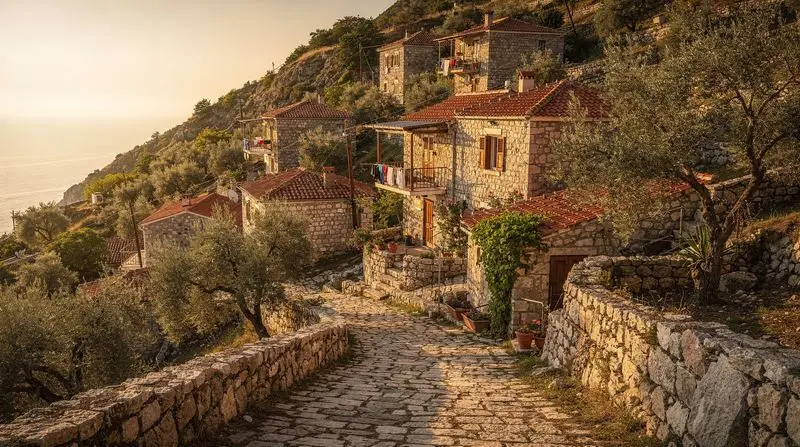
Vuno sits on a terrace above the coast, reached by a narrow lane that discourages casual visitors. Stone houses, a few guesthouses, terraces with views over the Ionian, olive trees, and the sound of the sea 400 metres below and several kilometres away. The walk down to Jale beach through the olive groves takes 45 minutes and the path is clear.
Staying in Vuno — one or two guesthouses take guests at EUR 35-55 per night for a double room — and accessing the beach on foot each day gives a completely different experience of the Riviera from the beach-club model below. You are in a working village that happens to have the sea nearby, rather than in a resort that happens to have hills behind it.
Palasa village above the beach of the same name is equally rewarding. The village predates the coast road and was the primary settlement when access was by mule path. Some of the stone houses are being restored by Albanian diaspora families returning to their ancestral villages; the process is visible and the results beautiful.
The Shala River and Surroundings
The Shala River in northern Albania is becoming more visited as it appears on more “hidden gems” lists. It is still, by any comparison, sparsely visited. The turquoise canyon, the traditional boat trips to the upper river, the swimming at the community gathering point, the floating restaurants moored to the canyon walls — these are experiences that feel like discovery regardless of how many other travellers are present, because the scale of the canyon and the quality of the water are inherently overwhelming.
The Shala River is best reached via the Koman Lake ferry, which itself ranks among the finest boat journeys in Europe. The two-hour ferry through the flooded canyon of the Drin River is simply extraordinary — limestone walls rising hundreds of metres above the emerald water, traditional villages visible on the rock faces, almost no infrastructure. From the ferry terminus at Fierza, the Shala River canyon is accessible by local boat.
Beyond the river itself, the Shala Valley above the canyon is an area of mountain farms and guesthouses where walking trails go for days without encountering another traveller. The Peaks of the Balkans trail, which extends through northern Albania, Kosovo, and Montenegro, passes through this area, connecting to Theth and Valbona further south.
Divjaka-Karavasta National Park
The Divjaka-Karavasta lagoon on the central Albanian coast is one of the Mediterranean’s most important wetland systems and one of Albania’s most underappreciated destinations. The park protects the breeding colony of Dalmatian pelicans — the largest bird in Europe by wingspan — along with flamingos, herons, spoonbills, and hundreds of migratory species.
Spring (April-May) and autumn (September-October) are the peak seasons for birdwatching here, when the migratory species stop over in the lagoon on their way between Africa and northern Europe. The Dalmatian pelicans breed on islands within the lagoon year-round and can be observed from the park’s boat tours.
The beach on the seaward side of the park is long, flat, and almost entirely undeveloped — kilometres of Adriatic sand without beach clubs, hotels, or crowds. In contrast to the Ionian Riviera, this beach is genuinely empty even in summer. A day trip to Divjaka from Tirana (1.5 hours each way) is one of the easiest off-beaten-path excursions available from the capital. Park entry is minimal — EUR 2-5 per person — and boat tours within the lagoon can be arranged from the park entrance for around EUR 10-15 per person.
Kelcyra Gorge: The Drive Nobody Takes
Between Tepelena and Permet, the Vjosa River runs through the Kelcyra Gorge in a series of dramatic canyon sections where the road clings to the cliff face and tunnels through rock at the narrowest points. This is one of the most spectacular road sections in Albania and is almost entirely unknown to foreign visitors.
Most travellers between Gjirokastra and Permet take the faster inland route. Taking the Kelcyra Gorge road instead adds 30 minutes and delivers scenery that is among the finest in the south. The combination with the Permet destination that lies at the end of it makes the gorge drive a worthy detour in its own right.
The gorge is at its most dramatic in autumn and spring when the river runs full and the walls are darkened by water. In summer, the reduced river reveals gravel beaches and swimming holes within the gorge that require a short scramble from the road to reach.
The Antigonea Ruins Near Gjirokastra
Ten kilometres south of Gjirokastra, the ancient Greek city of Antigonea occupies a hilltop above the Drinos Valley with a completeness of urban plan — streets, housing blocks, commercial quarter — that is visible across the entire site. Founded in the 3rd century BC and destroyed by the Romans in 167 BC, the city was never rebuilt, which explains why its layout is so perfectly preserved.
Antigonea receives a fraction of the visitors that go to Butrint, despite being closer to the main tourist circuit and equally atmospheric. The hilltop site provides extraordinary views, the scale of the ancient city becomes apparent only when you walk the full perimeter, and the absence of crowds allows a contemplative encounter with the ruins.
Access is by a rough road from the village of Saraqinisht; a standard car can manage in good weather. Allow two to three hours for a proper visit. No entry fee.
The Osumi River Valley and Skrapar District
The Skrapar district — the mountainous interior between Berat and the Greek border — contains concentrations of traditional Albanian culture that tourist infrastructure has not reached. The Osumi River valley between Corovode and Cepan is lined with traditional stone villages and Ottoman-era bridges. The Zgures Waterfall above the village of Cepan is a remarkable natural feature that requires a two-hour hike from the road.
The district capital Corovode is a functional small Albanian town with one or two guesthouses and restaurants. It is not a destination in itself, but it is the base for the Osum Canyon and a logical overnight stop for travellers exploring the interior.
How to Approach Off-Path Albania
The common practical requirement for most of these destinations is a rental car. Public transport reaches Permet, Pogradec, and Korce (though with limited frequency); it does not reach the Osum Canyon trailheads, Vuno village, or the more remote sections of the Divjaka park.
A car also allows you to combine these destinations efficiently. A circuit of southern Albania might go: Berat — Osum Canyon — Permet (two nights) — Gjirokastra — Riviera — Saranda. Adding Korce and Pogradec extends it by two days and adds the lake dimension.
See driving in Albania for road conditions on these less-travelled routes, and Albania road trip guide for a full route that incorporates several of these off-path destinations. The furgon and bus guide covers public transport options to the destinations that are reachable without a car.
The timing argument for off-path Albania: these destinations are at their best in May-June and September-October, when the main tourist circuit is already well-visited but the secondary destinations are completely quiet. Coming in May to Permet rather than August at Ksamil is a different kind of Albanian holiday — more demanding, more varied, and ultimately more memorable.
Practical Notes for Off-Path Travel
Going beyond the main tourist circuit in Albania requires slightly more preparation:
Accommodation: Book ahead even in shoulder season for Permet (limited guesthouses), and always for Pogradec and Korce in summer. Smaller villages like Vuno have extremely limited beds — email ahead or call through a Shkodra or Tirana travel agency if you cannot reach the property directly.
Language: English is less common off the tourist circuit. A few Albanian words go a long way — “faleminderit” (thank you), “sa kushton?” (how much?), and “gjesht?” (water?) will get you further than you expect.
Cash: ATMs are available in Permet, Korce, and Pogradec but not in small villages. Carry sufficient lek for two to three days before reaching the next town.
Local guides: For Osum Canyon, the Shala River upper sections, and serious hiking in the Skrapar district, engaging a local guide adds safety and depth. Ask at guesthouses in Corovode or Permet for recommendations.
The Albania travel tips guide covers the practical preparation for all kinds of Albanian travel, including the less-visited regions.
Camping and Wild Stays Off the Beaten Path
For travellers who want to go further than a guesthouse in a quiet village, wild camping in Albania is legal and increasingly popular in the mountain regions around Theth, Valbona, and the Skrapar interior, provided you follow basic leave-no-trace practice. More structured glamping in Albania has also started appearing near the Vjosa and Osum valleys, offering a comfortable middle ground between a hotel and a tent for travellers building an off-path itinerary. Agrotourism stays — working farms that host guests — are another distinctive option around Korce and Permet, putting you directly in contact with the rural economy that most tourist circuits never touch.
Rock Climbing and Via Ferrata in the Interior
Beyond hiking and canyoning, Albania’s interior has a small but growing outdoor sports scene worth knowing about. Rock climbing in Albania has developed around limestone crags in the south, including routes near the Osum Canyon, while via ferrata routes are beginning to appear in the Alps foothills as an accessible alternative to full alpine trekking. Both remain niche enough that you are unlikely to share a route with more than a handful of other visitors, even in peak months.
Frequently Asked Questions About Off-the-Beaten-Path Albania
Do I need a car to explore off-the-beaten-path Albania?
For most of it, yes. Permet, Pogradec, and Korce have some furgon (minibus) service, but the Osum Canyon trailheads, Vuno village, and the more remote parts of Divjaka-Karavasta National Park are only realistically reachable with a rental car. See the car rental Albania guide for options.
What’s the single best off-the-beaten-path destination in Albania for a short trip?
Permet, combined with the Benja thermal baths and, if timing allows, a Vjosa rafting trip. It’s reachable in a day from Berat or Gjirokastra, has a genuine off-circuit atmosphere, and packs thermal baths, ancient ruins, and river scenery into one base.
Is off-the-beaten-path Albania safe to visit alone?
Yes, generally. Albania overall has a good safety record, and the off-path regions are more remote rather than more dangerous. The main practical risks are logistical — poor phone signal in canyons, limited English, and fewer facilities — rather than safety concerns. Basic precautions (telling someone your route, carrying enough water and cash) apply as they would for any remote travel. See the Albania safety guide for the broader context.
Combining Off-Path Destinations With the Main Circuit
Most travellers get the best results by treating off-path Albania as an extension rather than a replacement for the highlights. A two-week trip might run: Tirana, Berat, Osum Canyon, Permet, Gjirokastra, then the Riviera and Saranda, with Pogradec and Korce as an optional northeastern loop if time allows. This keeps the well-known highlights while carving out real time for the quieter destinations that make an Albania trip distinctive rather than merely pleasant. For couples specifically, several of these destinations — Permet’s thermal baths, Vuno’s quiet coastal terraces — suit a romantic pace particularly well; see the Albania for couples guide for how to build that into an itinerary.