The Theth-Valbona Trek: Albania’s Greatest Mountain Journey
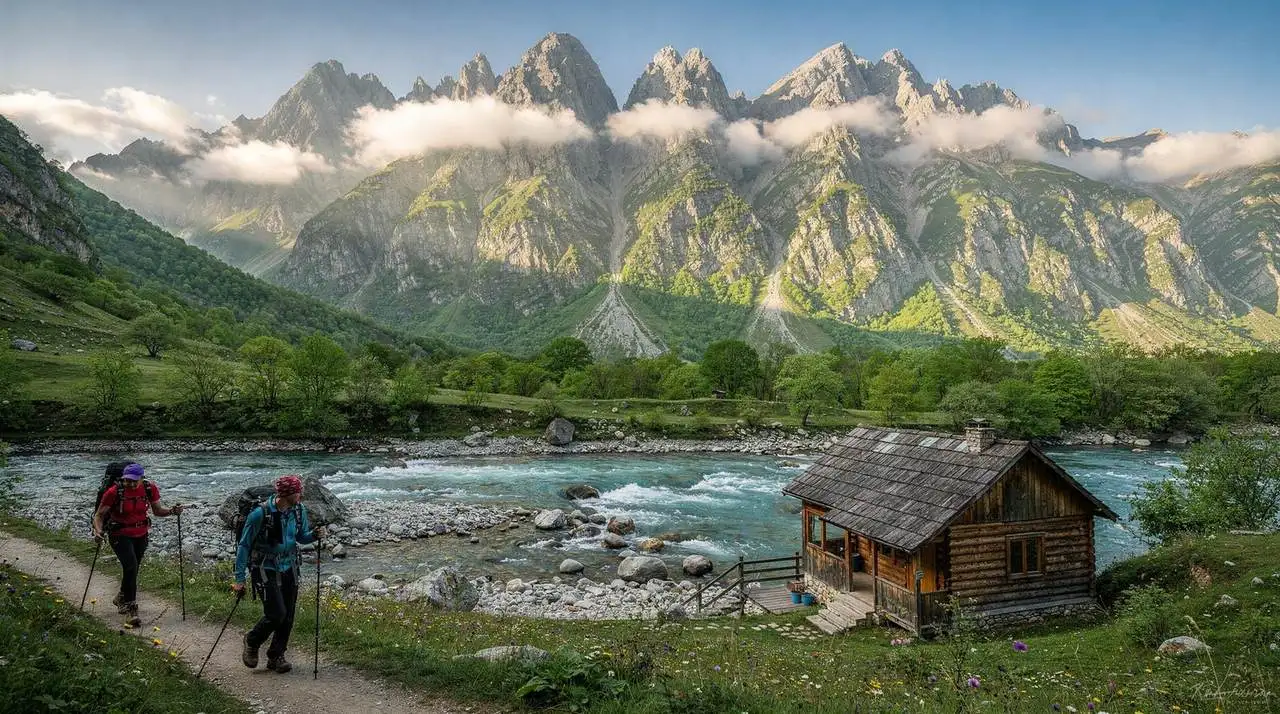
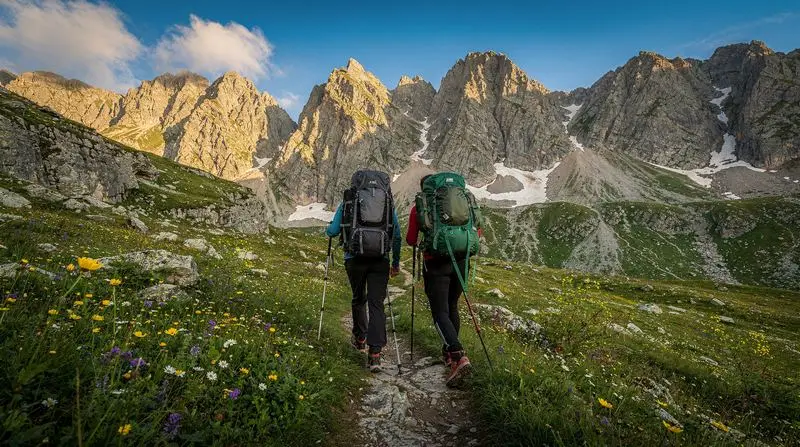
The crossing between Valbona and Theth is the most famous day hike in Albania and one of the finest mountain walks in the Balkans. Through the Bjeshkët e Namuna — the Accursed Mountains — the trail climbs from the Valbona Valley through dense beech forest to the Valbona Pass at 1,800 metres, then descends through increasingly green pastures and pine forest into the extraordinary Theth Valley. The round numbers: approximately 14 km, 1,200 m of ascent, 800 m of descent, 6–9 hours of walking.
Combined with the legendary Koman Lake ferry from Shkodra, this three-to-four-day circuit is one of the most rewarding mountain experiences anywhere in southeastern Europe — the kind of trip that completely recalibrates your sense of how beautiful and remote Albania’s north can be.
This guide covers the complete journey from Shkodra to Theth, including ferry logistics, guesthouse recommendations, the trail in detail, and what to see in Theth before returning. For context within a longer Albania trip, see the 7-day north Albania itinerary or the 10-day complete itinerary.
| Where | Shkodra → Koman Lake ferry → Valbona → Theth |
| Cost | around EUR 130–195/person for 3–4 days on a budget tier |
| Time needed | 3–4 days; the crossing itself is 6–9 hours of walking |
| Getting around | Shared taxi, the Koman Lake ferry, and the marked mountain trail |
| Best time | Mid-June to September; snow can block the pass into early June |
Is This Trek For Me?
The Valbona-to-Theth crossing is a long, strenuous day hike — not a technical climb, but demanding. You should be comfortable with:
- 6–9 hours of sustained walking including steep ascent and descent
- Rough, rocky trail surfaces (no paved sections)
- High-altitude conditions (temperature drop at the pass, possible afternoon thunderstorms)
- No rescue infrastructure (mobile coverage is limited in the mountains)
Trekking poles are strongly recommended. Trail running shoes work on this trail; proper hiking boots are better. Fitness level: you should be able to hike 5–6 hours comfortably before attempting this.
Non-hikers and those with limited mobility can cross the pass by 4WD vehicle on a rough mountain road (not always passable in early season or after heavy rain; arrange through your Valbona guesthouse).
The trail can be walked in either direction. This guide goes Valbona to Theth (the more popular direction for logistical reasons), but Theth to Valbona is equally beautiful and works just as well.
Day 1: Shkodra — Gateway to the Alps
Arrive in Shkodra
Take the morning bus from Tirana to Shkodra (2 hours, 400 lekë). Shkodra is a pleasant city with a compact historic centre, an excellent photography museum, and the great Rozafa Castle overlooking the lake confluence.
Visit the Marubi National Photography Museum (500 lekë) — the finest photography archive in the Balkans, documenting Albanian life from the 1850s through the communist era with over 500,000 photographs and negatives. Allow 1.5 hours.
Walk to Rozafa Castle (300 lekë) for the view over the confluence of the Buna, Drin, and Kiri rivers and across Lake Shkodra toward Montenegro.
Evening: Logistics and Preparation
This evening is critical for logistics. Speak to your guesthouse host about:
- Transport to the Koman ferry terminal tomorrow morning (shared taxi, around 1,200–1,500 lekë from Shkodra)
- Ferry schedules (the public ferry departs Koman at approximately 9am; the Berisha private ferry may run at different times)
- Whether they can arrange for your main bag to be transported to Valbona if you want to walk without a heavy pack
- Current trail conditions (snow lingers on the pass until late May; it can be icy in early season)
Pack your day bag for tomorrow: water (at least 2 litres, refillable from springs on the trail), snacks, sunscreen, rain layer, extra warm layer for the pass, first aid essentials. Cash in small denominations for guesthouse payments — Valbona and Theth guesthouses are cash-only.
Day 2: Koman Lake Ferry and Valbona
Early Morning: The Drive to Koman
Leave Shkodra by 6–6:30am for the shared taxi to Koman ferry terminal — the drive takes approximately 1.5 hours on a mountain road above the Drin River. The road itself offers dramatic views as it climbs; arriving at the terminal in the early morning with the ferry loading is an atmospheric experience.
Book a combined Koman Lake and Shala River tour from Shkodra for the most comfortable version of this journey — all transport arranged, including the extraordinary turquoise Shala River detour that most ferry passengers miss.
Morning: The Koman Lake Ferry
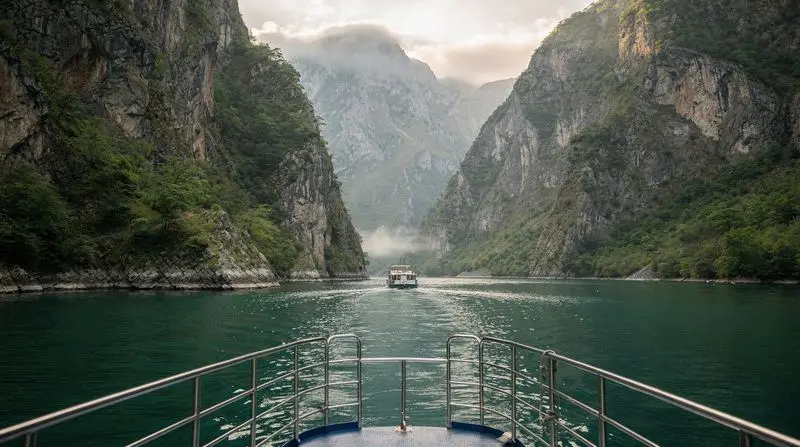
Board the ferry for the 2.5-hour crossing from Koman to Fierza. This is one of the most extraordinary journeys in Europe: a narrow reservoir filling the gorge that was carved by the Drin River before the 1970s dam was built, with sheer limestone and schist walls rising 200–300 metres directly from the water. There are no roads along the lake shores; the villages visible on ledges high above are accessible only by boat.
The ferry is used by local villagers, farmers, and motorcyclists as much as by tourists. There may be goats on board. Buy a coffee from the small bar at the stern and sit at the bow for the best views. In morning light, the colours in the rock — red iron oxide, white limestone, grey schist, the deep green of the water — are extraordinary.
The Shala River branches off the lake at one point: a narrow gorge of water so turquoise it seems artificially coloured, with local boats moored at a platform where you can swim, cliff-jump, and eat. Tour boats detour into the Shala; the public ferry does not — another reason to book the combined tour if you want the full experience.
Afternoon: Fierza to Valbona
At Fierza, the ferry docks and passengers scatter: a mix of motorcycles, shared taxis, and minibuses heading to Bajram Curri and Valbona. Negotiate with the shared taxi drivers for a ride to Valbona — approximately 1 hour, 1,000–1,500 lekë per person. The road climbs from the valley floor through increasingly spectacular mountain scenery before dropping into the Valbona River valley.
Valbona Valley National Park opens before you as the road enters the valley: a wide, flat-floored glacial valley surrounded by bare limestone peaks reaching 2,500+ metres, covered with dense beech and pine forest on the lower slopes, and threaded by the crystal-clear Valbona River. The scale and beauty of the landscape is immediately arresting.
Check into your guesthouse — family-run operations that are among the warmest and most welcoming in Albania. Most offer half-board (breakfast and dinner included), which is both excellent value and the most practical option since there are few other eating options.
Evening: Rest and Trail Briefing
Rest in the afternoon — swim in the river (extremely cold, immediately refreshing), walk a short way along the valley floor to stretch your legs, and eat a large guesthouse dinner. Ask your host about the trail: starting times, current conditions, any sections to be aware of.
Guesthouse options in Valbona:
- Guesthouse Margjeka: reliable, good food, central location
- Guesthouse Bujtina e Lugut: English-speaking hosts, experienced with hikers
- Guesthouse Rilindja: newer, good facilities Half-board rates: approximately 3,500–5,000 lekë per person.
Day 3: The Valbona-to-Theth Crossing
Pre-Dawn: Start Early
Breakfast at 6:30am (arrange with your guesthouse the night before). Leave by 7am at the latest — afternoon thunderstorms are common in the Albanian Alps from June through August, and you want to be over the pass well before noon.
Fill your water bottles from the guesthouse. The trail passes several spring water sources, but it’s worth starting with 2+ litres. Pack your rain layer and an extra warm layer — the pass can be 10–15°C cooler than the valley floor, and temperatures drop fast if cloud rolls in.
Book a guided 3-day Valbona-Theth crossing from Shkodra for a fully serviced experience with an expert guide, all logistics handled, and accommodation in both valleys included.
The Trail: Stage by Stage
Stage 1: Valbona village to Rrogam (2 hours, gradual ascent)
The trail begins at the far (eastern) end of Valbona village, marked with red-and-white Peaks of the Balkans waymarks on trees and rocks. The path initially follows the Valbona River through beech and pine forest on a gentle gradient, with views up to the surrounding peaks. Cross the river on a wooden bridge after approximately 30–40 minutes; the trail then climbs more steeply through the forest to the summer grazing settlement of Rrogam (1,250 m), where a shepherd family sometimes sells coffee and cheese.
Stage 2: Rrogam to Valbona Pass (2–2.5 hours, steep ascent)
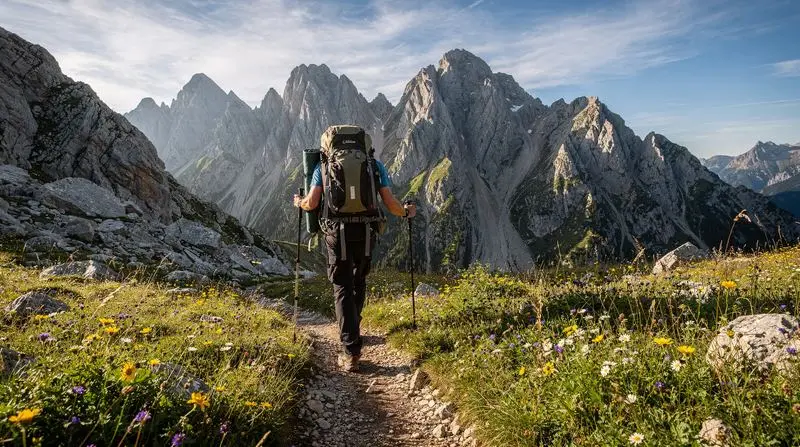
Above Rrogam the trail steepens significantly. The forest gives way to alpine meadow and then to bare limestone karst as you climb toward the pass. Navigation is clear in good weather; in cloud, follow the waymarks carefully. There are excellent viewpoints looking back down the Valbona Valley at approximately 1,500 m and 1,700 m.
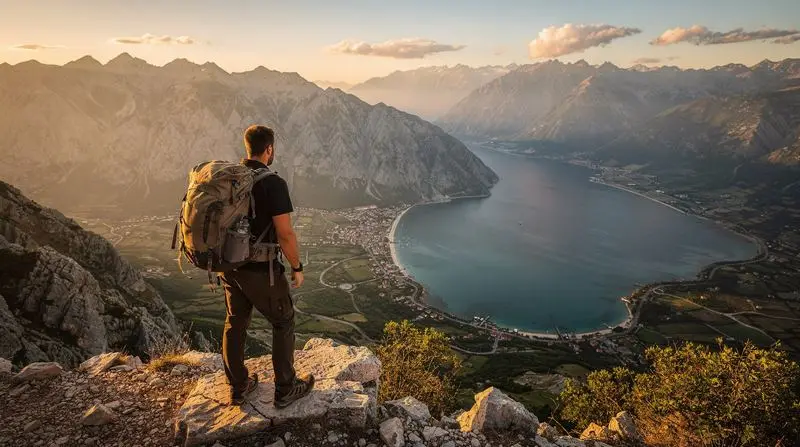
The Valbona Pass (Qafa e Valbonës, 1,793 m) is marked with a Peaks of the Balkans sign and a cairn. On a clear day, the 360-degree panorama encompasses the northern Albanian Alps, the Kosovo mountains to the northeast, and the beginning of the Theth Valley below to the southwest. This is the highest point of the day; eat, drink, and take photos.
Stage 3: Valbona Pass to Theth (3–3.5 hours, steep descent then gradual)
The descent from the pass into the Theth Valley is steep and loose for the first 45 minutes — go carefully here, especially if the rocks are damp. Trekking poles come into their own on the descent. The trail drops through pine and juniper forest before reaching the upper Theth grazing areas, where you may encounter cows, horses, and the stone shepherd huts called katunë.
The valley opens up gradually; the distinctive stone and wooden buildings of Theth become visible far below as you descend. The final section follows the Thethi River downstream through the valley, passing the Church of Theth (19th century, simple stone exterior) and various traditional stone houses before reaching the cluster of guesthouses that forms the village centre.
Arrival in Theth: Total walking time 6–9 hours depending on fitness and pace. Most hikers arrive between 2pm and 5pm.
Evening: Theth Guesthouse
Check into your Theth guesthouse (most are in the valley centre near the church). Half-board rates similar to Valbona: 3,500–5,000 lekë per person. The guesthouse dinner — after a long day on the mountain — will be among the best meals of your Albania trip: multiple courses, home-produced vegetables, meat from animals raised in the valley, homemade raki.
Guesthouse options in Theth:
- Guesthouse Polia: excellent reputation, central location
- Guesthouse Gjeloshi: good food, helpful hosts
- Guesthouse Lumi: quieter location near the river
Day 4: Theth — Exploration Before Return
Morning: Theth’s Three Highlights
Theth is a scattered highland village in a glacially carved valley of exceptional beauty. The traditional architecture — stone houses with slate or wooden-shingle roofs, stone towers (kulla), water mills on the river — has changed little over centuries. Three short walks cover the essential Theth experience:
1. Grunas Waterfall (45 minutes each way) Follow the marked path upstream from the village to the Grunas Waterfall — a 30-metre cascade plunging into a deep pool at the base of a limestone cliff. The gorge above the waterfall is narrow and dramatic. Swim in the pool below the falls in summer. Total walking time: 1.5 hours with a swim.
2. The Lock-In Tower — Kulla e Ngujimit (15 minutes from village) The stone defensive tower where men under threat of blood vengeance (gjakmarrja) historically sheltered while their families negotiated with feuding clans under the rules of the Kanun — the customary law code that governed highland Albanian society. The tower is open to visitors; entry by donation. This is one of the most culturally significant sites in northern Albania, a tangible reminder of a social system that was still operating within living memory.
3. Theth’s Blue Eye (30 minutes from village) A turquoise spring pool fed by cold water emerging from the rock — perfect for swimming and completely different from (but equally beautiful as) the famous Blue Eye near Saranda.
Afternoon: Return Journey Options
Option A — Return Valbona via 4WD (recommended) The return to Shkodra runs in reverse: shared 4WD taxi from Theth to Shkodra (2.5–3 hours on the mountain road via the Theth Gorge, approximately 2,000–3,000 lekë per person). This road is rough but offers some of the most dramatic canyon scenery in Albania — the Theth Gorge section involves driving along the bottom of a narrow limestone gorge with the river running alongside. From Shkodra, bus or taxi to Tirana.
Option B — Continue the Peaks of the Balkans Trail If you have a week or more and serious hiking ambitions, continue the Peaks of the Balkans long-distance trail from Theth northward into Montenegro or Kosovo. The full Peaks of the Balkans circuit covers approximately 192 km across three countries; the Albanian sections (Valbona to Theth, Theth to Vermosh) are among the most spectacular.
Trail Logistics Summary
| Segment | Distance | Time | Ascent/Descent |
|---|---|---|---|
| Valbona to Rrogam | 6 km | 1.5–2 hrs | +400 m |
| Rrogam to Valbona Pass | 4 km | 2–2.5 hrs | +550 m |
| Valbona Pass to Theth | 6 km | 2.5–3.5 hrs | -800 m |
| Total | ~14 km | 6–9 hrs | +1,200 m / -800 m |
What to Pack
- Hiking boots or trail shoes with ankle support
- Trekking poles (strongly recommended for descent)
- Rain jacket and extra warm layer
- 2+ litres water capacity (refill from trail springs)
- High-energy snacks: nuts, dried fruit, chocolate, energy bars
- Sunscreen and sunglasses (intense UV at altitude)
- Small first aid kit (blister plasters essential)
- Headlamp (in case of slow progress)
- Offline maps downloaded: Maps.me, AllTrails, or Peaks of the Balkans official app
- Cash in small denominations (guesthouses and trail refreshments are cash-only)
3-4 Day Trekking Budget Summary
| Category | Budget | Mid-range |
|---|---|---|
| Shkodra accommodation (1 night) | EUR 20–30 | EUR 40–60 |
| Transport to Koman | EUR 10–14 | EUR 12–16 |
| Ferry crossing | EUR 6–8 | EUR 8–12 |
| Transport Fierza to Valbona | EUR 9–14 | EUR 9–14 |
| Valbona guesthouse (1–2 nights half-board) | EUR 33–50 | EUR 45–65 |
| Theth guesthouse (1–2 nights half-board) | EUR 33–50 | EUR 45–65 |
| Return transport Theth to Shkodra | EUR 18–28 | EUR 20–30 |
| Total 3–4 days | EUR 130–195 | EUR 180–260 |
The Albanian Alps trekking circuit is one of the best-value mountain experiences in Europe. Guesthouse half-board in both Valbona and Theth represents exceptional value and the quality of home-cooked food is genuinely outstanding.
Weather and Seasonal Guide for the Trek
When to go: The Valbona-Theth crossing is typically accessible from late May to late October, weather and snow conditions permitting.
May–early June: The pass can still have significant snow, making the crossing potentially dangerous without winter equipment. Check conditions directly with Valbona guesthouses before committing. The valleys below the snowline are beautiful — wildflowers, full waterfalls, green beech forest.
Mid June–early July: Excellent. The pass is reliably snow-free; the days are long; the valleys are at their most lush. Some afternoon thunderstorms build in July — start early to be off the pass before noon.
July–August: Peak season. The trail is busy (by Albanian mountain standards — you may encounter 30–50 other walkers per day). Accommodation must be booked well in advance. The weather is generally stable; afternoon thunderstorms are possible, so start by 7am.
September: The best month for the crossing. Crowds thin dramatically after August. The beech forest begins turning gold by late September; the light is extraordinary and the air is clear. Weather is generally stable; temperatures are cooler and more comfortable for walking.
October: Still possible in early October. By mid-October, the Valbona Pass can be cold and icy; the mountain guesthouses begin closing from late October. Not recommended without local guidance on conditions.
Fitness and Preparation: A Realistic Assessment
The Valbona-to-Theth crossing is described as a “moderate” hike, which is somewhat misleading. The total elevation gain (1,200 m) over 14 km with a loaded pack in summer heat is genuinely demanding. A more accurate description:
- Experienced walkers who regularly do 6–8 hour day hikes: the crossing is straightforward and very enjoyable.
- Occasional walkers who do 3–4 hour walks comfortably: the crossing is achievable but tiring; allow the full 9-hour estimate and start early.
- Non-walkers or people with knee/hip issues: Take the vehicle over the pass. There is no shame in this — the views from the vehicle windows are also spectacular.
Training for the crossing: If you are preparing for this as a specific hiking goal, focus on: cardiovascular fitness (the 2.5-hour steep ascent to the pass is the crux), quadriceps strength (the steep descent is harder on the knees than the ascent), and total daily walking duration (build up to 6-hour days with a 10-12 kg pack over several weeks).
Day pack vs full pack: If you are continuing beyond Theth, you’ll carry everything. If you are going from Valbona to Theth and staying 2 nights in each valley before returning, you can leave luggage at Valbona and have it transported by vehicle (ask your guesthouse to arrange). A day pack of 8–10 kg (water, food, layers, first aid) is significantly more comfortable on the crossing than a 15 kg full backpack.
The Peaks of the Balkans Trail: Context
The Valbona-to-Theth crossing is a section of the Peaks of the Balkans long-distance trail — a 192 km transboundary hiking route through Albania, Kosovo, and Montenegro, completed in 2012 with EU development funding. The trail was conceived as both a hiking route and an economic development tool for some of the most remote and disadvantaged communities in the Western Balkans.
The Albanian section covers the most spectacular terrain. From Theth, the trail continues north into Montenegro via the Lugu i Tërthores pass (adding 2 more days). From Valbona, the trail connects east via Bajram Curri into Kosovo (another day of walking).
If you have a week in the mountains, the full Peaks of the Balkans circuit (5–7 days for the Albanian and Montenegrin sections) is one of Europe’s greatest trekking experiences. See the hiking in the Albanian Alps guide for the extended route.
Trail markers: The Peaks of the Balkans trail is marked with red-and-white paint blazes on trees, rocks, and stone cairns. The blazes are generally reliable throughout the Albanian section; in a few places they are faded or missing — download the official Peaks of the Balkans GPS track as backup.
Trail apps: AllTrails has the Valbona-Theth route uploaded by multiple users with GPS tracks and reviews. Maps.me covers the Albanian Alps with offline capability. Download both before leaving Shkodra — mobile coverage in the valleys is very limited.
The Guesthouses: What to Expect
The family-run guesthouses of Valbona and Theth are among the most characterful and welcoming accommodations in Albania. Here is what to expect:
Room quality: Simple but clean. Most rooms have a private or shared bathroom (with genuine hot water from a wood-heated boiler or solar system), a bed with multiple wool blankets (mountain nights are cold even in summer), and a window with a view of either the valley or the surrounding peaks. Wi-Fi is available in most guesthouses (slow but functional). Mobile charging is possible.
The food: Outstanding. Breakfast typically includes: fresh bread (often baked in the guesthouse), eggs from the guesthouse chickens, homemade jam, local honey, fresh cheese, and strong coffee. Dinner is typically 4–6 courses: soup, a vegetable salad, a main meat dish (lamb, chicken, or pork from animals raised on the property), bean stew, fresh bread, and dessert. All ingredients are sourced from the guesthouse’s own production or from neighbouring families.
Half-board pricing: Half-board (breakfast and dinner included) is the standard arrangement and is essentially compulsory — there are no restaurants in either valley, and the guesthouse kitchen is the only practical option. Prices: approximately EUR 30–50 per person per night all-in. This is outstanding value for the quality and quantity of food provided.
Communication: Most guesthouse hosts speak some English — often learned from YouTube and from years of hosting international trekkers. Google Translate handles the rest. The ability to speak even a few words of Albanian (faleminderit — thank you; mirëmëngjes — good morning) generates instant warmth.
Payment: Cash only in both valleys. Albanian Lek preferred; EUR usually accepted. There are no ATMs in Valbona or Theth — bring sufficient cash from Shkodra (lekë) or Bajram Curri (lekë from ATM).
Booking: In July–August, book at least 2 weeks ahead by email or WhatsApp. In May–June and September–October, a few days’ notice is usually sufficient. Most guesthouses have Facebook pages and/or WhatsApp numbers; a Google search for “Valbona guesthouses” or “Theth guesthouses” will return current contact details.
Environmental Notes: Tread Lightly in the Alps
Valbona and Theth are fragile environments facing increasing visitor pressure. Some principles for responsible trekking:
Stay on the trail: The vegetation on the high mountain slopes is slow-growing and easily damaged by boot traffic off the marked path. Stay on the waymarked trail, especially above the treeline.
Leave no trace: Pack out all rubbish. There are no trail waste bins; the mountain guesthouses have limited rubbish disposal capacity. Take your wrappers back to Shkodra.
Water sources: The mountain spring water is generally safe and excellent. Drink from established springs (your guesthouse will indicate which); avoid drinking directly from streams that have grazing livestock upstream.
Wildlife: Brown bears, wolves, and chamois inhabit the Albanian Alps. The chances of a dangerous encounter are extremely low; make noise on the trail (conversation, occasional shout) to alert wildlife to your presence. Do not approach or feed any wildlife.
The dam threat: Valbona Valley National Park has faced threats from hydroelectric dam proposals that would flood significant portions of the valley. Local and international conservation organisations (including EuroNatur) are actively working to protect the valley. Supporting local guesthouses — which benefit directly from tourism and have economic incentives to protect the environment — is the most practical contribution visitors can make.
Fitting the Trek Into a Longer Albania Trip
Most travellers don’t do this trek in isolation — it’s usually a 3-4 day detour within a longer Albania itinerary. It slots naturally into the north Albania leg of the 7-day north Albania itinerary, or as the mountain extension of the 10-day complete Albania itinerary. If you’re building your own route, budget the full 4 days (Shkodra, Koman ferry and Valbona, the crossing, Theth exploration and return) rather than compressing it — the crossing day alone needs to start early and you don’t want to rush the return leg immediately after a 6-9 hour walk. For those without hiking experience who still want to see the valleys, see the hiking Albanian Alps guide for the vehicle-crossing alternative in more detail.
Frequently Asked Questions About the Theth-Valbona Trek
Do I Need to Be an Experienced Hiker?
Not necessarily experienced, but you should be comfortable with 6-9 hours of sustained walking including steep, rocky ascent and descent. Regular walkers who do 3-4 hour hikes comfortably can complete it with an early start and realistic time expectations. Those unable to manage a full day’s walking should take the 4WD vehicle crossing instead.
Which Direction Is Better, Valbona to Theth or Theth to Valbona?
Both directions are commonly walked and equally beautiful. Valbona to Theth (covered in this guide) is slightly more popular for logistical reasons — it follows the natural flow from the Koman ferry — but Theth to Valbona works just as well if your route enters from Shkodra via a different road.
Is the Koman Lake Ferry Necessary, or Can I Skip It?
You can reach Valbona by road via Bajram Curri instead, but skipping the ferry means missing one of Europe’s most spectacular boat journeys. Unless you’re short on time, the ferry is very much worth building into the itinerary.
Do I Need to Book Guesthouses in Advance?
In July-August, yes — book at least 2 weeks ahead. In May-June and September-October, a few days’ notice is usually sufficient, though weekends can fill up. There are no ATMs in either valley, so bring enough lek in cash regardless of when you book.
Physical Preparation: What to Actually Train For
Beyond the general fitness guidance above, it’s worth being specific about what this crossing demands. The ascent to the pass is a sustained 2.5-hour climb with no flat recovery sections — cardiovascular endurance matters more here than raw leg strength. The descent into Theth is where most people struggle afterward: 800 metres of loose, rocky downhill over roughly 3 hours punishes knees and ankles far more than the climb punishes lungs. If you can, do a few long downhill-heavy training walks in the weeks before the trek rather than only flat or uphill training. Carrying weight matters too — even a light day pack changes your balance on loose scree, so practice with the pack you’ll actually carry, not an empty one.
Combining the Trek With the Rest of North Albania
Most travellers pair this crossing with time in Shkodra before and Tirana after, but the north has more to offer if you have extra days. The hiking Albanian Alps guide covers longer routes for those who want to continue past Theth rather than returning directly to Shkodra. If mountains aren’t enough on their own, Shkodra itself rewards a full day rather than a rushed overnight — the Marubi Photography Museum alone justifies extending your stay before or after the crossing, and the city’s cycling culture and lakeside setting make for an easy recovery day either side of the trek.
What Surprises First-Time Trekkers Most
Three things consistently catch first-timers off guard. First, the scale of the guesthouse dinners — after a 6-9 hour walking day, the 4-6 course meal that follows is genuinely enormous, and declining extra helpings is entirely acceptable despite the hosts’ generous instincts. Second, how cold the mountain nights are even in July and August — multiple wool blankets aren’t decorative, they’re necessary, and packing at least one warm layer for evenings surprises people who only prepared for daytime heat. Third, how limited mobile coverage becomes once you’re past Valbona village — downloading offline maps and telling someone your rough schedule before you lose signal is worth the five minutes it takes in Shkodra.
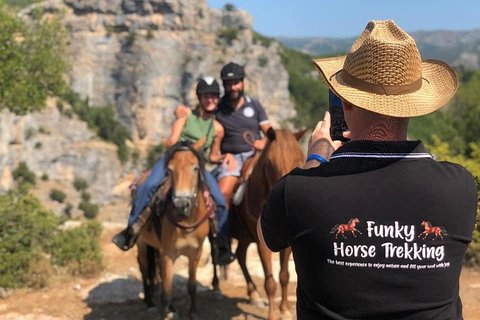
Alternatives if the Crossing Isn’t for You
Not every Albania trip needs the full walking crossing to experience the Alps. A shorter option is a day trip into Valbona from Shkodra without continuing to Theth, giving you the Koman ferry experience and a taste of the valley without the multi-day commitment. Alternatively, some guesthouses arrange horseback or 4WD access to viewpoints along the lower trail for those who want mountain scenery without a full day’s walking. Whichever version you choose, the hiking Albanian Alps guide is the right next stop for comparing options in detail.