Driving in Albania: What to Expect on the Roads
Driving in Albania has a reputation that often deters travelers who would otherwise benefit most from having their own wheels. The reality is nuanced: Albanian roads range from genuinely excellent four-lane highways to goat-track mountain switchbacks, and Albanian driving culture ranges from courteous mountain villagers to extremely assertive urban commuters. With the right expectations and a defensive driving mindset, most people manage perfectly well and come away having experienced Albania’s most rewarding landscapes from the driver’s seat.
This guide gives you an honest picture of what driving in Albania is actually like, covering road quality, traffic law, specific challenging routes, what to do if you have an accident, and practical tips for making the most of the freedom a car provides. Before committing to driving, also see the car rental Albania guide for information on vehicles, insurance, and rental companies.
| Main highways | Good quality, dual carriageway on key routes |
| Speed limits | 40 km/h urban, 80 km/h rural, 110 km/h highway |
| Drink-drive limit | 0.05% BAC |
| Hardest route | Shkodra to Theth (mountain road) |
| Emergency numbers | 127 ambulance, 129 police, 112 general |
The State of Albanian Roads
Main Highways
The A1 motorway between Tirana and Durres is Albania’s showpiece road — dual carriageway, well-maintained, with toll booths (50-100 ALL per section, paid in cash). The SH1 between Tirana and Shkodra has been dramatically improved and is now a fast, modern road with dual lanes for most of its length. The route from Tirana south toward Fier and Vlora has also seen major investment, and journey times that were painful a decade ago are now comfortable.
On these routes, driving feels entirely normal by European standards. Speed limits are posted, lane markings are clear, and the road surface is smooth. The Albanian road improvement program has transformed the main arteries over the past decade, primarily funded through EU pre-accession support and bilateral infrastructure loans from China and Gulf states.
Secondary Roads
The quality drops sharply once you leave the main corridors. Secondary roads (SH-numbered routes) vary enormously — some are newly surfaced and perfectly maintained, others have sections with significant potholes, subsided edges, and no road markings. Mountain roads can narrow to a single lane with passing places, particularly in the northeastern highlands and Accursed Mountains.
The road from Shkodra to Theth is the most notorious: a winding mountain route that has been progressively improved but still demands a confident driver and a vehicle with decent ground clearance. By 2025, the vast majority of this road is paved, and the worst sections have been repaired. The experience is genuinely beautiful and manageable with appropriate expectations and vehicle.
Road Works and Ongoing Construction
Albania is in a prolonged phase of road construction across the country. You will encounter temporary surfaces, detours, and sections where the road is partially built. Signage at road works is variable — sometimes excellent with clear diversions, sometimes absent. If you suddenly see a dirt track where a road should be, slow down and follow local vehicles who know the current route.
Major ongoing projects include sections of the new Tirana-Saranda expressway and various mountain road improvements. Each year the network gets meaningfully better, which means any specific road information ages quickly — conditions on a mountain route this year may be substantially better than reports from two years ago.
Mountain Passes and Scenic Routes
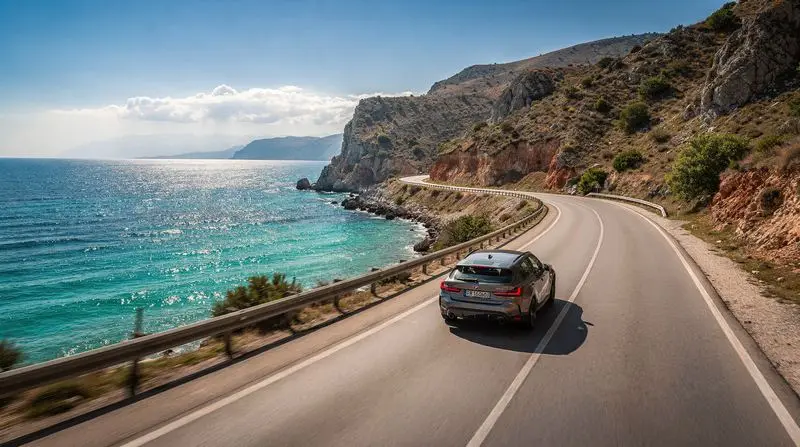
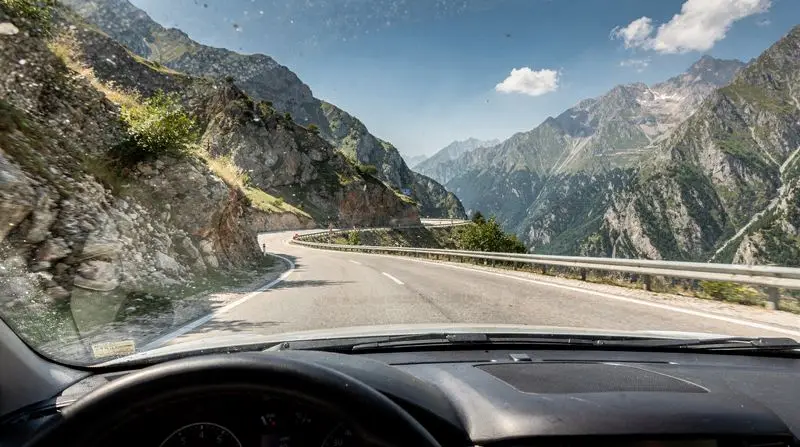
The highest and most scenic routes — Llogara Pass on the Riviera, the road over Qafa e Llogarasë, routes into the Valbona Valley and Theth — are genuinely dramatic. Llogara Pass (1,027 meters) offers one of the great drives in Europe, with a switchback descent to the turquoise Ionian far below. The view from the top is spectacular in good weather — park briefly at the pass and walk a few meters off the road for the full panorama.
In peak summer, the coastal mountain road is busy with tourist traffic; in spring or autumn it is quiet and spectacular. These mountain roads are safe for confident drivers in normal conditions. The concerns are: narrow sections where passing requires one car to reverse to a wider point; the absence of safety barriers on some exposed sections; and the very real risk of fog or rain dramatically reducing visibility. Always check weather before attempting a mountain pass.
Albanian Traffic Laws: What You Need to Know
Speed Limits
- Urban areas: 40 km/h (enforced; cameras in cities)
- Rural roads: 80 km/h
- Highways (A-roads): 110 km/h
Speed cameras are increasingly common on main roads, particularly approaching towns. Traffic police with handheld radar guns are deployed regularly on popular routes. Fines for speeding are issued on the spot and must be paid in cash (or via bank transfer in some cases). The amounts are modest but the process takes time — avoid the encounter by respecting limits. Rental agencies receive notifications of speed camera fines and will charge them to your card.
Drink Driving
The legal limit is 0.05 percent blood alcohol content — lower than the UK limit of 0.08 percent and in line with most EU countries. Police set up checkpoints, particularly on weekend evenings near popular restaurant areas and on summer beach roads. If you plan to drink, do not drive. This is not a rule to test.
Seat Belts
Mandatory for all occupants front and rear. Police enforce this actively in urban areas. Fines are issued on the spot. Ensure all passengers are belted before moving.
Mobile Phones
Illegal to use a handheld phone while driving. Use a phone mount and hands-free system. This is common sense anyway given that Albanian roads frequently demand full attention.
Lights
Dipped headlights must be used at all times during the day, even in bright sunshine. This is a legal requirement and is enforced. Modern cars handle this automatically if you set them to auto-mode; older or rental cars may require manual activation.
Child Seats
Children under 12 must use appropriate child restraints. If you are renting a car, request a child seat when booking — do not assume it will be available at pickup without advance notice. Most agencies have seats available but limited supply; book early in summer. See the Albania family travel guide for more on travelling with children.
Insurance and Documents at Police Checkpoints
Carry your driving license, vehicle registration, and proof of insurance at all times in the car. Albania accepts the EU Green Card for insurance documentation. International Driving Permits are officially required for non-EU licenses (UK, US, Australian, Canadian). Police checkpoints do occur on main roads — typically a brief document check that takes 2-3 minutes. Be polite, cooperative, and have your papers in an accessible location. See the car rental Albania guide for full documentation requirements.
How Albanians Drive
This section gives an honest picture rather than a diplomatic one. Albanian driving is assertive. Overtaking on blind bends happens — it is not universal or standard, but you will see it. Running amber lights happens in cities. Sudden U-turns, stopped vehicles with hazards on in moving lanes, and creative use of the horn all happen. In cities, particularly Tirana, traffic can feel chaotic — a combination of narrow streets, high vehicle density, and driving habits shaped by decades when private cars were banned under communism and then suddenly, in the 1990s, flooded the country in enormous quantity.
The right response is not panic but adaptation. Drive defensively. Assume the car ahead might stop suddenly. Give way generously to local vehicles who are clearly going to overtake regardless of the line markings. Do not drive angry. Honk when you need to — it communicates intent and is not offensive in the Albanian context.
Outside cities, particularly in the mountains, drivers are notably calmer and more patient. You will find people pulling over to let you pass on a narrow road, waving you forward on a mountain track, and generally behaving with the courteous pragmatism that comes from navigating genuinely difficult terrain together for generations.
The worst driving behavior in Albania is concentrated in Tirana during peak hours. Once you leave the capital, the roads quickly become more relaxed and the driving more predictable.
Night Driving: Why to Avoid It on Rural Roads
Avoid driving at night in rural areas if possible. Several specific hazards make night driving substantially more dangerous than daytime driving:
Unlit vehicles. Horse carts, tractors, and slow agricultural vehicles occasionally travel without lights on rural roads. They are invisible until you are very close.
Livestock on roads. Cattle, goats, and sheep cross and occasionally rest on roads in mountain areas. Collisions with cattle happen every year and cause serious accidents. This is a real risk in the early morning and evening.
Pedestrians. In villages, people walk on the road at night — sidewalks are absent on many rural routes. Children play near roads in villages. Drivers are expected to be aware.
Potholes and subsided edges. These are much harder to see at night and can cause a tyre blowout or loss of control in situations where they would be easily avoided in daylight.
Driving at night in Tirana, Durres, or on the main illuminated highways is fine. Driving after dark on mountain roads or rural secondary routes requires real caution and should be avoided unless necessary. If you are returning from a mountain area in the evening, leave enough time to complete the mountain sections in daylight.
Specific Routes: What to Expect
Tirana to Saranda (via the Riviera) — Albania’s Great Drive
This is one of Albania’s great drives and one most visitors do. From Tirana, take the SH4/SH8 south via Fier and Vlora. The coastal road from Vlora south along the Riviera is the highlight — narrow in sections, with the mountain dropping to the sea on your left and significant drops to your right. Allow 4-5 hours for the full Tirana to Saranda run with stops; rushing it misses the point.
The section through Llogara Pass can have traffic in summer — tour buses are wide and slow on the hairpins. Patience is required. Allow extra time. The descent from Llogara into the Riviera is, on a clear day, one of the most spectacular road views in Europe.
Tirana to Theth (via Shkodra) — The Mountain Approach
From Tirana to Shkodra on the SH1: fast, modern, around 90 minutes. From Shkodra, the road toward Theth winds into the mountains for about 75 kilometers, taking 2.5-3 hours depending on conditions and whether you stop for views. The final section into the Theth valley is the most dramatic and most demanding — steep, narrow, with some rough patches. A higher-clearance vehicle is strongly recommended.
The reward is arriving in Theth — one of the most beautiful mountain valleys in the Balkans — with your own transport to explore at will.
Tirana to Berat — Easy and Rewarding
The SH3/SH72 route to Berat is well-surfaced and straightforward. About 2 hours from Tirana. Entirely manageable in any small car. Berat’s old town streets within the historic neighborhoods are extremely narrow — park below the old town and walk. A guided experience in Berat adds historical context to the visit; day tours from Tirana to Berat include transport and local guide commentary if you prefer not to drive this route yourself.
Tirana to Gjirokastra — The Southern Circuit
Roughly 3.5-4 hours via the SH4 south. Road quality is largely good with some variable sections through hills and small towns. Manageable in any car. Gjirokastra sits high on a hillside — streets within the old city (Gjirokastër) are extremely narrow and steep with traditional stone paving; park at the bottom and walk. The approach from the south (from Saranda direction) is particularly scenic.
Tirana to Pogradec (Lake Ohrid)
About 3 hours via the A3/SH3 east. Road quality is good. The approach to Pogradec along Lake Ohrid’s shore is very scenic. This route is less traveled by tourists but worthwhile for the lake scenery and the Roman city of Apollonia en route.
Shkodra to Bajram Curri — The Northeast
For travelers heading to the Valbona Valley without taking the Koman Lake ferry, the road from Shkodra via Kukës to Bajram Curri is the overland alternative. This road has improved significantly but the mountain sections remain demanding. The Kukës-Bajram Curri section along the Drini Valley is beautiful. Allow 3-4 hours for this section.
Parking in Albanian Cities
In Tirana, central parking is managed by a zone system. Areas marked with yellow-and-blue lines require payment, collected by parking attendants who issue a ticket. Rates are low — around 50-100 ALL per hour. Enforcement has improved significantly; clamping happens. Multi-story car parks exist in the center and are clearly signed. Do not park on pedestrian areas or block building entrances — police patrols specifically target this.
In smaller cities and towns, parking is generally free and informal. Park where you see other local cars parked, use common sense about not blocking driveways or entrances, and you will be fine.
In mountain villages, parking is wherever you find space — which in some cases means on a slope with a rock behind your wheel.
What to Do If You Have an Accident
- Stop immediately and ensure everyone is safe. Call an ambulance (127) if there are injuries. Do not move anyone who may have a neck or spine injury unless there is a fire risk.
- Call the police (129). You must report any accident involving damage or injury to police before moving the vehicles. A police report is required for insurance claims.
- Exchange details with the other driver: name, contact information, license plate, insurance company.
- Photograph everything before any vehicles are moved: road position of both vehicles, all damage, skid marks, road signs and markings nearby. More photos are always better.
- Contact your rental company — they have an emergency line and will guide you through the process specific to their policy.
- Do not accept liability or make cash payments to settle without a police report. This can void your insurance entirely.
Police response time varies enormously by location. On a main road near a city, a patrol arrives within 20-30 minutes. In a remote mountain area, it could be hours. Be patient, document everything, and do not let anyone pressure you into moving vehicles or settling without proper documentation.
Road Signs and Navigation
Albanian road signage has improved considerably but is still not universally consistent. Newer roads use standard European signage (blue motorway signs, white direction signs on secondary roads, red prohibition signs). On older roads, signs may be faded, positioned in unhelpful locations, or missing entirely.
Key Albanian road sign words:
- Hyrje = Entry / Entrance
- Dalje = Exit
- Ndal = Stop
- Kujdes = Caution / Warning
- Devijim = Detour
- Punime rruge = Road works
- Mbushni = Fuel (fill up)
Speed limit signs use the standard European format (numbers in red circles). Town name signs on blue backgrounds indicate the start of an urban area — speed limit drops to 40 km/h immediately at that sign.
Navigation apps require some caution. Google Maps has improved significantly in recent years but still has gaps in rural road data. For mountain roads and the northeastern highlands, Maps.me or OsmAnd with offline Albania maps downloaded are more reliable. Download your Albania maps at your hotel while you have WiFi — you will not have reliable data signal in the Accursed Mountains or on the Koman Lake crossing. See best apps for Albania for specific app recommendations.
Dealing with Rural Hazards
Livestock on roads is a genuine issue in rural Albania, particularly at dawn, dusk, and during seasonal animal movement periods. Cattle, goats, sheep, and occasionally horses use the road as a path. Encountering a herd being driven along a mountain road — taking up the full width — is not unusual. The response is patience: slow to a complete stop, wait for the animals to pass, and do not try to push through the herd. Honking to rush a herdsman’s animals will not make you popular.
Horse-drawn carts still operate on rural roads, particularly in the north. They travel at walking pace and have no lights at night. They are essentially invisible in the dark and can be startling on bends even in daylight.
Dogs: Stray and farm dogs in rural areas sometimes chase vehicles. They almost never cause accidents, but they can be startling on mountain bends. Do not swerve to avoid a dog — slow down gently and maintain your line.
Fallen rocks: In spring and after rain, loose rocks from hillsides can fall onto mountain roads. This is a realistic hazard on the Riviera road and mountain passes after wet weather. Drive slowly around blind curves on mountain roads where the hillside above is steep and rocky.
Petrol Stations: Locations and What to Expect
Petrol stations are plentiful along main roads and in all towns. They become sparse in mountain areas and the far northeast. Never set off into the highlands with less than a full tank. Fill up whenever you see a station in remote areas, even if your tank is still half full.
Albanian petrol stations are run by a mix of local operators and some international brands (Agip, Total, ENI, Kastrati — the local chain). Most offer both petrol (benzine, 95 or 98 octane) and diesel. LPG is available at some stations in larger cities.
Attendants: Many Albanian petrol stations are not self-service — an attendant fills your car. You tell them the amount you want or say “mbush” (fill it up). Pay after filling. Tipping attendants is not required but appreciated.
Payment: Most stations accept cash (Lek). Card acceptance is improving but not universal, particularly at smaller stations in rural areas. Have cash as a backup.
Diesel runs roughly EUR 1.40-1.60 per liter and unleaded petrol (95 octane) around EUR 1.50-1.70 per liter as of 2025-2026 — similar to or slightly cheaper than EU averages.
Car Insurance When Driving Your Own Vehicle
If you are driving your own vehicle from another country (arriving via the Italy-Albania ferry or driving overland), your home country insurance must cover Albania. Check your policy documents:
- The Green Card (International Motor Insurance Certificate) provides third-party coverage across most European countries including Albania
- Not all UK and European policies automatically include Albania — call your insurer to confirm before departure
- If your policy does not cover Albania, you can purchase a short-term extension at the border or online before departure
If you arrive at the border without valid insurance, Albanian authorities can sell you a short-term policy, but it is better to resolve this before you travel. The Albania travel insurance guide covers vehicle coverage in the context of broader travel insurance needs.
The Reward of Driving Albania
Despite the challenges, driving Albania is genuinely one of the best ways to experience the country. The infrastructure improvements of recent years have made the main circuits very accessible while leaving the mountain roads dramatic enough to feel like an adventure.
Routes that reward driving most:
The Riviera from Vlora to Saranda: The most spectacular coastal drive in the Balkans. Stops at empty coves, the views from Llogara Pass, the fishing village of Dhermi perched above the sea — none of this is accessible by public transport on your own schedule.
The Northern Circuit (Tirana-Shkodra-Theth-Koman-Tirana): Requires an SUV and confidence on mountain roads, but delivers Albania at its most raw and beautiful. The road into the Theth valley is an experience in itself.
The Southern Interior (Tirana-Berat-Permet-Gjirokastra-Saranda): A week-long circuit through UNESCO towns, thermal springs, and the historic south. Comfortable in any car on main roads.
Day trips from Tirana by car unlock Kruja, Apollonia, Durres, and other destinations that public transport makes time-consuming. The day trips from Tirana guide covers these routes with specific directions and timing.
For travelers who want to combine driving with expert local knowledge on specific sites, half-day guided tours in Tirana are a good starting point before you take the car out into the country — they orient you to Albanian culture and history in ways that enrich everything you see independently afterward.
Practical Pre-Departure Driving Checklist
Before setting out from your accommodation each day in Albania:
- Check the fuel level — fill up if below half a tank before leaving a town
- Download or confirm offline maps are available for your route
- Note the emergency number (127 ambulance, 129 police, 112 general)
- Check weather for mountain passes if applicable
- Confirm your rental documents, driving license, and IDP are in the car
- Let someone know your planned route for mountain sections
Give Albania’s roads the respect they deserve — meaning attention, patience, and defensive awareness — and they will reward you with scenery and freedom that makes every kilometer worthwhile.
A daily routine of fuel stops, offline maps and mountain plans only works if the car suits the roads you intend to take. Choose a model you are comfortable driving on narrow rural roads, read what the rental conditions say about your driving licence and IDP, and reserve early enough to have a real choice of vehicles. Pick-up options and conditions are easy to compare on DiscoverCars for Albanian rentals.
Driving vs Public Transport vs Organized Tours
Deciding whether to drive at all is worth thinking through before committing to a rental. A car gives you the freedom to stop at viewpoints, reach places like Byllis or Bovilla Lake that public transport barely serves, and set your own pace on routes like the Riviera. Public transport — buses and furgons — covers the main cities affordably and is entirely workable for a Tirana-Berat-Gjirokastra-Saranda route, but it constrains your schedule to departure times and makes spontaneous stops impossible.
Organized tours remove the driving burden entirely for the most demanding routes (Theth, the Koman ferry approach) and add expert commentary, at the cost of flexibility and a higher per-day price. Many visitors find the best approach is a hybrid: rent a car for the flexible middle of a trip, and use organized tours specifically for the routes that most reward local driving expertise, like the mountain roads into the Albanian Alps.
Renting a Car: What Kind of Vehicle to Choose
The right rental vehicle depends heavily on your planned route. For a trip confined to the main highways and cities — Tirana, Durres, Berat, the coastal SH8 as far as Vlora — a standard compact or midsize car handles everything comfortably. For any itinerary including the road to Theth, the upper Mount Tomorr trailhead, or Byllis, a vehicle with genuine ground clearance (a compact SUV at minimum) makes a material difference to comfort and safety on rough, unpaved sections. Automatic transmissions are available from most agencies but cost more and should be requested well in advance in peak season, as manual remains the default fleet standard in Albania. See the car rental Albania guide for agency comparisons, insurance details, and booking timing.
Frequently Asked Questions About Driving in Albania
Is it safe for foreigners to drive in Albania?
Yes, with defensive driving habits. Main highways meet ordinary European standards, and the biggest adjustment is Albanian drivers’ assertive style rather than road quality itself. Avoid rural night driving, respect the 0.05% drink-drive limit strictly, and treat mountain roads with appropriate caution, and most visitors report driving in Albania as manageable and genuinely rewarding.
Do I need an International Driving Permit to drive in Albania?
Non-EU license holders (UK, US, Australian, Canadian, and others) are officially required to carry an International Driving Permit alongside their home license. EU license holders can drive with their national license alone. Police checkpoints occasionally check documentation, so carrying the IDP avoids any complication even though enforcement is inconsistent.