| Best for | Riviera beaches, Alps hiking, nightlife |
| Coast temps | 32-37°C, sea 25-28°C |
| Crowds | High to very high (peaks mid-August) |
| Prices vs spring/autumn | 40-50% higher |
| Booking | Theth guesthouses: months ahead. Coast: 2-3 weeks ahead in August |
| Bring | Sun protection, a fleece for the Alps at night |
Albania in Summer: Everything You Need to Know
July and August transform Albania. The quiet country of spring and autumn becomes something altogether more energetic: beaches packed with Albanian families and an increasing tide of European visitors, coastal roads buzzing with traffic, beach clubs playing music until 3am, and guesthouse owners in Theth turning away bookings they received only the night before. Albania in summer is the best and the worst of itself simultaneously — magnificent and occasionally maddening.
This guide gives you the honest picture: where to go and where to avoid, what the heat and crowds actually feel like, and how to structure a summer visit to get the most out of the season.
Summer Weather in Albania
Albanian summers are genuinely hot. July and August on the Riviera regularly reach 34-36°C by early afternoon, and interior cities like Tirana can touch 38°C during heat waves. The saving grace is that humidity on the coast is lower than on the Adriatic or in Greece’s island towns, and the prevailing afternoon breeze off the Ionian Sea makes the shade feel bearable.
Rain in July and August is rare — some years see none at all on the coast. The Albanian Alps are a different climate entirely: afternoons bring thunder at altitude, and temperatures at Theth drop to 15-17°C at night even in August. Bring a fleece for the mountains regardless of the calendar.
| Month | Coast Temp | Sea Temp | Crowds | Beach Conditions |
|---|---|---|---|---|
| July | 32-36°C | 25-27°C | High | Peak — warm, calm sea |
| August | 32-37°C | 26-28°C | Very high | Peak — the sea is at its warmest |
Sea temperatures peak in late August at 27-28°C, making the swimming genuinely extraordinary. The Ionian water is clear, warm, and calm on most days — conditions that rival anywhere in the Mediterranean.
The Albanian Riviera in Summer
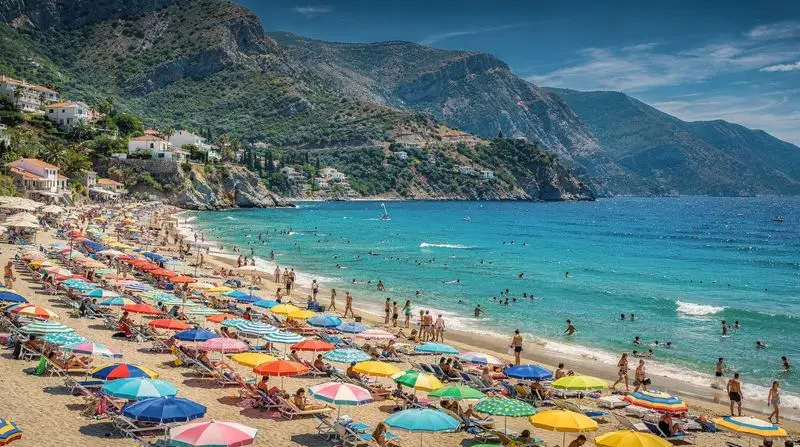
The Riviera is the undisputed centrepiece of an Albanian summer. The 110-kilometre coastal stretch from Vlora to Saranda offers beaches ranging from the world-class to the merely very good, set against a backdrop of limestone mountains that descend directly into the sea.
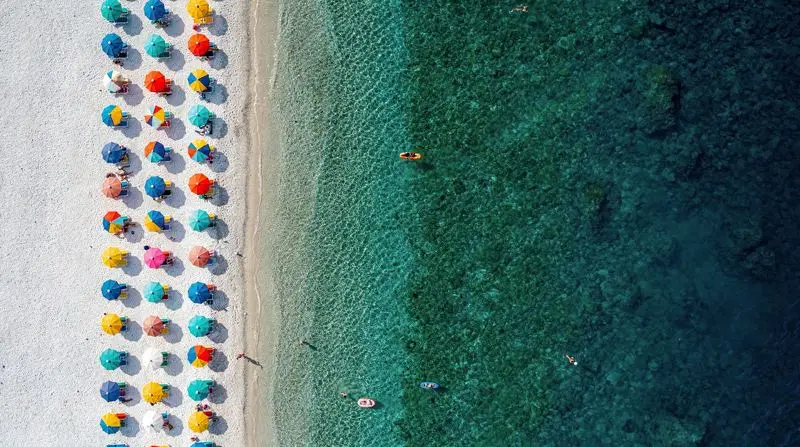
Ksamil is summer’s flagship. The turquoise lagoon with its scatter of offshore islands produces photographs that look digitally enhanced — they are not. In July, Ksamil is busy; in August, particularly in the two weeks around August 15th (the Italian Ferragosto holiday, when many Italian visitors arrive), it is genuinely crowded. Beat the crush by arriving before 9am or taking a water taxi to the islands, which are always quieter than the main shore. Water taxis to the nearest island cost EUR 5-7 return per person and operate from approximately 9am in peak season.
Himara is the Riviera town that manages summer best. It has a settled, year-round community that keeps it grounded, a long beach with enough space that July crowds feel manageable, and a strip of outdoor restaurants and cafes facing the sea. The old village above the town is worth an hour of exploration in the cooler morning or evening.
Dhermi leans fully into summer hedonism. The beach clubs here are the most developed on the Riviera, the music is consistent, and the scene is young and energetic. If you want a party-adjacent beach holiday, Dhermi delivers. If you want quiet, go elsewhere in July and August. Sunbed hire at the main Dhermi beach clubs costs EUR 10-15 per set, at the higher end of the Albanian scale.
A boat tour is the best way to experience the Riviera in summer. Getting on the water allows you to reach coves that are inaccessible by road — including Gjipe, Porto Palermo, and the Blue Cave near Dhermi — while escaping the road traffic and beach crowds. This Albanian Riviera boat tour from Himara is one of the most popular on the coast and covers the best swimming spots, including a stop at the Blue Cave. Book 2-3 days ahead in July and August — these tours fill quickly. Prices run approximately EUR 25-40 per person for a half-day.
Best Beaches for Summer
Not all Albanian beaches handle summer equally well. Here is a ranking by how they perform under peak pressure:
Gjipe Beach: Accessible only on foot (30-40 minute walk from the road) or by boat. The 20-minute footpath deters casual visitors, so even in August you may find fewer than 100 people on a beach of extraordinary beauty. Perfect for those who do not mind a walk.
Porto Palermo Bay: The bay around Ali Pasha’s castle gets busier in summer but never overwhelming. The castle itself is worth visiting and the water quality is exceptional.
Drymades Beach (near Dhermi): 3km from Dhermi and less developed, this long pebble beach has more space than the main Dhermi beach and clearer water due to lower foot traffic.
Borsh: Albania’s longest beach at 7km, located between Himara and Saranda. The sheer length means even in August you can find uncrowded sections.
Ksamil north bay: The beach on the north side of the village, facing away from the islands, is consistently less crowded than the famous island-facing beaches. Gentler water entry too, ideal for children.
Hiking the Albanian Alps in Summer
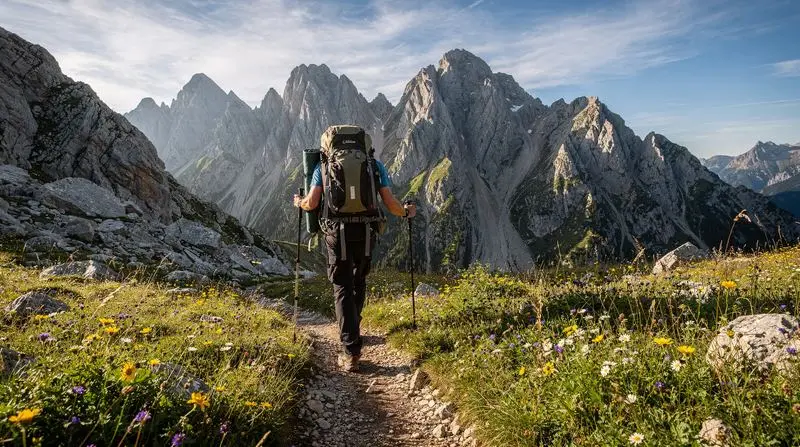
While the coast swelters, the Albanian Alps offer a completely different experience — and arguably a better one for active travellers. July and August are peak season for the Theth-Valbona hike, the signature walk that crosses the Valbona Pass at 1,793 metres through some of the most dramatic mountain scenery in Europe.
The trail is fully open in summer with the most reliable conditions, and the villages of Theth and Valbona are at their most lively, with guesthouses full of hikers from across Europe. Book accommodation months in advance — this is not an exaggeration. The best Theth guesthouses for July and August are typically full by April. Half-board rates run EUR 22-35 per person including dinner and breakfast.
Hiking in the Albanian Alps goes well beyond the Theth-Valbona route. Shorter day hikes from Theth include the walk to the Grunas waterfall and the canyon below Grunas village, and the more demanding route to the Peaks of the Balkans trail junction. Valbona valley itself offers day walks to high pastures where shepherds still summer with their flocks.
The upside of summer hiking: maximum daylight, dry trails, and huts and guesthouses fully operational. The downside: afternoon thunderstorms at altitude arrive reliably from 2pm onwards between late June and mid-August. Start early, aim to be below the pass before noon, and you will have no problems.
Shkodra, the gateway city for the Alps, is worth a day of exploration. Rozafa Castle — rising from a limestone crag above the confluence of three rivers — is one of Albania’s most dramatic fortresses, and the old town’s Ottoman-era bazaar is atmospheric without being heavily touristy.
Summer in Albania’s Interior Cities
Berat and Gjirokastra are best visited before 10am and after 4pm in July and August. The midday heat in these stone Ottoman cities is intense, and the tour groups arrive mid-morning. The morning light on Berat’s Castle hill is extraordinary; the evening light on Gjirokastra’s tower makes the city look like a film set.
Tirana in summer is a local experience. Most European visitors pass through briefly, but the capital’s outdoor restaurant culture comes fully alive in July and August. The Blloku neighbourhood, with its pavement cafes and bars operating late into the night, is one of the more enjoyable urban experiences in the Balkans. The Grand Park around the artificial lake is popular with families on summer evenings.
For those who want guided context on Tirana in summer, this Tirana communist Albania tour including Bunk’Art is best done early morning before the heat peaks — the underground bunker sections are genuinely cooler than the streets above, making this one of the more comfortable summer activities in the capital.
Summer Prices: What to Expect
Summer prices in Albania are significantly higher than the rest of the year but still represent exceptional value by European standards. A good guesthouse room in Ksamil in August costs EUR 60-90 per night — roughly what you would pay for a budget hostel in a Greek island town. Meals remain affordable: a full dinner with wine at a Riviera restaurant runs EUR 15-25 per person.
Beach chair and umbrella hire is the main cost at beaches: typically EUR 5-10 per set per day, sometimes EUR 12-15 at the most developed clubs in Dhermi. This is optional at every beach — most retain a free zone.
See Albania travel budget for a detailed cost breakdown by season. The difference between July-August prices and October prices is typically 40-50 percent across accommodation categories.
Staying Cool: Practical Heat Management
Summer in Albania requires active strategies to stay comfortable:
Schedule around heat: Plan activities for before 10am and after 5pm. The two-to-three hour window from roughly noon to 3pm is genuinely brutal — use it for lunch, shade, and air-conditioned museums.
Air conditioning is not universal: In budget guesthouses and older properties, fans rather than AC are common. In 35-38°C heat, a fan is not adequate for sleeping. Confirm that your accommodation has proper air conditioning before booking, particularly in the UNESCO cities.
Sea swimming is the best cooling: The Ionian coast water at 26-28°C is warm but still cooler than the air. An hour in the sea is the most effective and pleasurable way to reset body temperature.
Stay hydrated aggressively: The combination of heat and activity means you need to drink significantly more water than feels natural. Albanian tap water varies in quality — buy bottled or use filtered water.
Night temperatures: The coast cools significantly after dark, making evenings genuinely pleasant even in the hottest months. Albanian dining culture starts late (dinner rarely before 8pm, often later) which naturally aligns with the cooler evening hours.
How to Beat the Summer Crowds
Adjust your hours. The beach is significantly less crowded before 9am and after 5pm. The light at both ends of the day is also more photogenic than the flat midday sun.
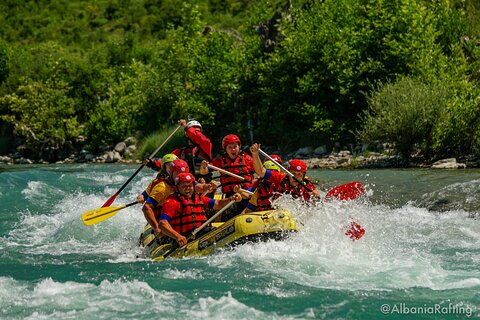
Get on the water. A boat tour reaches coves that road travellers never find. Even a kayak or paddleboard rental allows you to escape the beach concentration points. The Porto Palermo kayak and SUP tour reaches sea caves that motorised boat tours pass too quickly — a slower, more intimate experience of the coast’s most dramatic section.
Go north. The Albanian Alps receive a fraction of the visitors that the Riviera does, even in peak season. Theth is busier than it was five years ago, but it remains genuinely remote and quiet compared to any Riviera beach.
Explore the interior. Permet, Berat, Pogradec on Lake Ohrid, and Korce in the southeast see almost no foreign tourists even in August. They are not sacrifices — they are excellent.
Book early and stay longer. Arriving at a beach for two hours in the heat of the day and then moving on is the worst possible way to experience the Riviera. Staying several nights in one place allows you to be at the beach at 7am when it is empty and perfect.
Summer Itinerary Ideas
One week, Riviera focus: Fly into Corfu, take the Corfu to Albania ferry to Saranda, spend three nights in Ksamil with day trips to Butrint and Gjirokastra, then drive north along the Riviera staying in Himara and Dhermi before finishing in Vlora.
Ten days, coast and mountains: Tirana for two nights, drive to Shkodra and on to Theth for three nights of hiking, then south via Tirana and Berat to the Riviera for the final five nights.
Two weeks, everything: Build in the above and add Permet and the south, a night at Lake Ohrid in Pogradec, and Korce.
What Summer Does Well That No Other Season Can
There is a particular energy to Albania in August that is hard to explain to someone who has only seen it in spring or autumn. The entire country seems to be on holiday simultaneously. Extended Albanian families from the diaspora return from Italy, Greece, Germany, and North America; the beaches fill with generations of people who last saw each other the previous August; the restaurants stay open past midnight because nobody is in any hurry to leave.
This is not a performance for tourists. It is what Albanian summer actually looks like, and being present in it — eating grilled fish at a plastic table ten metres from the sea at 10pm, surrounded by three generations of a family celebrating nothing in particular — is one of the finer available experiences in the European summer.
The nightlife guide for Albania covers the Riviera beach clubs and Tirana’s Blloku scene, both of which peak in July-August. The beach clubs guide gives specific recommendations for the best Dhermi and Himara venues.
Summer Water Sports Beyond Swimming
The Riviera’s clear, calm summer sea makes it a genuinely good base for water sports beyond a boat tour. Diving and snorkelling in Albania is best from June through September when visibility is at its highest, with sites around Himara and the Karaburun Peninsula. Kayaking and SUP is widely available from Saranda, Himara, and Dhermi and lets you reach small coves that beach traffic never touches. For something faster, sailing along the Albanian coast is increasingly available from Vlora and Saranda marinas in peak season.
Getting to the Riviera in Summer
Most visitors reach the Riviera via Tirana. Flights to Albania land at Tirana International Airport, followed by a drive or transfer south — Tirana Airport to Saranda covers the route options and realistic journey times, which stretch in peak summer traffic. An increasingly popular alternative is arriving via the Corfu to Albania ferry directly into Saranda, which is often faster than driving down from Tirana in August traffic and pairs well with a Greek islands leg of a trip.
Frequently Asked Questions About Albania in Summer
Is August too hot to visit Albania?
It’s hot — 32-37°C on the coast, occasionally 38°C inland — but manageable if you schedule around it: mornings and evenings outdoors, midday for the beach or shaded lunches. The sea, at 26-28°C in late August, is the best cooling tool available and makes the heat far more bearable than the numbers suggest.
How far ahead should I book accommodation for summer in Albania?
For the Albanian Alps (Theth, Valbona), book months ahead — the best guesthouses fill by April for July-August dates. For the Riviera, two to three weeks ahead is usually enough outside the Ferragosto period around 15 August, when even a few days’ notice can be tight in Ksamil and Dhermi.
Is it worth renting a car for a summer trip to Albania?
Yes, for most itineraries. Public transport (furgon minivans) covers the main routes but runs on informal schedules and doesn’t reach smaller coves or mountain villages easily. A rental car gives you the flexibility to chase quiet beaches and beat the crowds by arriving early. See car rental Albania and driving in Albania for what to expect on Riviera roads in peak traffic.
See the best time to visit Albania for a complete seasonal comparison.