Tepelena: Where Two Rivers Meet and a Legend Was Born
There are places in Albania whose importance vastly exceeds their current size, and Tepelena is one of them. This small town in the valley of the Vjosa river, where the Drino joins from the east and the combined waters continue north through a dramatic limestone gorge, is the birthplace of the man who arguably shaped the history of the entire western Balkans in the early 19th century: Ali Pasha of Ioannina.
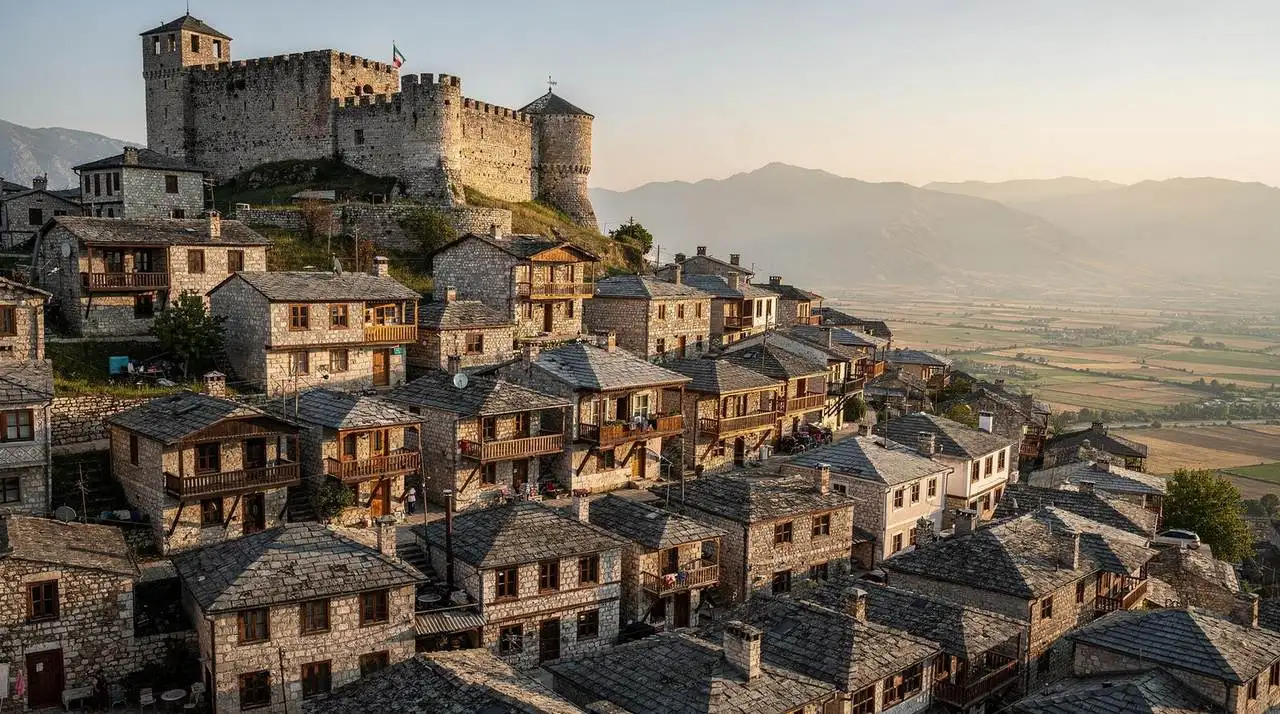
Today Tepelena is a quiet, rather unremarkable Albanian town of perhaps 5,000 people. The castle ruins on the hill above the town are substantial enough to justify a stop, the confluence of the Vjosa and Drino rivers is genuinely spectacular, and the historical associations make it one of those places where the weight of the past is almost tangible. But it is not a polished tourist destination — there are no visitor centres, no guided tours, and the castle is in a state of romantic decay rather than careful preservation.
That is, in many ways, precisely its appeal. Tepelena is off the beaten path in the truest sense: a place you stop because the road takes you there, because the history matters, and because the rivers and the hills make for a view worth pausing for. It sits naturally on the road between Gjirokastra (45 km south) and Permet (40 km east), making it a natural stop on the southern Albania interior circuit. The 14-day Albania itinerary references Tepelena as a stop on the southern interior circuit, providing context for how it fits into a broader journey through the country.
| Where | Southern Albania interior, Vjosa-Drino confluence |
| Cost | Free castle entry; coffee/meal around EUR 3-10 |
| Time needed | 1-2 hours as a stop |
| Getting there | 45 min from Gjirokastra, 45 min-1hr from Permet |
| Best time | April-May (river) or June-September (swimming) |
The Setting: Two Rivers, One Gorge
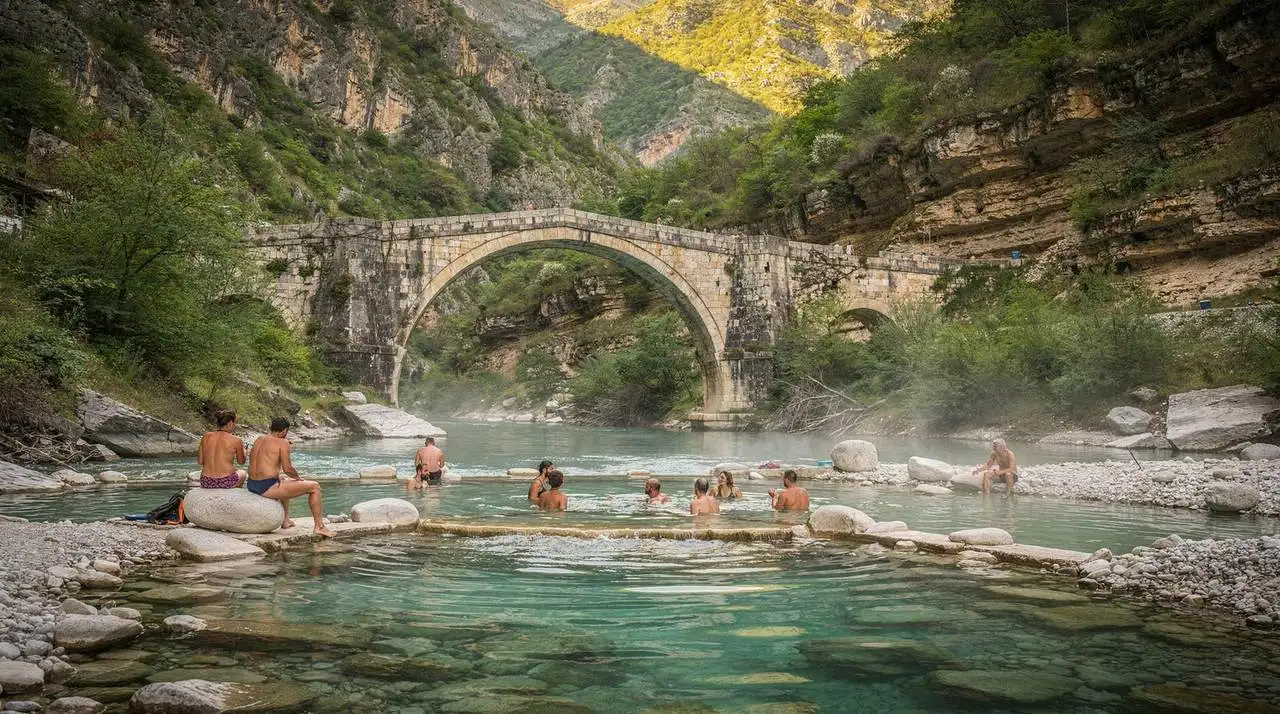
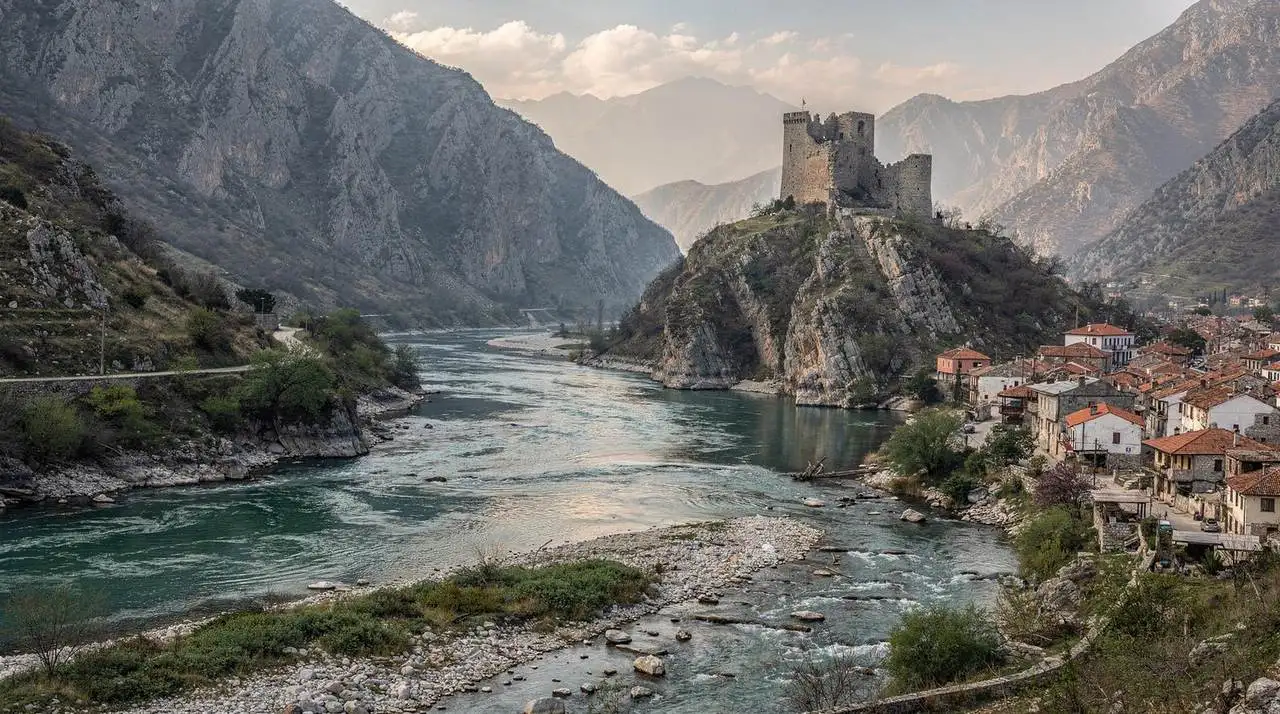
The physical setting of Tepelena is what strikes you first. The town sits at the point where the Drino river — coming from the east, from Gjirokastra and the Greek border — joins the Vjosa, the largest undammed river in Europe outside Scandinavia. The Vjosa here runs through a deep limestone gorge, its water the extraordinary turquoise-blue characteristic of Albanian limestone rivers.
Standing above the confluence, with the two rivers meeting below and the gorge walls rising on either side, is one of the more dramatic natural moments available in southern Albania. The colours — blue-green river, grey limestone, scrubby green vegetation on the slopes — are vivid and elemental. The confluence itself is best viewed from the castle hill or from the old bridge area below the town, where the two rivers are visible converging in the valley below.
The contrast between the two rivers at their junction is sometimes visible: the Drino carries a slightly different sediment load and colour from the Vjosa, and at the confluence point the two streams run side by side for a short distance before merging. The effect depends on season and water levels — in spring snowmelt, both run high and the mixing is spectacular; in late summer, the colours can be even more vivid against exposed limestone banks.
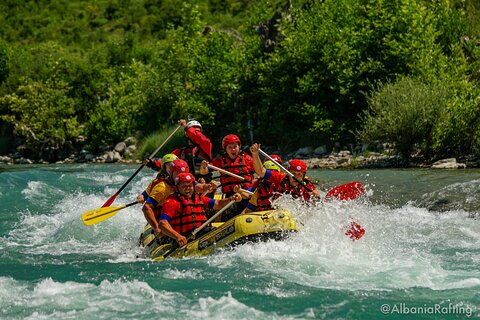
The Vjosa through this section is part of what environmentalists and scientists call one of Europe’s last wild river systems. The river has never been dammed along its entire course, its floodplain retains its natural character, and the biodiversity associated with an unregulated river — rare fish species, otters, kingfishers, diverse riparian vegetation — is still present in numbers that most European rivers lost decades ago. The core section of the river has been designated as the Vjosa Wild River National Park, the first wild river national park in Europe, a designation achieved in 2023 after years of advocacy by Albanian environmentalists and international conservation organisations. Permet to the east is the primary base for rafting and activities on the Vjosa upper section.
Ali Pasha: The Lion Born Here
Ali Pasha of Ioannina — also known as “the Lion of Ioannina” or, in Albanian, Ali Pasha Tepelena — was born in Tepelena around 1740. The circumstances of his early life were violent even by the standards of 18th-century Albania: his father died when he was young, his family was attacked and dispossessed by rival clans, and he spent years as a brigand and minor local leader before beginning the sustained political and military career that would eventually make him the autonomous ruler of a territory larger than many European states.
His rise was a masterclass in the politics of late Ottoman provincial power. By building local alliances, eliminating rivals with calculating brutality, and making himself useful enough to the Ottoman central administration that they could not easily remove him, Ali Pasha constructed a personal domain that stretched from the Aegean to the Adriatic. He was appointed Pasha of Ioannina by the Ottomans but quickly turned that appointment into the foundation for de facto independence — collecting his own taxes, maintaining his own army, pursuing his own foreign policy.
From Tepelena, he rose to govern an area encompassing most of what is now Albania and northwestern Greece — nominally as a vassal of the Ottoman Sultan, but in practice as an independent power who pursued his own diplomatic agenda, maintained his own army of tens of thousands, negotiated directly with Napoleon and the British, and ran his domain with extraordinary complexity and brutality. He spoke Greek, Albanian, and Turkish, and his court was a polyglot environment that attracted merchants, diplomats, adventurers, and writers from across Europe and the Ottoman world.
His court at Ioannina, now in northern Greece, became one of the most important political centres in the post-Napoleonic Balkans. Lord Byron visited in 1809 and described the encounter in “Childe Harold’s Pilgrimage,” establishing Ali Pasha in the European romantic imagination as the archetype of the exotic, dangerous Oriental ruler. Byron found him simultaneously fascinating and terrifying — a small, fat, elderly man with a white beard and eyes that could shift from grandfatherly warmth to lethal calculation in an instant. The poet’s portrait of him is among the most influential in 19th-century travel literature.
He was finally brought down by Ottoman Sultan Mahmud II, who had finally consolidated enough central power to deal with the independent-minded pashas who had long operated as states within the state. The Ottoman army besieged Ali Pasha at Ioannina from 1820 to 1822, ending when he was killed under a flag of parley — a treachery that would have been familiar to many of his own victims.
The same Ali Pasha built the remarkable Porto Palermo castle on the Ionian coast as his naval stronghold — a beautiful triangular fortification that visitors to the Albanian Riviera can still explore today. The castles of Albania guide covers both Porto Palermo and the Tepelena ruins in the context of Ali Pasha’s architectural and military legacy across southern Albania. If you want to compare it with a better-preserved Albanian fortress, a day trip from Tirana to Kruja Castle and its Old Bazaar shows how a restored hilltop stronghold looks next to Tepelena’s romantic ruin.
The Castle Ruins
Ali Pasha’s castle at Tepelena sits on the hill above the town, commanding the confluence of the two rivers and the gorge below. It was his family stronghold — the base from which he launched his political career — and unlike Porto Palermo, which was built specifically as a maritime fortress, Tepelena was a residence and administrative centre as well as a fortification.
The castle is now a ruin, its walls partially collapsed, its towers open to the sky. It has not been systematically conserved or developed as a tourist site — entry is informal, there are no signs or interpretive panels, and you navigate the ruins on your own terms. The walls are still substantial in places, with sections of dressed stone construction that speak to the original scale of the complex. The towers, though roofless, are largely intact. The views from the ramparts over the river confluence are exceptional and are the primary reward for the climb.
The interior of the castle contains scattered architectural fragments — carved stone blocks, sections of vaulted ceiling, the outlines of what were once substantial rooms and service areas. Without interpretive help it is difficult to reconstruct exactly what stood where, but the overall impression is of a sizeable residential and administrative compound that was once genuinely grand by provincial Albanian standards. The silence and the slow reclamation by vegetation give the place a melancholy grandeur that careful restoration would risk destroying.
Getting up to the castle requires a short climb from the town below — the path is not well marked but the route is obvious from the town centre, heading uphill from the main square. Allow 30-45 minutes for the climb and exploration, more if you want to walk the full perimeter of the walls. The climb is steep in places; wear appropriate footwear.
Practical details: Entry is free and informal. No ticket office, no entry fee, no formal signage. The castle is accessible during daylight hours. Take care on unrailed sections of the castle walls, particularly where the original stonework has degraded. The best light for photography is in the late afternoon, when the western sun illuminates the castle and the river below.
For those who want historical context for both Tepelena and Gjirokastra, this guided tour combining Gjirokastra and Tepelena visits both the famous UNESCO city and the smaller birthplace of Ali Pasha, giving historical context that connects the two sites and their shared Pasha heritage. It is the most efficient way to understand the two places in relation to each other without managing your own transport on the mountain roads.
The Gjirokastra to Tepelena to Permet Route
This is one of the more rewarding road trips in southern Albania, and one that relatively few international visitors make. Following the Drino river north from Gjirokastra to Tepelena, then turning east up the Vjosa towards Permet, provides a complete landscape and history transect of the interior south — moving from the UNESCO stone city through the birthplace of the man who dominated it, and on to the wild river landscape where Albania’s nature conservation story is unfolding in real time.
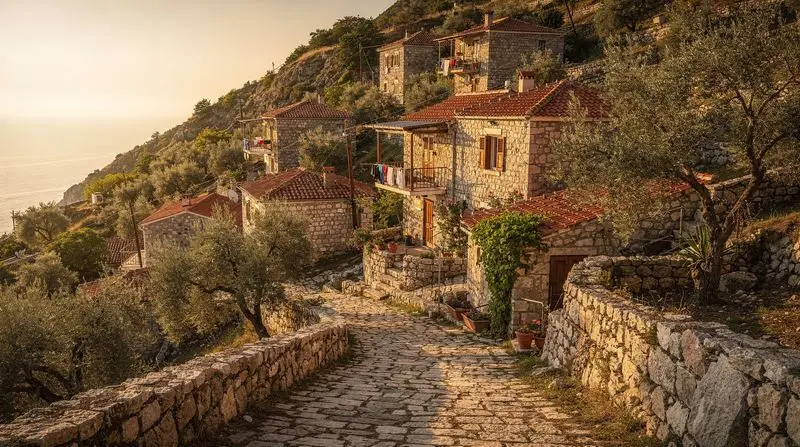
The Drino valley road from Gjirokastra to Tepelena is scenic throughout — a wide river valley with mountains on both sides, traditional villages with stone houses and old bridges, and the occasional ancient watchtower or ruined fortification on the hillsides. The valley opens and closes as the road follows the river, and the changing light on the limestone mountains changes the character of the landscape through the day.
The Vjosa valley east of Tepelena is even more dramatic, the river running between increasingly steep gorge walls as you approach Permet. The road periodically climbs above the river on the gorge wall, offering aerial views of the turquoise water below before descending back to river level. In spring, when snowmelt swells the river, the colour contrast between the white water and the limestone is extraordinary.
Allow a full day for this route, with the castle and river confluence at Tepelena in the middle, Gjirokastra as the southern anchor, and Permet as the eastern terminus with its thermal baths and Vjosa rafting. This three-destination circuit covers the UNESCO city, the historical birthplace, the wild Vjosa river, and the best thermal baths in Albania with a comfortable pace. The Albania off the beaten path guide covers this interior southern circuit in detail, including less-visited villages along the Drino and Vjosa valleys.
Alternatively, continue north from Tepelena along the Vjosa rather than east — the road towards Berat follows the river through spectacular gorge scenery and is one of the great underrated drives of central Albania.
North of Tepelena: The Vjosa Valley Drive
North of Tepelena, the road follows the Vjosa upstream through some of the most spectacular river gorge scenery in Albania. The turquoise river fills the canyon below, and the road occasionally narrows to single-track sections carved into the cliff face above the water. This drive — often overlooked in favour of the more famous routes to the coast or the northern Alps — is one of the genuine underrated drives of southern Albania, combining natural beauty with near-total absence of tourist infrastructure.
The gorge section immediately north of Tepelena, where the Vjosa cuts through the Kacanik limestone formation, is particularly dramatic. The river makes several large bends here, and from the road above each bend you can see the serpentine course of the water through the white canyon far below. There are no guardrails and no warning signs — this is Albania, and the driving requires attentiveness. But the views reward the attention.
Further north, the valley opens into wider agricultural sections with traditional villages, walnut groves, and the occasional stone bridge spanning side streams. The villages along this route see almost no tourist traffic; stopping for coffee in a roadside cafe will be a genuine novelty for the locals. Our rafting in Albania guide covers the Vjosa’s character from Tepelena upstream to Permet, including the section suitable for independent swimming and kayaking in summer when water levels drop.
What the Town Has to Offer
Tepelena the town, as distinct from its castle and river setting, offers a glimpse into ordinary southern Albanian provincial life. The main square is the social centre — cafes line the edges, men play chess or backgammon in the shade, and the pace of life is markedly slower than Tirana or the coast. The modest bazaar area near the square has small shops selling household goods, produce, and the basics of daily life.
The town’s market days bring in villagers from the surrounding valleys — a useful reminder that Tepelena still functions as a service centre for a wide rural hinterland. The surrounding mountains are dotted with small villages that have maintained traditional patterns of life, and the weekly market is where those communities intersect with the town economy.
The municipal museum, if it is open (hours are erratic — enquire at the main square), holds some local historical material including Ottoman-era artifacts and early 20th-century photographs. It is a modest collection but provides some historical grounding for the castle visit.
For visitors traveling through in summer, the swim spots along the Vjosa below the town are genuine refreshers — the water is cold year-round (the snowmelt character of the upper Vjosa keeps temperatures low even in August) and clean. Local boys swim here on summer afternoons; the riverside spots accessible from the road just below the confluence are the most practical.
Where to Eat in Tepelena
Tepelena has minimal restaurant options — this is a small provincial town, not a tourist destination. What it does have is honest Albanian cooking at prices that reflect local rather than tourist economics.
Restorant Vjosa (main square area) — The most reliable food option in Tepelena, serving standard Albanian grilled meat, salads, and byrek. Simple and filling. The tave kosi and qofte (meat patties) are competently done. Budget EUR 4-8 per person.
Restorant Drinoja (near the river, when open) — A seasonal option closer to the river confluence, serving grilled fish from the Vjosa alongside Albanian staples. Fish availability depends on season and what was caught; when fresh Vjosa fish is available, it is excellent. Budget EUR 5-10 per person.
Roadside cafes — Several basic cafes on the main road through town serve coffee, cold drinks, and small snacks. A coffee here costs around 100 ALL and can be consumed while watching the town’s daily rhythms from the pavement table. Useful for a quick break on a driving day.
Byrek vendors — Look for the small pastry shops near the market area selling freshly baked byrek with spinach, cheese, or meat. The best byrek in small Albanian towns often comes from the most unassuming storefronts. Budget 100-200 ALL per portion.
For better food, Gjirokastra (45 minutes south) has the full range of southern Albanian cooking including restaurant-quality taverna food and some of the best byrek in the country. Permet (45 minutes east) has grown considerably as a destination and now has several excellent restaurants focused on local southern Albanian cuisine including lamb, fresh vegetables from the valley, and the famous local raki.
Where to Stay
Tepelena is overwhelmingly a stop rather than an overnight base — most travelers see the castle and confluence, eat, and continue on to Gjirokastra or Permet the same day. That said, a handful of family guesthouses operate in and around the town for anyone who prefers to break the drive or wants an early start on the Vjosa gorge road north.
Guesthouses near the main square are simple, family-run affairs — a room, a bathroom, sometimes breakfast — priced around EUR 15-25 per night. Booking ahead is not usually necessary outside peak Albanian holiday weekends, but a phone call the day before is sensible since reception desks are informal or non-existent.
If you want proper hotel infrastructure, push on to Gjirokastra or Permet, both 45 minutes away and both with a far wider range of guesthouses and small hotels; see our where to stay in Gjirokastra guide for options in the UNESCO city. Overnighting in Tepelena itself only really makes sense if you are splitting the Vjosa gorge drive north toward Berat into two days, or want a very early start on the river before the day’s heat sets in.
Tepelena vs. the Neighbouring Stops
| Stop | Best for | Time needed | Overnight? |
|---|---|---|---|
| Tepelena | Castle ruins + river confluence | 1-2 hours | Rarely — pass through |
| Gjirokastra | UNESCO old town, bazaar, restaurants | Full day+ | Yes — best base in the south |
| Permet | Thermal baths, Vjosa rafting | Full day+ | Yes — good mid-trip base |
Getting to Tepelena
Tepelena is on the main road (SH75) between Gjirokastra and Fier, which makes it accessible from both north and south without significant detour.
From Gjirokastra: Approximately 45 kilometres north — about 45 minutes by car on a decent two-lane road through the Drino valley. Public transport between Gjirokastra and Tepelena is possible via the buses and furgons running on the Fier-Gjirokastra route; ask to be let off at Tepelena. Return transport south to Gjirokastra runs throughout the morning hours.
From Permet: The road via the Vjosa valley is around 40 kilometres — roughly 45 minutes to an hour on a scenic road that requires care, particularly on the narrower gorge sections. There is bus and furgon service between Permet and Tepelena, though frequency is limited. Check locally for current schedules.
From Fier: Around 70 kilometres south by the SH75 — about an hour from the north on good road. From Fier, onward connections to Berat, Tirana, and the coast are frequent.
From Berat: The Vjosa valley road provides a scenic connection of approximately 80 kilometres, taking 1.5 to 2 hours. This is one of the most scenic drives in central-southern Albania and worth considering as a route even if Tepelena is not the primary destination.
See our car rental in Albania guide for vehicle recommendations if driving the interior southern route independently. A standard car handles all the roads in this area; a higher-clearance vehicle is only needed if exploring unpaved tracks into the surrounding villages.
Practical Information
What to expect: Tepelena is a small town with minimal tourist infrastructure. A few cafes and restaurants serve Albanian basics, and some accommodation options exist for those who choose to overnight rather than pass through. As a stopping point on a driving day rather than a destination in itself, one to two hours is sufficient to see the river confluence from a good vantage point, walk up to the castle, and have a coffee in the town. Those with more time can extend into the Vjosa gorge north, explore the surrounding villages by car, or spend an afternoon swimming in the river.
Castle access: Free and informal. No entry fee, no formal signage. The path up from the town is obvious from the main square — head uphill toward the visible ruins on the hill. Take care on unrailed sections of the castle walls and on the upper stairs of the towers.
River access: The Vjosa and Drino are accessible from several points on the edge of town. Swimming in the calmer sections near the confluence is possible in summer; avoid the main current, which is stronger than it appears, particularly in spring and early summer.
Budget: Very low by any standard. Coffee, a meal, and a castle walk can be accomplished for under EUR 10 per person. Accommodation in Tepelena, if needed, typically runs EUR 15-25 per night in family guesthouses.
When to visit: The river is most spectacular in April and May, when snowmelt keeps the water level high and the turquoise colour is most vivid. Summer (June-September) is ideal for swimming and comfortable exploration. Winter is cold and the gorge can feel forbidding — not recommended as a primary destination in those months, though the dramatic emptiness has its own appeal.
The Broader Context: Ali Pasha’s Albania
Ali Pasha’s physical legacy in Albania is spread across multiple sites that together trace the geography of a singular life. Porto Palermo Castle on the Riviera was his naval stronghold, chosen for the natural protection of its enclosed bay. The fortress at Gjirokastra bears his influence — he used and modified it as an administrative centre for his southern territories. The ruins at Tepelena are his birthplace and family seat, the place from which everything began.
Understanding that lineage gives a visitor’s movement through southern Albania a narrative thread that transforms individual sites into something larger. You are not just visiting a castle here or a UNESCO city there; you are following the geography of a man who shaped the character of southern Albania in a formative period, whose decisions determined which communities flourished and which were destroyed, whose court brought European attention to a region that had previously been largely invisible to the outside world.
Tepelena is not a polished museum. It is a place where history happened and where the physical evidence of it — the castle walls above the river, the strategic confluence below, the mountain terrain that produced the violence and ambition of Ali Pasha’s world — is still present and still legible. That combination of raw nature and unmediated history, available without interpretation panels or entry queues, is increasingly rare in European travel. Tepelena offers it for the price of a drive off the main road.
Our Albania off the beaten path guide includes more context on the southern Albania circuit, including less-visited sites in the Vjosa valley and the road east towards the Greek border. The historical sites in Albania guide places Tepelena in the broader context of Albanian castle and fortification history, from Illyrian foundations through the Ottoman period. The 7-day south Albania itinerary references Tepelena as an optional stop on the Permet-to-Gjirokastra connection, giving context for visitors planning the southern interior circuit.
Frequently Asked Questions About Tepelena
Is Tepelena worth stopping at?
Tepelena is worth a stop of 1-2 hours for travelers on the Permet-to-Gjirokastra route. The castle ruins above the river confluence provide interesting historical context on Ali Pasha’s origins, and the gorge confluence where the Drino meets the Vjosa is genuinely dramatic scenery. It is not a destination in its own right that warrants a dedicated overnight visit — the sites are limited and the town modest — but as a stop on the southern Albania interior circuit, it adds meaningful historical depth.
Who was Ali Pasha of Tepelena?
Ali Pasha of Ioannina (1740-1822), born in Tepelena, was the Ottoman governor of the western Balkans who effectively ruled as an independent potentate for much of the late 18th and early 19th centuries. He built an autonomous state from his capital at Ioannina (now in Greece), receiving foreign diplomats, taxing trade, and defying Ottoman central control for decades. Lord Byron visited his court in 1809 and wrote about him in Childe Harold’s Pilgrimage, making him famous across Europe. He was eventually executed by Ottoman forces in 1822.
What is there to see in Tepelena?
The main sights are the ruined Ali Pasha castle on the hill above the town (walls and towers remain, though largely unrestored), the Vjosa-Drino river confluence visible from the castle and bridge, and the general atmosphere of a small Albanian city with a remarkable historical pedigree. The rivers themselves — the Vjosa running turquoise through the gorge — are worth seeing independently of the castle context. The journey to Tepelena through the Vjosa valley from Permet is itself one of the scenic highlights of southern Albania.
How do you get to Tepelena?
Tepelena sits on the SH4 highway connecting Permet (approximately 30 km north, 30-40 minutes) and Gjirokastra (approximately 45 km south, 45-60 minutes). It is most naturally visited as a stop between these two destinations rather than as an endpoint. Buses running the Tirana-Gjirokastra route pass through Tepelena, but the most practical approach is by rental car or private taxi if you want to stop and explore the castle rather than simply pass through the town.
Is Tepelena near Permet?
Yes — Tepelena is approximately 30 km north of Permet along the Vjosa River valley, connected by a scenic road that follows the river through a series of dramatic limestone gorges. The drive from Permet to Tepelena takes 30-40 minutes. If you are visiting both Permet and Gjirokastra, Tepelena is a natural and easy addition to the route between them, adding 1-2 hours to the journey.