Lake Prespa: Albania’s Remote Transboundary Lake
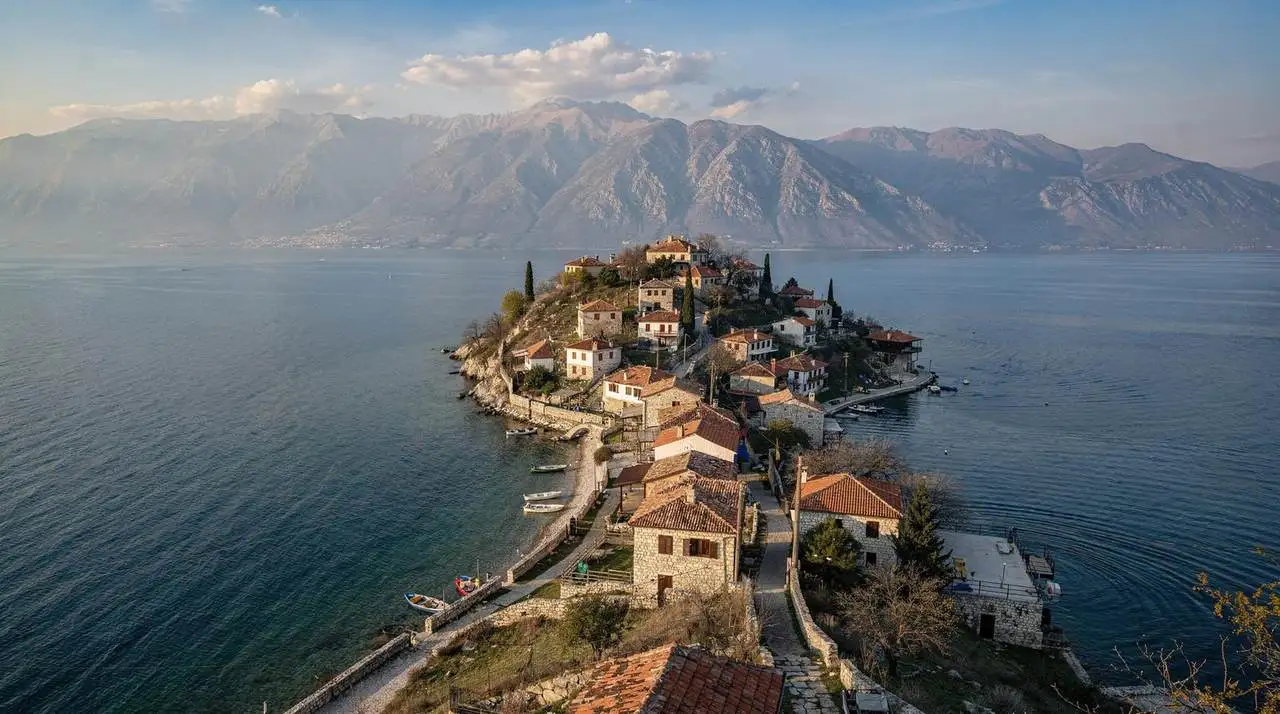
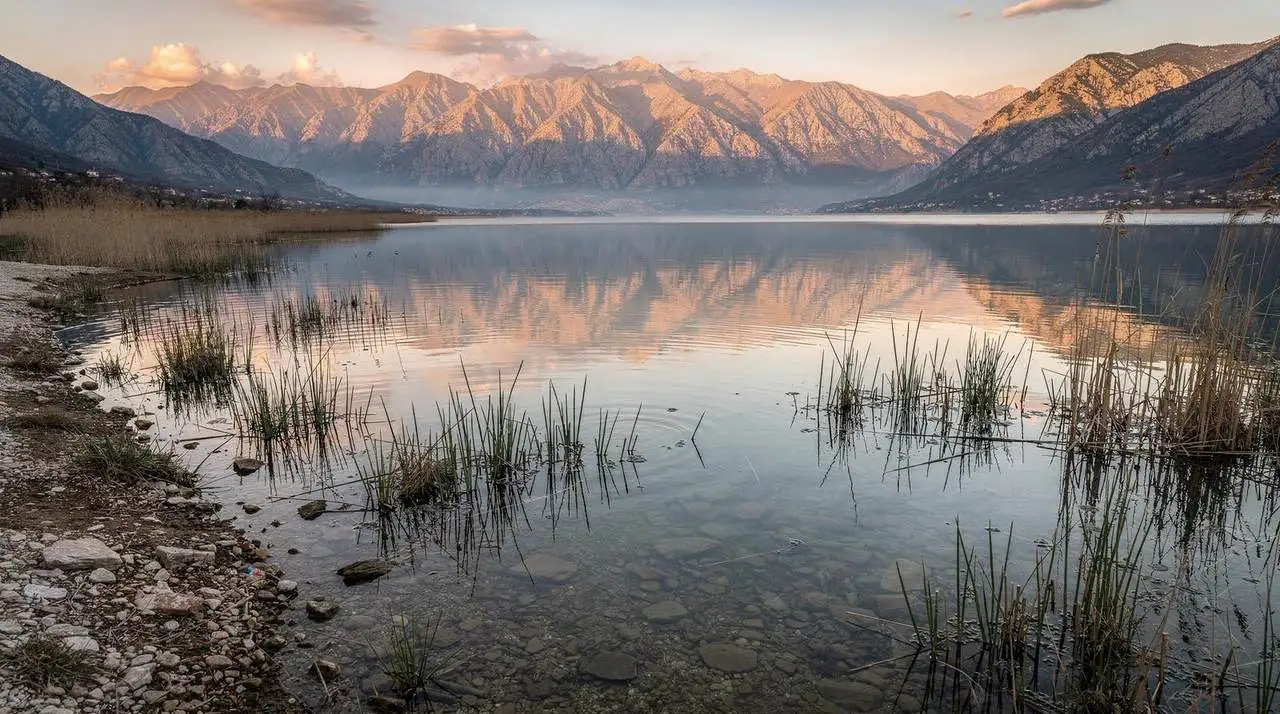
In the far southeast of Albania, where the country’s territory narrows to a point between Greece and North Macedonia, Lake Prespa fills a high mountain basin at 853 metres above sea level. It is one of three interconnected lakes in the region — the others being the smaller Micro Prespa and the larger, more famous Lake Ohrid — and together they form one of the most ecologically and historically significant lake systems in the Balkans.
Lake Prespa is a transboundary lake, its shores divided between Albania (the western shore), Greece (the southern shore), and North Macedonia (the eastern and northern shores). This political geography has an unexpected ecological benefit: the absence of heavy development pressure from any single national administration has left the lake relatively undisturbed, and the Prespa basin is today one of the wildest and least-visited landscapes in the western Balkans.
The recognition of Prespa’s exceptional natural value is formal and international: the lake and its surrounding wetlands are part of the Prespa Park transnational protected area, covering more than 270,000 hectares across all three countries. The designation includes national park status in each country and forms part of the broader UNESCO-recognised natural heritage of the Ohrid-Prespa region. For travellers seeking remote natural beauty, exceptional birdwatching, and the particular pleasure of a place that most international visitors simply have not found, the Albanian shore of Lake Prespa is one of the finest destinations in eastern Albania.
| Where | Southeastern Albania, ~60-70 km / 90 min from Korca |
| Getting there | Hired taxi, rental car, or organised day trip from Korca |
| Time needed | 1-2 days (day trip possible, overnight richer) |
| Food/water | Bring your own — no reliable restaurant infrastructure at the shore |
| Best for | Birdwatching (Apr-Jun), swimming (Jul-Sep) |
Birdwatching on the Albanian Shore
Lake Prespa is one of the most important bird areas in the Balkans, and the Albanian shore — less visited and less disturbed than the Greek and Macedonian sides — offers exceptional wildlife encounters for patient visitors.
The lake hosts a globally significant breeding colony of Dalmatian pelicans (Pelecanus crispus), the world’s largest pelican species, whose Prespa population is one of the most important in the Mediterranean range. The pelicans breed on reed-island colonies in the lake’s shallower eastern sections and can be observed from the shore or by boat throughout the breeding season from early spring through summer.
More than 270 bird species have been recorded in the Prespa basin across all three countries. The Albanian shoreline and associated wetlands support:
- Dalmatian pelican: breeding colony of considerable significance
- Pygmy cormorant (Microcarbo pygmeus): important population
- Great white pelican (Pelecanus onocrotalus): regular visitor
- Purple heron, grey heron, night heron: common in reedbeds
- Ferruginous duck (Aythya nyroca): threatened species present regularly
- White-tailed eagle (Haliaeetus albicilla): resident birds visible year-round
- Lesser kestrel and various raptors over the surrounding hillsides
Spring migration (April-May) brings additional species moving through the Balkans along the Adriatic flyway. Autumn (September-October) offers a second migration window with different composition. The quietness of the Albanian shore — compared to the Greek Prespa area which has a more developed ecotourism infrastructure — gives visitors a quality of undisturbed observation that more popular birdwatching destinations cannot provide.
The Albanian Village Shores
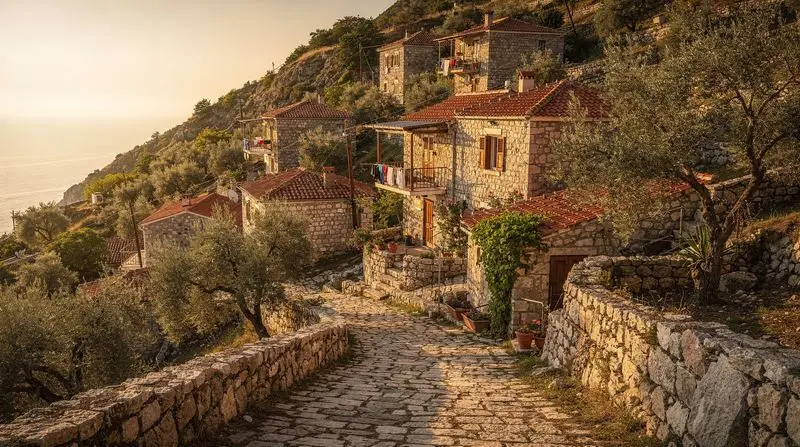
The Albanian shore of Lake Prespa is sparsely populated and relatively undeveloped. Several small villages along the western shore — including Goricë e Madhe, Goricë e Vogël, and Liqenas — maintain traditional agricultural and fishing practices that have changed little in the past half-century.
These villages have a distinctive character shaped by their isolation: the combination of mountain terrain, lake-edge location, and political remoteness during the communist period created communities that developed in relative self-sufficiency. The stone houses, the fishing boats pulled up on the shore, the vegetable gardens running to the water’s edge — all have the quality of a landscape that has not been rearranged for tourism.
The small Byzantine church remains visible at several shore villages, and the lake views from the village terraces — looking east across the water toward the mountains of North Macedonia and Greece — are extraordinary in the morning light. This is not a destination with developed tourism infrastructure. There are no restaurants with English menus, no guesthouses with TripAdvisor reviews, no boat tours run by licensed operators with websites. What there is instead is a lakeside landscape of genuine wildness and authentic village life, accessible to travellers willing to accept basic conditions in exchange for exceptional scenery and solitude.
The Connection to Lake Ohrid
Lake Prespa and Lake Ohrid are hydrologically connected through underground karst channels — water flows underground from Prespa into Ohrid, emerging as springs including the famous Drilon springs near Pogradec. This underground connection links two of Albania’s most important water bodies in a geological relationship that has fascinated scientists and was a factor in the UNESCO designation of both lakes.
The Prespa-Ohrid region as a whole represents one of the oldest lake systems in the world. Lake Ohrid in particular is estimated to be between 2-5 million years old, making it one of the ancient lakes of the world and home to many endemic species found nowhere else. Lake Prespa, while younger, shares many of the ecological characteristics of this ancient system.
For travellers visiting eastern Albania, the combination of Lake Ohrid’s Albanian shore (Pogradec, Lin, Drilon springs) and Lake Prespa forms the classic eastern circuit. The two lakes are approximately 30 kilometres apart, connected by mountain roads through the Albanian highlands. Korca serves as the hub connecting all of these destinations.
Getting to Lake Prespa
The Albanian shore of Lake Prespa is reached via Korca, approximately 60-70 kilometres to the northeast. The road south from Korca through the mountain passes toward the lake takes approximately 90 minutes and is paved throughout, though the mountain sections are winding.
There is no regular public transport from Korca to the lake shore villages. Options include:
- Hired taxi from Korca for a day trip, negotiating a return fare
- Self-drive with a rental car from Korca
- Organised day trips from Korca combining Prespa with other eastern Albania highlights
For organised Korca and eastern Albania tours that can include Prespa: this Korca experience provides a base for exploring the wider eastern Albania region. Local guides in Korca can arrange customised Prespa day trips with naturalist or birdwatching focus. The Albania off the beaten path guide covers the eastern circuit in detail, including the Prespa detour as an extension of the standard Korca-Pogradec itinerary.
Ecology and Conservation
The Prespa basin’s ecology is extraordinarily complex and reflects millions of years of isolation and speciation. The lake supports endemic fish species found nowhere else in the world, as well as plant communities specific to the high-altitude lake environment. The combination of deep water, extensive reedbeds, surrounding mountain slopes, and agricultural land creates a mosaic of habitats that supports exceptional biodiversity.
Conservation pressures on the Albanian shore include agricultural runoff, unsustainable fishing practices, and the very basic waste management infrastructure of the shore villages. The transboundary Prespa Park initiative attempts to coordinate conservation across the three national jurisdictions, but the resources available for Albanian protected area management remain limited compared to the scale of the task.
Tourism of the right kind — low-volume, nature-focused, economically beneficial to local communities — is increasingly seen as part of the conservation solution rather than the problem. Travellers who visit the Albanian shore, eat at local establishments, hire local guides, and respect the wildlife are contributing to the economic argument for conservation. The Albania birdwatching guide explains this conservation tourism model in more detail.
What to Expect from a Prespa Visit
Visiting the Albanian shore of Lake Prespa requires a willingness to accept the absence of conventional tourist infrastructure in exchange for a genuinely remote and beautiful natural experience. Expect:
- Extraordinary lake views with mountains in the background on all sides
- Bird activity at the lake shore that is visible without specialist equipment (pelicans, herons, and eagles are large enough to be obvious)
- Simple village life without tourist-facing services
- Roads that are paved but narrow and sometimes rough
- No reliable restaurant or cafe infrastructure in the immediate lake shore area — bring food and water from Korca
The reward for accepting these conditions is a landscape and wildlife experience that visitors consistently describe as among the most memorable in Albania. Coming to Prespa after Korca, the UNESCO art museum, the bazaar, and the brewery creates a particular pleasure — the movement from cultural sophistication to remote natural beauty within a single day.
Practical Information
Base for visits: Korca, approximately 60-70 kilometres and 90 minutes away.
Best birdwatching season: April through June for breeding pelicans and migrant species; September-October for autumn migration.
What to bring: Binoculars, camera with telephoto lens for bird photography, packed lunch and water (no reliable food supply at the lake shore), sun protection, insect repellent for reedbeds.
Road conditions: Paved throughout but mountain roads require careful driving, particularly in wet conditions.
Photography: Early morning provides the best light for both landscape and wildlife photography. Arrive at the lake shore by 7-8am for optimal conditions.
Respectful wildlife viewing: Maintain distance from pelican nesting sites. Do not enter reedbeds that may contain nesting birds. The lake is a national park and wildlife disturbance is a legal concern as well as an ethical one.
Combining Prespa with Eastern Albania
The full eastern Albania circuit — Korca city, Voskopoje churches, Dardha mountain village, Lake Prespa, Pogradec lake town, Lin peninsula — is one of the most complete off-beaten-path itineraries in the country. Three nights in Korca allows comfortable coverage of all these destinations as day trips, with the city itself providing evening culture, dining, and the famous brewery.
If you are arriving from the coast or Tirana first, a guided day out such as this Berat UNESCO and Belshi Lake tour pairs well with the quieter lake scenery further east. Few international travellers make this circuit, which is precisely its value. The Albania off the beaten path guide rates eastern Albania as the single best region for travellers who have exhausted the obvious Albanian destinations and want to understand the deeper character of the country.
The Transboundary Prespa Park
The Prespa Park international agreement — covering protected areas across Albania, Greece, and North Macedonia — is one of the more successful examples of transboundary conservation in Europe. The three countries, despite their complex political history and the sensitive border arrangements in the region, have maintained cooperation on conservation management that has in some areas produced demonstrable ecological improvements.
The pelican colony at Prespa is one of the most cited success stories of this cooperation. When comprehensive monitoring began in the 1980s, the Dalmatian pelican breeding population at Prespa was critically low — fewer than 50 pairs in the entire lake system. Coordinated protection across all three countries, focusing on reducing human disturbance to nesting sites and managing fishing pressure, contributed to a recovery that brought the breeding population to several hundred pairs by the 2000s.
For Albanian visitors and travellers approaching the lake from Korca, the transboundary aspect is tangible: the lake extends beyond the Albanian shore into two other countries, visible from any elevated viewpoint. Looking east from the Albanian shore toward the Macedonian mountains or south toward the Greek hills is a reminder that the political borders drawn through the lake in the 20th century are genuinely arbitrary from the water’s perspective.
Flora and Vegetation Around the Albanian Shore
The Albanian shore of Lake Prespa supports a distinctive vegetation that reflects the combination of high altitude (853m), the relatively continental climate with cold winters and warm summers, and the lake-moderating influence that keeps temperatures at the shore somewhat more stable than the surrounding uplands.
The reedbeds that fringe the shallower shore sections are dominated by common reed (Phragmites australis) in extensive stands that provide the nesting habitat for waterbirds. Behind the reedbeds, wet meadows with sedge and rush communities transition to the drier grasslands and scrub of the hillsides.
The hillsides above the Albanian shore carry mixed oak and beech forest on their lower slopes, transitioning to open mountain grassland and rocky terrain at the higher elevations above the village level. In spring the transitional zone between the reed beds and the lower meadows produces a succession of wetland plants: yellow iris (Iris pseudacorus), marsh marigold (Caltha palustris), and various water-loving plants that create a garden of colour in May and June.
Wild herbs — thyme, oregano, sage, and various mint species — grow abundantly on the dry hillsides above the lake. The combination of lake moisture and well-drained slopes creates ideal conditions for the aromatic herbs that have always been part of the cooking and herbal medicine traditions of lake shore communities.
Goricë e Madhe: The Main Albanian Prespa Village
The village of Goricë e Madhe (Big Gorica) is the largest Albanian settlement on the western shore of Lake Prespa and the most practical base for exploring the Albanian side of the lake. The village is small by most standards — a few hundred permanent residents — but it has the basic infrastructure that allows independent travel: a cafe or two, basic accommodation options, a small boat available for hire during the summer months.
The village sits directly on the lake shore with its agricultural land running to the water and the mountain slopes rising behind. The combination of working fishing boats pulled up on the pebble shore and the lake filling the view from the village is the defining Prespa image from the Albanian side — a landscape of great beauty and complete ordinariness that has not been curated for visitors.
The church in Goricë e Madhe — a small Orthodox building with modest but interesting frescoes from the 18th or 19th century — represents the Albanian Christian heritage of this remote corner. The church is typically locked but the key is held by a village family; asking around produces access within a reasonable wait. The frescoes inside, while not in the class of the Voskopoje paintings, show the same regional tradition operating at the village level — local painters working with local materials to produce religious images for a community that needed them.
Wild Swimming at Lake Prespa
The Albanian shore of Lake Prespa offers wild swimming in a setting that has almost no equivalent in accessible European travel. The lake at 853 metres above sea level, surrounded by mountains and the absence of any commercial beach infrastructure, provides a water experience of extraordinary purity.
The lake water is generally good quality on the Albanian side. The main agricultural activity in the immediate lake shore area is relatively low-intensity, and the absence of industrial development means the water does not carry the chemical pollutants that affect many European lakes.
The water temperature is cooler than Lake Ohrid at comparable elevation because Prespa is shallower (maximum 54 metres versus Ohrid’s 289 metres) and therefore warms more in summer but loses that heat faster. Surface temperatures in July and August typically reach 20-22°C — comfortably warm for swimming, though the mountain air at the shore makes the transition from water to air noticeably cool.
Entry from the Albanian shore is mostly over rocky or pebble substrate — water shoes are recommended. The clearest water and best swimming is found away from the village immediate shorelines and away from any obvious agricultural runoff entry points.
Lake Prespa by Season
| Period | Highlight | Notes |
|---|---|---|
| April-May | Spring migration, breeding pelicans arriving | Wetland wildflowers, best overall birdwatching |
| June | Late breeding season, warming water | Good balance of birds and early swimming |
| July-August | Warmest swimming (20-22°C) | Least bird activity; bring sun protection |
| September-October | Autumn migration | Second birdwatching window, cooling water |
| November-March | Quiet, cold | Little tourist infrastructure operates |
Comparing Prespa with Lake Ohrid
| Lake Prespa | Lake Ohrid, Albanian side | |
|---|---|---|
| Development | Almost none | Resort towns (Pogradec, Lin) |
| Main appeal | Birdwatching, wild swimming, solitude | Swimming, dining, accessible lakeside towns |
| Infrastructure | Bring your own food and water | Restaurants, guesthouses, boat rentals |
| Depth/character | Shallow (max 54m), warms and cools faster | Very deep (max 289m), ancient endemic ecosystem |
| Best for | Travelers who want genuine remoteness | Travelers who want lake scenery with comfort |
The two lakes are connected underground and only about 30 km apart by road, making it easy to experience both extremes — Ohrid’s polish and Prespa’s wildness — within the same eastern Albania trip.
Frequently Asked Questions About Lake Prespa
What countries share Lake Prespa?
Lake Prespa is shared between Albania, Greece, and North Macedonia — a rare example of a transboundary lake touching three different countries. The borders meet in the middle of the lake, making it one of the few places in the world where three national territories converge on a single body of water. This unusual political geography has contributed to a transboundary conservation initiative — the Prespa Park — that coordinates protected area management across all three countries.
Are there Dalmatian pelicans at Lake Prespa?
Yes — Lake Prespa hosts one of the most important Dalmatian pelican breeding colonies in the entire Mediterranean region. The pelicans breed on reed-island colonies in the lake from late winter through summer, and are visible from the Albanian shore throughout the season. The Prespa pelican colony, combined with the Karavasta Lagoon colony near Divjaka, makes Albania one of the most significant countries in Europe for Dalmatian pelican conservation.
How do you visit Lake Prespa from Korca?
The Albanian shore of Lake Prespa is approximately 60-70 kilometres south of Korca, reached in about 90 minutes by car on mountain roads. There is no regular public transport to the lake shore villages. The most practical options are a hired taxi from Korca (negotiate a day rate), a rental car, or an organised day trip with a local guide. The lake can be combined with Voskopoje for a full day southern excursion from Korca.
Is Lake Prespa good for swimming?
The lake is clean and suitable for swimming in summer, though the remote shore villages have no organised beach facilities. The water is warmer than Lake Ohrid by August, as Prespa is shallower. The Albanian shore has several accessible spots where entering the water is straightforward. Water quality is generally good, though agricultural runoff from the shore areas means the cleanest swimming is away from the village immediate shorelines.
Why is Lake Prespa considered ecologically important?
Prespa is part of one of the oldest lake systems in the world, with endemic species found nowhere else. The lake and its surrounding wetlands support more than 270 bird species including globally threatened waterbirds such as the Dalmatian pelican and ferruginous duck. The transboundary nature of the lake creates complex governance challenges but has also helped limit development pressure. The Prespa basin is recognised in international conservation literature as one of the most important biodiversity hotspots in the Balkans.
Is Lake Prespa or Lake Ohrid better to visit?
They serve different purposes rather than competing. Lake Ohrid’s Albanian side offers accessible resort towns, restaurants, and comfortable swimming infrastructure at Pogradec and Lin. Lake Prespa offers genuine remoteness, exceptional birdwatching, and wild swimming without any commercial development. Most eastern Albania itineraries visit both, since they are only around 30 km apart and offer contrasting experiences within the same trip.
Do you need a guide to visit Lake Prespa?
Not strictly, but a local guide or organised day trip from Korca adds considerable value, particularly for birdwatching, since there is no visitor centre or signage at the Albanian shore. Independent travelers with a rental car can absolutely visit on their own, but should bring binoculars, food, water, and expect no English-language services once away from Korca itself.