Birdwatching in Albania: The Definitive Guide
Albania is one of Europe’s most underrated birdwatching destinations. With 361 recorded species, exceptional habitat diversity — from coastal lagoons and wetlands to alpine forests and Mediterranean scrubland — and a near-absence of the visitor pressure that affects birding in more touristed countries, Albania offers experiences that serious birders find extraordinary.
This guide covers the best birdwatching sites in detail, the key species to target at each location, the best seasonal timing, practical logistics including local guides and transport, and how to combine a birding trip with Albania’s broader tourism appeal.
| Best site | Divjaka-Karavasta National Park (Dalmatian pelican colony) |
| Best season | April-May (spring migration) |
| Species recorded | 361 |
| Typical cost | around EUR 400-700/week including guide, accommodation, transport |
| Getting there | Rental car recommended; furgon possible to Divjaka/Shkodra with local taxis on site |
Why Albania for Birdwatching?
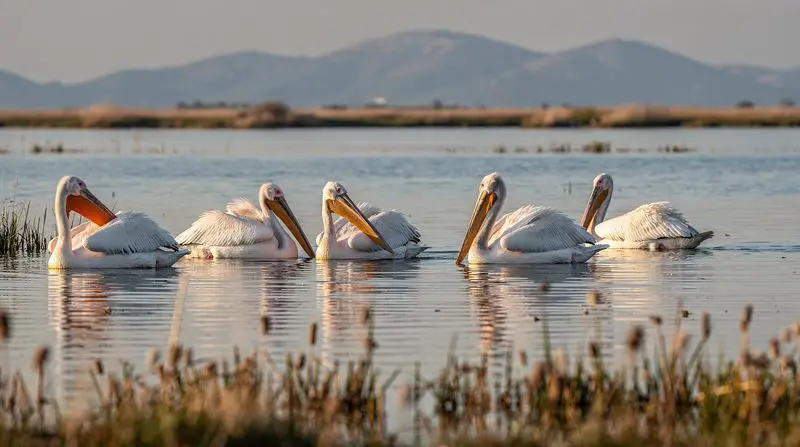
Dalmatian pelicans. Albania hosts one of the last significant breeding populations of the Dalmatian pelican in the world. Seeing these enormous birds — the world’s largest freshwater bird with a wingspan reaching 3.5 meters — in their active breeding colony at Karavasta Lagoon is one of the great wildlife experiences in Europe. The species numbers fewer than 12,000 individuals globally; seeing a breeding colony of 80-100+ pairs in Albania is a genuinely significant encounter.
Exceptional habitat variety in a compact area. Drive two hours from the Adriatic coast to the Albanian Alps and you pass through Mediterranean scrubland, coastal lagoons and wetlands, agricultural land with traditional farming practices, river systems, broadleaved forest, mixed mountain forest, and alpine zone. Each habitat zone has distinct and often internationally significant bird communities.
Very low disturbance. Birdwatching is not yet a significant tourist activity in Albania. Key sites receive a fraction of the human pressure they would face in Western Europe. At Karavasta in shoulder season, you may be the only visiting birder. This absence of disturbance produces genuinely wild bird behavior and accessible views at distances impossible at comparable Western European wetland sites.
Migration. Albania sits on the eastern Adriatic flyway, one of Europe’s major bird migration corridors. Spring (April-May) and autumn (August-October) bring significant passage of raptors, waders, herons, and passerines using the narrow coastal strip as a navigation corridor.
Cost. A dedicated birding week in Albania costs a fraction of equivalent birding in Western Europe. Seven days of focused birdwatching — accommodation, food, local transport, guide fees — can be managed for EUR 400-700 per person, including some comfortable guesthouse nights in the mountains. The value proposition for European birders is exceptional.
Combining with tourism. Albania’s main birding sites distribute across the country in a way that integrates naturally with standard tourist circuits. Divjaka-Karavasta is between Tirana and the Riviera. Lake Shkodra is adjacent to Shkodra city. Butrint’s lagoon is part of the archaeological site visit. The Prespa Lakes area can be combined with the city of Korce.
Key Birdwatching Sites in Detail
Divjaka-Karavasta National Park: The Flagship Site
This is the most important Albanian birding destination and the primary reason serious European birders visit Albania. The combination of Karavasta Lagoon — the third largest in the Mediterranean at approximately 4,000 hectares — with the adjoining Divjaka coastal pine forest creates habitat capable of supporting extraordinary waterbird populations.
Dalmatian Pelican colony: The breeding colony at Karavasta consistently holds 80-120+ pairs — one of only a handful of significant breeding populations remaining in Europe, alongside Lake Prespa, Lake Skadar/Shkodra, and a few sites in Greece and Turkey. The colony is present and active from late January (early pair bonding) through to June (late chicks). Peak viewing for the full colony experience is February-April, when birds are at the nest and the colony is at its most active and visible.
Access to the colony: An observation tower at the lagoon edge allows viewing of the colony without disturbance. Boat trips on the lagoon, operated by local fishermen and ecotourism operators, provide closer perspectives of the colony and the broader lagoon waterbird community. Book boat trips through the park visitor center or local operators in Divjaka town.
Other waterbirds at Karavasta:
- Pygmy Cormorant — large numbers year-round, particularly concentrated in autumn. Albania holds some of the largest Pygmy Cormorant populations in Europe.
- Great Egret, Little Egret, Grey Heron — abundant throughout the year at the lagoon edge
- Glossy Ibis — regular passage, sometimes in large flocks in spring and autumn
- Greater Flamingo — increasingly regular visitor, occasional large flocks
- Purple Heron — breeding in reedbeds and lagoon edge vegetation
- Squacco Heron — breeding, best seen at the lagoon margins in summer
- Little Bittern — breeding in reedbeds; heard (distinctive pumping call) more often than seen
- Black-crowned Night Heron — breeding colony; most active at dusk
Waders during migration (April-May and August-October):
- Marsh Sandpiper, Common Sandpiper, Green Sandpiper — passage
- Curlew Sandpiper and Dunlin — autumn passage on muddy lagoon edges
- Black-winged Stilt — also breeding; dramatic black-and-white waders visible throughout the season
- Pied Avocet — occasional, typically spring passage
- Whiskered Tern and White-winged Tern — spring passage, sometimes in significant numbers over the lagoon
Pine forest (Divjaka section): The extensive coastal pine forest that borders the lagoon to the west has a distinct woodland bird community:
- Great Spotted Woodpecker and Middle Spotted Woodpecker
- Short-toed Treecreeper
- Cetti’s Warbler — heard constantly in reedbeds adjacent to the forest
- Various warblers including Reed Warbler and Sedge Warbler in breeding season
- Hobby — summer visitor, spectacular aerial hunter visible over the lagoon
Practical information: The park entrance is near the town of Divjaka. Entry fee approximately EUR 2-3. The observation tower and walking path to the lagoon edge take 30-45 minutes on foot from the entrance. A local guide significantly enhances the experience — asking at the park visitor center or through ecotourism operators in Lushnja (the nearest significant town) arranges this. The park is accessible by bus from Lushnja, which is itself reached from Tirana or Fier. By car, Divjaka is approximately 2 hours south of Tirana.
Best timing: February-June for the breeding pelican colony; April-May and September-October for migration.
Lake Shkodra: The Balkans’ Largest Lake
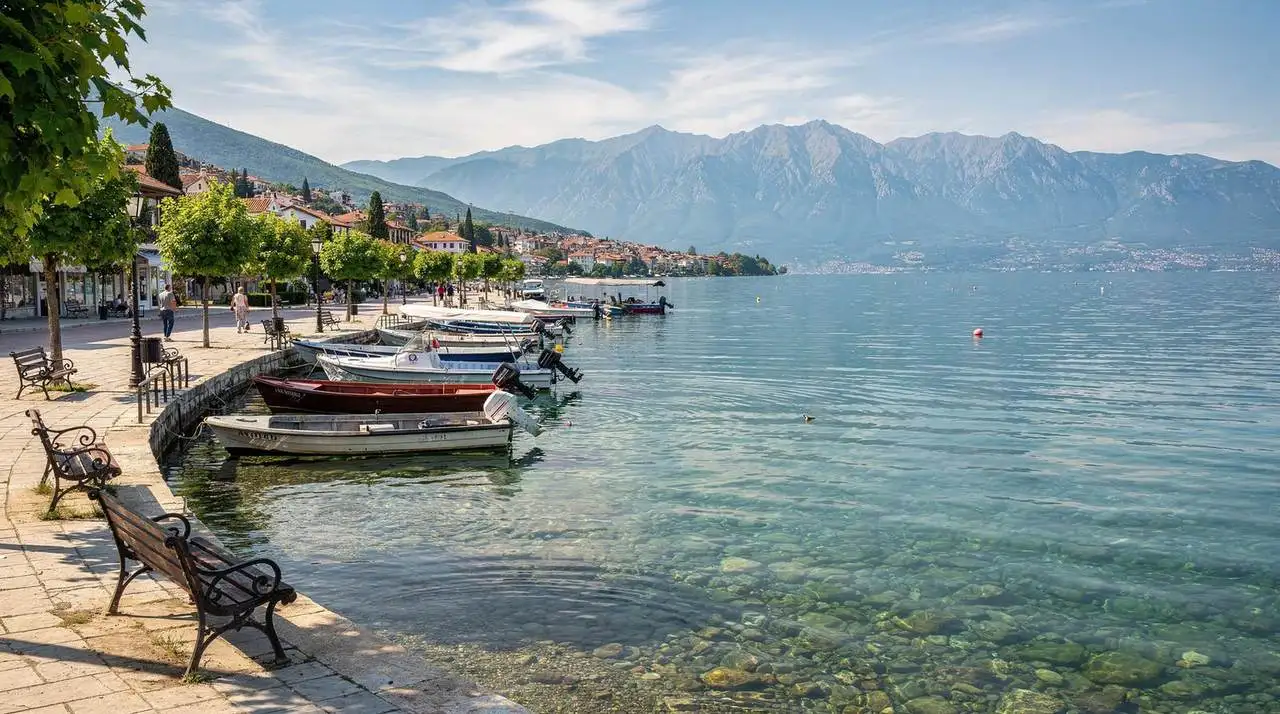
Lake Shkodra — the largest lake in the Balkans, shared between Albania and Montenegro — is one of Europe’s most important freshwater bird habitats. The Albanian shore, particularly the marshy areas and agricultural land around the southern and eastern shore near Shkodra city, holds exceptional bird concentrations.
Key species at Lake Shkodra:
- Pygmy Cormorant — one of the largest European populations. Roosting flocks on lakeside trees are a dramatic sight, sometimes numbering thousands.
- Great White Pelican — regular visitor alongside Dalmatian Pelicans at certain seasons
- Dalmatian Pelican — uses the lake particularly in winter and during migration
- Ferruginous Duck — winter visitor; this diving duck is globally threatened and Lake Shkodra is an important site
- White-headed Duck — occasional winter visitor; globally endangered
- Smew, Goosander, and other diving ducks — winter season
- Western Marsh Harrier — breeding and abundant on passage; the reedbeds are excellent habitat
- Eurasian Bittern — breeding in dense reedbeds; deep booming calls heard at dawn and dusk in spring
- Great Reed Warbler — abundant breeding species; its loud, repetitive song is the sound of Albanian summer reedbeds
- Penduline Tit — breeding in willows and tamarisk at the lake edge
Raptors of the Lake Shkodra area: The combination of lake, marsh, and agricultural land produces good raptor watching:
- Short-eared Owl — winter visitor, hunting over fields and marsh
- Long-eared Owl — winter roosts in certain lakeside plantations
- Peregrine Falcon — regular, particularly in migration and winter
- Montagu’s Harrier — spring and autumn passage
- Red-footed Falcon — sometimes large numbers in spring passage
Practical information: Lake Shkodra is 5 km from central Shkodra city — accessible by bicycle (recommended), taxi, or on foot from the city. The Ana e Malit area on the southeastern shore provides the best access to the marshy areas. Kayak trips on the lake (operators available from Shkodra) provide excellent birding perspective, particularly for waterbirds at the lagoon edges. See the Lake Shkodra destination guide for full visitor and accommodation information.
Best timing: October-March for maximum waterbird concentrations and wintering diving ducks; April-May for breeding species and spring migration.
Prespa Lakes: Dalmatian Pelicans in a Remote Setting
The Prespa Lakes in southeastern Albania, shared with North Macedonia and Greece, support the second significant Albanian breeding colony of Dalmatian pelicans alongside large numbers of other waterbirds. The Albanian section — smaller and less visited than the North Macedonian side — offers a more intimate encounter with the pelicans than Karavasta.
Key species at Prespa:
- Dalmatian Pelican — breeding colony on lake islands; smaller than Karavasta but more intimate viewing typically possible
- Great Cormorant — substantial breeding colony on islands
- Pygmy Cormorant — abundant
- Little Egret, Great Egret, Grey Heron — breeding
- Little Bittern — reedbeds around the lake margins
- Night Heron — breeding
- Gadwall and Pochard — breeding ducks
- Red-necked Grebe — regular
Additional Prespa woodland species:
- Black Stork — breeding in surrounding forests; one of the rarest and most sought storks, genuinely more regularly encountered in Albania than most Western European countries
- Lesser Spotted Eagle — breeding; the “ant eagle” visible hunting agricultural fields
- Short-toed Snake Eagle — breeding; spectacular snake-hunting raptor
- European Roller — brilliant blue plumage, declining across Europe but present in Albanian agricultural areas
- Golden Oriole — woodland edges in breeding season
Practical information: The Albanian section of Prespa is accessed from Korce (approximately 70 km). The small resort settlement at Liqenas has guesthouse accommodation. Roads are passable but rough in places — a higher clearance vehicle is helpful. Very limited tourist infrastructure; Albanian birding guides who know the specific access points are strongly recommended. The Pogradec destination guide covers the Lake Ohrid and Prespa area.
Best timing: May-July for breeding species including the pelican colony; October-November for large waterbird concentrations.
Butrint National Park: Archaeology and Birds Combined
The Butrint lagoon and wetland system near Saranda provides excellent birdwatching integrated with one of Albania’s most spectacular archaeological sites. An early morning arrival at Butrint allows birding the wetland channels and lagoon edges before the tour groups arrive.
Key Butrint species:
- Great Cormorant — roosting flocks, often perched dramatically on ancient ruins walls
- Little Egret and Great Egret — feeding in the shallow lagoon areas adjacent to the archaeological paths
- Kingfisher — along the channels and the Vivari Channel that connects the lagoon to the sea
- Bee-eater — spectacular in summer, groups hunting from the ruins walls and surrounding vegetation
- Subalpine Warbler and Sardinian Warbler — in Mediterranean scrub throughout the site
- Short-toed Lark — open areas around the site entrance and carpark
- Glossy Ibis — passage through the wetland areas
Practical information: Entry fee to the archaeological site (approximately EUR 5-7) includes access to the lagoon walks. Arrive at opening time to bird before crowds arrive. See the Butrint destination guide for visitor hours and access logistics.
How to integrate: A morning at Butrint (arriving at opening, doing the archaeology and birding circuit) followed by an afternoon at Ksamil beach makes an excellent day from a Saranda base. Boat trips from Saranda that pass through the Vivari Channel offer a water-based perspective on the Butrint lagoon birding that complements the land-based circuit.
Albanian Alps: Forest and Alpine Bird Communities
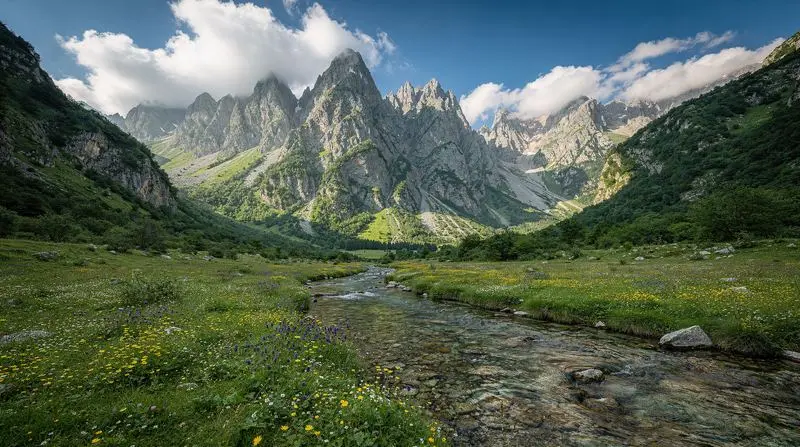
The mountain zone — Theth National Park, Valbona Valley, and the Shebenik-Jablanica National Park — offers a completely different bird community from the wetland sites. The beech forests, alpine meadows, cliff faces, and fast mountain streams each have characteristic species.
Target species in the Albanian Alps:
- Lammergeier (Bearded Vulture) — rare but genuinely present in the highest ranges. The massive bone-cracking vulture is occasionally seen from the Theth-Valbona trail. An encounter is one of the great European wildlife experiences.
- Golden Eagle — regular over mountain ridges; soaring thermals produce regular sightings in summer
- Peregrine Falcon — cliff faces throughout the Alps, often near the Theth canyon walls
- Alpine Chough and Red-billed Chough — mountain pastures and cliff edges; typically in small flocks
- Wallcreeper — rock faces and cliff edges; intensely sought by European birders. The Theth canyon is one of the better Albanian sites for this spectacular spider-hunting species.
- White-throated Dipper — fast mountain streams; look along any rushing stream in the valleys
- Grey Wagtail — rivers and streams throughout; the yellow underparts make it more striking than the name suggests
- Ring Ouzel — mountain scrub and pasture edges in summer
- Snowfinch — high alpine zone above 1,800 meters; look on rocky open ground near the passes
- Black Woodpecker — mature beech forest; particularly in Shebenik-Jablanica. The largest European woodpecker, heard (loud, echoing calls) more often than seen.
- Hazel Grouse — dense mixed forest; heard more often than seen
- Eurasian Eagle-Owl — cliffs and gorges; listening at dusk from the Theth village area sometimes produces distant hooting
The hiking in the Albanian Alps guide covers the terrain and trail system that gives access to mountain bird habitats.
Vjosa River: Riparian Specialists
The new Vjosa Wild River National Park protects one of the last undammed wild rivers in Europe and supports a riparian bird community that has declined severely in more developed river systems.
Key Vjosa species:
- White Stork — nesting on utility poles in villages along the river banks; distinctive large nests visible from the road
- Black Stork — breeding in riverside forests; significantly rarer than White Stork and a major birding prize
- Little Ringed Plover and Kentish Plover — breeding on shingle banks and sandbars, dependent on the wild river dynamics
- Common Tern — nesting on gravel islands where habitat is suitable
- Kingfisher — along the entire river system; abundant where the river banks are suitable
- Sand Martin — large colonies in riverbank sandy cliffs; sometimes thousands of nests
Birding the Vjosa: The river is best birded by boat or kayak, as the bank habitat and island birds are seen properly from the water. The Permet destination guide covers access to the river; local operators in Permet arrange kayak and boat trips. The thermal baths at Benja near Permet make an excellent combined destination — birdwatching the Vjosa in the morning and soaking in the geothermal springs in the afternoon.
Agricultural and Scrubland Habitats: Often Overlooked
Between the headline wetland and mountain sites, Albania’s agricultural landscape, olive groves, and Mediterranean scrubland support populations of species that have declined severely in Western Europe. These habitats are accessible along almost any rural road.
Species to watch for in farmland and scrub:
- Red-backed Shrike — common breeder in scrub and agricultural field margins. Declining throughout much of Western Europe.
- Woodchat Shrike — common in olive groves and Mediterranean scrub in summer. Striking rufous-and-black plumage.
- Tawny Pipit — pale, long-legged pipit of stony agricultural areas
- Stone Curlew — open stony and disturbed fields
- European Roller — open country with large trees; brilliant turquoise and chestnut. Declining across Europe but regular in Albania.
- Hoopoe — ubiquitous throughout Albania, often seen at guesthouses, in gardens, and along roadsides. One of the most reliable species anywhere in the country.
- Cirl Bunting — scrubby hillsides, uncommon in much of Western Europe
- Black-headed Bunting — scrub and cultivation; a striking southern bunting
Seasonal Birdwatching Calendar
Winter (December-February)
Best for: Wintering waterbirds at Lake Shkodra and Karavasta (diving ducks, pelicans, large egret roosts), raptors including Short-eared Owl and Long-eared Owl, and quiet access to all sites with minimal other visitors. Temperatures are manageable — Tirana rarely drops below 5°C and coastal areas stay milder. The pelican colony at Karavasta is visible but less active than in breeding season.
Spring Migration (April-May)
The best overall season for birding in Albania. Migration is at peak intensity, summer breeding species are arriving, pelican colonies are active at Karavasta and Prespa, the landscape is extraordinarily beautiful (wildflowers, green hills, crystal-clear mountain air), and visitor numbers are lower than summer. April-May is the time most experienced birders choose for Albania.
Summer (June-August)
Good for: Breeding species at all sites, the most active period for alpine birds in the mountains, bee-eaters and rollers in full summer activity. The wetland sites become very hot and the coast is crowded — birding early morning and late afternoon avoids the worst heat. Mountain birding (the Alps, Prespa) is most comfortable in summer and the altitude moderates temperatures.
Autumn Migration (August-October)
Excellent for: Wader passage at Karavasta (August-September), raptor migration south over the Llogara Pass area (a worthwhile raptor watchpoint in September-October), and the beginning of waterbird concentrations at Lake Shkodra from September onward. Autumn migration in Albania is generally less spectacular than spring but still produces significant passage.
Using Local Birding Guides
Albania has a small but growing community of professional birding guides. Using a local guide adds significantly to any serious birding trip:
What a local guide provides:
- Knowledge of specific access points that are not on any map or online resource
- Ability to locate species by call — essential for forest species and nocturnal birds
- Access to sites known only through local networks
- Contacts with guesthouse owners and boat operators in remote areas
- Context on Albanian ecology and conservation that enriches the experience
Finding guides: BirdLife International partner organizations in Albania are the starting point. Ecotourism networks in the Divjaka and Shkodra areas have guide contacts. Specialist birding tour operators based in the UK, Netherlands, and Germany who run Albanian itineraries work with established local guide networks.
For organized birding tour packages that cover the main Albanian sites with expert guidance, guided nature experiences from Tirana include birding and wildlife options at certain sites — worth checking for Divjaka and Shkodra day trips if a full specialist birding guide is not available.
Integrating Birding with Standard Albania Travel
Albania’s birding sites integrate naturally with a non-specialist Albania trip. You do not need to be on a dedicated birding tour to access excellent birding — the sites are distributed to align with standard tourist circuits:
Divjaka-Karavasta is 2 hours south of Tirana on the road to the Riviera. A half-day dedicated visit to the lagoon fits naturally into a southern Albania road trip. By car, stop on the way from Tirana to Vlora.
Lake Shkodra is 5 km from Shkodra city, which is itself a natural first night stop on the way to the Albanian Alps. A morning at the lake before or after Shkodra sightseeing adds the birding dimension without disrupting the itinerary.
Butrint combines archaeology and birding in a single visit — arrive early, walk the lagoon paths before the crowds, then do the archaeological circuit.
Prespa Lakes can be combined with a visit to Korce, the elegant southeastern Albanian city with an excellent museum and café culture.
The Albanian Alps for mountain species integrates with the standard Theth-Valbona hiking itinerary — the trail itself provides access to mountain bird habitats while covering one of the classic Balkan hiking experiences.
A Sample Birding Itinerary (7-10 Days)
Day 1: Arrive Tirana. Afternoon in the capital. Boat trip on the Lana River greenway.
Days 2-3: Drive to Divjaka-Karavasta. Half day at the lagoon (pelican colony, waterbirds). Afternoon at the pine forest. Night near Divjaka.
Day 4: Drive north to Shkodra. Afternoon birding at Lake Shkodra (Ana e Malit area). Night in Shkodra.
Days 5-6: Koman Lake ferry to Valbona (see the Koman Lake ferry guide). Mountain birding — alpine species, raptors, woodpeckers in forest. Night in Valbona.
Day 7: Hike to Theth. Mountain birding on the pass — Lammergeier potential, choughs, alpine species.
Day 8: Drive south via Elbasan to Prespa Lakes. Afternoon birding including pelican colony. Night at Liqenas.
Day 9: Vjosa River (Permet area) — riparian specialists. Afternoon at the Benja thermal baths.
Day 10: Drive to Saranda. Afternoon at Butrint lagoon. Night in Saranda before departure.
This itinerary covers all six major birding sites and most of the key species, combined with the scenery, culture, and food that make Albania rewarding beyond the birds. The Albania travel budget guide confirms the overall cost for a 10-day Albania trip is substantially lower than an equivalent trip in Western Europe — the birding value proposition is exceptional.
Gear and Equipment for Albanian Birding
Optics: Bring your own binoculars (8x42 is a good general-purpose choice) and a spotting scope with tripod if you have one — scopes are not readily rentable in Albania, and the open lagoon habitats at Karavasta and Lake Shkodra reward the extra magnification for distant waterbird identification.
Field guides and apps: A Europe-wide field guide covers Albania adequately since no dedicated Albanian bird guide exists in English. The Merlin Bird ID app (offline packs downloaded in advance) and eBird are both useful — eBird’s Albania hotspot data, while sparser than Western Europe, is growing and can flag recent sightings at Karavasta and Lake Shkodra before you travel.
Clothing: Neutral colors, layers for temperature swings between coastal wetlands and mountain elevations, waterproof boots for lagoon-edge walking, and a hat and high-SPF sunscreen for exposed wetland sites in summer.
Vehicle: A rental car gives far more flexibility than public transport for reaching birding sites — many, including the Lake Shkodra marshes and the Vjosa riverbanks, are along rural roads with no bus service. See the car rental Albania guide for options, or the driving in Albania guide for road conditions on the rural routes birding sites often require.
How Albania Compares to Neighboring Birding Destinations
Albania sits alongside Greece, North Macedonia, and Montenegro on the same major flyways, and shares some sites directly — the Prespa Lakes pelican colony spans Albania, North Macedonia, and Greece, while Lake Shkodra is shared with Montenegro. What distinguishes the Albanian side is lower visitor pressure and lower cost: guided birding days in Albania typically run EUR 60-120 compared to EUR 150-250 in Greece for comparable access, and key sites like Karavasta see a fraction of the birder traffic that similar wetlands in Western Europe receive. The trade-off is less-developed visitor infrastructure — fewer hides, less consistent English-language interpretation — which is where a local guide earns their fee.
Frequently asked questions about Birdwatching in Albania
Do I need a guide to go birdwatching in Albania?
Not strictly, but a local guide adds significant value at Prespa, Lake Shkodra, and the Vjosa, where access points are not well signposted and species like the Wallcreeper or Lammergeier are far easier to locate with local knowledge. Divjaka-Karavasta and Butrint are more straightforward for independent birders thanks to marked trails and observation towers.
What is the single best birding site in Albania?
Divjaka-Karavasta National Park, for the Dalmatian pelican breeding colony alone — one of only a handful remaining worldwide, with 80-120+ breeding pairs visible from an observation tower without disturbing the birds. See the national parks Albania guide for the park’s other protected areas.
When is the worst time to go birdwatching in Albania?
Late July and August are the least productive months for most sites. The Dalmatian pelican colony at Karavasta has largely finished breeding activity by then, wetland heat drives birds to shelter during the hottest hours, and both spring and autumn migration windows have closed. If your trip dates are fixed for midsummer, focus on the Albanian Alps instead, where mountain bird activity — Golden Eagle, Alpine Chough, Wallcreeper — holds up better through summer than the lowland wetlands.
A Two-Day Weekend Birding Add-On
Not every visitor has 7-10 days for a dedicated birding trip. For travelers combining a shorter Albania visit with a focused birding component, this two-day add-on from Tirana covers the highest-value sites without derailing a broader itinerary:
Day 1: Drive or take a taxi from Tirana to Divjaka-Karavasta (about 2 hours). Spend the morning at the observation tower for the Dalmatian pelican colony, then the pine forest for woodland species. Return to Tirana or continue toward the Riviera in the afternoon.
Day 2: Drive to Shkodra (about 2 hours from Tirana). Spend the morning at Lake Shkodra’s Ana e Malit area for Pygmy Cormorant roosts and marsh harriers. Combine with an afternoon at Rozafa Castle or continue toward the Albanian Alps if time allows.
This compact version delivers the two flagship experiences — the pelican colony and the Lake Shkodra waterbird concentrations — within a standard long weekend, and both sites sit naturally on the route toward other Albanian highlights rather than requiring a dedicated detour.
Extending to three days: Add a night in Korce and a half-day at the Prespa Lakes for a second, more intimate Dalmatian pelican colony and a genuinely different landscape from the coastal wetlands — southeastern Albania’s elegant café culture makes a pleasant contrast to two days of wetland birding, and the drive between sites takes in some of the most scenic agricultural countryside in southern Albania.