We almost did not stop in Gjirokastra.
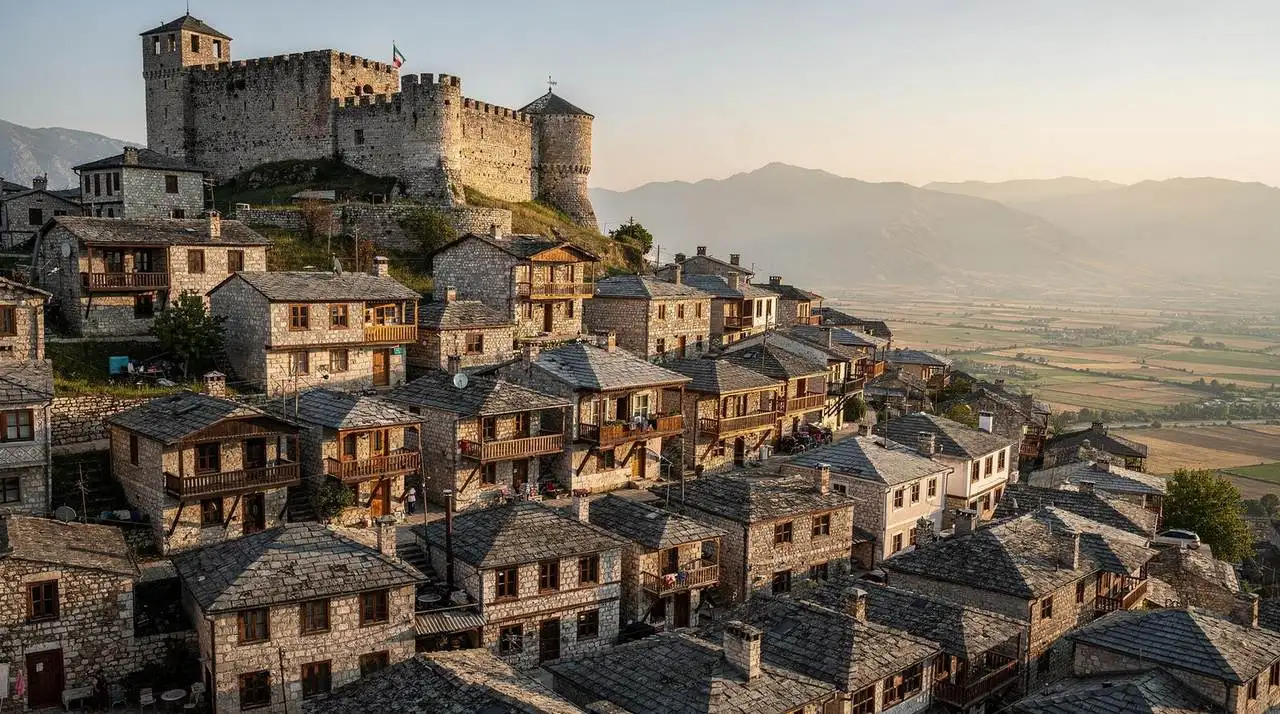
The plan had been to drive straight through from Saranda toward Berat, making the most of a clear day. But somewhere on the road north, with the city visible on its hillside from the valley below — the castle perched above, the stone rooftops cascading down the slope, the whole thing looking like a place that belongs to an older world entirely — we made a silent, simultaneous decision. We pulled over. We turned around.
We stayed for two days. We should have stayed longer.
| Where | Southern Albania, ~230km / 3.5hrs from Tirana by bus |
| Stay | 2 nights minimum — do not day-trip it |
| Cost | Guesthouses from around €25-45/night; dinner for two around €15-25 |
| Getting there | Bus from Tirana, Saranda, or Permet; combine with the southern circuit |
| Best time | Spring or autumn; the folk festival (every 5 years) is a special-case draw |
The City on the Hillside
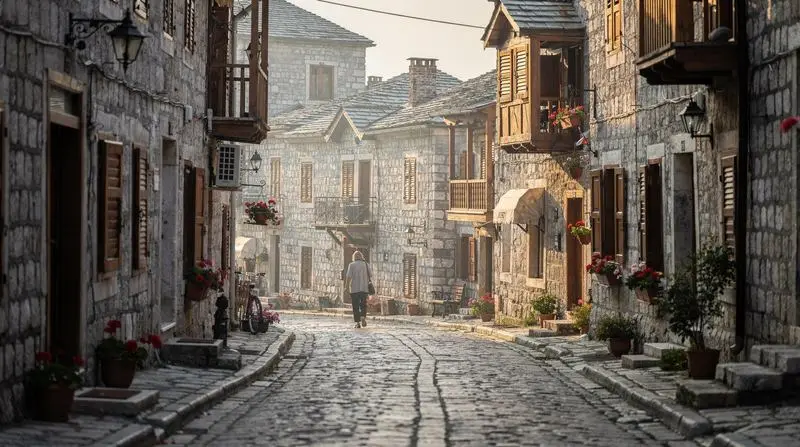
Gjirokastra is built on a steep slope above the Drino River valley, and its architectural character is inseparable from that steepness. The old city is a UNESCO World Heritage Site and one of the best-preserved Ottoman townscapes in the Balkans — grey stone houses with distinctive slate roofs, high towers, and fortified facades that reflect the city’s history as a frontier settlement between the Ottoman and Greek spheres.
The stone is the first thing you notice and it never stops defining the experience. These are not the white-washed houses of Berat or the wooden Ottoman structures of Sarajevo — Gjirokastra is built from the grey limestone of the surrounding mountains, dense and heavy, the walls thick enough to keep out a siege. The streets between the houses are also stone-paved, irregular and uneven, laid without mortar in some sections so that the gaps between the stones grow small plants in the summer.
Walking these streets at any hour is a particular experience. The buildings lean slightly toward each other above you. The towers — kulla, fortified upper rooms that served as refuges during blood feuds under the Kanun code — rise at odd angles. The city creates the sensation of being inside something that has closed around you, which is not claustrophobic but rather enveloping, like being inside a very old story.
Getting to Gjirokastra
Gjirokastra sits approximately 230 kilometres south of Tirana, reachable by bus in around three and a half hours or by car in roughly the same time via the national highway through Fier and Tepelena. The drive via the valley road from Saranda is slower but extraordinarily scenic — the Drino valley approach to the city from the south gives you the classic first view of the castle on the ridge.
From Permet, Gjirokastra is about an hour north by road — making a Permet-Gjirokastra combination one of the most rewarding two-stop southern Albania itineraries. Our 7-day south itinerary structures this approach and also includes Berat in the circuit, giving you all three of Albania’s great historic interior cities in a logical route. The how to get to Albania guide covers transport options for the full route.
The Castle
The Gjirokastra Castle is massive and visible from almost everywhere in the valley below. It has been occupied since at least the twelfth century and expanded through multiple periods of Byzantine, Ottoman, and Albanian control. Inside the walls, the scale surprises you: the castle is large enough to contain a full military museum, multiple towers, cisterns, an outdoor theater used for a music festival each summer, and — in the inner courtyard — a captured American military aircraft from the Cold War era, kept here as a monument to Albanian sovereignty under the Hoxha regime.
The story of the aircraft is quintessentially Albanian: a US reconnaissance plane that made an emergency landing in Yugoslavia in 1957 was acquired by Albania from the Soviets and displayed here as proof of American aggression. The Cold War geopolitics that produced this situation are complicated and strange, but the plane itself, sitting incongruously in a medieval fortress courtyard with Albanian mountains all around it, is one of those images that stays with you.
We joined a guided tour of Gjirokastra for our first afternoon, which we strongly recommend. The history of the city is layered and specific, and having a guide who could explain the significance of individual buildings, the social structures that produced the kulla towers, and the city’s role in Albanian political history made the visual experience considerably richer. We spent the rest of the second day wandering on our own, now with enough context to see what we were looking at.
The Skenduli House
Among the old houses that have been preserved as museums, the Skenduli House stands out. It is a traditional Gjirokastra mansion from the eighteenth century, fully furnished and maintained by the family who still owns and lives in part of it. The size is immediately striking — these are not the modest homes of a working population but the residences of a wealthy trading class, with large reception rooms, separate quarters for men and women, a hammam, storage areas, and the kind of detailed woodwork in ceilings and panels that represents months of skilled craftsmanship.
Our host walked us through the house explaining how different spaces were used at different times of year and by different members of the household. The design is sophisticated and the cultural logic embedded in the architecture — the way sight lines were managed so that guests could not see into women’s spaces, the positioning of rooms to capture winter sun, the ventilation systems built into the walls — is fascinating once you understand what to look for.
This is also a family that is genuinely invested in explaining their house to visitors. They are not museum docents — they are custodians of a living heritage, and that comes across in every explanation. Book through your accommodation or the local tourist office to ensure the house is open and staffed when you arrive.
Ismail Kadare’s City
Gjirokastra is the birthplace of Ismail Kadare, Albania’s greatest novelist and the country’s only serious contender for the Nobel Prize in Literature (shortlisted multiple times, never awarded, a fact that generates genuine irritation in Albanian literary circles). His novel Chronicle in Stone, set in Gjirokastra during World War Two, is essentially a love letter to the city written from the perspective of a child narrator. We read it before visiting and found that it gave the physical place a dreamlike quality — we kept recognizing descriptions in stone, kept feeling the overlap between the book’s version and the real one.
If you read Albanian fiction (or have access to a translation, which Chronicle in Stone has), it makes an exceptional pre-trip read for Gjirokastra. Kadare’s prose is dense with the particular sensory world of the city — the smell of stone after rain, the sound of the muezzin echoing through the valleys, the weight of the castle above the neighborhood — and experiencing the city after having read the book is one of those rare instances of literature and place reinforcing each other completely.
Gjirokastra in the Context of Albania’s Other Cities
Having now visited Gjirokastra, Berat, Permet, and Tirana, we can say that each Albanian city has a completely distinct character and that all of them are essential to understanding the country.
Tirana gives you the country’s contemporary energy — the painted apartment blocks, the Blloku social scene, the extraordinary museums documenting communism’s recent and painful history. A communist Albania tour with BunkArt museum visit in Tirana is the most efficient way to understand what the country came from, which makes Gjirokastra’s history make much more sense when you visit it afterward.
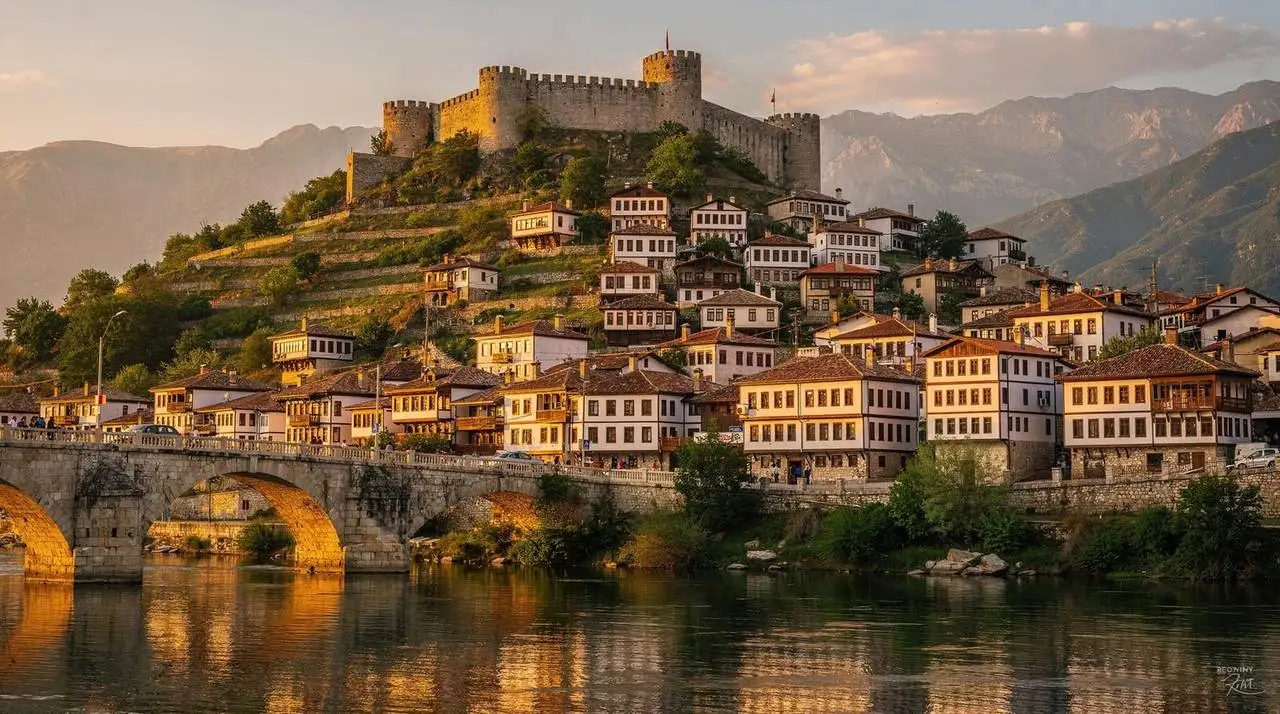
Berat gives you the Ottoman warmth — white houses, river reflections, a castle with a living community inside. Berat is beautiful in a way that is immediately accessible, immediately legible.
Gjirokastra gives you something harder and older. The grey stone, the towers built for blood feuds, the castle that has survived siege and occupation and dictatorship — this is a city that does not give itself away easily. You have to spend time with it. You have to walk the same streets twice to start understanding the grammar of the place.
The combination of all three, connected by the southern route through the Drino and Vjosa valleys, is the best interior Albania experience available. Our 14-day Albania itinerary combines all three cities with the coast and the northern mountains.
The Food in Gjirokastra
The restaurants in the old city tend to cluster around the bazaar area, which was restored a few years ago and now offers a pleasant concentration of cafes and simple restaurants in historic buildings. The food is traditional southern Albanian: lamb, goat, thick beans, local cheeses, and the inevitable byrek.
We had dinner one evening at a restaurant set into one of the old stone buildings, with a terrace looking across the valley toward the mountains. A lamb stew that had clearly been cooking for several hours. Bread baked in the wood oven. A carafe of local wine. The light failing over the valley while we ate, the city going quiet around us. This is the kind of dinner that an atmosphere makes: the food was excellent, but the setting was the meal.
For the full picture of what Albanian cuisine offers across the south, the Albanian food guide covers regional variations including the specific dishes you are most likely to find in Gjirokastra and the surrounding area.
Where to Stay and Eat
We would book the same way again: a guesthouse inside a restored kulla or Ottoman mansion in the old town itself, not down in the newer part of the city. Our where to stay in Gjirokastra guide covers the options across budgets, and the best restaurants in Gjirokastra guide will get you to the bazaar terraces faster than we found them on our own.
A Note on the Bazaar Restoration
The restored bazaar deserves a bit more explanation than we gave it above, because it is a genuinely interesting case study in how Gjirokastra has balanced preservation with practical tourism needs. The renovation project, completed a few years before our visit, deliberately kept the working shops and cafes rather than converting the whole area into a museum piece, which is part of why it still feels inhabited rather than staged. Local craftsmen who work in copper, wood, and textile still operate from a handful of the restored units, continuing trades that predate the tourism economy by generations. Watching a coppersmith at work in a shop that has likely done the same trade for a century is one of those small, unbilled Gjirokastra experiences that ends up being a highlight.
Combining Gjirokastra with the Wider South
Gjirokastra sits naturally on a southern Albania route that also takes in the castles of the region — our castles in Albania guide has Gjirokastra’s fortress in context alongside Berat’s and a handful of others worth the detour. If communist history interests you as much as it did us in Tirana, the communist history of Albania guide explains how a frontier trading city like Gjirokastra fit into the Hoxha era, including why Hoxha himself, born here, complicated the city’s later relationship with his legacy. For the practical side of stitching Gjirokastra into a longer trip, our day trips from Saranda guide is useful if you are based on the coast and only have a day to spare, though we would still argue for the overnight.
Practical Notes for Visiting Gjirokastra
Getting around: The old town is steep and stone-paved. Comfortable shoes that grip well are essential — the streets can be slippery when wet. Allow more time than you think for uphill sections.
Accommodation: The best guesthouses are in the old town itself, occupying restored kulla-style houses or Ottoman mansions. Book at least a month ahead for summer visits, two to three months for Easter week or the folk festival period.
The folk festival: Gjirokastra hosts a national folk festival every five years, drawing musicians from across Albania and the diaspora. When the timing aligns with your visit, it is extraordinary — the castle courtyard becomes a performance space and the city fills with music in a way that amplifies its already theatrical character.
Day trip vs stay: We cannot recommend day-tripping Gjirokastra from Saranda or even from Berat. The city reveals itself over time. Two nights is the minimum. Three is better.
What Gjirokastra Does to You
Every city has a dominant quality — something it communicates through its stones and streets and the weight of its history that accumulates over the time you spend there. Berat communicates warmth, its white houses and riverside setting creating an Ottoman paradise of sorts. Tirana communicates energy and transformation. Gjirokastra communicates something older and more resistant: a city that has seen occupation and siege and war and survived by being built from the same material as the mountain it sits on.
Walking out of the castle at dusk, the valley spread below and the city descending in layers of grey stone, we felt that particular gravity that some very old places exert. Not heaviness, exactly, but weight — the accumulated presence of everyone who has lived here and built here and defended these walls for nine centuries.
We have not stopped thinking about Gjirokastra since.
Include it in your Albania itinerary. Do not make it a day trip. Stay at least two nights and let the city get under your skin. It will.