Vjosa Wild River National Park: Europe’s Last Wild River
On 14 March 2023, Albania declared the Vjosa River and its entire watershed a national park — making it the first Wild River National Park in Europe and placing Albania at the centre of an international conservation story that has drawn attention from environmentalists, adventurers, and travellers worldwide. The Vjosa flows 272 kilometres from its source in the Pindus mountains of northern Greece through southern Albania to the Adriatic Sea at Narta Lagoon near Vlora, completely unimpeded by dams, weirs, or significant infrastructure along its entire length.
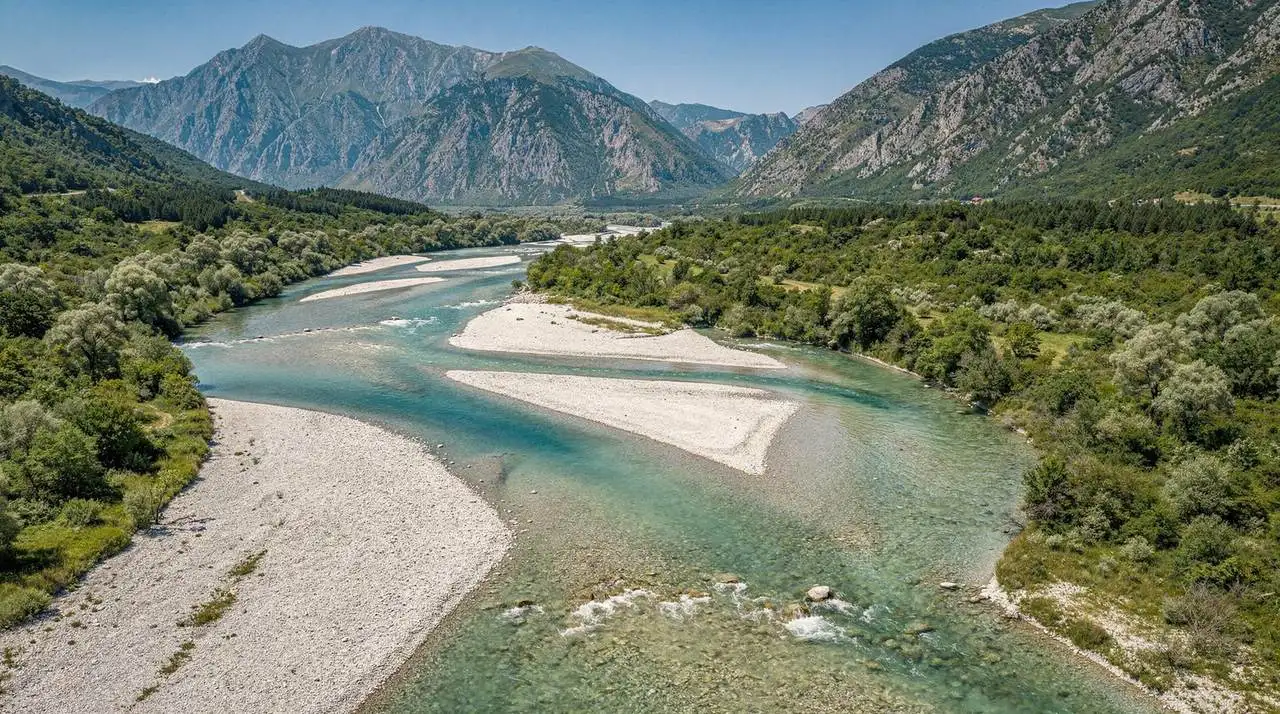
In an era when almost every major European river has been dammed, diverted, regulated, or otherwise engineered out of its natural state, the Vjosa’s survival as a genuinely wild river is extraordinary. The designation as a national park — championed by a coalition of Albanian conservationists, international environmental organisations, and celebrity advocates including the late Patagonia founder Yvon Chouinard — protects not just the river channel but the entire dynamic riverine system: the braided channels that shift with floods, the gravel bars where birds nest, the riverside forest that filters water and shades the banks, and the extraordinary mosaic of habitats that a free-flowing river creates.
For travellers, this means something concrete: the Vjosa offers experiences that European rivers once provided and no longer can. Wild camping on gravel bars under a sky undimmed by nearby urban light pollution. Rafting through canyon sections where the rock walls are sheer and the river has its own way. Swimming in water that is genuinely clear, genuinely cold, and genuinely alive with the aquatic biodiversity that only an unimpaired river ecosystem sustains.
| Where | Vjosa valley, southern Albania, base in Permet |
| Cost | Around EUR 25-50/day; rafting tours around EUR 30-50 |
| Time needed | 1-3 days |
| Getting there | 1.5-2 hrs from Gjirokastra, 4-5 hrs from Tirana |
| Best time | April-June (rapids), July-September (swimming/warmth) |
Rafting the Vjosa
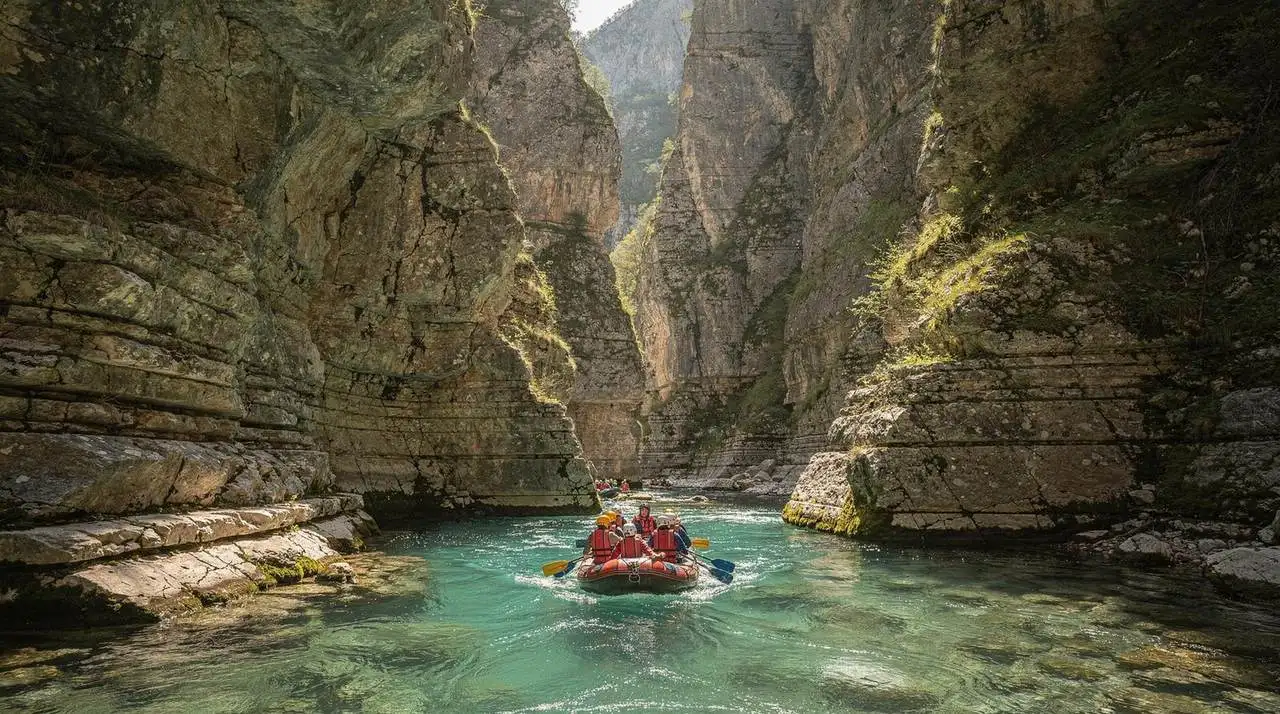
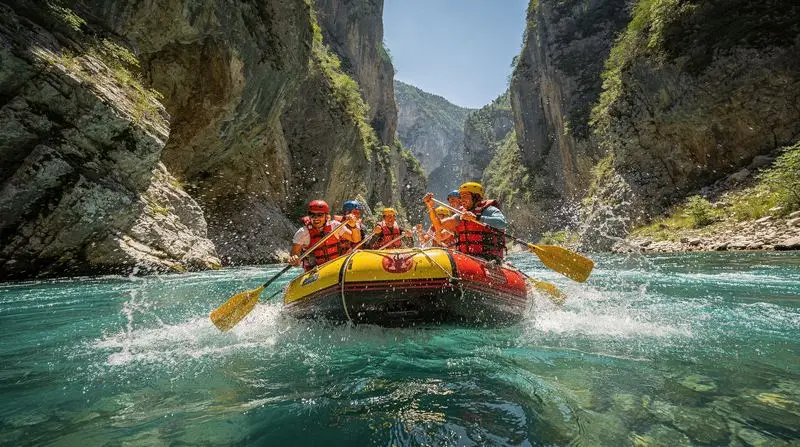
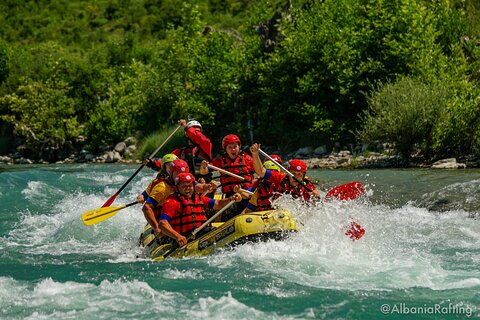
Rafting on the Vjosa is the headline adventure activity and the reason most international adventure travellers come to the river. The Vjosa through the Permet section offers whitewater of varying grades, set within canyon scenery of genuine drama. The river drops through a series of rapids, pools, and canyon narrows that create a multi-hour rafting experience unlike anything else in Albania.
The rafting season runs from April through October, with the highest water — and therefore the most dramatic rapids — from April through June, when snowmelt from the upstream mountains feeds the system. By August the water level drops and the character changes: still beautiful, still excellent for floating and swimming, but with less whitewater intensity. October gives excellent colour in the riverside vegetation and very few other rafters.
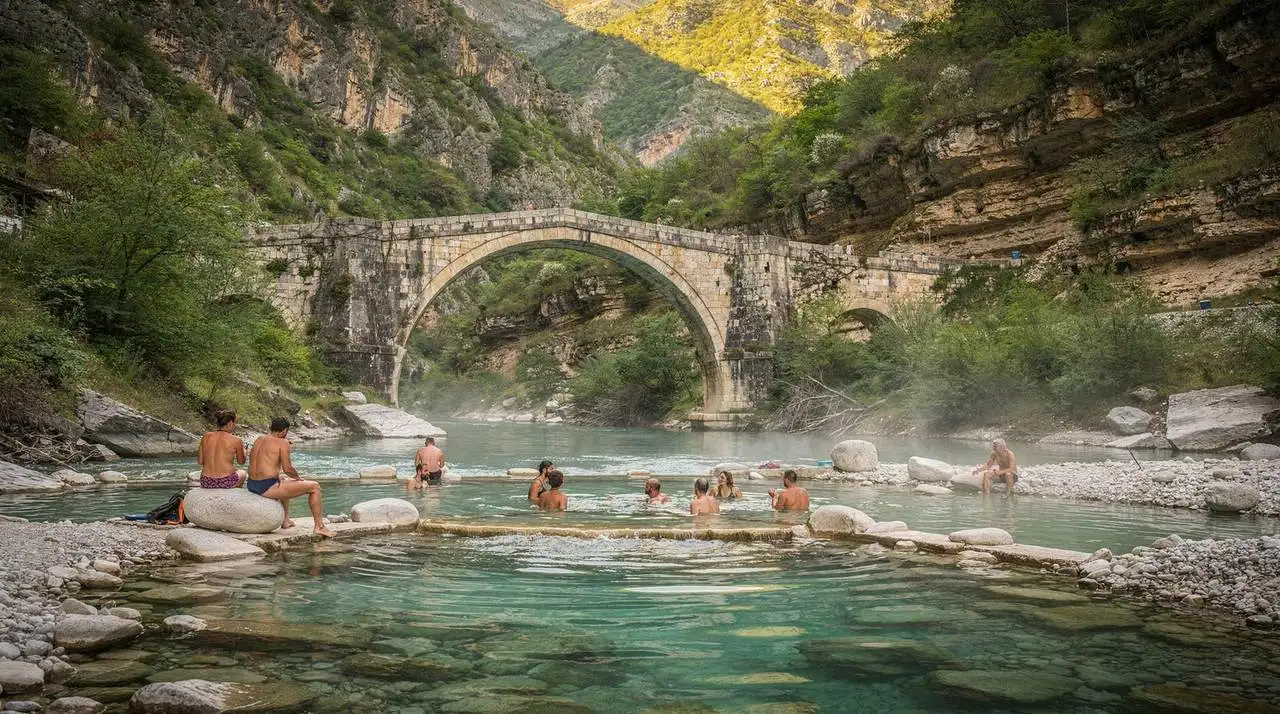
For an excellent rafting experience on the Vjosa near Permet: this rafting experience at Vjosa River in Permet covers the key rapid section with experienced guides and all equipment provided. For a combined rafting and thermal baths day: this Vjosa rafting and Benja thermal baths tour pairs the whitewater with a relaxing soak at the famous Benja springs, making it one of the best single-day adventure and wellness combinations in southern Albania.
Both options provide all safety equipment, helmets, and wetsuit if needed. No rafting experience is required for the standard Vjosa tours, which are designed to be accessible to fit beginners while delivering genuine excitement.
Our Albania rafting guide covers the Vjosa in detail alongside the Osum and other Albanian rivers, comparing the different rafting experiences and explaining what to expect from each.
Wild Camping on the Vjosa
The Vjosa’s gravel bars — the wide, flat expanses of rounded river stone that form on the inside bends of the braided channel — are among the most extraordinary wild camping places in Europe. Setting up a tent on a Vjosa gravel bar means sleeping metres from the river, with the sound of the current as a constant companion, no other campers visible, and the stars overhead undimmed by urban light.
This kind of wild camping is legal within the national park under responsible camping principles — the leave no trace ethic applies absolutely, and campers are expected to take all waste out with them. The park designation supports rather than restricts wild camping, because the Vjosa National Park’s founding philosophy is that the river should be experienced as a wild place, not managed into domesticated nature tourism.
Multi-day Vjosa float trips — paddling and camping over two to four days from upstream put-in points to the mouth near Vlora — are possible for experienced paddlers and represent one of Albania’s finest adventure travel experiences. Local operators in Permet can arrange multi-day river trips with camping equipment and food supplies for groups.
The Vjosa Ecosystem
The declaration of Vjosa as a national park rests on the ecological value of a genuinely unimpaired river system — and understanding what that means helps explain why the park designation matters beyond the adventure tourism opportunity.
The Vjosa supports populations of freshwater fish species that require unimpaired river channels for spawning migration, including the huchen (Hucho hucho) — Europe’s largest river trout, now rare throughout its range — and multiple species of river trout. The dynamic river morphology — channels shifting with floods, gravel bars forming and reforming — creates the habitat diversity that supports these species. A dammed or regulated river cannot sustain them.
The riverside forests (riparian woodland of willow, alder, and poplar) filter water, stabilise banks, and provide nesting habitat for kingfishers, sand martins, and the little ringed plover that nests on gravel bars. The open gravel bars themselves support specialist invertebrate communities. The whole system functions as an integrated ecological unit in a way that dam-fragmented rivers cannot.
For visitors with an interest in conservation biology, the Vjosa offers a rare opportunity to see a functioning large-river ecosystem and to understand, by contrast, what has been lost on almost every other European river.
Hiking Along the Vjosa
The national park boundary extends far beyond the river channel itself, incorporating the surrounding mountain slopes and subsidiary valleys. Hiking trails follow the Vjosa valley and climb into the surrounding hills, offering routes at various difficulty levels with consistently excellent scenery.
The valley section between Permet and the upstream villages is particularly beautiful in spring and autumn, when the riverside trees are at their most colourful and the light in the mountains has the quality specific to these seasons at this latitude. Day hikes from Permet of 3-6 hours can be self-guided with basic navigation skills; longer routes into the mountain interior require local guide knowledge.
The village of Benje, upstream from Permet, is the base for the famous Benja thermal baths and the starting point for several hiking routes into the Langarica canyon — a tributary gorge of the Vjosa with dramatic limestone walls and the Ottoman-era Kati Bridge. This combination of thermal bathing, canyon walking, and Vjosa valley scenery makes the Permet area one of the finest outdoor activity bases in southern Albania.
Permit and the Southern Circuit
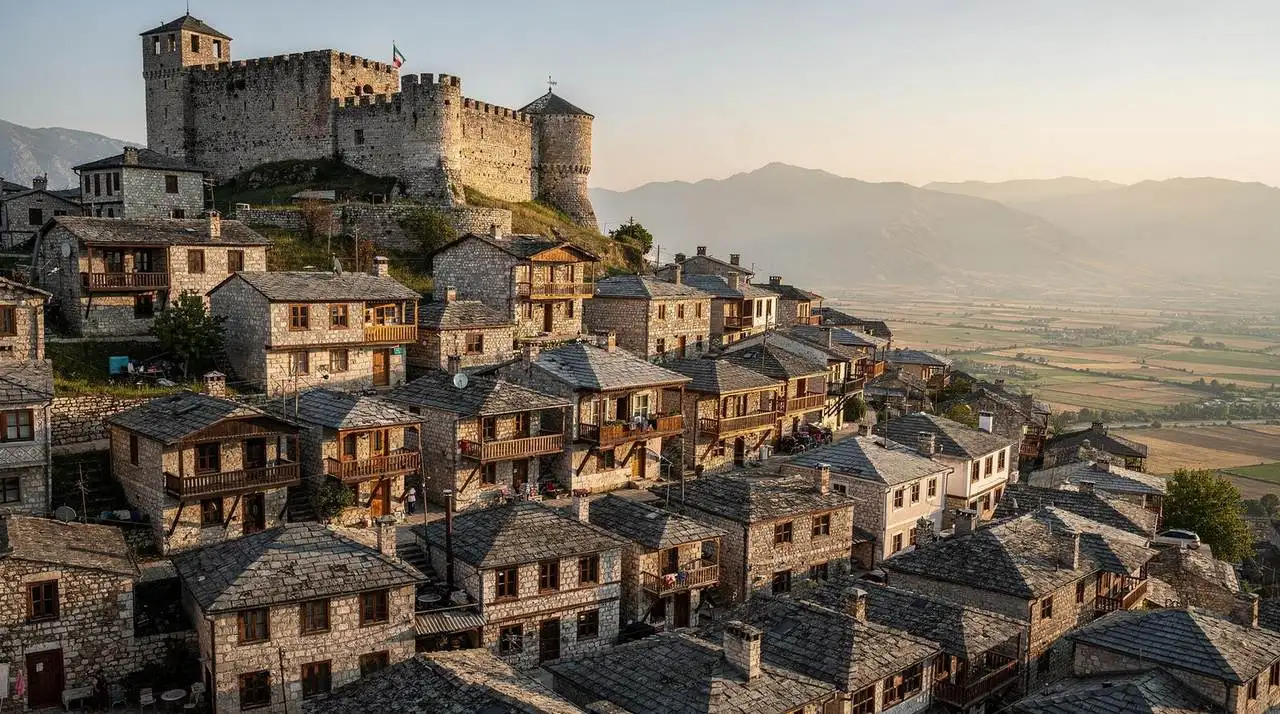
Permet is the practical base for Vjosa National Park visits. The town sits in the Vjosa valley at an altitude of around 340 metres, provides all necessary accommodation, food, and activity operator services, and has been developing its identity as an adventure and nature tourism hub since the national park designation.
The broader southern Albania circuit that includes the Vjosa typically combines: Tirana arrival, Gjirokastra (UNESCO city), Permet (Vjosa rafting, Benja thermal baths), and return to Tirana via Elbasan or via the southern coastal route through Himara and Vlora. This circuit, covered in detail in the 14-day Albania itinerary, gives a comprehensive picture of southern Albania that the Riviera-focused itinerary misses entirely.
Conservation and Responsible Tourism
The Vjosa National Park designation has focused international attention on Albania’s environmental policies and created both an opportunity and a responsibility. The river’s wild character — its most valuable attribute — is also what is most easily degraded by inappropriate tourism development.
Visitors to the Vjosa are asked to observe basic principles: no waste left at the river (gravel bar camping generates particular amounts of rubbish that must be carried out), no motorised craft on the river beyond the regulated tour sector, respect for the gravel bar nesting birds during spring season, and adherence to the leave-no-trace camping ethic. The national park authority and the local operators who work on the river are the most informed sources on current regulations.
The Albania off the beaten path guide includes the Vjosa in its discussion of destinations that offer not just unusual experiences but also genuine ecological significance for travellers interested in the intersection of adventure and conservation.
Getting to the Vjosa National Park
The national park extends along the Vjosa from its Albanian entry near Kelcyre upstream to the Greek border. The main visitor access point is Permet, approximately 190 kilometres from Tirana by road.
- From Tirana: Drive south via Gjirokastra (approximately 5-6 hours) or via Elbasan and the interior (approximately 4-5 hours). Buses run from Tirana to Permet, though the journey takes around 5 hours.
- From Gjirokastra: Permet is 90 kilometres northeast — a 1.5-2 hour drive through the valley. This is the most convenient approach for travellers coming from the south.
- From the Osum Canyon: Corovode, the gateway to Osum Canyon, is approximately 80 kilometres northeast of Permet. Combining the two canyons in a circuit is a popular outdoor itinerary.
Vjosa Season at a Glance
| Period | Water level | Best for |
|---|---|---|
| April-June | High, snowmelt-fed | Most dramatic rafting/rapids |
| July-August | Warm, moderate flow | Swimming, wild camping, comfortable float trips |
| September-October | Lower, calmer | Solitude, autumn colour, fewer rafters |
| November-March | Variable, cold | Not recommended — most operators closed |
Where to Stay Near the Vjosa
There is no accommodation directly on the river within the national park itself — Permet is the practical base for any Vjosa visit, with the full range of guesthouses, small hotels, and restaurants needed to support a rafting or camping trip. Budget guesthouses in Permet run roughly EUR 20-35 per night; a handful of more comfortable small hotels are available for those who want it after a night on a gravel bar. For those planning to combine the Vjosa with the Osum Canyon further north, basing in Corovode is the equivalent option on that side of the circuit.
Practical Information
Best base: Permet town — full range of accommodation, restaurants, and activity operators.
Rafting season: April through October. Peak water level April-June. Best weather July-September. Best solitude September-October.
Wild camping: Permitted on gravel bars under leave-no-trace principles. All waste must be removed. Spring camping near gravel bars should avoid areas with visible bird nesting activity.
What to pack: River sandals or water shoes for rafting and gravel bar walking. Sunscreen (river reflections amplify UV). Dry bags for electronics and valuables. Insect repellent for riverside camping evenings.
Swimming: The Vjosa is excellent for swimming in the deeper pools between rapids. Water is cold even in summer (13-16°C) due to the mountain source. Wet shoes are helpful on the algae-covered stones.
The Vjosa’s International Conservation Significance
The designation of the Vjosa as Europe’s first Wild River National Park in March 2023 attracted international attention that went well beyond typical national park announcements. The reason: the Vjosa’s survival as an undammed, unregulated river system is genuinely anomalous in Europe, and the park designation represents a model that conservation advocates hope other European countries will follow.
The campaign to protect the Vjosa from dam construction spanned more than a decade, with multiple dam projects proposed by successive Albanian governments and opposed by a coalition of environmental organisations, local communities, and international advocates. The key argument — that the economic value of the river as a free-flowing ecosystem, including its fisheries, water quality, flood regulation, and increasingly its tourism value — exceeded the value of the hydroelectric generation the dams would produce, was eventually accepted. The park designation makes future dam construction legally impossible.
The international dimension of the campaign brought significant media coverage to both the Vjosa specifically and to Albanian natural heritage more broadly. The late Yvon Chouinard, founder of Patagonia and one of the 20th century’s most influential environmental advocates, visited the Vjosa and was vocal in his support for its protection. The dam fights that preceded the park designation are documented in international conservation media and give the park a campaigning history that adds a dimension to visits beyond the immediate adventure tourism appeal.
Birdwatching on the Vjosa
The riparian (riverside) habitats of the Vjosa support excellent birdwatching that is rarely discussed in the context of the river’s adventure tourism reputation. The combination of gravel bars, riverside forest, and the open river channel creates a mosaic of bird habitats.
Gravel bar species: The little ringed plover (Charadrius dubius) and common sandpiper (Actitis hypoleucos) nest on the gravel bars. The rare and declining wryneck (Jynx torquilla) uses the scrubby edges. Sand martins (Riparia riparia) colonise sandy banks.
Riverside forest species: Kingfisher (Alcedo atthis) — one of the most visible and rewarding birds on any Albanian river — is present throughout the Vjosa, diving from overhanging branches. The white-throated dipper (Cinclus cinclus) appears at the faster sections. The river warbler (Locustella fluviatilis) and various other Locustella species are present in the denser vegetation.
Raptors: Osprey (Pandion haliaetus) fish the Vjosa during migration. Hobby (Falco subbuteo) hunts above the river. Booted eagle (Hieraaetus pennatus) and short-toed snake eagle (Circaetus gallicus) use the wider valley.
Multi-day float trips on the Vjosa, covering the calm sections between rapids, are the best approach for river birdwatching — the slow drift allows observation that active rafting cannot.
The Vjosa in Albanian Culture
The Vjosa River runs through the cultural landscape of southern Albania as much as through its physical one. The river appears in Albanian folk song, in the literary works of southern Albanian writers, and in the daily life of the communities along its banks who have fished, farmed its floodplain, and used its water for irrigation and domestic purposes across centuries.
In Permet, the market stalls sell fresh trout from the river’s tributary streams and the vegetable gardens that line the lower Vjosa floodplain. In the downstream communities near the coast, the river defines the agricultural calendar in a way that any irrigation-dependent farming system requires. The river’s seasonal floods — previously managed by drainage and embankments in many sections — are part of the natural cycle that the national park designation now protects.
The park designation, welcomed by the national and international conservation community, has a more mixed reception in some local communities where the restrictions on water extraction, fishing, and floodplain agriculture represent genuine economic constraints. Understanding both perspectives — the conservation value and the local economic reality — gives a more complete picture of the park than simple celebration provides.
Frequently Asked Questions About Vjosa National Park
Why is the Vjosa River called the last wild river in Europe?
The Vjosa flows 272 kilometres from its source in Greece to the Adriatic without a single dam, weir, or significant engineered obstruction along its entire course. Almost every other major European river has been dammed at multiple points for hydroelectric power, irrigation, or flood control. The Vjosa’s undammed status means it retains the free-flowing character, dynamic sediment transport, braided channel morphology, and ecological integrity that European rivers once universally had and have now almost universally lost.
What grade is the rafting on the Vjosa?
The Vjosa near Permet offers Grade 2-3 whitewater during typical season conditions — genuinely exciting for beginners and enjoyable for experienced paddlers, but not technical class 4-5 extreme water. The grade varies with water level: April-June high water produces the most demanding conditions; late summer lower water makes the trip more of a scenic float with occasional rapids. The standard tour operators specify the grade conditions and are experienced in matching groups to appropriate sections.
Can you camp wild on the Vjosa River?
Yes — wild camping on the Vjosa’s gravel bars is permitted and represents one of the best wild camping experiences in Europe. The national park designation supports responsible wild camping as part of the park’s philosophy of experiencing the river as a wild place. Leave-no-trace principles apply absolutely: all waste must be carried out, campfires should be managed carefully, and gravel bar nesting birds should not be disturbed during spring season.
Is the Vjosa National Park the same as the Permet area?
Permit is the main town near the most-visited section of the national park, and most activity operators (rafting, hiking, thermal baths) are based there. The national park itself extends far beyond the immediate Permet area, covering the entire Vjosa watershed in Albania. Other access points include the lower Vjosa valley near Tepelena and the river mouth near Vlora, but Permet is the hub for adventure tourism and the destination for most visitors.
What other activities are available besides rafting on the Vjosa?
The Vjosa National Park area near Permet offers: hiking in the Langarica canyon and surrounding mountains, swimming in the river pools, wild camping on gravel bars, multi-day float trips for experienced paddlers, kayaking, cycling along the valley road, birdwatching (the river corridor is excellent for riparian species), and the Benja thermal baths — a separate natural attraction within easy reach. The combination of adventure and relaxation activities within a single day’s radius of Permet makes it one of Albania’s most versatile outdoor destinations.