Llogara National Park: The Gateway Between Two Worlds
There is a moment, driving south from Vlora along the switchback road that climbs through Llogara National Park, when everything changes. You have been in the heat of the coastal plain, passing petrol stations and roadside restaurants, and then the road begins to climb into pine forest, the air cools, mist sometimes drifts between the trees, and the Adriatic disappears behind the ridge. At the summit of the Llogara Pass, at 1,027 metres above sea level, you step out of the car and find yourself standing on the spine of the Ceraunian Mountains with the Ionian Sea spread out below you like a promise.
This is one of the defining geographic and experiential moments of any Albanian trip. Below that ridgeline, the Albanian Riviera begins — Dhermi, Palasa, Himara, Borsh, Qeparo, stretching south towards Saranda. The descent from Llogara into the Riviera is one of the most dramatic drives in the Mediterranean.
But Llogara is not merely a pass. The national park that surrounds it covers 1,010 hectares of mountain terrain, and it deserves more than a stop for photos and coffee before you continue south. For hikers, paragliders, and anyone who loves high-altitude forest landscapes, Llogara is a destination in its own right. It sits naturally in any Albanian Riviera itinerary and provides a complete contrast to the beach scene below. The 14-day Albania itinerary includes a Llogara stop as the gateway moment between the central Albanian interior and the Riviera coast.
| Where | 35km south of Vlora, summit 1,027m |
| Cost | Free park access; tandem paragliding around EUR 50-80 |
| Time needed | 2-3 hours minimum, half day to see more |
| Getting there | Car, furgon (Vlora-Saranda routes stop on request) |
| Best time | May-October; June and September for fewer crowds |
The National Park: Geography and Nature
Llogara National Park was established in 1966, making it one of Albania’s oldest protected areas. It encompasses the upper slopes and summit zone of the Ceraunian Mountains — a range of limestone peaks that runs parallel to the coast, separating the Adriatic/Ionian sea from the interior valleys of southern Albania.
The park is dominated by black pine forest, with some areas of mixed Mediterranean scrub on the lower southern slopes. The trees are old and tall, and the forest has an almost Nordic quality at certain times of year — cool, shaded, quiet, with the sound of wind in the pines replacing the usual Mediterranean ambient noise. Wildlife includes golden eagles, peregrine falcons, wolves, and wild boar, though you are unlikely to encounter large mammals on a casual day visit. The birdwatching is genuinely good: the ridge acts as a migration corridor in spring and autumn, and the forest holds several species of owl.
The landscape is karst limestone, which means dramatic formations, steep gullies, and the occasional cave. Several springs feed small streams that disappear into the porous rock. In spring, the wildflower display on the open grasslands near the pass is exceptional — the combination of Mediterranean plants at their seasonal peak and the cooler mountain air creates a flora unusually rich for such a compact area.
The contrast between the north and south faces of the mountain is striking. The north-facing slopes above Vlora are cooler and more densely forested; the south-facing slopes above the Riviera are more exposed, with a distinctly Mediterranean scrub character. Standing at the pass, you can observe both climatic zones simultaneously — one of the more unusual ecological experiences available on a mountain road in Europe.
Things to Do at Llogara
Hiking at Llogara
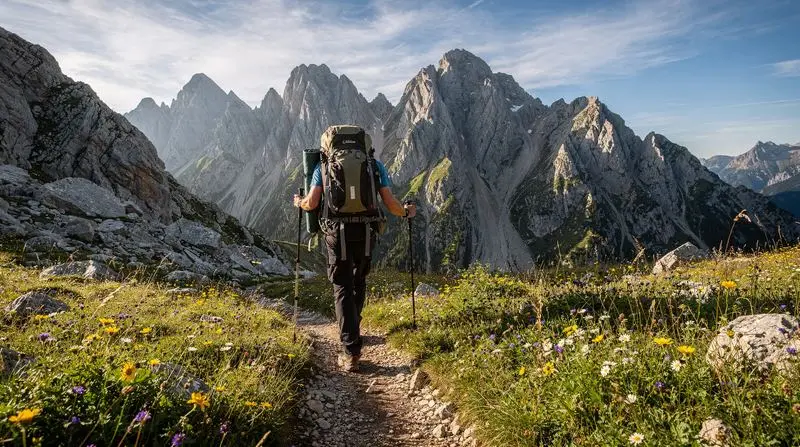
Llogara is arguably the best hiking terrain in southern Albania, offering trails through dense forest, along rocky ridges, and to viewpoints that render the Ionian coast in full panoramic glory.
Maja e Çikes (2,044m): The signature hike at Llogara is the ascent to the highest point in the national park. This is a serious mountain walk, taking 4-6 hours round trip from the pass, with significant elevation gain. The route follows the ridge south from the Llogara pass, climbing through pine forest before breaking into open alpine terrain. The views from the summit extend along the entire Albanian Riviera, across to the Greek island of Corfu, and back over the coastal plain to Vlora Bay on clear days. This hike requires good boots, adequate water, and mountain awareness. Start early and watch the weather — the summit can cloud over quickly.
Forest trails near the pass: For less demanding walking, several marked trails loop through the pine forest around the pass. These are suitable for families and casual walkers, typically 1-3 hours, with good shade and cool temperatures even in summer. The trails pass through the oldest sections of black pine forest and include several lookout points above the coast. The forest floor in these areas is carpeted with pine needles and supports a range of woodland flowers in spring.
The descent path to Dhermi: A traditional path descends from the pass to Dhermi on the Riviera below — a route used for centuries by villagers moving between the coast and the mountain interior. The descent takes roughly 2-3 hours on foot and is steep in places. Few travellers walk it in its entirety, but it is a memorable alternative to the road for those who want to experience the mountain-to-coast transition on foot rather than by vehicle. You will need a car or taxi waiting at the bottom.
Our Albania hiking guide covers the Llogara routes in more detail, including the Maja e Cikes approach and conditions by season. The guide also covers the longer ridge walks that connect Llogara to the wider Ceraunian range.
Paragliding at Llogara
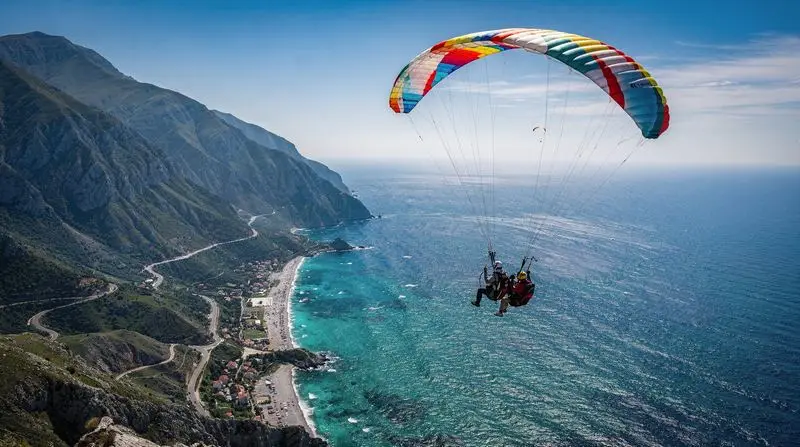
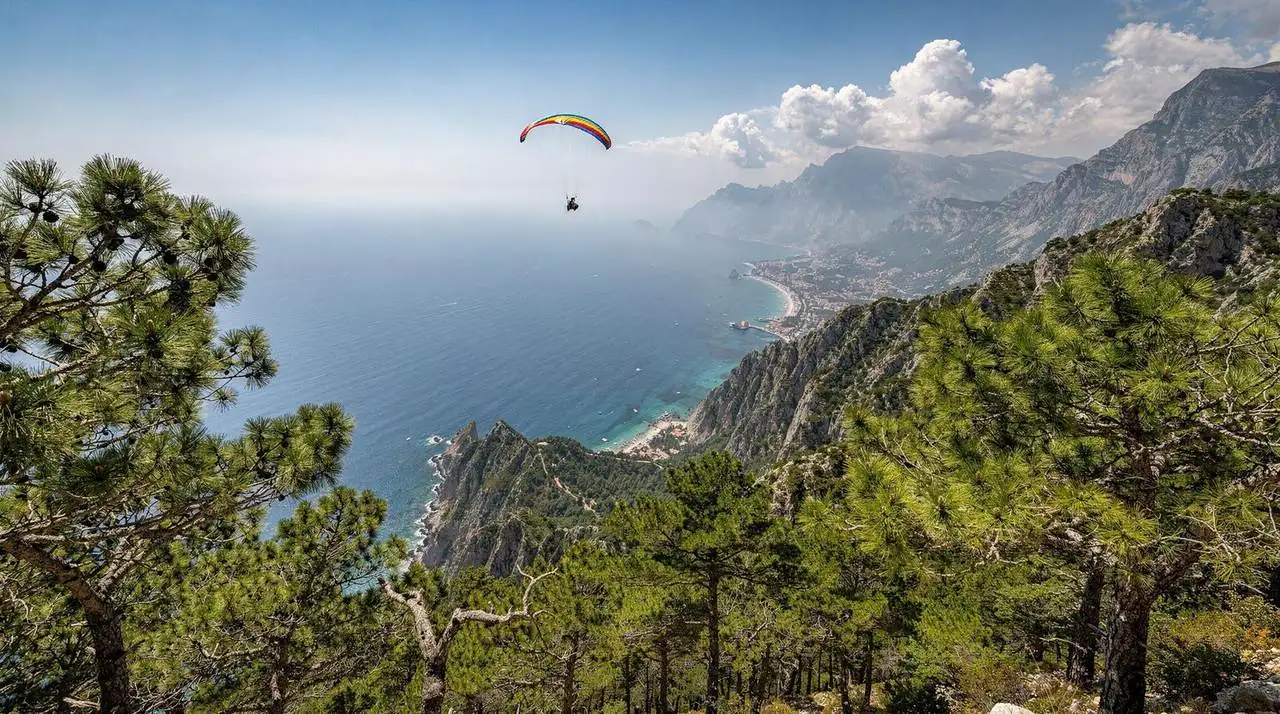
The Llogara Pass is Albania’s premier paragliding location. The combination of reliable thermal lift off the sun-baked south-facing slopes, reliable sea breezes from the Ionian, and a landing zone directly on Dhermi beach makes this one of the most spectacular paragliding sites in the entire Balkans.
Tandem flights from the launch site near the pass typically last 20-40 minutes and descend more than 900 metres from the mountain to the beach below. The view during the flight — looking down the Riviera coastline with the sea glittering to one side and the mountains rising on the other — is extraordinary by any standard. Pilots routinely describe this as one of the finest tandem flight sites they have encountered anywhere in Europe, combining technical flying interest with scenery that is simply incomparable.
This tandem paragliding flight from Llogara Pass is operated by experienced, licensed pilots with transport from Vlora available. It is one of the most memorable activities available anywhere in Albania — the combination of the mountain launch, the flight along the Riviera coastline, and the beach landing is unique. Flights are weather-dependent; the best conditions are in the morning before sea breezes strengthen.
Our dedicated Albania paragliding guide covers conditions, operators, what to expect on your first tandem flight, and the technical details of the Llogara site for solo pilots.
Wildlife and Birdwatching
The Llogara Pass sits on a significant bird migration route. In spring (March to May) and autumn (September to October), raptors, waders, and passerines move through in significant numbers. Resident species include golden eagle, peregrine falcon, and several species of owl in the forest. The high meadows support wheatears, larks, and various finches. The south-facing slope above the Riviera is particularly productive for raptor watching in autumn migration.
Wolves are present in the park and occasionally seen at dawn or dusk near the forest edge. Wild boar tracks are visible on muddy paths. Roe deer inhabit the forest edges. The large mammals are rarely seen but their presence is evident to those who pay attention.
Photography
The views from the pass in both directions are among the most photogenic in southern Albania. Looking south, the entire Riviera coast unfolds in a panorama from the cliffs above Dhermi to the distant headlands near Himara. Looking north, Vlora Bay with its distinctive profile and the flat Myzeqe plain beyond reward a telephoto lens. Early morning in clear weather produces the best conditions before haze builds over the coast. The mist that sometimes sits in the valleys on summer mornings, photographed from above, gives Llogara views a fairytale quality.
The forest itself is photogenic in all seasons: spring wildflowers, summer green, autumn gold, and (occasionally) winter snow. The gnarled old pines near the pass summit have a character worth photographing in their own right.
Camping and Stargazing at Llogara
For travellers with their own equipment, informal camping is common in the forested areas near the pass in summer, taking advantage of the cool nights and the absence of light pollution. This is not a formally serviced campground — bring everything you need, pack out all rubbish, and be respectful of the protected status of the park. The clear mountain air and minimal ambient light make Llogara one of the better stargazing spots accessible from the Riviera coast; on a clear moonless night the Milky Way is visible without any special equipment. Combine an evening at the pass restaurants with a short walk away from the road lighting for the best view of the sky.
Wild camping is technically permitted in Albania in most non-restricted natural areas, though visitors should check current park regulations before pitching a tent, as rules can tighten during high fire-risk periods in July and August. The wild camping in Albania guide covers the practicalities in more depth, including what gear suits the Albanian mountain climate.
Llogara vs the Coast Below: Choosing Your Time
| Consideration | Llogara Pass | Riviera beaches below |
|---|---|---|
| Temperature | 5-10°C cooler than the coast | Hot, often 30°C+ in summer |
| Crowds | Light except summer weekends | Heavy in July-August |
| Activities | Hiking, paragliding, forest walks | Swimming, beach clubs, boat tours |
| Best visited | Morning (clear views, cooler hiking) | Afternoon and evening |
| Accommodation | A handful of mountain guesthouses | Extensive along Dhermi and Himara |
Getting to Llogara
From Vlora. Llogara is 35 kilometres south of Vlora by road — about 45 minutes to an hour depending on traffic. The SH8 road from Vlora climbs steadily from the coast into the mountains, passing through a series of switchbacks as it approaches the pass. From Vlora, furgons heading to Himara and Saranda pass through Llogara and will drop you at the pass on request — confirm this with the driver before boarding. The journey costs around 200-300 ALL to the pass.
From Dhermi or Himara. Coming from the south, Dhermi is about 10 kilometres below the pass, and Himara is approximately 30 kilometres south. The climb from Dhermi to the pass takes around 20 minutes by car.
This guided day trip from Vlora covering Llogara National Park and Himara is an efficient way to experience both the mountain pass and the coastal town in a single well-organised day, including stops at the best viewpoints and the option for a paragliding flight. The guide provides geological and ecological context for the pass that makes the landscape more legible.
See our car rental in Albania guide for vehicle recommendations if driving independently. The Llogara road is fully paved but requires attention — it is steep and winding, with no barriers on exposed sections.
Where to Eat and Sleep at Llogara
The Pass Restaurants
At the summit of the Llogara Pass, a cluster of restaurants and guesthouses has grown up to serve travellers making the transit between Vlora and the Riviera. The setting is memorable — wooden terraces among the pines at nearly 1,000 metres, with views either north or south depending on which side you choose.
Restorant Gjiku (pass summit) — The best-regarded of the pass restaurants, serving grilled lamb, byrek, and Albanian mountain standards with excellent views. The slow-cooked lamb and cornbread are particularly good. The bread here is baked in a wood-fired oven using old varieties of wheat. Budget EUR 6-12 per person.
Bufe Llogara (pass area) — A simpler option for coffee, qofte (grilled minced meat balls), and cold drinks — the quick stop that most drivers make on the transit. Budget EUR 3-6 per person.
Stopping for a coffee and a meal while watching the mist move through the trees is one of those simple Albanian pleasures that stays with you. The mountain air and the pine forest setting make even basic food taste better. The early morning stop, when the first light comes through the pines and the coast below is still in shadow, is particularly atmospheric.
Staying at the Pass
A handful of guesthouses operate at or near the pass, offering simple rooms in a genuinely extraordinary setting. Sleeping at Llogara means waking in cool mountain air with the sound of wind in the pines rather than the tourist cacophony of the beach. If you want the hiking and the forest rather than the beach, staying at the pass makes practical sense.
Guesthouse Llogara (near pass summit) — The most established accommodation at the pass, offering simple rooms with basic facilities in the middle of the national park. Ideal for hikers planning early starts on the Maja e Cikes route. The guesthouse can arrange transfers to the paragliding launch and to the trailheads for longer walks. Budget EUR 20-35 per night.
Prices are low — significantly cheaper than beachfront accommodation on the Riviera below. Our Albania travel budget guide covers accommodation cost expectations at different levels and helps you plan the overall Riviera circuit budget.
What to Bring and When to Go
Season
May through October is the viable window, with June, July, and September being the best months. The pass can receive snow well into April, and the road occasionally closes in winter. Summer weekends see Albanian families picnicking at the pass in considerable numbers — if you want the mountain to yourself, weekday mornings are best.
What to Pack
Even in July, the pass can be significantly cooler than the coast below — sometimes 10 degrees cooler. Bring a layer regardless of the season. For hiking, proper footwear is essential — the rocky trails require ankle support on the longer routes. Sunscreen and water are critical for any time in the open, particularly at altitude where UV exposure is higher. For paragliding, wear comfortable athletic clothing and secure shoes. The pilots will brief you on exact requirements when you arrive.
Llogara as a Journey, Not Just a Stop
Most visitors experience Llogara as a point of transition — the moment the road climbs from the coast, crosses the ridge, and descends to the Riviera. That transition is genuinely one of the great driving moments in the Balkans, and it alone justifies the route.
But giving Llogara an extra half-day, or even a full day, transforms it from a scenic interlude into a destination with its own character. The forest is real, the hiking is serious, the paragliding is world-class, and the views from the ridge define the geography of southern Albania. Whether you are heading south to Dhermi, returning north to Vlora, or simply exploring the Albanian Riviera in depth, give Llogara the time it deserves. The Albania travel budget guide helps plan the costs for a Llogara stop within the broader Riviera itinerary.
Frequently Asked Questions About Llogara National Park
What is Llogara Pass famous for?
Llogara Pass (1,027 meters) is famous for the most dramatic section of the Albanian Riviera coastal drive — the point where the road climbs from the Vlora plain, crosses the ridge of the Ceraunian Mountains through dense pine forest, and descends to reveal the entire Albanian Riviera spread below to the south. The view from the pass over the Ionian Sea and the coastline stretching to Ksamil is one of the most photographed in Albania. The pass also marks the boundary of Llogara National Park, home to serious hiking trails and paragliding launch sites.
Can you go paragliding at Llogara?
Yes — Llogara is one of the best paragliding sites in the Balkans, with consistent thermal conditions generated by the thermal gradient between the heated Ionian coast and the cooler forested mountain slopes. Several operators based near the pass offer tandem paragliding flights for EUR 50-80 per person, with flights lasting 15-30 minutes and covering spectacular views of both the Vlora Bay and the Riviera coast. No experience is required for tandem flights. The season runs May through October, with the most reliable conditions in June and September.
Is there good hiking in Llogara National Park?
Yes — Llogara National Park has several marked hiking trails through its old-growth black pine and beech forest. The most popular routes from the pass area include summit hikes to the ridgeline peaks (approximately 3-4 hours round trip) with exceptional panoramic views, and forest walks accessible to all fitness levels. The flora is particularly rich — Llogara contains some of the best-preserved remnant forest in Albania, with ancient pines that have survived because the terrain is too steep for logging.
Where is Llogara on the way to the Albanian Riviera?
Llogara Pass sits approximately 35 km south of Vlora on the SH8 coastal highway. Traveling from Vlora to Dhermi, you climb to the pass over approximately 18 km of switchback road, cross at 1,027 meters, and descend 12 km to the Dhermi junction. The entire climb-and-descent takes around 45-60 minutes by car. This is the gateway through which most road travelers first see the Riviera, and the moment the sea comes into view below the treeline is reliably one of the highlights of any Albania itinerary.
Is there accommodation at Llogara Pass?
Yes — several mountain lodges and guesthouses cluster around the pass area, operating from May through October. These serve travelers who want to break the Vlora-Riviera journey, walkers doing multi-day mountain routes, and paragliding participants. The lodges offer simple accommodation with views over either the Ionian coast or the forested mountain slopes. Prices are modest — typically EUR 20-35 per person with dinner and breakfast. Out of season, most accommodation closes; the pass is accessible year-round by car but has no winter tourist infrastructure.
Can you camp at Llogara?
Informal wild camping is common in the forested areas near the pass in summer, taking advantage of cool nights and minimal light pollution — this makes Llogara one of the better stargazing spots on the Riviera. There is no formal campground, so bring all your own equipment, pack out rubbish, and check current park rules before pitching a tent, as restrictions can tighten during high fire-risk periods in July and August.