Apollonia: Where Ancient Greece Met the Adriatic
Of all the ancient ruins in Albania, Apollonia makes the most immediate impression. You approach along a road that climbs a low hill above the Myzeqe plain, pass through a gate, and then the columns and archways of a genuinely significant Greek city emerge from the surrounding landscape — not rebuilt, not reconstructed, but standing where they have stood for two and a half millennia. The effect is quietly remarkable.
Apollonia was one of the most important Greek colonies on the eastern Adriatic coast. Founded in 588 BC by colonists from Corfu and Corinth, it grew into a prosperous city of perhaps 60,000 inhabitants during its classical peak. It minted its own coins, hosted a famous philosophical school, exported grain across the ancient world, and served as a critical staging point for Roman military campaigns into Macedonia. Julius Caesar used Apollonia as his base during the civil war against Pompey. The young Octavian — who would become Augustus Caesar — was studying here when news arrived of his great-uncle’s assassination, an event that set him on the path to reshaping the Roman world.
After centuries of prosperity, a significant earthquake in the third century AD altered the course of the Apsus river, Apollonia’s commercial lifeline. The city declined, was partly absorbed by the Byzantine settlement at Byllis, and was eventually abandoned. What remains today is one of the best-preserved and least crowded ancient sites in the Balkans.
If you are building an itinerary around Albania’s historical sites, Apollonia is non-negotiable. It sits naturally on the route between Tirana or Durres in the north and Berat or Vlora further south, making it an ideal stop on any central Albania circuit. The UNESCO sites in Albania guide also places Apollonia within the broader heritage context of Albanian antiquity.
| Where | ~12 km west of Fier, ~120 km / 2hrs from Tirana |
| Getting there | Furgon Tirana-Fier + taxi, or rental car (easiest) |
| Time needed | 2-3 hours (4+ with a meal in Pojani) |
| Entry | 700 ALL, includes museum |
| Food on site | None — bring a picnic or eat in Pojani/Fier |
What to See at the Apollonia Archaeological Park
The Bouleuterion
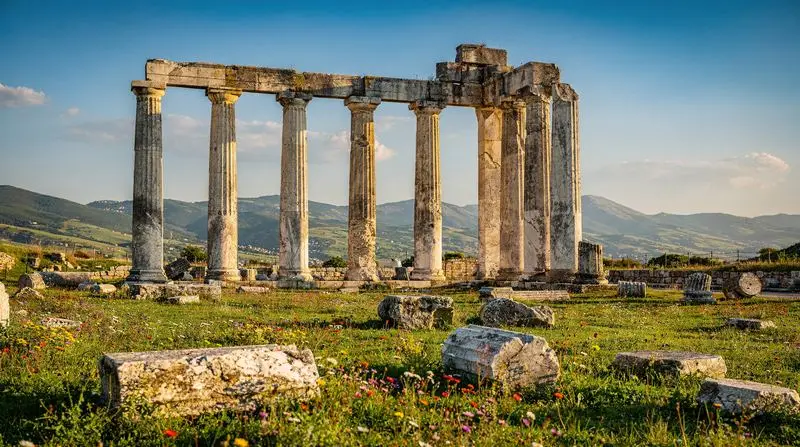
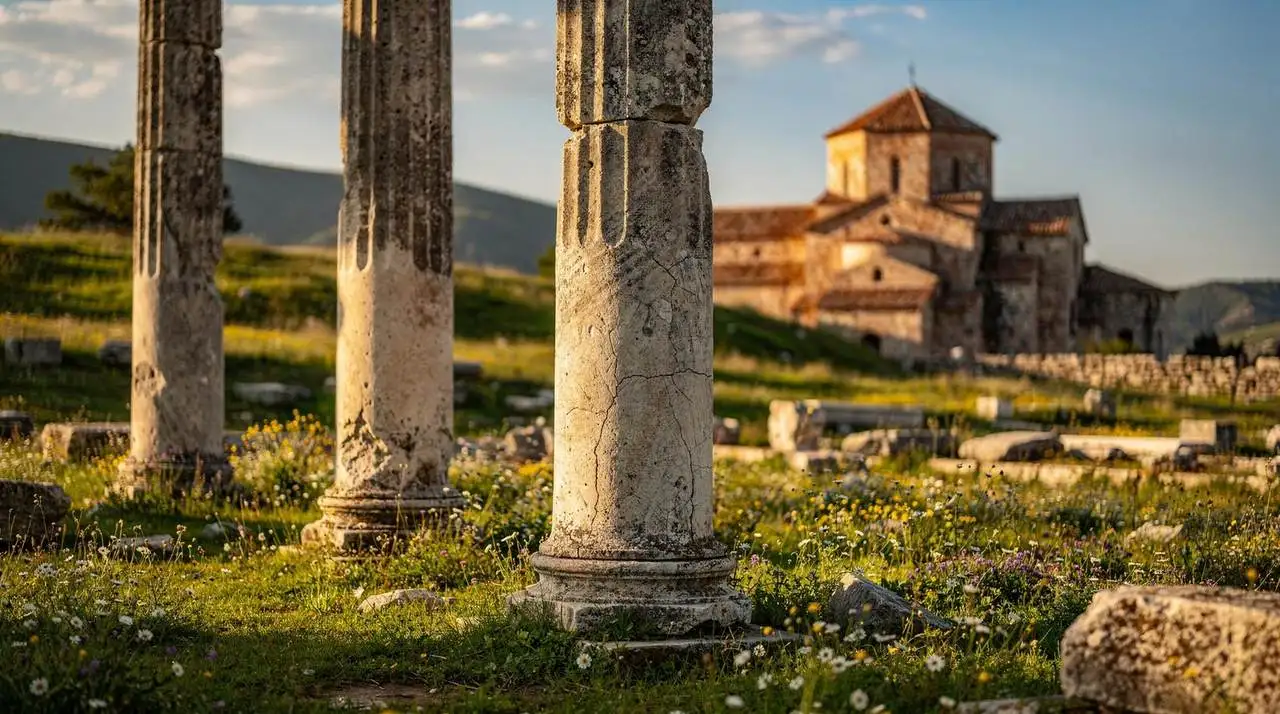
The most striking surviving structure is the Bouleuterion, the ancient city council chamber. Dating from the second century BC, it features a well-preserved portico with elegant Corinthian columns that have become the visual signature of the entire site. Standing before it, surrounded by the sounds of wind and birdsong rather than tourist crowds, the connection to the ancient world feels unusually direct. This is the structure that appears in every photograph of Apollonia — and it is more impressive in person than in any image.
The columns are original and remarkably intact. Their survival owes something to the site’s relative obscurity in the post-classical period, when the buildings were too remote to be systematically robbed for construction material in the way that Roman monuments near large cities typically were. Walking beneath the portico, running your hand along the fluted columns, you are touching stone that has stood in this position for over 2,000 years — a simple fact that the site communicates with unusual directness.
The Odeon
Adjacent to the Bouleuterion, the small Odeon — a covered theatre used for musical performances and intimate civic gatherings — has been partially restored. Its stepped seating and semicircular form are clearly legible, and it gives a strong sense of the urban culture that once flourished here. The Odeon would have held several hundred spectators for private recitals, philosophical lectures, and council deliberations.
The acoustics of the space, even in its current roofless state, are notably good — speaking at normal volume from the stage area carries clearly to the upper tiers. The Odeon provides the most vivid imaginative contact with Apollonia as a living urban community: a place where ideas were debated, music was performed, and the intellectual life of a significant Hellenistic city played out.
The Monastery of St Mary
At the centre of the archaeological park sits a functioning Byzantine monastery, the Monastery of St Mary, built in the 13th century using stones quarried from the ancient ruins around it. This layering of history — Greek over Roman over Byzantine — is one of the things that makes Apollonia so compelling. The monastery church contains medieval frescoes and is still occasionally used for religious purposes.
The monks who have maintained this site for centuries created an inadvertent archive, preserving the ruins by building with and around them rather than clearing them away. The visual juxtaposition of the medieval monastery rising from within the classical landscape is striking — this is what Albanian history looks like at its most layered and complex. The church is open to respectful visitors; dress modestly and avoid visiting during active services.
The National Museum of Apollonia
The on-site museum houses artefacts recovered from decades of excavations: coins, sculptures, pottery, jewellery, and architectural fragments. The collection is informative and well-organized, and a visit before exploring the site helps orient you to what you are looking at among the ruins. Entry to the museum is included in the site ticket. Allow 30-45 minutes for the museum.
The coin collection is exceptional — Apollonia minted distinctive silver coins for several centuries, and the museum displays examples from different periods showing the evolution of the city’s monetary production. The sculptural fragments include several well-preserved heads and torsos from both Greek and Roman periods. Pottery displays document the commercial connections of the ancient city: Corinthian, Attic, and Apulian wares recovered from the site demonstrate how thoroughly Apollonia was integrated into Mediterranean trade networks. The museum labels are in Albanian and English, and the explanatory texts are genuinely informative rather than merely decorative.
The City Walls and Agora Area
The ancient defensive walls of Apollonia, some sections still standing several metres high, enclose the main excavated area. Beyond the central monuments, archaeological digs have uncovered portions of the agora, residential quarters, temples, and a triumphal arch. Much of the site remains unexcavated — archaeologists believe only a fraction of the ancient city has been properly studied, which means the visible ruins represent a selective highlight reel of a much larger urban space.
Walking the circuit of the walls takes about 30 minutes at a relaxed pace and provides a sense of the city’s overall scale. The views from the higher sections over the Myzeqe plain are excellent, particularly in the softer light of morning or late afternoon. The defensive towers at intervals along the wall give a sense of the military sophistication of the city’s fortifications — Apollonia was not a simple village but a major urban centre that required serious infrastructure to protect.
The View
Apollonia sits on a hill above the coastal plain, and the views across the Myzeqe lowlands towards the Adriatic are expansive. On clear days, the light has a quality that makes the landscape look painted. Allow time to simply sit among the ruins and absorb it — this is not a site to rush through, and the atmosphere rewards those who slow down.
In spring, wildflowers grow between the ancient stones — poppies, chamomile, and wild orchids appear in April and May. In autumn, the low light of October over the Myzeqe gives the ruins a warmth and depth that summer visitors do not see. The site is visually rewarding in every season, though summer requires shade and water management.
History in Depth
The name Apollonia is a common one in the ancient world — there were at least a dozen cities with this name. The Albanian Apollonia, known in Latin as Apollonia Illyrica to distinguish it, was for several centuries arguably the most important of them.
Its position made it strategically critical. The Via Egnatia, the great Roman road connecting the Adriatic to Constantinople, had its western terminus near Apollonia’s port. Control of the city meant control of the main overland route to the eastern Mediterranean. Rome absorbed Apollonia into its sphere of influence in the second century BC, and the city thrived under Roman patronage, becoming thoroughly Romanized while retaining its Greek cultural character.
The philosophical school at Apollonia attracted students from across the Greek world. Octavian was sent there by his great-uncle Julius Caesar specifically to receive what was considered the finest intellectual education available. When Caesar was murdered in 44 BC, Octavian was 18 years old, far from Rome, and surrounded by his adopted father’s loyal legions. The decision he made at Apollonia — to return to Rome and claim his inheritance — changed the history of the world.
The decline of Apollonia after the third-century earthquake illustrates a broader pattern in Albanian history: settlements dependent on specific geographic advantages could shift rapidly when those advantages changed. The silting of rivers and changes in coastal topography reshaped the commercial geography of Illyria and Epirus several times over the classical period. What had been a thriving port city became, within a few generations, a backwater, and then a memory.
Excavation at Apollonia has been ongoing since the early 20th century, with French, Albanian, and later international teams contributing to the site’s gradual uncovering. Communist-era Albania restricted foreign archaeological access for decades, which paradoxically slowed the pace of excavation but also protected the site from the kind of aggressive, poorly documented digging that damaged some Mediterranean ruins elsewhere. Since the 1990s, renewed international collaboration has resumed careful excavation, and new sections of the ancient city continue to be mapped. What is visible today is still, by most estimates, a fraction of the full ancient footprint.
Combined Day Trips: Apollonia Plus
Apollonia stands alone as a worthwhile destination, but it combines naturally with other sites in central Albania.
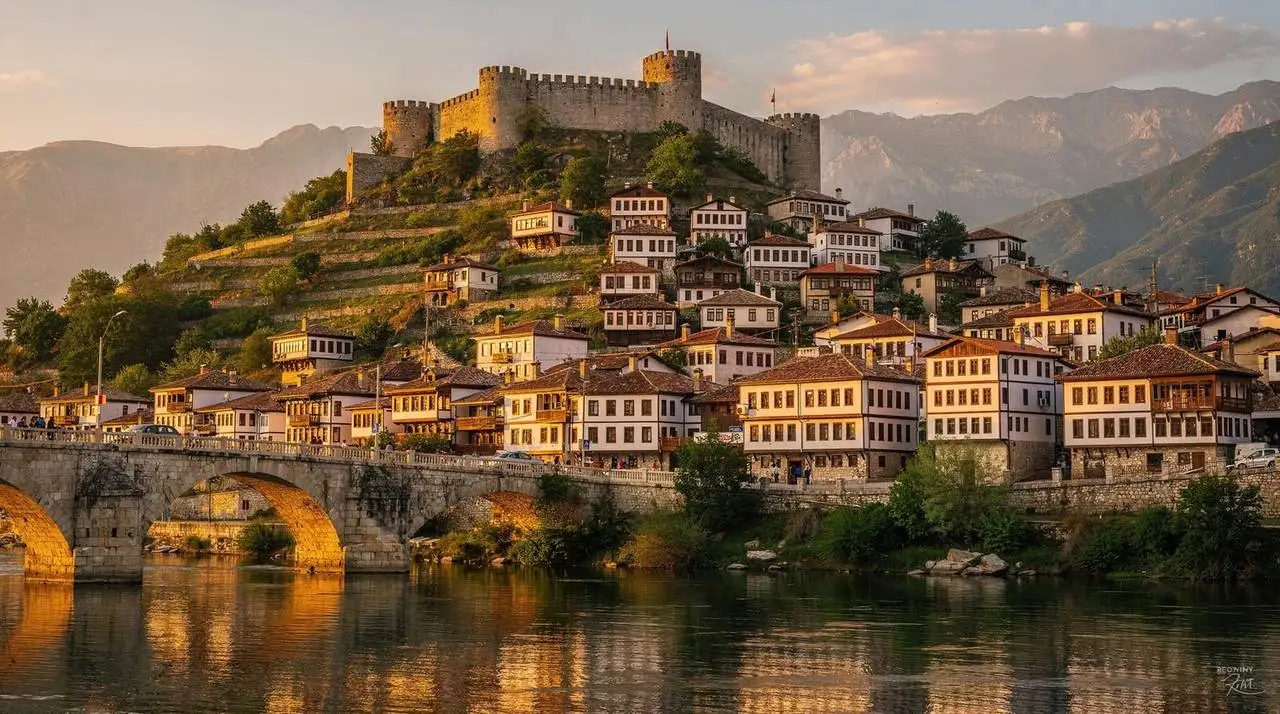
This guided day trip from Tirana to Apollonia and Berat is the most popular combination, pairing the ancient ruins with the Ottoman cityscape of Berat, a UNESCO World Heritage Site in its own right. The two sites complement each other perfectly, spanning Greek, Roman, and Ottoman history in a single day. The Berat old town, with its famous whitewashed Ottoman houses cascading down the hillside above a medieval castle, is one of the most photogenic places in Albania and makes a natural partner for the more austere classical landscape of Apollonia.
This guided day trip combining Apollonia with the Ardenica Monastery pairs the archaeological site with a beautiful 18th-century Orthodox monastery on a hilltop west of Fier where Skanderbeg is said to have married Donica of Arianit. The two sites make for a rich half-day each, covering both classical history and Albanian medieval heritage.
Both tours depart from Tirana and include transport, a guide, and entry fees — highly recommended if you want context and convenience rather than navigating independently. For those with their own vehicle, the car rental in Albania guide covers the options for driving the central Albania circuit. The 14-day Albania itinerary includes Apollonia as a half-day stop on the route between Tirana and Berat.
The Ardenica Monastery, Close Up
Ardenica Monastery deserves a paragraph of its own rather than a footnote to Apollonia. Perched on a hilltop about 25 kilometres from the ruins, the 18th-century church is Orthodox in tradition and celebrated locally as the site where Gjergj Kastrioti Skanderbeg — Albania’s national hero — is said to have married Andronika Arianiti in 1451. The church interior holds an iconostasis and wall paintings that, while later than the Byzantine work found elsewhere in Albania, are well preserved and rarely crowded. The monastery courtyard, shaded by old plane trees, is a peaceful spot to break up a day that otherwise revolves around classical ruins, and the contrast between Apollonia’s Greek columns and Ardenica’s Orthodox frescoes captures Albania’s layered religious history in a single afternoon.
Countryside Around the Site
The drive out to Apollonia crosses the Myzeqe plain, historically Albania’s agricultural heartland and still dominated by wheat fields, vegetable plots, and grazing land. Storks nest on utility poles and rooftops in the villages along the route each spring, a common and much-loved sight across rural Albania. The plain’s flatness is part of why Apollonia’s hilltop setting feels so dramatic on arrival — the ruins rise abruptly above miles of open farmland, visible from a considerable distance on a clear day. If you have time, a slow drive through Pojani and the surrounding villages gives a genuine sense of everyday rural Albanian life that the archaeological park alone does not show.
Getting to Apollonia
From Tirana
The drive from Tirana takes roughly two hours, heading south on the SH4 highway towards Fier. Apollonia is signposted from the town of Fier, and the site is about 12 kilometres west of the city centre on the road towards the village of Pojani. Total distance from Tirana is approximately 120 kilometres.
If travelling by public transport, take a furgon from Tirana’s South Bus Terminal to Fier (roughly 2 hours, around 400-500 ALL), then a taxi from Fier to the site (about 10 minutes, 500-600 ALL each way). There is no direct public bus service to the ruins. The day trips from Tirana guide covers the transport logistics and timing in detail.
From Berat
Berat is only 45 kilometres east of Apollonia — about 45 minutes by car. This makes the Apollonia-Berat combination particularly easy if you are staying in Berat or planning to overnight there. The UNESCO sites in Albania guide covers both Apollonia and Berat in the context of Albania’s heritage circuit.
From Vlora
Vlora is about 60 kilometres south of Apollonia — roughly an hour’s drive. If you are heading up the coast from the Riviera, Apollonia can be a worthwhile detour on the drive north to Tirana. The Albanian Riviera circuit naturally passes close enough to include Apollonia on a longer routing.
From Durres
Durres is approximately 90 kilometres north — about 90 minutes by car. Combining Apollonia with Durres’s Roman amphitheatre makes an impressive historical double covering two of the most significant ancient sites in Albania in a single long day. Both sites represent different phases of classical occupation of this territory — the Greek colonial period at Apollonia, the Roman imperial presence at Durres — and together they give an unusually complete picture of ancient Albania.
Where to Eat Near Apollonia
There is no cafe or restaurant within the Apollonia site itself. The on-site facilities include a small souvenir shop and basic seating near the entrance, but no food service. Plan accordingly.
Restorant Pojani (village of Pojani, 2 km from site) — The nearest restaurant to the ruins, serving standard Albanian grilled meat, salads, and byrek. Basic but adequate for a post-visit lunch. Budget EUR 5-10 per person. The lamb on the grill is reliably good, and the local vegetable salad is made with garden-fresh produce.
In Fier (12 km): The town of Fier has a broader restaurant selection. The main boulevard has several cafes and restaurants serving traditional Albanian food at reasonable prices. The byrek shops near the central market are excellent for a morning pastry before driving out to the site.
Bring a picnic: The archaeological park has shaded seating near the monastery, and eating among the ruins on a quiet morning is one of the more atmospheric lunch experiences available in Albania. The monastery orchard in spring has a particularly peaceful quality. Bring food and water from the nearest town. Our Albanian food guide covers the central Albania food traditions if you want context for what to expect at regional restaurants.
Practical Information
Entry and hours: The archaeological park is open year-round. Hours are approximately 8am-6pm in summer and 8am-4pm in winter, though these can vary — arrive early to be safe. The entry fee is 700 ALL (approximately EUR 7) for adults, which includes access to the museum. Children under 10 are typically free or charged a reduced rate. There is no ticket machine; pay at the gate in cash.
Time required: Two hours is sufficient for a good look at the main monuments. Three hours allows a more relaxed exploration, including the museum, a walk along the city walls, and time to sit and absorb the atmosphere. If you combine with a meal in Pojani village, plan for four hours minimum from arrival to departure.
Guides: The site has English-speaking guides available, though their availability varies by season and day of week. Booking a guided tour from Tirana (as linked above) is a more reliable way to ensure depth and context. Independent visitors with a serious interest in classical history should consider downloading background reading beforehand — the Butrint Foundation and various academic sources have produced accessible introductions to the site’s significance.
What to bring: The site is partly shaded by mature trees but partly exposed. Bring sunscreen and water, especially in summer. Wear comfortable shoes — the paths are uneven in places and the monastery gardens involve some uneven ground. A hat is useful in the open sections of the site during the middle of the day.
Photography: Permitted throughout the site. The Bouleuterion portico in morning light is the canonical image, but the monastery courtyard, the Odeon, and the wall circuit all offer excellent photographic opportunities. Drone photography requires a permit and advance arrangement.
Accessibility: The site involves walking on grass, gravel and uneven stone paths, with some gentle slopes between monuments. There is no paved accessible route, and visitors with mobility limitations should expect a genuinely rustic archaeological park rather than a modern museum campus. Our accessible travel in Albania guide covers what to expect at sites like this one across the country.
Toilets: Basic facilities are available near the entrance and museum. Do not expect anything beyond the essentials — this is a rural archaeological park, not a resort attraction.
Visiting Tips
Go in the morning if possible. The light is better, the heat is manageable, and the site is at its quietest before any organised tour groups arrive. Most groups visit between 10am and noon, so arriving at opening time or after 1pm keeps the experience more personal.
Spring and autumn are particularly good seasons. The wildflowers that grow among the ruins in April and May are beautiful, and the October light over the Myzeqe plain is extraordinary. Summer is fine but hot — this is a low-lying, inland site without the coastal breeze you might expect elsewhere in Albania. Bring more water than you think you need in July and August.
Apollonia rarely appears at the top of mainstream Albania travel lists, which is partly its strength. If you make the effort to get here, you will almost certainly have significant portions of the ruins entirely to yourself — a rare experience at a site of this historical importance. The Albania off the beaten path guide places Apollonia in a broader list of undervisited but genuinely significant Albanian sites, giving context for how it fits alongside other less-trafficked but rewarding destinations.
Families travelling with children generally do well here too — the open grassy site gives kids room to run between monuments without the crowd-management concerns of a busier attraction, and the low walls and open agora area are easy for younger visitors to explore safely under supervision. There is little shade beyond the monastery courtyard, so plan around the midday heat in summer and bring a hat for anyone in the group who tires quickly in direct sun.
Why Apollonia Matters
There is a tendency in travel writing about Albania to describe everything as a hidden gem, a well-kept secret, an undiscovered paradise. Apollonia is not quite like that — it is known to serious travellers and well-regarded in academic circles. But it has not yet entered the mainstream European consciousness as a must-see site, despite being genuinely comparable in importance and atmosphere to better-known ruins elsewhere in the Mediterranean.
A city where Julius Caesar strategized, where the future Augustus Caesar received his education, where Greek culture flourished for centuries on the edge of the ancient world — that is not a footnote. That is history that shaped everything that followed. The cultural thread running from the philosophical school at Apollonia to the consolidation of Roman imperial power is direct and documented. Standing among these columns, you are standing in a place that contributed to the formation of the world we inhabit.
For broader context on how Apollonia fits into Albania’s remarkable historical landscape, our historical sites guide covers the full picture, from the Illyrian hillforts of the north to the Ottoman towns of the south. The Albania travel budget guide helps you plan the overall cost of the central Albania circuit, including Apollonia, Berat, and the other major historical sites in the region.
Come and stand among the columns. Few places in the Balkans offer a comparable encounter with the deep Mediterranean past in such uncrowded circumstances.
Frequently Asked Questions About Apollonia
What is Apollonia famous for?
Apollonia was one of the most important Greek colonies in the ancient Mediterranean world. Founded around 588 BC, it became a major intellectual and cultural centre — the philosopher Aristotle praised its institutions, Julius Caesar used it as a supply base during his civil war campaigns, and the future Emperor Augustus Caesar spent time studying at Apollonia’s philosophical school. The city flourished for centuries before declining in the Byzantine period. Today the archaeological park preserves temples, a theatre, a monastery, mosaics, and an excellent museum.
How do you get to Apollonia from Tirana?
From Tirana, the most practical approach is by bus or shared taxi to Fier (approximately 2-2.5 hours, around 500-600 ALL by bus), then a short taxi ride from Fier to the Apollonia site entrance (approximately 10-15 minutes, EUR 5-8). Driving gives considerably more flexibility and allows you to combine Apollonia with nearby Berat in a single day — the two sites are around 45 minutes apart. No direct public bus runs to the site entrance.
Is Apollonia worth visiting?
Apollonia is one of the most rewarding archaeological sites in the Balkans and is significantly undervisited relative to its historical importance. The combination of well-preserved ruins, an excellent on-site museum, beautiful hilltop setting, and very few crowds makes for an outstanding few hours. Entry costs 700 ALL. If you have any interest in ancient Mediterranean history, Greek colonisation, or Roman history, Apollonia is an essential stop.
Can you combine Apollonia with Berat in one day?
Yes — combining Apollonia and Berat is one of the most efficient day trips available from Tirana. Drive south to Apollonia first (arriving when it opens at 8am), spend two to three hours, then continue to Berat (45 minutes) for the afternoon. Return to Tirana in the evening, or overnight in Berat. This makes excellent use of a full day and pairs two of Albania’s most historically significant sites in a single circuit.
What are the opening hours and entry fee for Apollonia?
Apollonia is open daily from 8am to 7pm in summer (8am to 5pm in winter). The entry fee is 700 ALL (approximately EUR 6.50) for adults, which includes access to the archaeological site and the on-site museum. A guide can be hired at the entrance for a richer experience — rates are typically EUR 10-15 for a one-hour guided tour. Arrive in the morning before tour groups for the best experience and the most pleasant light on the ruins.
Is there food or water available at Apollonia?
No — there is no cafe or restaurant inside the archaeological park itself, only a small souvenir stand near the entrance. Bring your own water, especially in summer, and either pack a picnic to eat in the shaded areas near the monastery or plan to eat afterwards in Pojani village (2 km away) or Fier (12 km away).
Can you visit Apollonia and Ardenica Monastery together?
Yes, and it is a natural pairing. Ardenica Monastery sits about 25 kilometres from Apollonia and can be reached in under 30 minutes by car. Several guided day tours from Tirana combine the two sites directly, and the contrast between the classical ruins and the Orthodox monastery makes for a rewarding half-day if you are driving independently.