Albania by Bus and Furgon: The 14-Day No-Car Itinerary
Albania is one of Europe’s most rewarding countries to travel without a car. The furgon network — minivans that connect almost every town and village in the country — makes even remote destinations accessible with patience and local knowledge. Buses link the major cities at reasonable frequency. The Koman Lake ferry is one of the most spectacular boat journeys in Europe. And the entire country is compact enough that a 14-day bus circuit covers more ground than most visitors expect possible without a vehicle.
This itinerary proves the case. It runs from Tirana south to Berat, Gjirokastra, the Blue Eye, and Saranda on the Ionian coast, then back up the Riviera through Himara and Vlora, north to Shkodra, out to Koman Lake by boat, into the Valbona Valley, and over the mountain to Theth — completing a loop that covers the full range of Albanian highlights.
Budget travellers, backpackers, and anyone curious about authentic local travel will find this route genuinely rewarding. You share transport with Albanian families, students, and workers. You wait at junctions and market squares for the next furgon. You experience the country at ground level, at local pace, and at local prices.
| Where | Tirana → Berat → Gjirokastra → Saranda → Riviera → Shkodra → Koman Lake → Valbona → Theth |
| Cost | around EUR 50–70/person for 14 days of intercity transport |
| Time needed | 14 days, no car needed |
| Getting around | Furgon (shared minivan), intercity bus, and the Koman Lake ferry |
| Best time | May–September for the Alps leg; the coastal and city loop works year-round |
Understanding Albania’s Transport System
Furgons
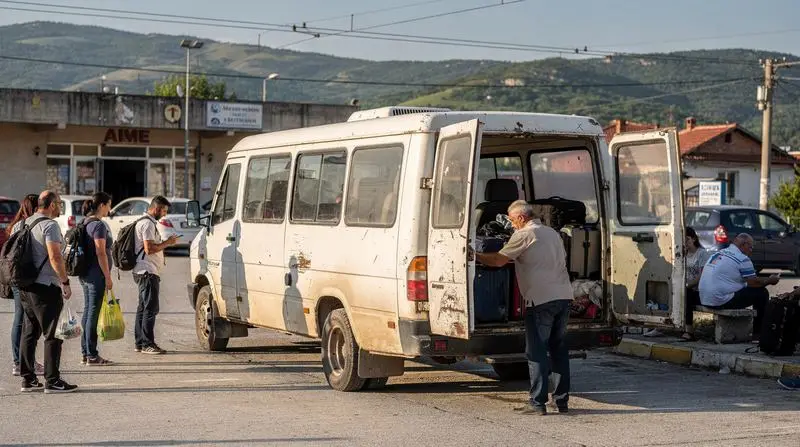
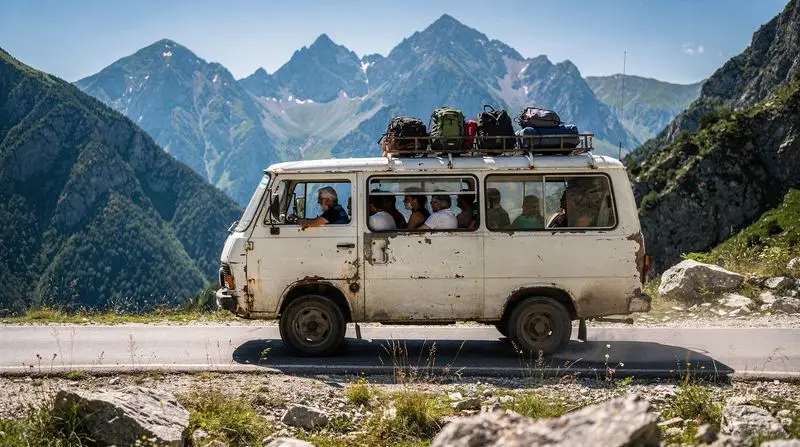
The furgon (from the French “fourgon” — van) is the backbone of Albanian intercity and rural transport. These are typically Toyota HiAce-sized minivans that depart from fixed points in town centres and markets when full. They serve routes that buses do not cover — including the mountain roads to Theth, Valbona, and many southern villages.
How to use furgons:
- Find the departure point: in most towns, furgons for specific destinations leave from the main market area (tregu) or a designated stopping point. Ask locals or your accommodation.
- Depart when full: furgons generally leave when they have enough passengers. For popular routes, this is quick. For remote routes, you may wait.
- Pay the driver or conductor: cash only. Prices are fixed by route and extremely low.
- No advance booking: just show up. For remote routes and peak season, arriving early is wise.
Buses
Intercity buses serve the main corridor routes: Tirana-Berat, Tirana-Shkodra, Tirana-Gjirokastra, and others. These depart from the city’s main bus station or from the relevant neighbourhood based on route direction. More reliable schedules than furgons, often slightly more expensive.
The coastal bus: A limited bus service runs along the Albanian Riviera (Vlora-Himara-Saranda) in summer. In low season, this becomes furgon-dependent.
The Koman Lake Ferry
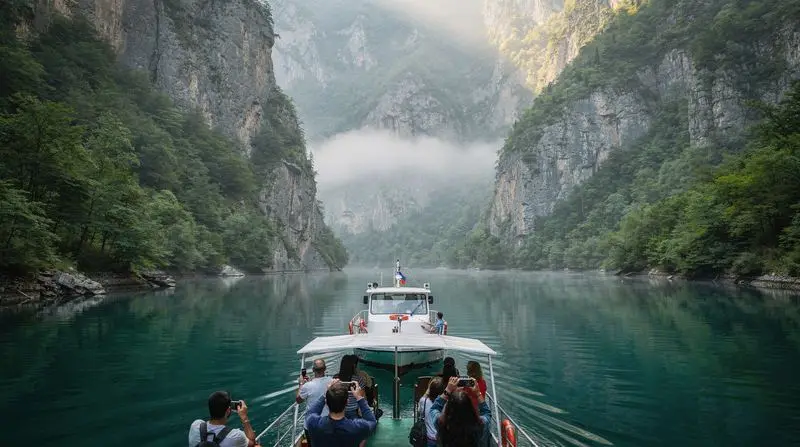
The Koman Lake ferry is technically a passenger and cargo boat, not a tourist vessel — but it has become one of Albania’s signature travel experiences. The 2.5-3 hour journey through the Drin River gorge is genuinely spectacular: limestone walls, forested slopes, waterfalls, and water of extraordinary colour. See the Koman Lake Ferry guide for full logistics.
Taxis
For connections that buses and furgons do not cover efficiently, shared taxis are available on many routes. They cost more than furgons but significantly less than Western-standard taxi prices.
Route Overview
Days 1-2: Tirana Day 3: Tirana → Berat Day 4: Berat Day 5: Berat → Gjirokastra Day 6: Gjirokastra + Blue Eye day trip Day 7: Gjirokastra → Saranda Day 8: Saranda (Ksamil, Butrint) Day 9: Saranda → Himara Day 10: Himara → Vlora Day 11: Vlora → Shkodra (long day) Day 12: Shkodra → Koman Ferry → Valbona Day 13: Valbona → Theth (hike or jeep) Day 14: Theth → Shkodra → Tirana
Days 1-2: Tirana — The Capital on Foot
Tirana is the ideal starting point — not just logistically (the international airport serves it), but because the capital provides context for everything you will see over the following two weeks.
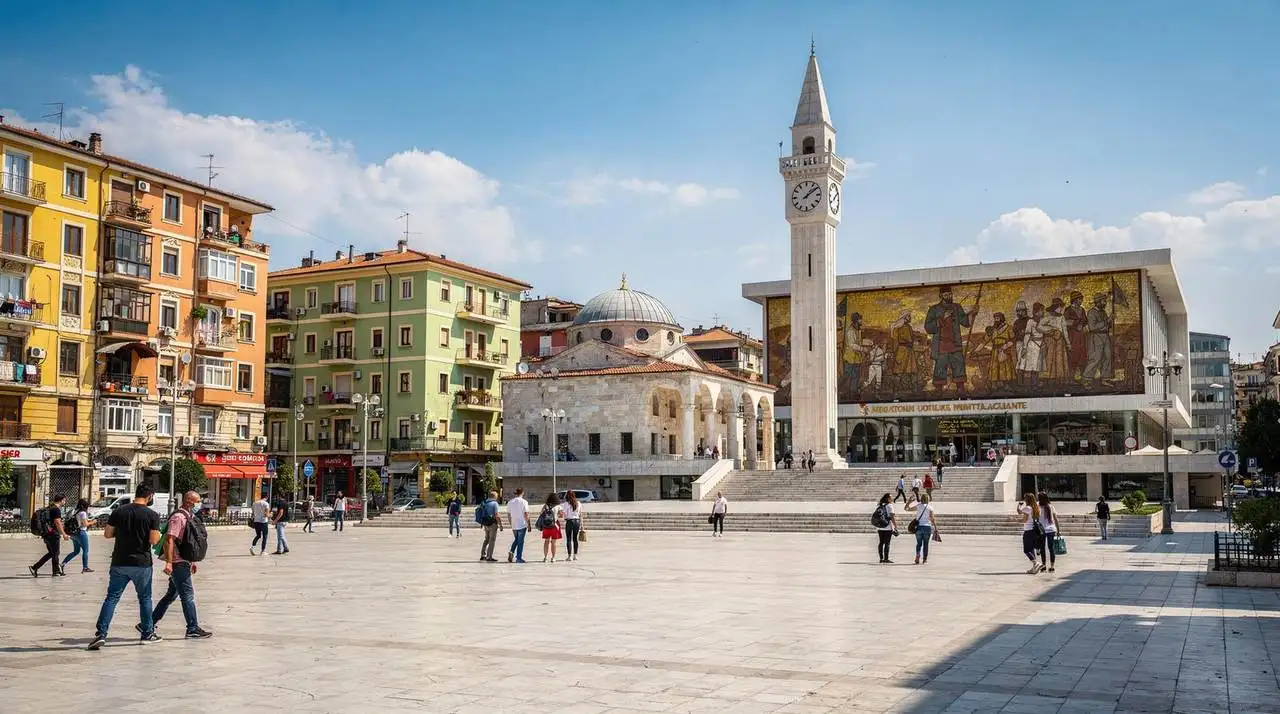
Explore on foot. Tirana is a walkable city — Skanderbeg Square to the National Museum to the Et’hem Bey Mosque to the BunkArt 2 bunker to the Blloku district is a half-day walking circuit that covers the essential architecture and history.
The Tirana walking tour is an excellent introduction to the city’s history and architecture, providing context that enriches everything you subsequently see in Albania. Local guides bring the communist period, the national revival, and the post-1991 transformation to life in a way that no museum exhibit fully captures.
If the communist-era story interests you most, the Tirana communist Albania tour with the Bunk’Art museum is a good way to go deeper on that chapter.
Day 2: The BunkArt museum experience, the Pyramid (the controversial Enver Hoxha mausoleum repurposed as a youth arts centre), and the evening in the Blloku district complete the Tirana introduction.
Public transport from Tirana: Buses to all major cities depart from the Tirana bus station near the city centre, or from neighbourhood-based departure points for specific routes (Berat buses depart from the area near Rruga Mujo Ulqinaku).
Day 3: Tirana to Berat
Bus from Tirana to Berat departs from approximately 06:30-09:00 from the central bus area near the Kombinat neighbourhood (confirm current departure point with your accommodation). Journey time: approximately 2 hours. Cost: approximately EUR 3-4.
Arrive in Berat mid-morning and check into a guesthouse in the old town. Spend the rest of the day in the lower town — the Mangalem and Gorica quarters, the riverside, and the central bazaar area.
Berat’s old town guesthouses are among the best value accommodation in Albania — comfortable, character-filled rooms in 18th-century Ottoman houses for EUR 25-45 per night.
Day 4: Berat — UNESCO City Full Day
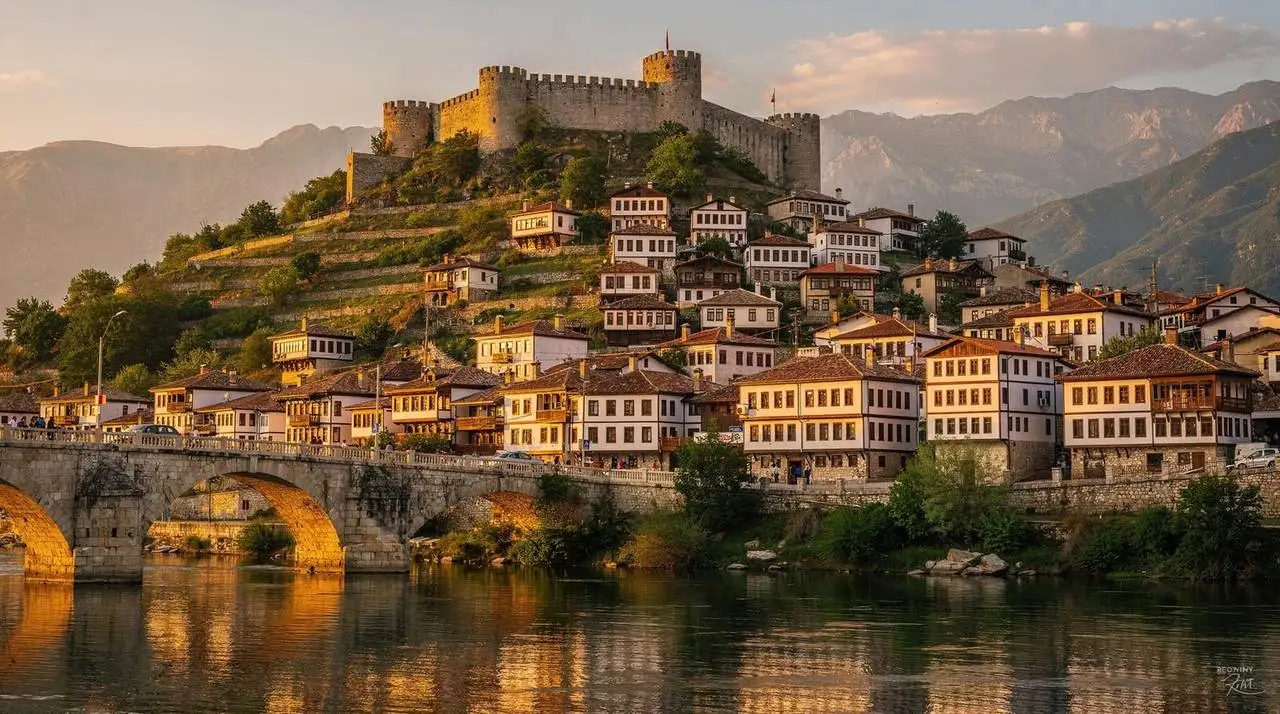
The full Berat experience: morning at the Kalaja (castle) — climb through the old castle gate, explore the inhabited citadel with its Byzantine churches and Albanian houses, and visit the Onufri icon museum. Afternoon in the Mangalem quarter — the stacked houses with their characteristic grid windows are best photographed in afternoon light. Evening by the Osum River.
Berat deserves at least two nights — it is one of the most rewarding cities in Albania to simply wander. Every alley reveals a view, a detail of Ottoman architecture, or a glimpse of daily life in a historic setting that is genuinely lived-in rather than preserved for display.
Day 5: Berat to Gjirokastra
Furgon from Berat to Gjirokaster operates via Fier and Tepelene. Ask at your guesthouse for current furgon departure points and times. The journey takes approximately 3-4 hours with connections, passing through the Vjosa Valley and the southern mountains.
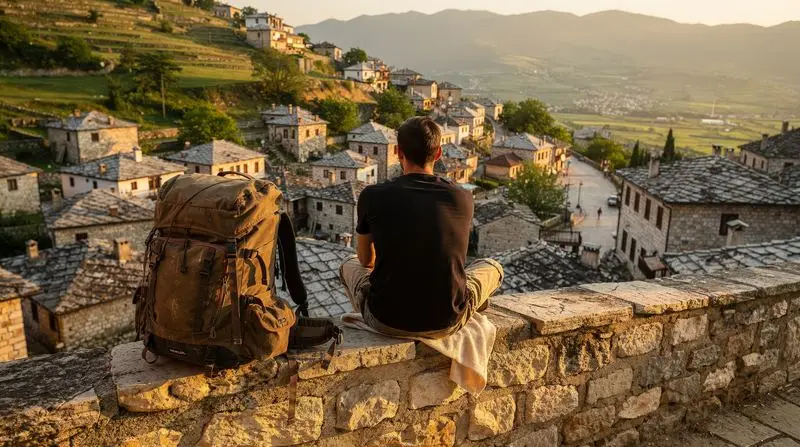
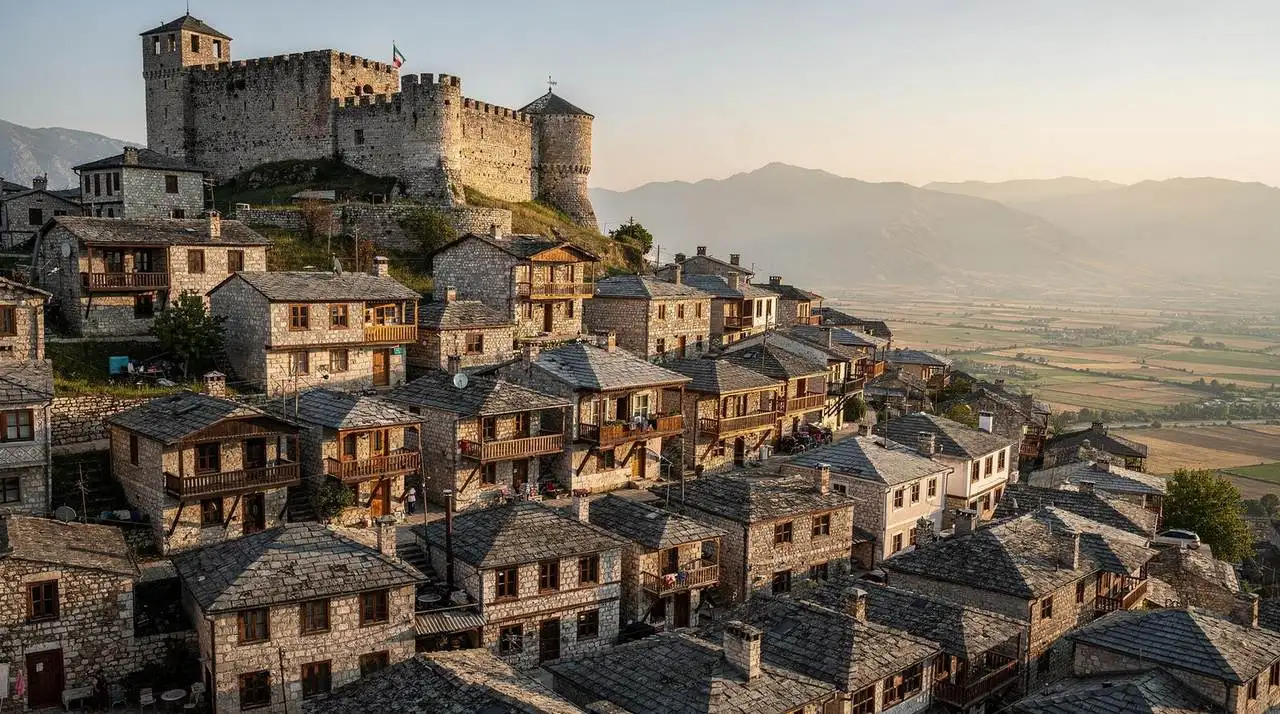
Gjirokastra is the second of Albania’s two UNESCO World Heritage cities — and in many ways the more dramatically sited. The city climbs a steep hillside above the Drinos Valley, dominated by a massive castle at the top. The stone houses of the old town are unlike anything else in Albania — solid, grey, fortified, reflecting the city’s history as a centre of Albanian culture and resistance.
Check in to a guesthouse in the old bazaar area for the best access to the city’s sights.
Day 6: Gjirokastra and Blue Eye Day Trip
The Blue Eye (Syri i Kaltër) is one of Albania’s most visited natural attractions — a karst spring of impossibly blue water 25km from Gjirokastra on the road toward Saranda. The spring produces millions of litres of crystal-clear water per day, which erupts upward from a circular pool over 50 metres deep. The blue colour, caused by depth and water clarity, gives it its name.
Reaching the Blue Eye by public transport requires a furgon toward Saranda (ask the driver to drop you at the Syri i Kaltër junction) and a short walk. Alternatively, a shared taxi from Gjirokastra covers the return trip affordably. Confirm current arrangements with your accommodation.
Spend the morning at the Blue Eye and return to Gjirokastra for an afternoon in the city: the castle (the National Armaments Museum within is free or low cost), the old bazaar, and the Gjirokastra bazaar’s traditional craft and food shops.
Day 7: Gjirokastra to Saranda
Furgon from Gjirokastra to Saranda runs in the morning (approximately 1.5 hours). Alternatively, take a bus toward the coast via Libohove. Saranda is the most tourist-oriented town on the Albanian Riviera — a waterfront city on the Ionian with views of the Greek island of Corfu visible on clear days.
Saranda is the base for the Riviera south: the Ksamil islands, Butrint Archaeological Site, and sea activities. The waterfront promenade, the seafood restaurants, and the characteristic mix of Albanian families and international visitors give Saranda a lively character even as a backpacker base.
Accommodation in Saranda: Hostels, budget guesthouses, and apartments all available at budget-to-moderate pricing.
Day 8: Saranda — Ksamil, Butrint, and Sea Time
A full day of Saranda-area exploration by local transport:
Morning — Butrint National Park: Take a local furgon 18km south to Butrint, one of the most remarkable archaeological sites in the Mediterranean — a UNESCO World Heritage Site where Greek, Roman, Byzantine, Venetian, and Ottoman layers are visible simultaneously. The site sits in a lagoon setting of extraordinary natural beauty.
Afternoon — Ksamil: Return north to Ksamil (furgon from Butrint or Saranda), a village with small islands accessible by short boat rides or swimming. The water is extraordinary — turquoise, shallow between the islands, warm in summer. Spend the afternoon swimming and on the beach.
Day 9: Saranda to Himara
Furgon north from Saranda to Himara (approximately 1.5-2 hours). The road hugs the coast with increasingly dramatic scenery as you travel north — the Ceraunian Mountains rising from the sea, beaches accessible only by boat visible below.
Himara is the most characterful coastal town on the Riviera — a Greek-speaking Orthodox minority town with a well-preserved castle above the modern settlement, excellent waterfront restaurants, and a more local atmosphere than the busier Saranda.
Evening in Himara: The Old Town (Kastro) above the new settlement is worth the climb — views over the entire coastline in both directions, ancient churches, and a genuine Byzantine character. Dinner at a waterfront restaurant with fresh Ionian seafood.
Day 10: Himara to Vlora
Furgon from Himara north to Vlora (approximately 2 hours). The route passes through some of the most dramatic coastal scenery on the Riviera — Gjipe beach canyon, Drymades beach, Dhermi — with the option to stop at any of these for a few hours before continuing.
Vlora is Albania’s second city on the Adriatic — a city of national historical significance (Albanian independence was declared here in 1912), with a modern waterfront, access to the Karaburun Peninsula, and good public transport connections north.
Spend the afternoon exploring Vlora: the Independence Museum, the Muradi Mosque (one of the oldest Ottoman mosques in Albania), and the Flag Square (Sheshi i Flamurit). Vlora’s seafood is excellent and cheaper than equivalent coastal restaurants in Saranda.
Day 11: Vlora to Shkodra
This is the itinerary’s longest transport day — the full north-south spine of Albania by public transport.
Depart Vlora early by bus to Tirana (approximately 2.5 hours). Connect in Tirana to a bus or furgon for Shkodra (2 hours). Arrive in Shkodra mid-afternoon.
Shkodra is Albania’s northern capital — a city of Ottoman mosques and 19th-century buildings, with the remarkable Rozafa Castle above the city at the confluence of three rivers. The city has a strong cycling culture (it is the most bicycle-friendly city in Albania), a vibrant arts scene, and serves as the gateway to the Albanian Alps.
Evening in Shkodra: The pedestrianised Kole Idromeno Street is the social centre — cafes, restaurants, and the evening promenade (xhiro) of Shkodra life. Try the local lake fish (from nearby Lake Shkodra) and Shkodra raki.
Day 12: Shkodra to Koman Ferry to Valbona
The most logistically complex but most rewarding transit day of the itinerary.
Depart Shkodra by early bus or shared taxi to Koman (approximately 1 hour). The Koman Lake ferry departs at approximately 09:00 (check current schedule — this is critical). The journey through the Drin gorge takes 2.5-3 hours.
See the Koman Lake Ferry guide for all current departure times, prices, and logistics. This is one of the great boat journeys in Europe — do not miss it.
Arrive at Fierza on the far side of the gorge. From Fierza, a furgon or taxi (approximately 1 hour) to Valbona Valley. Arrive in the afternoon.
The Valbona Valley guesthouses are welcoming at the end of this transit day. The valley is stunning — high peaks all around, the river running clear and cold, and the sense of having genuinely arrived somewhere remote.
Day 13: Valbona to Theth
The classic mountain crossing — an 18km hike over the Valbona Pass (1,793m) to Theth. See the Albanian Alps hiking guide for full detail.
Non-hikers can arrange a 4WD vehicle transfer over the mountain track at additional cost — ask at your Valbona guesthouse the evening before.
Arrive in Theth in the afternoon. Theth is the most beautiful village in the Albanian Alps — remote, traditional, surrounded by extraordinary peaks, with a waterfall gorge below the village. The guesthouses serve enormous dinners and the conversation at the communal table is typically excellent.
Day 14: Theth to Shkodra to Tirana
Morning furgon from Theth to Shkodra (departs typically around 07:00 — confirm timing with guesthouse the evening before). Journey takes 2-3 hours over the mountain road.
From Shkodra, bus or furgon to Tirana (2 hours). Arrive in Tirana for a final afternoon before departure — the airport serves major European hubs with good connectivity.
Final afternoon in Tirana: If departure is the next day, use the afternoon for anything missed from Days 1-2 — museum visits, the Grand Park, or a final dinner in the Blloku district.
Public Transport Tips for Albania
Always confirm departure points. Transport infrastructure in Albania shifts more frequently than in Western Europe. Ask your accommodation the evening before for current departure points, times, and whether furgons are running on your planned route.
Carry cash. Furgons and many buses are cash only. Always have Albanian lek (ALL) for transport. EUR is sometimes accepted but change is in lek.
Be flexible with timing. Furgons depart when full, not to a fixed schedule. For popular routes in peak season, this means quick departures. For remote routes, allow time.
Start early. Most long-distance furgon and bus services depart in the morning. Starting travel before 09:00 maximises connections.
Bring a bag for the roof. Larger backpacks typically go on the roof rack on furgons. Keep valuables with you in the cabin.
Furgon vs Bus vs Shared Taxi: Which to Use When
| Option | Best for | Cost | Comfort |
|---|---|---|---|
| Furgon | Rural routes, mountain valleys, small towns | Lowest | Basic, sometimes crowded |
| Intercity bus | Main city-to-city corridors (Tirana-Berat, Tirana-Shkodra) | Slightly higher than furgon | More reliable schedule, more seat space |
| Shared taxi | Last-mile connections buses/furgons don’t cover well | Higher than furgon, still cheap | Fastest, most flexible |
| Koman Lake ferry | The Shkodra-to-Valbona crossing — no road alternative worth taking | Moderate | Slow but the scenery is the point |
For deeper detail on routes, timetable quirks, and how furgon departure points actually work day to day, see the buses and furgons Albania guide and the bus routes Albania guide.
Packing and Money for a No-Car Trip
Since this itinerary avoids car rental entirely, pack lighter than you might for a driving trip — a backpack that fits comfortably on a furgon roof rack or under a bus seat makes every transfer easier. Carry more small-denomination lek than you think you’ll need; furgon drivers frequently can’t break large notes, and card machines are rare outside city centres. The Albania currency and money guide covers ATM availability by region, which matters more on this route than on a self-drive trip since you can’t simply detour to the nearest bank in a rental car.
Solo Travel and Meeting Other Travellers
This route is a strong fit for solo travellers specifically because public transport in Albania is inherently social — you end up waiting alongside other backpackers at furgon departure points, sharing tables on the Koman ferry, and comparing notes on trail conditions in Valbona guesthouses. Hostels in Tirana, Berat, Gjirokastra, and Saranda make it easy to team up with others heading the same direction, particularly useful for splitting shared taxi costs on the Fierza-to-Valbona and Theth-to-Shkodra legs.
See the Albania solo travel guide for broader safety and logistics notes, and the Albania backpacking guide for hostel-specific recommendations along this exact route. Female solo travellers report Albania as comfortable and welcoming on this route specifically, with the shared, communal nature of furgon travel adding a layer of informal safety compared to travelling alone by rental car; the Albania female solo travel guide covers route-specific notes in more depth.
SIM Cards and Staying Connected on the Move
A local SIM bought on arrival in Tirana makes furgon-hunting considerably easier — checking live departure information, translating with locals at market stopping points, and confirming Koman ferry schedules the night before all lean on having data. Coverage is reliable in the cities and along the main bus corridors; it thins out in the Valbona and Theth valleys, where you should expect to be offline for stretches. Download offline maps before leaving Shkodra for the mountain section. See the Albania SIM card guide for current providers and where to buy one, and compare current data plans in the SIM provider comparison guide if you’re deciding between operators before you land.
Frequently Asked Questions About Albania by Public Transport
Is Albania Really Feasible Without a Car?
Yes, for the route in this itinerary. The main cities and towns covered here are all connected by regular public transport. Some specific activities (certain trailheads, remote guesthouses) may require a taxi or short walk, but car hire is not necessary.
How Cheap Is Public Transport in Albania?
Extremely cheap by European standards. Tirana to Berat by bus costs EUR 3-4. Saranda to Himara furgon costs EUR 2-3. The Koman Lake ferry costs around EUR 8-10. The total transport budget for 14 days rarely exceeds EUR 50-70 per person.
Are Furgons Safe?
Generally yes. Albanian furgon drivers know their routes well. The main safety variable is mountain road conditions — the Theth and Valbona roads are narrow and rough. Travel in daylight, avoid mountain roads in severe weather, and you will be fine.
What Happens if I Miss a Connection?
Albania is small. There is almost always another option — a different furgon, a shared taxi, or a short wait. Albanian travellers and locals are generally helpful to foreign visitors struggling with connections. Ask, and someone will help.
How Do I Find Furgon Departure Points in Each Town?
Ask your accommodation the evening before. The departure point information in this guide is accurate as of writing but can shift. The market area (tregu) and main square are the most common departure hubs in each city. Local knowledge from guesthouse owners is the most reliable real-time source.