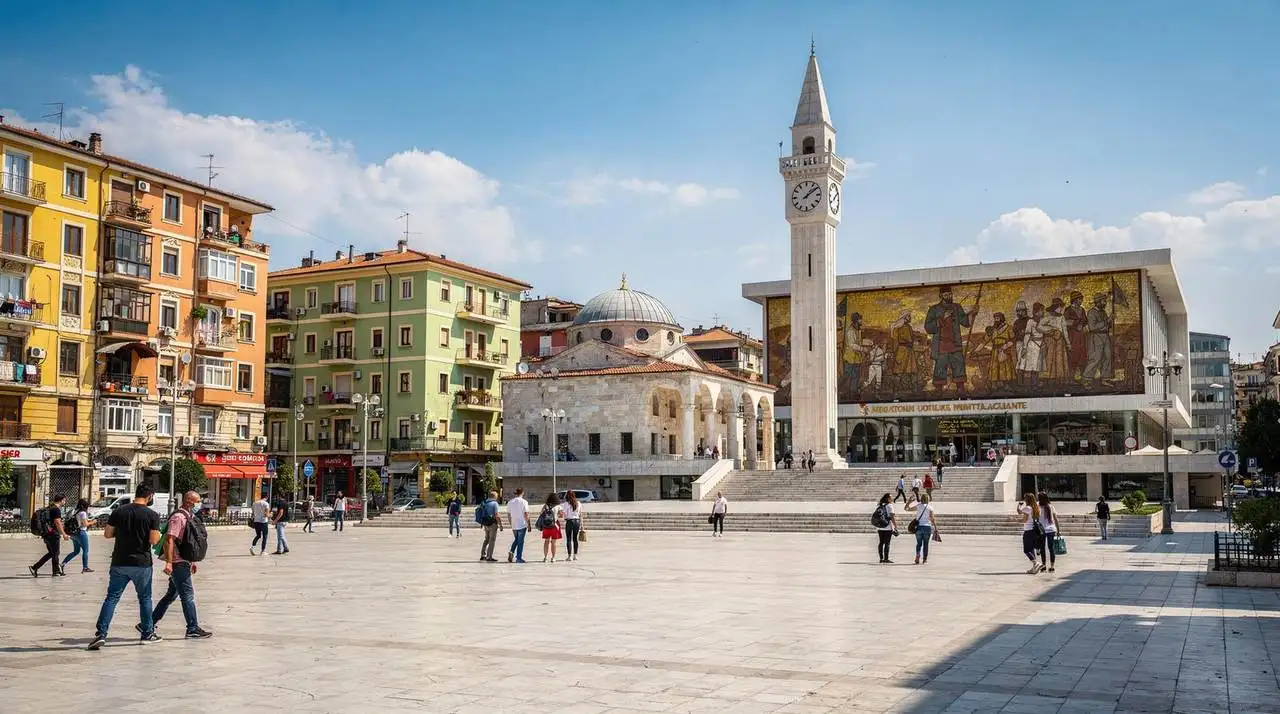
In the early 1990s, Tirana was one of Europe’s greyest cities. Not metaphorically grey — literally grey. Forty-five years of communist rule had produced a capital of concrete apartment blocks, wide empty boulevards designed more for military parades than for daily life, and a near-total absence of the commercial color that makes most cities visually alive. When the regime collapsed in 1990 and 1991, the city that emerged into daylight was austere, drained, and bearing the physical marks of one of Europe’s most extreme dictatorships.
What happened next is one of the more remarkable urban stories in European history. And understanding it is, we think, essential to understanding why Tirana is worth your time today.
| Stay | 2 days minimum for a first visit |
| Cost | Coffee around €1-1.50; dinner for two around €25-40 |
| Best area | Blloku for evenings, Skanderbeg Square area for daytime sightseeing |
| Getting around | Walkable centre; expanding electric bus lines, taxis cheap |
| Best time | Spring or autumn; summer evenings are lively but hot by day |
The Man Who Painted the City
The transformation of Tirana’s visual identity is largely the story of one mayor: Edi Rama, who was elected in 2000 and served until 2011, when he left to lead Albania’s opposition before eventually becoming Prime Minister. Rama is an artist by training, and when he came to office he began by doing something that sounds simple and turned out to be revolutionary: he had the apartment blocks painted.
Not painted a uniform color or a corporate beige. Painted in bold, contrasting, sometimes clashing patterns — bright orange blocks next to deep blue, yellow stripes on a red background, geometric shapes that turned entire building facades into abstract art. Residents were initially baffled and then largely delighted. The international press noticed. Rama argued that color was not cosmetic — that changing the visual environment of a city changes how people feel about living in it, and that changing how people feel changes how they behave.
Whether or not you agree with the theory, the effect on Tirana is undeniable. Walking through the city today, the painted facades are so embedded in the urban fabric that they feel like they have always been there. They have become the visual signature of a city that was reshaped by an act of radical aesthetic will.
The Blloku: From Forbidden Zone to Beating Heart
One of the most telling physical changes in Tirana is the Blloku neighborhood. During the communist era, this residential area was literally closed to ordinary citizens — it was where the party elite lived, including dictator Enver Hoxha himself, surrounded by a guarded perimeter that no civilian could cross. For most Tiranans it was a place they passed by but never entered.
Today, the Blloku is the most vibrant neighborhood in the city. The streets are lined with cafes, restaurants, bars, and boutiques. The terraces on a warm evening are full of young people. The area buzzes continuously from morning coffee to late-night drinks. The houses of the former nomenklatura have been converted into businesses or divided into apartments. Hoxha’s villa stands on a quiet street, now housing a foundation, its garden open to the public.
The transformation of the Blloku from forbidden zone to social center is not just urban geography — it is a physical statement about what the city has become. The spaces that were reserved for the powerful are now used by everyone. Tirana has reclaimed its own geography.
A guided Tirana walking tour is the most efficient way to understand all of this in context. A good guide walks you through the Blloku, the Grand Boulevard, Skanderbeg Square, and the Pyramid while explaining the political geography that made each space what it was under communism and what it has become since. Without that context, the city is interesting; with it, it becomes genuinely moving.
What the BunkArt Museums Tell You
To understand Tirana properly, we think you need to spend time in the BunkArt museums. There are two of them: BunkArt 1, a vast underground command bunker built into the mountains above the city for the regime leadership, and BunkArt 2, a smaller civil defense bunker located beneath the Ministry of Internal Affairs in central Tirana.
We went on a communist Albania tour with BunkArt museum visit that gave us historical context before we entered, which made the experience considerably richer. Walking through the tunnels alone might leave you with images; walking through with someone who can explain what each room was for, who used it, and what the regime was preparing to defend against gives you something more disturbing and more valuable.
BunkArt 2 is the one we found more affecting. It is smaller, more focused, and its documentation of the communist security apparatus — the surveillance networks, the political prison system, the files kept on ordinary citizens — is presented with a directness that hits hard. The museum occupies the actual building from which the secret police operated for decades. There is something important about a reckoning happening in the original space.
We recommend both, but if you have limited time, start with BunkArt 2 and then walk the neighborhood around it, which takes on a different quality once you know what happened there.
The Pyramid: History Made Into Something New
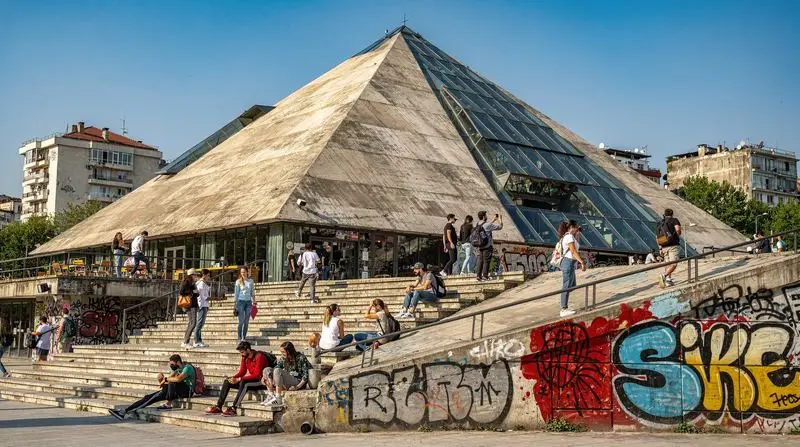
The Pyramid of Tirana — built as Enver Hoxha’s mausoleum, later used as a NATO headquarters, a television station, and a semi-derelict climbing frame for the city’s teenagers — has completed its most recent and most ambitious transformation. Dutch architecture firm MVRDV has remade it as TUMO Tirana, a free technology and creative education center for young people. The exterior staircases that now zigzag up its concrete slopes are one of the most photographed new additions to the city, and the view from the top across central Tirana to the Dajti mountains is genuinely spectacular.
The Pyramid sits on the Grand Boulevard between Skanderbeg Square and the Blloku, which makes it a natural stop on any Tirana walk. Its free entry and open public spaces mean there is no reason not to climb it. The internal exhibitions change regularly and are often excellent — when we visited, a photography exhibition on everyday life in communist Albania occupied the main hall with images that were quietly devastating.
The New Bazaar and the Food Scene
One of the best physical changes to Tirana in recent years is the renovation of Pazari i Ri — the New Bazaar, which is confusingly quite old but has been beautifully restored. The market area around Rruga e Kavajes was rundown for years, and its regeneration into a mixed space of traditional market stalls, artisan food producers, restaurants, and cafes has been one of the more successful examples of urban renewal we have seen anywhere in the Balkans.
The bazaar in the morning is one of the great pleasures of Tirana. The vegetable stalls are magnificent — seasonal produce laid out with a care that reflects how seriously Albanian markets take freshness. The herb sellers have bundles of mountain oregano, sage, and wild thyme. The cheese sellers offer feta-style gjizë and aged kashkaval. The byrek shops are already open and the pastry is still hot.
The food scene in Tirana more broadly has developed significantly in recent years. Restaurants that would have been unimaginable here twenty years ago — places with wine lists, thoughtful menus, and genuine culinary ambition — are now part of the landscape. The city has its own food culture and it is worth exploring. Our Albanian food guide covers what to order, where to find the best traditional dishes, and which Tirana restaurants are worth your time.
For a structured introduction to the food, a Tirana food tour with meals included takes you through the New Bazaar and into the neighborhood restaurants with a guide who can explain what you are eating and why it matters. We did this on a return visit and found it reframed our understanding of Albanian food culture considerably more than our earlier self-guided exploration had.
The Street Art
Tirana has embraced street art in a way that goes beyond the painted apartment blocks. The city is full of murals, from carefully commissioned large-scale works on prominent buildings to smaller, more guerrilla interventions in alleyways and on utility boxes. Some of it is political, some of it is purely aesthetic, and some of it is bewildering in the way that the best street art should be.
The area around the Blloku and the old city center has the highest concentration. Wandering without a map and letting the art lead you through the streets is one of the more enjoyable ways to spend a morning in Tirana, and it keeps yielding new things even on a third or fourth visit.
Unlike the managed street art trails of cities like Bristol or Melbourne, Tirana’s murals feel genuinely organic — some commissioned, some not, some overlaid by newer work, some preserved carefully. The city treats its walls as a medium still in use rather than a gallery to be curated, and the result is a visual environment that is alive rather than archived.
The Grand Park and the Dajti Mountain
Not all of Tirana’s transformation is in the central streets. The Grand Park, which runs along the artificial lake south of the center, has become one of the city’s most used public spaces — walkers, cyclists, families with children, groups of older men playing chess under the trees. The park was redesigned and renovated in the 2010s and now provides the kind of green breathing space that large cities need. In the evening, it fills up with Tiranans doing exactly what people in parks everywhere do, and there is something quietly reassuring about this.
From the park, the cable car to Dajti Mountain operates on clear days and provides the best elevated view over the city. The ride takes about fifteen minutes and deposits you on a plateau at 1,600 meters, where the temperature is several degrees cooler and the views over Tirana to the Adriatic coast on clear days are extraordinary. Coming down in the late afternoon, with the city going orange in the evening light below, is one of those Tirana experiences that stays with you.
The Nightlife That Grew Alongside the Color
Tirana’s transformation was not only visual. The city’s nightlife scene has developed enormously in the same period, particularly around the Blloku and the newer bar streets further out. Our nightlife in Albania guide covers where the current best spots are, and the coworking spaces in Albania guide is worth a look if you are the kind of visitor who wants to work a few mornings from one of the city’s growing number of cafes-turned-coworking spots before joining the evening scene.
Shopping and Everyday Tirana
Beyond the murals and the museums, part of what makes Tirana feel like a real, functioning capital rather than a curated tourist zone is the ordinary commercial life happening alongside it — the shopping streets around the centre, the small design and craft shops that have opened in the last several years, and the general sense of a city building an economy for its own residents as much as for visitors. Our shopping and souvenirs in Albania guide covers where this everyday commercial energy is most visible in Tirana specifically, beyond the obvious tourist-facing spots.
Airport and First Moves
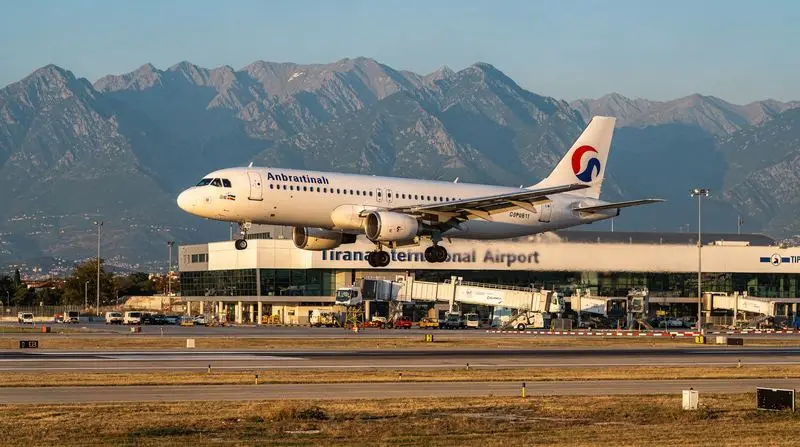
For visitors landing at Rinas for the first time, our airport transfers Tirana guide covers the options from the airport into the city centre, which matters more than it might seem given how much of Tirana’s charm is in the details you would otherwise miss stuck in an overpriced taxi. For digital nomads specifically considering a longer stay to watch the city’s evolution up close, the digital nomad Tirana guide covers what a longer stay actually looks like.
The Museums That Round Out the Picture
Beyond BunkArt and the Pyramid’s own exhibitions, Tirana has developed a genuinely strong museum scene in recent years, one that rewards more than a single afternoon if you have the time. Our museums in Albania guide covers the National History Museum on Skanderbeg Square and several smaller collections that together give a fuller picture of Albanian history than any single stop can. For visitors interested specifically in how the country’s communist decades are documented and discussed today, our communist history of Albania guide is a useful companion to what you see at BunkArt and the Pyramid, connecting the individual sites into a broader historical narrative.
How Tirana Compares to Albania’s Other Cities
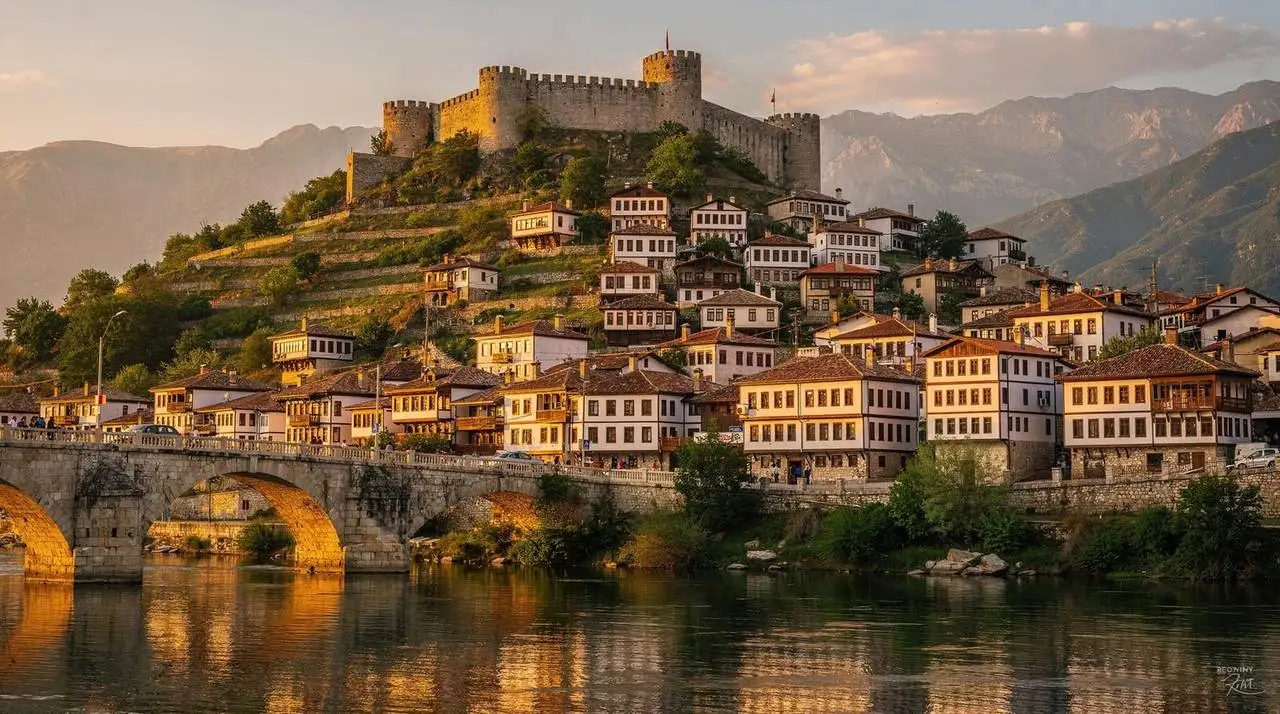
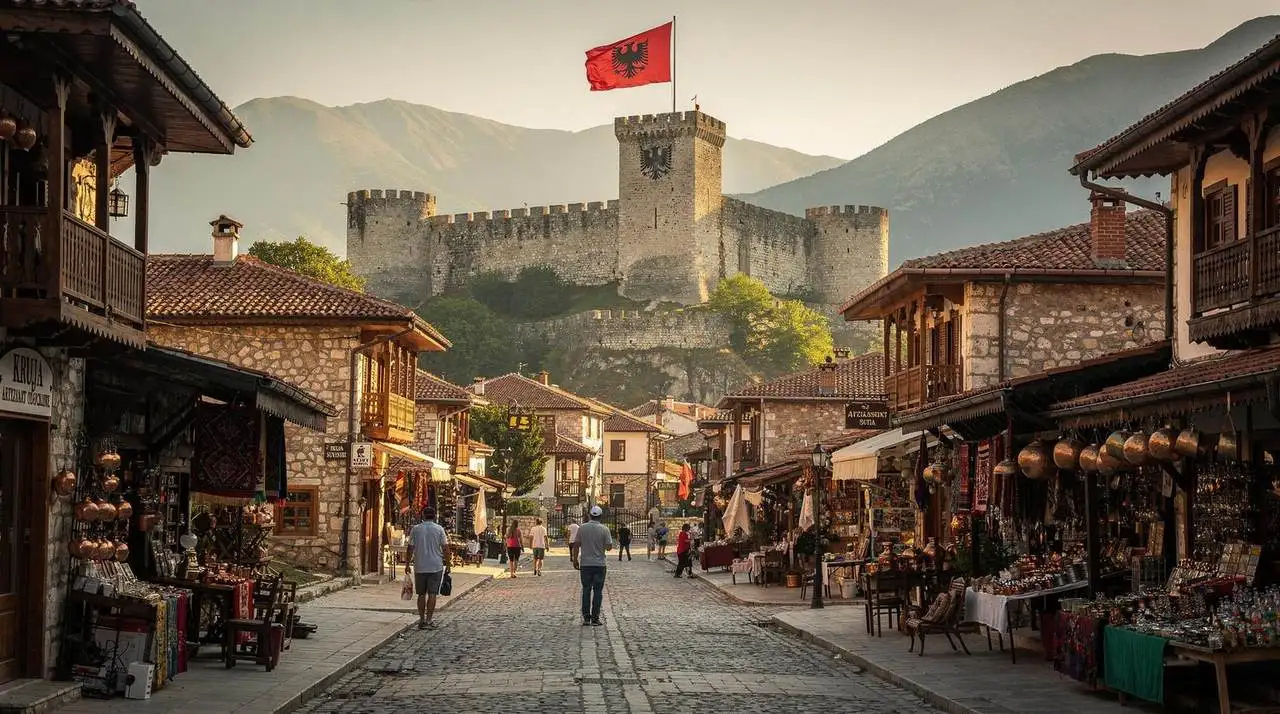
Having spent considerable time across Albania, we think Tirana is best understood in the context of the country’s other historic cities rather than in isolation. The contrast between Tirana’s energy and the medieval weight of Gjirokastra is startling. The visual character of Berat — white Ottoman houses, church towers, an inhabited castle — is almost everything Tirana is not. And the Kruja bazaar, a day trip from the capital, gives you a sense of what Tirana itself might have looked like before the communist planners got to work.
Doing Tirana first, before heading to any of these, is the approach we consistently recommend. The capital orients you to Albanian history, culture, and contemporary life in a way that makes everything you see afterward more comprehensible. Our 14-day Albania itinerary structures this north-to-south progression through the country.
A City Still Becoming
What we find most interesting about Tirana is the sense that it is still in process — still becoming the city it will eventually be. Construction is everywhere. New buildings rise next to old ones. The urban fabric has gaps and contradictions that reflect how quickly everything has changed and how much is still uncertain.
This is not a city that has finished its transformation and settled into confident maturity. It is a city in the middle of figuring itself out, which gives it an energy and a slight unpredictability that fully-formed cities rarely have. Coming here now means being present at a moment that will not last.
If you need to plan your base, our where to stay in Tirana guide covers the neighborhoods and accommodation options across different budgets. The Blloku area puts you at the center of the evening scene; the area closer to Skanderbeg Square is more convenient for daytime sightseeing. Both work. Neither is wrong.
We love Tirana for what it has become. We love it even more for what it is still becoming.
Spend at least two days here at the start of your Albania trip, and let the city set the context for everything that follows.