The Western Balkans: Albania, Kosovo, and North Macedonia
The Western Balkans — Albania, Kosovo, North Macedonia, Montenegro, Bosnia, and Serbia — form one of Europe’s most rewarding multi-country travel regions. The three countries at the core of this itinerary (Albania, Kosovo, and North Macedonia) share deep historical connections through the Ottoman Empire, significant Albanian diaspora communities, and landscapes that transition dramatically between lowland plains, alpine mountains, and ancient lake basins.
All three countries are among Europe’s most affordable travel destinations. Combined, they offer more UNESCO World Heritage Sites, more dramatic mountain scenery, more ancient ruins, and more genuinely distinctive cultural experience per travel dollar than almost anywhere else on the continent.
This itinerary runs Albania as the primary focus (7–10 days), with Kosovo and North Macedonia as 2-to-4-day extensions from Tirana or Shkodra. It works for 14 days at a solid pace; 21 days allows much more depth in each country.
Currency: All three countries use different currencies (Albanian Lek, Kosovo Euro, North Macedonia Denar) but EUR is widely accepted everywhere. ATMs are reliable in all three capitals and most major towns.
Visas: EU, UK, US, Canadian, and Australian passport holders can visit all three countries visa-free.
| Countries | Albania, Kosovo, North Macedonia |
| Duration | 14–21 days |
| Best route | Albania north → Kosovo → North Macedonia → Albania south |
| Currency | Lek (Albania), EUR (Kosovo), Denar (N. Macedonia) — EUR widely accepted everywhere |
| Getting between | Bus, furgon (shared minivan), and shared taxi — no direct trains between the three capitals |
| Budget (14 days) | around EUR 520–740 per person on a budget tier |
For general visa and border-crossing detail before you commit to the loop, see the Albania visa requirements guide.
Routing Options
Option A (recommended): Albania North → Kosovo → North Macedonia → Albania South Tirana → Shkodra → Alps → Pristina → Prizren → Ohrid → Tirana → Berat → Gjirokastra → Saranda
Option B: Albania South-North → Kosovo Day Trip → North Macedonia Day Trip Saranda → Gjirokastra → Berat → Tirana → Shkodra → Alps → back to Tirana, with day trips to Pristina and Ohrid from Tirana
Option C: Linear route (14+ days) Enter Albania at Tirana, exit at Saranda by ferry to Corfu or bus to Greece
Days 1-2: Tirana — Albania’s Capital
Day 1: Arrival and Orientation
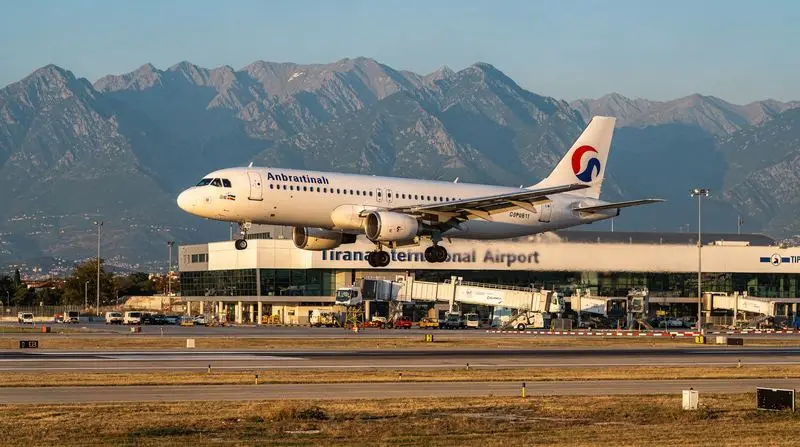
Fly into Tirana International Airport. Albania’s capital is the ideal starting point for a Balkans trip — it’s the most cosmopolitan city in the three-country loop, with the best accommodation, the most international food, and the easiest onward transport connections.
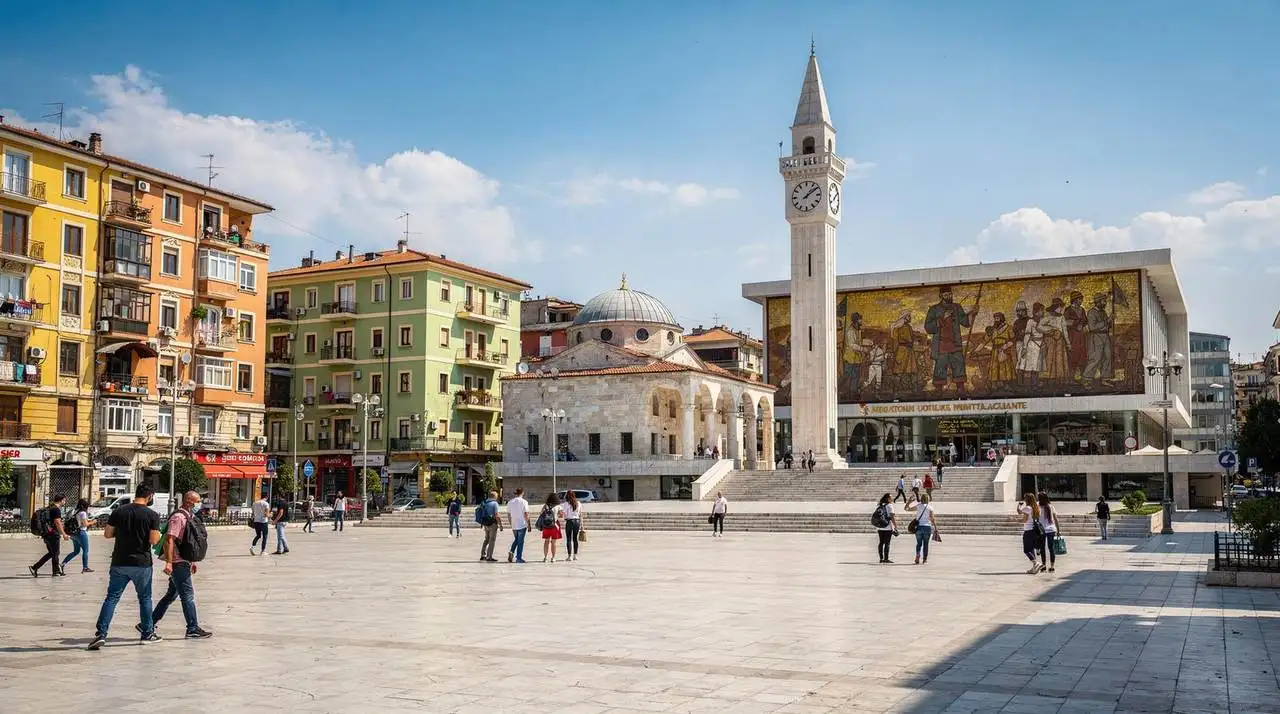
Spend Day 1 at Skanderbeg Square and the Blloku neighbourhood. Join a guided Tirana walking tour for immediate historical context — Albanian history is closely interwoven with Kosovo and North Macedonian history, and understanding Skanderbeg’s legacy here prepares you for what you’ll encounter in Pristina and Ohrid.
Day 2: Museums and Food
National History Museum (700 lekë), BunkArt 2 (600 lekë), Pazari i Ri market lunch. Join the Tirana food tour in the evening for a comprehensive introduction to Albanian cuisine before heading out into the wider region.
Days 3-4: Shkodra and the Albanian Alps
Day 3: Tirana to Shkodra
Morning bus to Shkodra (2 hours, 400 lekë). Visit Rozafa Castle (300 lekë) for the magnificent three-river-confluence views, and the Marubi Photography Museum (500 lekë) — one of the best documentary photography archives in Europe.
Day 4: Koman Lake and Optional Mountain Detour
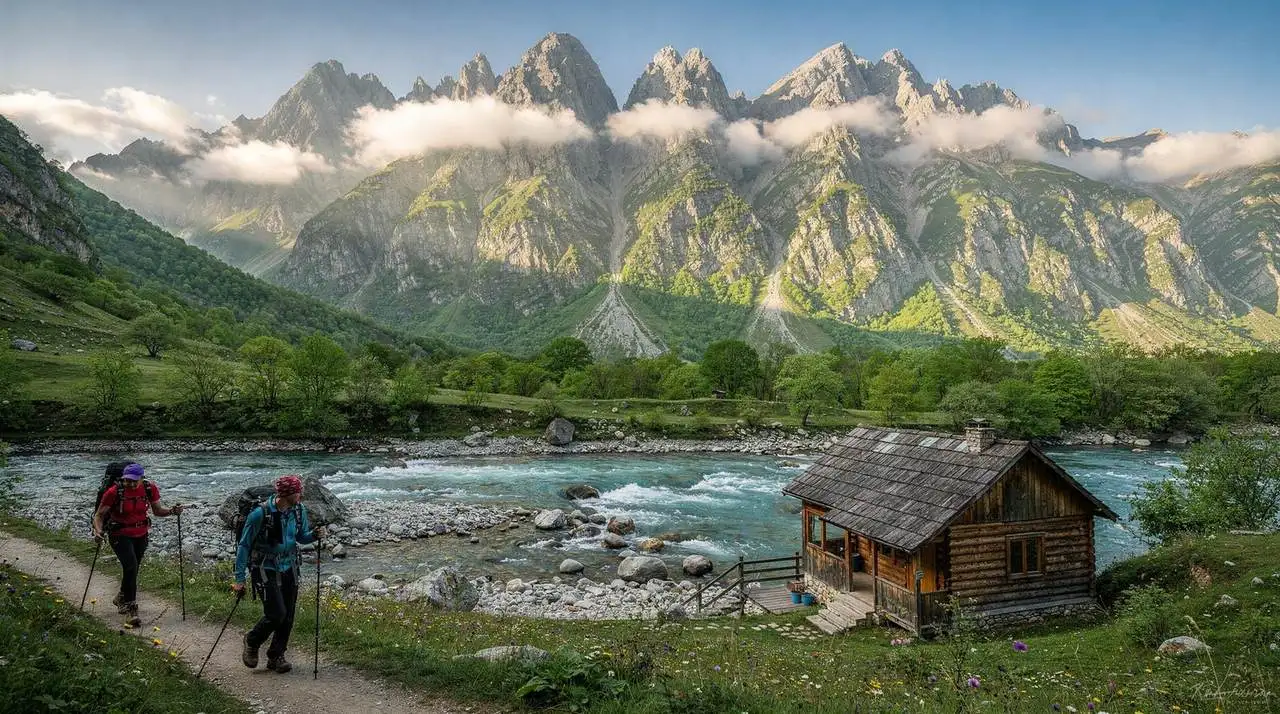
If your itinerary includes a mountain section, Day 4 onwards takes you to Koman Lake and the Albanian Alps (see the 7-day north Albania itinerary for the full Valbona-Theth circuit). This adds 3–4 days to the total.
For the 14-day version without the Alps: use Day 4 for the Shala River boat trip from Shkodra before heading to Kosovo. Book the Koman Lake and Shala River tour from Shkodra as a spectacular half-day experience.
Days 5-6: Kosovo — Pristina and Prizren
Day 5: Tirana to Pristina Day Trip or Overnight
From Tirana, Kosovo is surprisingly accessible. Book a 1-day trip from Tirana to Pristina and Prizren — the most efficient way to see both Kosovo cities in a single long day, with transport and a guide included. The round trip from Tirana covers approximately 700 km and 10+ hours of driving, but the cities are so different from anything in Albania that the effort is worthwhile.
Alternatively, take the morning bus from Tirana or Shkodra to Pristina (3.5–4 hours from Shkodra via the Kosovo border crossing, approximately 800–1,000 lekë) and stay overnight. Pristina is an easy city to navigate; accommodation is cheap (hostels from EUR 12, good hotels from EUR 40).
Pristina: The Newest Capital in Europe
Pristina (Prishtinë) is the capital of Kosovo — the youngest country in Europe, which declared independence from Serbia in 2008. The city is raw, energetic, and still finding its feet as a post-war capital, which gives it a fascinating character quite unlike anything else in the Balkans.
Key sights: the Newborn monument (the word “NEWBORN” in giant painted letters, renovated and repainted annually to mark independence day), the National Library (one of the most striking communist-era buildings in the region — polarising but undeniably memorable), the Ethnological Museum, and the National Museum documenting Kosovo’s history and the 1998–1999 war. The Mother Teresa Square pedestrian zone is the social heart of the city.
Prizren: The Most Beautiful City in Kosovo
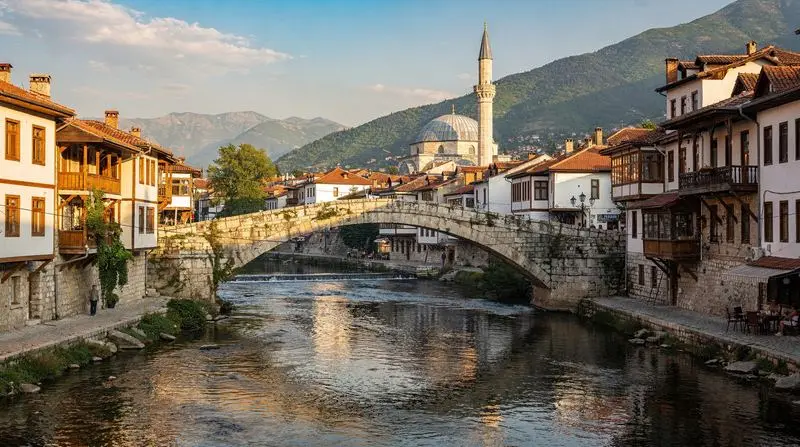
If you can only see one Kosovar city, make it Prizren. A 90-minute bus from Pristina, Prizren is one of the best-preserved Ottoman cities in the Western Balkans: a riverfront of stone bridges and mosques, a hill covered in old neighbourhoods climbing toward the Prizren Fortress, and a culinary scene that combines Albanian, Turkish, and Serbian influences.
The Sinan Pasha Mosque (1615), the Gazi Mehmed Pasha Hammam (1563, restored), the Cathedral of Our Lady of Ljeviš (14th century UNESCO site, damaged in the 2004 riots and partially restored), and the Prizren Fortress with views over the old town are all within easy walking distance.
Prizren’s restaurants serve excellent food at very reasonable prices: grilled meats, stuffed peppers, lake fish, and burek — essentially Albanian cuisine but with some Serbian and Turkish cross-influences. Dinner for two with beer: EUR 15–25.
Days 7-8: North Macedonia — Ohrid and Lake Ohrid
Day 7: Pristina or Tirana to Ohrid
From Pristina: bus to Skopje (3 hours), then bus or taxi to Ohrid (3 hours). Or direct minibus Pristina–Ohrid in approximately 4 hours.
From Tirana: Book a North Macedonia day tour from Tirana — a day trip that covers the highlights of North Macedonia’s most important city without requiring an overnight, returning to Tirana in the evening.
Ohrid is the jewel of North Macedonia and one of the most beautiful cities in the Western Balkans — a lakeside city of Byzantine churches, Ottoman old town lanes, a Roman amphitheatre, and a setting on the ancient Lake Ohrid that is both UNESCO World Heritage (both the lake and the city) and extraordinarily beautiful.
Day 8: Ohrid — Churches, Lake, and Old Town
Ohrid’s highlights:
Sveti Jovan at Kaneo — the most photographed church in North Macedonia, a 13th-century Byzantine church perched on a cliff above the lake. Swim in the remarkably clear water directly below the church.
Ohrid Fortress — Samuel’s Fortress (10th century) above the old town, with views over the lake extending south toward Albania.
Sveta Sofia Church — an 11th-century Byzantine basilica with extraordinarily preserved frescoes; one of the finest churches in the Balkans.
Plaošnik/Sveti Kliment i Pantelejmon — the newly rebuilt church on the site of the original 9th-century complex founded by St Kliment of Ohrid, one of the most important early Slavic cultural figures.
The Roman Amphitheatre — one of the best-preserved in the Balkans, still used for summer performances.
Lake Ohrid is one of the oldest and deepest lakes in Europe — up to 1 million years old — and one of the most biologically diverse freshwater ecosystems on the planet. Swimming in it feels like a privilege.
Note: Lake Ohrid is shared between North Macedonia and Albania. The Albanian shore (Pogradec, Lin village) is accessible from the eastern Albania itinerary — see the 3-week Albania itinerary for the Pogradec section.
Days 9-13: Albania South — Berat, Gjirokastra, Saranda
Return to Tirana from Ohrid (bus via Struga and the Qafë Thanë border crossing to Pogradec, Albania, then bus to Tirana — approximately 4–5 hours total; or direct bus Ohrid to Tirana in some seasons).
Then follow the classic south Albania route:
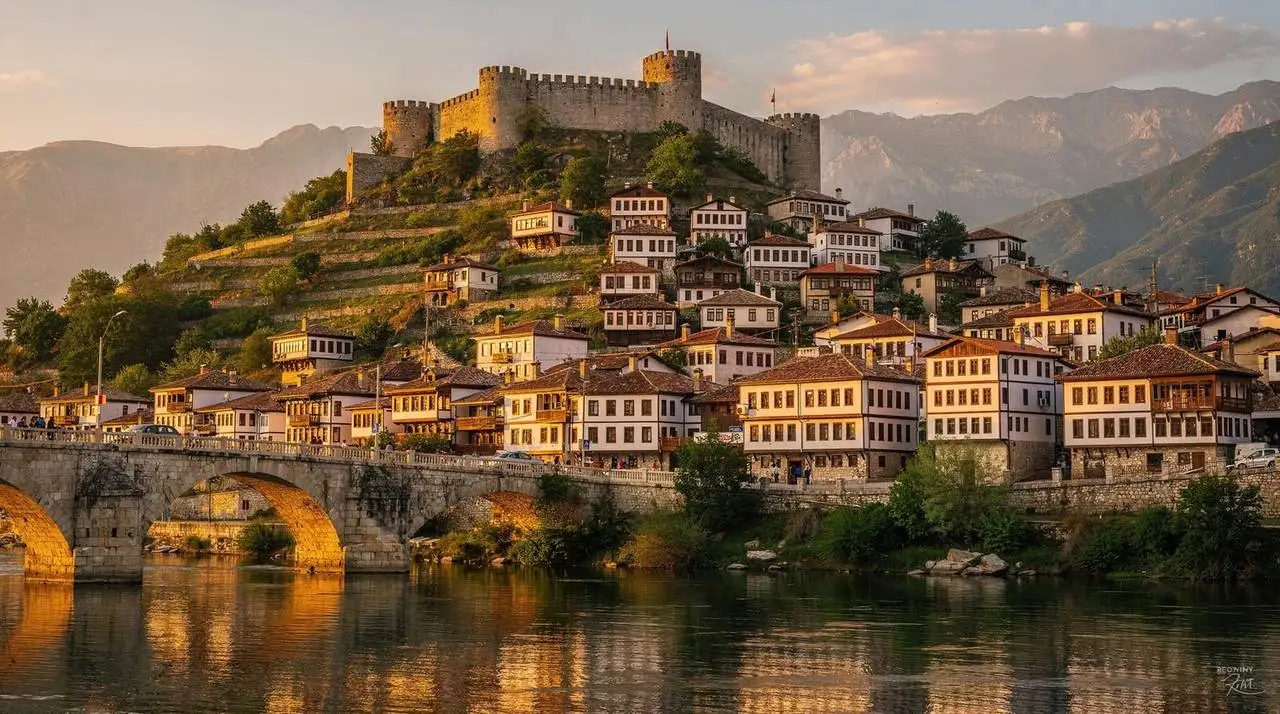
Berat (1–2 days): UNESCO city of the thousand windows, Kalaja castle, Onufri Museum. See the southern cultural tour itinerary for a detailed guide.
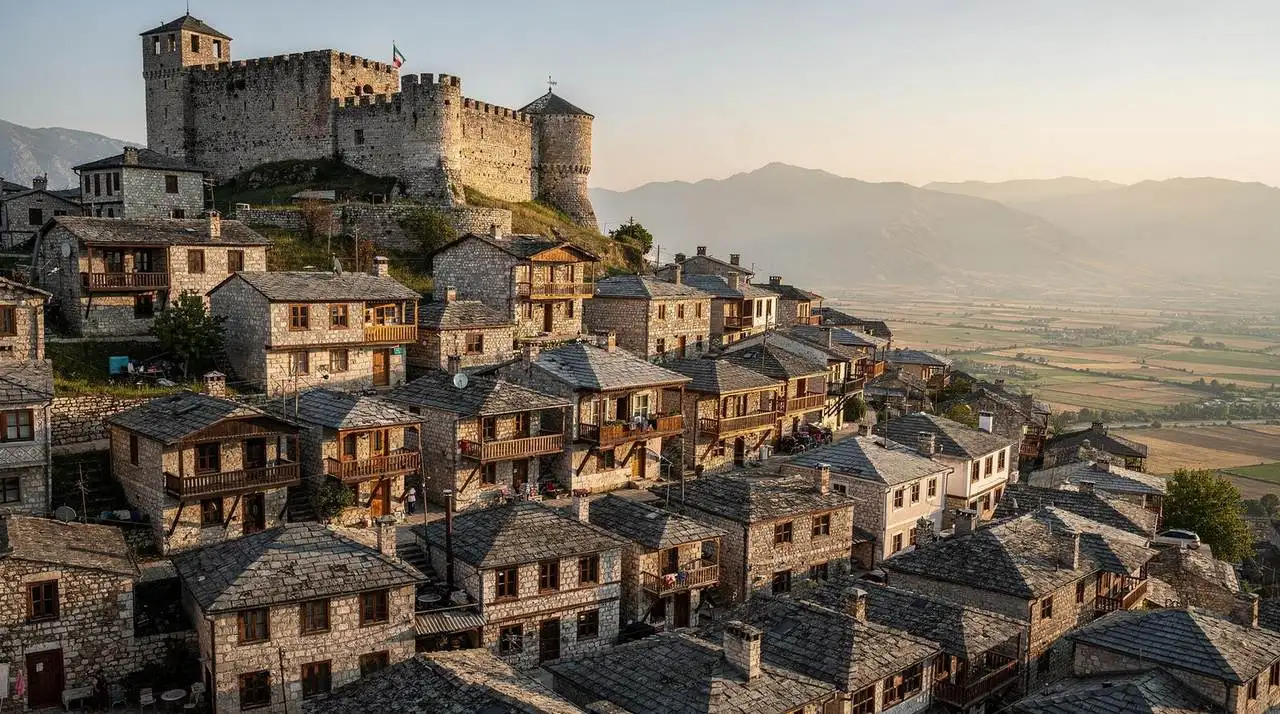
Gjirokastra (1 day): UNESCO stone city, Gjirokastra Castle, Zekate House, old bazaar. Join a guided Gjirokastra tour for proper cultural context.
Blue Eye and Saranda (1–2 days): The extraordinary Blue Eye karst spring, Butrint UNESCO site, Ksamil beach, and the Saranda waterfront.
The Regional Context: Why These Three Countries Work Together
Historical connections: Albania, Kosovo, and North Macedonia were all part of the Ottoman Empire for 400–500 years. Ottoman architecture — mosques, hammams, hans (caravanserais), covered bazaars — appears across all three countries in different states of preservation. Seeing Berat’s Ottoman quarter, then Prizren’s Ottoman riverfront, then Ohrid’s Ottoman old town allows you to understand the regional Ottoman legacy in a way that no single-country trip does.
Albanian diaspora: Significant Albanian populations live in Kosovo (where Albanians are the majority) and North Macedonia (where they make up approximately 25% of the population, concentrated in the west). The similarities in language, food, and cultural practices across borders are striking and interesting.
The Skanderbeg thread: Gjergj Kastrioti Skanderbeg — Albania’s national hero — appears as a historical figure across all three countries. In Tirana (his statue dominates the central square), in Kruja (his castle), in Kosovo (significant monuments and place names), and in Prizren (he was born in the nearby region). Tracing his story across the region gives the trip a satisfying historical thread.
Price comparison: In 2024, approximate daily budget costs: Albania EUR 30–45; Kosovo EUR 28–40; North Macedonia EUR 30–45. All three are significantly cheaper than Serbia or the Adriatic coast. The combined trip is exceptional value.
14-Day Balkans Itinerary: Condensed Schedule
| Day | Location | Main activities |
|---|---|---|
| 1 | Tirana, Albania | Arrive, Skanderbeg Square, walking tour |
| 2 | Tirana | Museums, food tour |
| 3 | Shkodra, Albania | Rozafa Castle, Marubi Museum |
| 4 | Koman Lake/Shkodra | Boat tour, prepare for Kosovo |
| 5 | Pristina, Kosovo | Old town, Newborn monument, museums |
| 6 | Prizren, Kosovo | Ottoman old town, fortress, return to Tirana |
| 7 | Tirana → Ohrid | Travel day |
| 8 | Ohrid, North Macedonia | Churches, lake, old town |
| 9 | Tirana, Albania | Return, overnight |
| 10 | Berat | UNESCO city, Kalaja, Onufri Museum |
| 11 | Berat/Gjirokastra | Travel and Gjirokastra guided tour |
| 12 | Gjirokastra | Old bazaar, Zekate House |
| 13 | Blue Eye, Saranda | Spring visit, Butrint archaeological site |
| 14 | Ksamil, Saranda | Beach, departure |
21-Day Version: More Depth Everywhere
With 21 days, extend each section:
Albania (12 days): Add Permet and the Benja Thermal Baths, the Albanian Alps (Valbona-Theth trek), Apollonia, and Korce.
Kosovo (3 days): Add the Rugova Canyon near Peja — a dramatic limestone gorge with waterfalls and traditional guesthouses; the Patriarchate of Peja (a medieval Serbian Orthodox monastery in a remarkable setting); and the Decani Monastery (another UNESCO-listed medieval monastery with extraordinary 14th-century frescoes).
North Macedonia (3 days): Add Skopje (the capital, architecturally bizarre and fascinating — the communist core surrounded by the Skopje 2014 neoclassical theatre), the Canyon of Matka (a beautiful lake canyon near Skopje with cave swimming), and the Heraclea Lyncestis Roman site near Bitola.
Balkans 14-Day Budget Summary
| Category | Budget | Mid-range | Comfortable |
|---|---|---|---|
| Albania accommodation (8 nights) | EUR 110–160 | EUR 280–400 | EUR 560–800 |
| Kosovo accommodation (2 nights) | EUR 24–40 | EUR 60–100 | EUR 120–200 |
| N. Macedonia accommodation (2 nights) | EUR 24–40 | EUR 60–100 | EUR 120–200 |
| Intercity transport (all) | EUR 55–85 | EUR 100–160 | EUR 200–320 |
| Museum entries (all countries) | EUR 35–45 | EUR 35–45 | EUR 35–45 |
| Food (avg. per day all countries) | EUR 18–25 | EUR 35–55 | EUR 60–95 |
| Guided tours and activities | EUR 20–60 | EUR 100–180 | EUR 250–450 |
| Total 14 days | EUR 520–740 | EUR 1,020–1,490 | EUR 2,100–3,200 |
Per person. The three-country combination delivers extraordinary value: 14 days of UNESCO World Heritage Sites, mountain landscapes, Ottoman cities, ancient ruins, and Ionian beaches for budgets that would cover a week in Italy or Greece.
Essential Tips for the Three-Country Loop
Border crossings: Albania-Kosovo (Morina crossing near Kukes, or Han i Hotit near Shkodra), Albania-North Macedonia (Qafë Thanë near Pogradec, or Qafë Prushi), Kosovo-North Macedonia (multiple crossings). All are straightforward for Western passport holders; allow 30–60 minutes.
No direct trains: The Western Balkans have limited rail infrastructure. Buses and shared taxis (furgons) are the primary transport. They are cheap, frequent, and generally reliable.
Language: Albanian is spoken in Albania, Kosovo, and western North Macedonia. In Kosovo, Serbian is the other official language. In North Macedonia’s capital Skopje and along the eastern coast, Macedonian (South Slavic) is dominant. English is widely understood by younger people and tourism workers in all three countries.
Schengen: As of 2025, Albania has joined the Schengen Area. Kosovo is not Schengen. North Macedonia is not Schengen. Check entry requirements for your specific passport before travelling.
The Western Balkans: A Shared History
Understanding the shared history of Albania, Kosovo, and North Macedonia transforms a simple multi-country trip into a genuinely coherent historical journey. The three countries are bound by the Ottoman period (all were part of the empire from the 14th–20th centuries), by the post-Ottoman carve-up of 1912–1913 (which left large Albanian populations inside the new borders of Serbia and Macedonia), and by the subsequent 20th century in which Albanian identity was alternatively suppressed (in Yugoslavia) and fiercely protected (in Albania, at the cost of extreme isolation).
The Albanian Question: The single largest unresolved legacy of the 1912 Balkan Wars is the fragmentation of the Albanian ethnic territory between four states: Albania, Kosovo, North Macedonia, and Montenegro. Approximately 7–8 million ethnic Albanians live in this region; only about 3 million live in Albania itself. Kosovo has an Albanian-majority population of about 92%; western North Macedonia (around Tetovo and Gostivar) is majority Albanian. Understanding this geography makes the three-country trip far more coherent — you’re not moving between alien cultures but between different political expressions of a continuous cultural zone.
Ottoman city form: All three countries have exceptional examples of Ottoman urban form — the covered bazaar (çarshi), the mosque and associated buildings (medrese, hammam, han), and the tower house. Compare Berat’s Mangalem, Prizren’s Old Town, and Ohrid’s old town to see three variants of the same Ottoman Balkan urban tradition, each shaped differently by local topography, climate, and social history.
Religious complexity: All three countries have complex, layered religious histories. Albania is officially secular with a Muslim majority but strong Orthodox and Catholic minorities; Kosovo is majority Muslim but with significant Orthodox Serbian communities (protected in monasteries and enclaves); North Macedonia has a majority Orthodox Christian population but a substantial Muslim Albanian minority. Across all three, religious identity intersects with ethnic identity in ways that are historically meaningful but not always straightforwardly predictable.
Food Across the Three Countries
Albanian food (Albania and Kosovo): The cuisine is essentially the same across both countries — the political border does not correspond to a cultural one. Byrek, tave kosi, qofte, flia, and the raki culture are shared. Kosovo does have some Serbian-influenced dishes (cevapi, pljeskavica) that appear more commonly in Serbian-run restaurants, but the Albanian food culture dominates.
North Macedonian food (Ohrid and Skopje): North Macedonian cuisine draws more heavily on the South Slavic tradition — shopska salad (tomatoes, cucumbers, onions with white cheese, essentially the same as Greek horiatiki), tavche gravche (baked beans in earthenware, the national dish), and various grilled meats. In the Albanian-majority western regions around Tetovo, the food transitions toward Albanian cuisine. Lake Ohrid has its own specialty: the Ohrid trout and the endemic lake crayfish (raki from lake fish is a local delicacy).
Shared food culture: Across all three countries, the coffee culture is strong, the restaurant hospitality is warm, and the prices are far below Western European norms. A full sit-down dinner with drinks costs EUR 8–15 per person at a good local restaurant in all three capitals.
Accommodation Comparison: Value Across Three Countries
| Country | Hostel dorm | Budget private | Mid-range hotel | Good hotel |
|---|---|---|---|---|
| Albania | EUR 10–15 | EUR 20–35 | EUR 40–70 | EUR 80–150 |
| Kosovo | EUR 10–14 | EUR 18–30 | EUR 35–65 | EUR 70–130 |
| North Macedonia | EUR 10–15 | EUR 20–35 | EUR 40–75 | EUR 80–160 |
All three countries offer similar price ranges. Kosovo is marginally cheaper in the budget category; North Macedonia (Ohrid specifically) can be slightly more expensive in the comfortable category due to high domestic tourism demand at the lake in summer.
Getting Between Kosovo and North Macedonia
The Kosovo-North Macedonia border crossing at Blace (the main road crossing between Pristina and Skopje) is straightforward for Western passport holders. The bus from Pristina to Skopje takes approximately 1.5 hours and costs EUR 8–12. From Skopje, buses to Ohrid take 3 hours (through the mountains via Tetovo and Struga); the road is dramatic and the final descent to the lake is spectacular.
From Ohrid to Albania, the Qafë Thanë border crossing (near Struga on the lake) is the most convenient. Buses and shared taxis run the Struga-Pogradec (Albania) route; from Pogradec, connections to Elbasan, Tirana, and south Albania are straightforward.
A Note on Kosovo’s Status
Kosovo declared independence from Serbia in 2008 and is recognised by over 100 countries, including the USA, most of the EU, and Albania. Serbia does not recognise Kosovo’s independence; neither do Russia, China, and several other countries.
For travellers, this means: Kosovo has its own border controls (separate from Serbia), its own customs procedures, and its own stamps in your passport. If you intend to visit Serbia after Kosovo, be aware that Serbia may refuse entry to travellers with Kosovo entry stamps (though this has become less common in practice — verify current policy before travelling). If you enter Kosovo via Albania (as this itinerary does) rather than via Serbia, you have more flexibility.
Kosovo is a young, energetic country that is very positive about international visitors. The people — predominantly young; Kosovo has the youngest median age in Europe — are enthusiastic, internationally minded, and genuinely welcoming to tourists. The capital Pristina, despite its rough edges, has one of the most energetic nightlife and cafe scenes in the Western Balkans.
Best Time of Year for the Three-Country Loop
Timing affects this itinerary more than most single-country trips, because you’re crossing altitude zones (Albanian coast to Kosovo highlands to the Ohrid basin) and because some sections — the Koman Lake ferry and the Alps detour in particular — are weather-dependent.
| Season | Conditions | Verdict |
|---|---|---|
| May–June | Warm, green, pass roads clearing, low crowds | Best overall — good light for Ohrid and the Alps |
| July–August | Hot, peak crowds at Ohrid and the Riviera, book ahead | Workable but busier and pricier everywhere |
| September | Warm days, thinning crowds, stable weather | Excellent — arguably the best month |
| October | Cooling fast, mountain guesthouses closing late month | Fine for the lowland loop, risky if adding the Alps |
| November–March | Cold, wet, mountain roads and Koman ferry schedules unreliable | Skip the Alps extension; the city/UNESCO loop still works |
If you’re adding the Valbona-Theth extension mentioned in Days 9–13, plan the trip between June and September — see the Theth-Valbona trek itinerary for exact seasonal windows.
Practical Money and Connectivity Notes
Carry small-denomination lek for Albania, euros for Kosovo, and be ready to withdraw denar on arrival in North Macedonia — ATMs are reliable in all three capitals but rarer in smaller towns. A local SIM bought in Tirana (see the Albania SIM card guide) generally works fine for data throughout Albania; expect to swap or roam once you cross into Kosovo or North Macedonia, since coverage doesn’t carry over. Budget more buffer time than you think for the furgon and bus network — schedules are reliable in spirit but loose in practice, especially on the Kosovo and North Macedonia legs.
Frequently Asked Questions About the Balkans Albania Itinerary
Do I Need a Car for This Itinerary?
No. Buses, furgons, and the day tours referenced throughout this itinerary cover every leg, including the Kosovo and North Macedonia extensions. A car adds flexibility for the 21-day version’s extra stops (Rugova Canyon, Matka Canyon) but isn’t required.
Is 14 Days Enough, or Should I Aim for 21?
14 days works at a solid but busy pace and covers the itinerary’s core. 21 days is meaningfully better if you can manage it — it allows the Albanian Alps extension, plus proper depth in Kosovo and North Macedonia rather than one long day each.
Which Currency Should I Carry Across Three Countries?
Euros cover you almost everywhere as a backup, but withdraw local currency (lek in Albania, euro is already the currency in Kosovo, denar in North Macedonia) on arrival in each country for small purchases, furgons, and market stalls, which are usually cash-only.
Can I Do This Trip Without Speaking Albanian, Serbian, or Macedonian?
Yes. English is widely understood by tourism workers and younger people in all three countries’ main cities and tourist areas. Smaller towns and market interactions sometimes need gestures or a translation app, but this is not a barrier to independent travel.
Packing for a Three-Country, Three-Season Trip
This itinerary crosses coastal Albania, alpine terrain if you add the north, and the inland basins of Kosovo and North Macedonia, so pack in layers rather than for a single climate. A lightweight rain shell earns its place year-round — mountain weather near Shkodra and Rugova Canyon turns quickly even in summer. Comfortable walking shoes matter more than anything else on this itinerary: Berat’s cobbled Mangalem lanes, Prizren’s riverfront stones, and Ohrid’s old town hills are all best explored on foot, often for hours at a stretch. Bring a padlock and a few passport photocopies — border crossings are straightforward, but having documentation backed up removes one source of stress on a trip that crosses three sets of customs and immigration checks. See the Albania packing list guide for a fuller checklist that applies equally well across the Kosovo and North Macedonia legs.