Southern Albania Cultural Tour: Two UNESCO Cities, Ancient Thermal Baths, and Ionian History
Southern Albania is one of Europe’s richest cultural landscapes: two UNESCO World Heritage cities built by different civilisations on the same mountain ridges, Hellenistic and Roman cities buried in the lowlands, Byzantine churches whose frescoes have survived centuries of conquest, and a living culinary tradition rooted in Ottoman, Greek, and Albanian influences. This 5-to-7-day cultural tour focuses on depth over distance — taking cooking classes, joining guided tours, and spending proper time in each place rather than rushing through the highlights.
This itinerary is ideal for travellers who prioritise cultural immersion over physical challenge: there is no serious hiking, the transport is manageable without a car, and the pace is gentle enough to allow genuine engagement with what you’re seeing. For those who want to add beaches to the cultural experience, the itinerary ends in Saranda, from where the Riviera is easily accessible.
| Where | Tirana → Berat → Permet → Gjirokastra → Blue Eye → Butrint → Saranda |
| Cost | around EUR 230–330/person for 5 days on a budget tier |
| Time needed | 5–7 days, no car required |
| Getting around | Intercity bus and shared taxi |
| Best time | April–June or September–October for mild weather and lighter crowds |
Overview
- Day 1: Tirana — arrival and orientation
- Day 2: Travel to Berat; afternoon in the old town
- Day 3: Berat cooking class and castle
- Day 4: Permet and the Benja Thermal Baths
- Day 5: Gjirokastra guided tour
- Day 6: Blue Eye and Butrint
- Day 7: Saranda and departure
Day 1: Tirana — A City Transformed
Afternoon: Skanderbeg Square and Blloku
Arrive at Tirana International Airport and transfer to your accommodation. Tirana rewards the culturally curious: behind its brightly painted facades and energetic cafe culture lies an extraordinarily complex history of Illyrian, Byzantine, Ottoman, and communist occupation, all compressed into a walkable city centre.
Begin at Skanderbeg Square — the vast pedestrianised central plaza — and visit the Et’hem Bey Mosque (1821), whose interior features unusually naturalistic frescoes of landscapes and animals, technically forbidden in Islamic art but reflecting the syncretic character of Ottoman Albania. Take the Clock Tower elevator (200 lekë) for views over the square.
Walk south through Blloku — the neighbourhood sealed off for communist party elites until 1991, now the city’s trendiest quarter — and explore the contrast between the Soviet-era apartment blocks and the post-communist colour. The street art here is among the best in the region.
Evening: Traditional Dinner
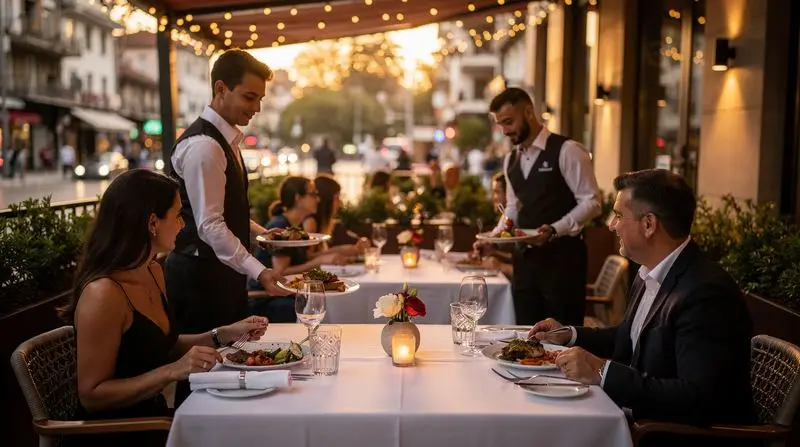
Dinner at Oda Restaurant (Rruga Luigi Gurakuqi) — one of the finest traditional Albanian restaurants in Tirana, set in a space filled with Ottoman-era antiques. Order the sampler of traditional dishes: fërgësë (Tirana’s signature pepper and cottage cheese dish), tave kosi (lamb baked with yoghurt and eggs), and dolma (stuffed vine leaves). Wash it down with house raki and local wine. Budget 2,000–3,500 lekë per person.
Day 2: Tirana to Berat
Morning: National History Museum
Before leaving Tirana, spend the morning at the National History Museum (700 lekë) — the best single introduction to Albanian history, from Illyrian bronze-age objects through Byzantine religious art, Ottoman-era objects, and communist period documentation. The museum prepares you to understand what you’ll see in Berat and Gjirokastra in cultural context.
Afternoon: Travel to Berat
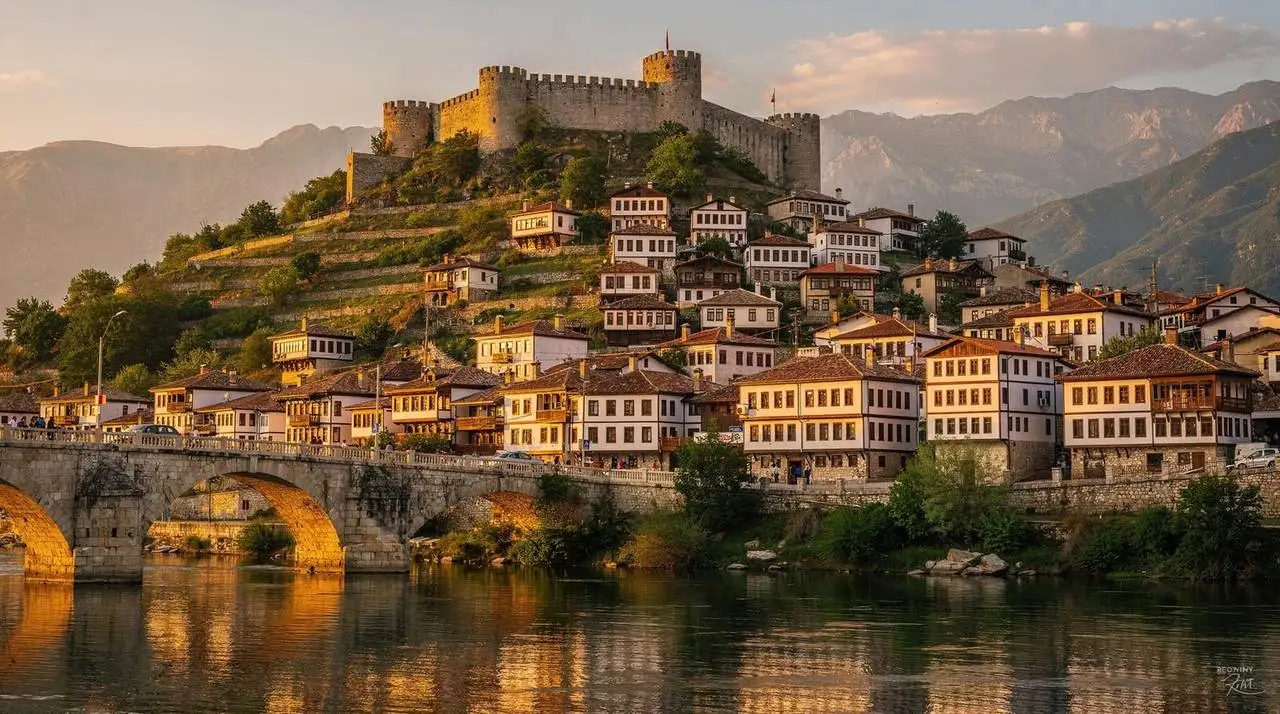
Morning bus to Berat — 2 hours, 400 lekë. Arrive in the UNESCO city and check into your old town guesthouse in Mangalem. Spend the afternoon walking the quarter’s cobblestone lanes and getting oriented: the Bachelors’ Mosque, the old fountains, the views up to the castle.
Cross the ancient bridge to the Gorica quarter for a sunset coffee at one of the cafe terraces overlooking the Osum River and the Mangalem hillside. The famous “thousand windows” catch the late-afternoon light and create the most photogenic scene in Berat.
Evening: Guesthouse Dinner
Most Berat guesthouses in the old town serve excellent home-cooked dinners. This is the truest introduction to Albanian hospitality: large portions of fresh local food, sometimes with the host family eating alongside you, raki poured generously, and conversation that ranges across language barriers with good will.
Day 3: Berat — Cooking Class and the Castle
Morning: Albanian Cooking Class
This is the cultural centrepiece of the tour. Join a Berat cooking class — typically 3–4 hours working with a local host to prepare traditional Albanian dishes: byrek with spinach and cheese, tave kosi, flia (layered crepe dish), homemade pickles, and local desserts. Most classes begin with a visit to the morning market to select ingredients, then move to a traditional kitchen.
Albanian cooking is more complex and interesting than its relative obscurity suggests: it draws from Ottoman, Greek, Italian, and Balkan traditions, uses exceptional local ingredients (olive oil, lamb, fresh vegetables, local dairy), and has distinct regional variations. A cooking class in Berat — using produce from the Osum valley — gives you both skills and stories to take home.
Afternoon: Kalaja Castle and Onufri Museum
After lunch (which you’ve just cooked), walk up to Kalaja — Berat’s inhabited castle, one of the most extraordinary historical sites in Albania. People still live within the castle walls: around 400 inhabitants tend gardens and keep chickens inside a medieval fortification, giving the whole site a lived-in quality entirely unlike a standard tourist attraction.
The Onufri Museum in the Church of the Dormition of St Mary (400 lekë) houses icons by Onufri — a 16th-century Albanian master whose work is the finest example of post-Byzantine painting in the region. His distinctive red pigment (“Onufri red”) is immediately recognisable; the quality of his execution and the expressiveness of his figures are remarkable for the period.
Explore the castle’s multiple Byzantine churches, the cisterns, the towers, and the views over the Osum valley. The castle at sunset, when the light turns the limestone walls golden, is spectacular.
Evening: Berat Wine and the Old Town
Berat produces distinctive local wine from the Trebicano grape variety (white) and various indigenous red grapes. Several restaurants and wine shops in the old town stock locally produced bottles. A wine-focused dinner at one of the Mangalem terrace restaurants — tasting local wines with grilled meats and salads — makes a fitting end to a day of culinary immersion.
Day 4: Permet — Thermal Baths and the Vjosa River
Morning: Travel to Permet
Bus or shared taxi from Berat to Permet — approximately 3 hours via Tepelena. Permet is a small, relaxed town on the Vjosa River in a valley surrounded by forested limestone mountains. It is less visited than Berat or Gjirokastra, which gives it an authenticity and quietness that cultural travellers tend to prize.
The town centre has a pleasant promenade along the Vjosa, several good cafes, and craft shops selling the local speciality: Permet gliko (fruits preserved in sugar syrup, particularly quince, orange, citrus, and rose). These make excellent gifts and are sold by elderly women from home kitchens as much as from shops.
Afternoon: Benja Thermal Baths
Join a Permet and Benja thermal baths tour for a guided excursion to the hot springs and the canyon.
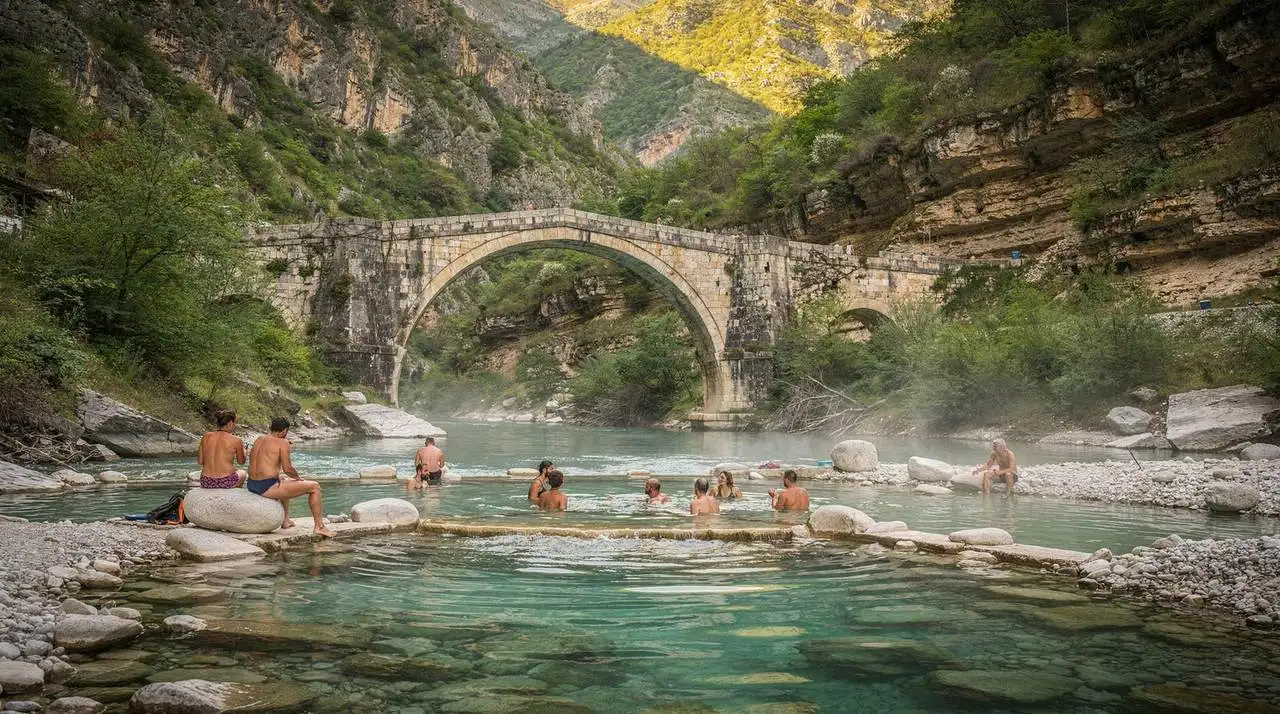
The Benja Thermal Baths on the Langarica River — a tributary of the Vjosa — are among the most beautiful natural bathing spots in Albania. Hot mineral water emerges from the rock walls of a limestone canyon at temperatures ranging from 29°C to 38°C, collected in natural and semi-natural pools. The setting — sheer canyon walls, the cold river rushing below, the ancient Ottoman bridge spanning the gorge upstream — is extraordinary.
The Ottoman bridge at Benja (18th century) is a beautifully proportioned single-arch stone bridge spanning the Langarica gorge; walk across it before or after your bath for the full effect.
The canyon itself — the Langarica Canyon — extends several kilometres upstream from the thermal pools, with walls up to 150 metres high. It’s possible to walk into the canyon in dry season when the water level is low.
Evening: Overnight in Permet
Stay overnight in Permet — guesthouses and small hotels in the centre are good value (2,500–4,000 lekë per room). Dinner at one of the riverside restaurants: local trout, lamb, and vegetables. Permit wine is worth trying; the region produces some underrated bottles from indigenous Vlosh and Serekan grapes.
Day 5: Gjirokastra — The Stone City in Depth
Morning: Travel to Gjirokastra
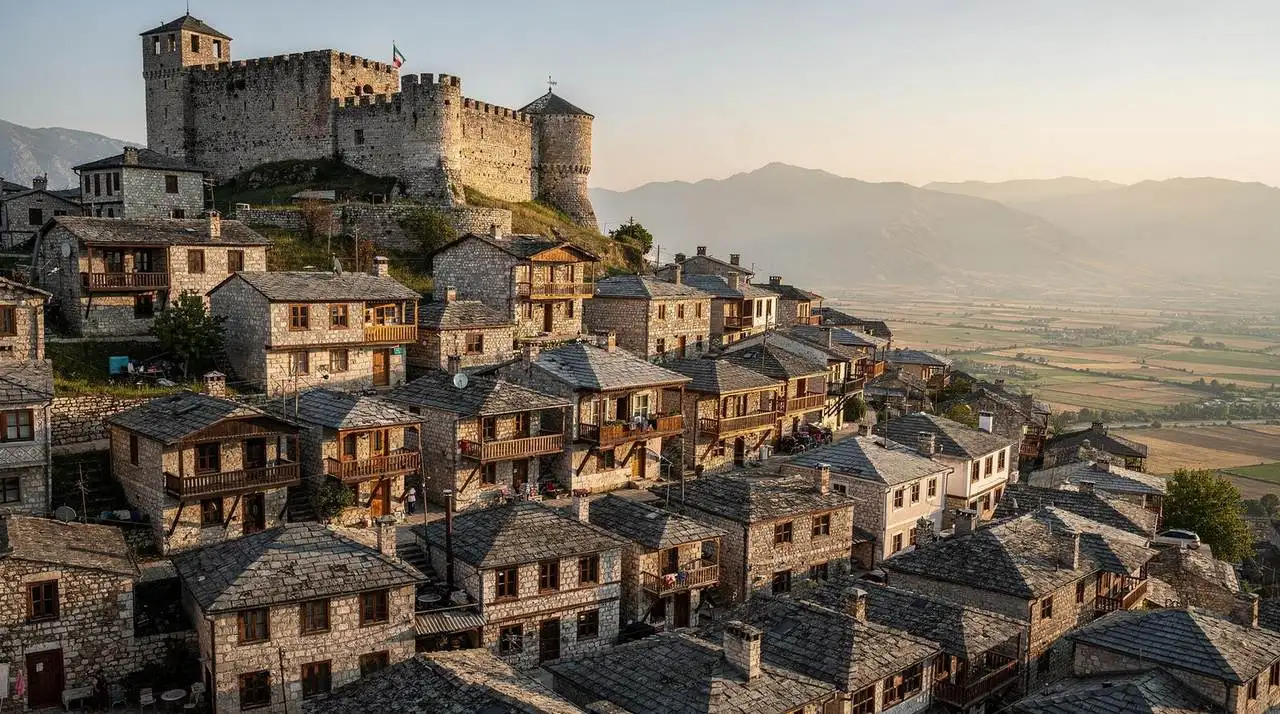
Bus or shared taxi from Permet to Gjirokastra — approximately 1.5–2 hours. Gjirokastra is UNESCO World Heritage alongside Berat but feels entirely different: built from grey local stone on a dramatically steep hillside, it is more austere, more fortress-like, and perhaps even more visually powerful.
Morning/Afternoon: Guided City Tour
Book a guided Gjirokastra city tour — this is the single most important investment you can make in your Gjirokastra experience. The guides here are excellent, typically with deep local knowledge of the specific families who built the tower houses, the folklore and legends attached to particular buildings, the city’s role in Albanian resistance to the Ottomans and later to the communist regime, and the literary significance of the city as birthplace of Ismail Kadare (Albania’s greatest novelist).
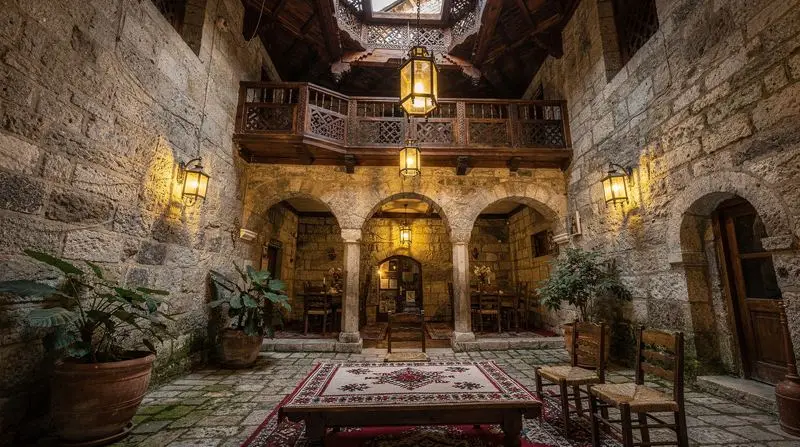
The tour covers: Gjirokastra Castle (500 lekë) with its extraordinary views and captured US Air Force jet, the Old Bazaar and its mosque, the Zekate House (300 lekë — the finest example of the tower house typology, 18th century, with superb painted wooden ceilings), and the Kadare birthplace museum.
Afternoon: Ethnographic Museum and Castle Bazaar
If time permits, visit the Ethnographic Museum in another restored tower house — excellent collections of traditional costumes, weapons, household objects, and documentation of the Gjirokastra architectural tradition. The museum explains the building typology (defensive lower storey, habitable upper storey, roof terrace with views) that makes Gjirokastra’s houses so distinctive.
Walk the castle neighbourhood at your own pace after the guided tour: the old town is small enough to cover entirely on foot, and the streets between the tower houses — some so narrow two people must turn sideways to pass — are as interesting as the formal sights.
Evening: Old Town at Night
Gjirokastra’s old town at night, when day visitors have left, is beautiful and atmospheric. Several restaurants in the bazaar area serve good food; Sopoti Restaurant and Kujtimi Restaurant are reliable. After dinner, walk to one of the upper viewpoints for a night view over the valley.
Day 6: Blue Eye Spring and Butrint
Morning: The Blue Eye
From Gjirokastra, take a shared taxi or morning bus toward Saranda and stop at the Blue Eye (Syri i Kaltër) — 25 km east of Saranda on the Gjirokastra road. The Blue Eye is a karst spring where water wells up from an unknown underground source, creating a vivid cobalt disc fringed by turquoise and green in the forest floor. The colour is extraordinary and genuinely difficult to capture in photographs — more saturated and complex than any image suggests.
The surrounding plane tree forest is ancient and beautiful; the sound of the water and the filtered light through the leaves make this one of the most calming natural environments in Albania. Entry to the park: 100 lekë. The water temperature is a constant 10°C year-round.
Join a half-day Blue Eye tour from Saranda for transport and a guide — the easiest option if you’re already based in Saranda.
Afternoon: Butrint Archaeological Site
Continue to Saranda for lunch (1 hour from the Blue Eye), then take a taxi (600–800 lekë) or bus to Butrint — 12 km south of Saranda, one of the most significant archaeological sites in the Balkans and a UNESCO World Heritage Site since 1992.
Butrint is a compact peninsula site where six distinct civilisations left their mark: Greek colonists, Romans, Byzantines, Normans, Angevins, and Venetians — all visible within a 2 km walk through ancient forest. Key monuments: the well-preserved Greek theatre (3rd century BC, still intact enough to see where the audience sat), the extraordinary baptistery mosaic (one of the finest floor mosaics in the region, covering the full interior of an early Christian church), the massive city walls, the Roman forum, and the Venetian tower. Entry 1,000 lekë; allow 2 hours.
Evening: Saranda Waterfront
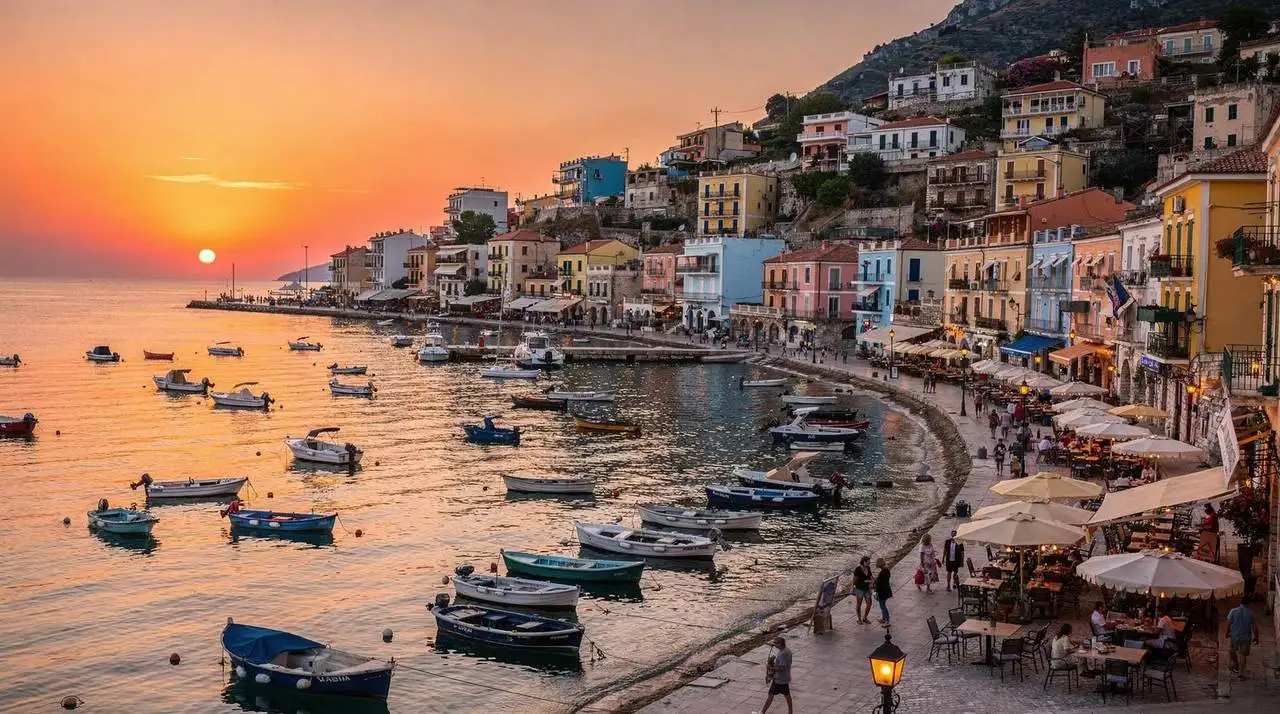
Saranda’s promenade at sunset, with Corfu visible directly across the water, is one of the great Ionian views. Fresh seafood dinner on the waterfront — grilled sea bass, octopus salad, fresh calamari with local white wine. Budget 1,800–2,800 lekë per person for a proper restaurant dinner.
Day 7: Saranda and Departure
Morning: Ksamil or Slow Morning
Spend the final morning either at the beach in Ksamil (15 km south of Saranda, Albania’s finest beach) or at a leisurely breakfast cafe on the Saranda promenade. The morning is for decompression after a culturally rich week.
From Saranda you can: take the bus back to Tirana (4–5 hours, 700 lekë), take the ferry to Corfu (45 minutes), or continue along the Riviera toward Vlora. For the Albania and Greece combined itinerary, the Saranda-Corfu ferry is the natural connection.
Cultural Experiences Checklist
Working through this itinerary, you’ll have:
- Visited two UNESCO World Heritage cities (Berat and Gjirokastra)
- Attended a traditional Albanian cooking class
- Bathed in naturally hot thermal springs in a limestone canyon
- Explored a major Greek/Roman/Byzantine/Venetian archaeological site (Butrint)
- Seen some of the finest Byzantine icons in southeastern Europe (Onufri Museum)
- Experienced authentic Ottoman domestic architecture (Zekate House)
- Swum in one of Europe’s most unusual natural springs (Blue Eye)
- Tasted wines from indigenous Albanian grape varieties
- Sampled traditional preserved fruits from the Permet region
5-7 Day Southern Cultural Tour Budget Summary
| Category | Budget (5 days) | Mid-range (5 days) | Comfortable (7 days) |
|---|---|---|---|
| Accommodation | EUR 70–100 | EUR 175–250 | EUR 350–490 |
| Intercity transport | EUR 15–22 | EUR 28–45 | EUR 45–70 |
| Museum entries | EUR 25–30 | EUR 25–30 | EUR 35–40 |
| Cooking class | EUR 30–50 | EUR 45–65 | EUR 65–90 |
| Food and drink (per day) | EUR 15–22 | EUR 30–50 | EUR 50–80 |
| Guided tours | EUR 0–25 | EUR 50–80 | EUR 120–180 |
| Total | EUR 230–330 | EUR 440–620 | EUR 850–1,200 |
Prices per person. The cooking class is included as a separate line item; it represents exceptional value as both an experience and a meal.
Albanian Culinary Culture: A Deep Dive
Food is inseparable from Albanian cultural identity. Albanian cuisine drew on centuries of Ottoman, Greek, Byzantine, and Slavic influences, then developed its own regional distinctiveness based on local ingredients, geography, and social customs. Understanding the food gives you access to the culture in a way that museum visits alone cannot.
The raki culture: Raki — a grape or mulberry brandy, typically 40–50% alcohol, almost always homemade — is the social lubricant of Albanian life. It appears at the beginning of meals as a welcome drink, at the end as a digestif, and at any point in between when something worth celebrating occurs. Commercial raki (Kastrioti, Skënderbeu) is available but the artisanal home production of guesthouses and restaurants is almost always better. The correct response to raki is to accept it graciously, sip it slowly, and use it as an opportunity to toast your hosts.
The coffee ritual: Albanian coffee culture is Mediterranean in tempo — slow, social, and fundamental. The standard order is a macchiato (espresso with a small amount of hot milk), served in a small glass. Turkish coffee (kafe turke) is also widely available and is the traditional form: finely ground coffee simmered in a small copper pot (xhezve) with water and sometimes sugar, served with the grounds in the bottom of the cup. Do not drink the last centimetre.
The taverna experience: Traditional Albanian tavernas (still common in Berat and Gjirokastra despite the rise of tourist-oriented restaurants) operate on a simple model: a set menu of seasonal dishes, no printed menu, whatever the kitchen made that day. Point at what you want or ask what is available. The quality is typically excellent because the kitchen is making one or two things well rather than a long menu of things tolerably.
Regional food differences: This cultural tour passes through three distinct food regions. In Berat, the food is influenced by the Ottoman baking tradition — excellent byrek, lamb slow-cooked in earthenware pots, local dairy. In Permet, the Vjosa valley’s produce and the tradition of wild herb gathering give the food a distinctive herbal character; the local wine is robust and interesting. In Gjirokastra, the food reflects the city’s mountain character — lamb, game, and the excellent Gjirokastra byrek (different from the Tirana version in its higher filling-to-pastry ratio).
The UNESCO Heritage of South Albania
This itinerary passes through two of Europe’s most significant UNESCO World Heritage Sites — Berat and Gjirokastra — plus the UNESCO-listed ancient site of Butrint. Understanding why UNESCO recognised these places, and what exactly the recognition protects, enriches the experience of visiting them.
Berat (inscribed 1008 and extended to include Gjirokastra 2008): The UNESCO inscription specifically recognises Berat and Gjirokastra as “well-preserved examples of Ottoman-era urban planning and architecture.” The justification notes that both cities demonstrate “outstanding examples of a built landscape in which the Ottoman residential architecture of the 18th and 19th centuries has been exceptionally well preserved.” The key criterion is the continuity of habitation: both cities are lived in, not museumified, which gives them a quality of authenticity that abandoned heritage sites cannot match.
What UNESCO protection means in practice: The inscription means that any significant changes to the built fabric of the historic zones requires UNESCO approval. This has protected the cities from some of the development pressure that has altered other Albanian cities. However, it has not entirely prevented inappropriate new construction in the buffer zones or the gradual loss of traditional building skills. The cities are under pressure from tourism infrastructure, from younger generations who prefer modern apartments to cold stone houses, and from the difficulty of maintaining traditional buildings on Albanian incomes.
Butrint (inscribed 1992, extended 1999): Butrint received UNESCO status on the basis of its exceptional archaeological layering — six distinct civilisations within a compact site — and for the biodiversity of the surrounding Butrint National Park, which protects wetland habitats of international significance. The site is under ongoing threat from illegal construction in the buffer zone and from the long-term impacts of sea-level rise on the low-lying coastal areas.
Off the Beaten Track in South Albania
Cultural travellers with time beyond the main itinerary can explore:
Voskopoja: A village near Korce (easily combined with a Korce visit) with some of the finest 18th-century Byzantine fresco cycles in Albania, painted on the walls of several surviving churches. The village was once one of the largest and most prosperous in the western Balkans; it was destroyed in raids during the early 19th century and never fully recovered, which preserved its medieval character.
Libohova: A castle town near Permet with a dramatically positioned 18th-century fortress built by Ali Pasha’s family, and an important Orthodox church with well-preserved frescoes. Almost never visited by tourists.
Finiq: An Illyrian and Roman archaeological site near Gjirokastra — a hilltop city with extensive walls, towers, and cisterns that rivals Butrint in scope but receives perhaps 1% of its visitors. Completely unmanaged and freely accessible; the views from the hilltop are extraordinary.
Mesopotam: A village between Gjirokastra and Saranda with a Byzantine church — the Church of St Nicholas — containing 13th-century frescoes of exceptional quality that rival anything in Greece or Serbia. Almost unknown internationally.
Himare interior villages: The villages above Himara on the road to Gjirokastra — Palasa, Dhermi village proper (separate from the beach), Ilias — are examples of traditional Albanian Riviera village architecture almost untouched by tourism.
Preparing for Your Cultural Tour: Reading List
The south Albania cultural tour is enriched enormously by some preparatory reading:
Ismail Kadare, “Chronicle in Stone” (1971): The definitive literary portrait of Gjirokastra — the city as a child narrator experiences it during World War II. Should be read before your Gjirokastra visit.
Noel Malcolm, “Kosovo: A Short History” (1998): Broader than its title, this academic history is the best English-language introduction to the complex political history of the region that shaped Berat, Gjirokastra, and the communities that built them.
Lloyd Daly and Besa Luci (eds.), “New Albanian Photography” (various): The Marubi archive in Shkodra (easily visited if you extend to the north) and the emerging contemporary photography scene give visual context for Albanian life across the centuries.
Arthur Evans, “Illyrian Letters” (1878): The Victorian archaeologist’s account of travels through the western Balkans, including visits to Shkodra and Durres. Dense but filled with observations that resonate when you visit the same sites today.
Extending the Tour: Where to Add Days
If you have more than 7 days, two extensions fit naturally onto this route without breaking its cultural focus. Adding Korca and Voskopoje (2 extra days from Berat, via a detour before Gjirokastra) brings in the Byzantine fresco cycles of Voskopoje’s churches and Korca’s National Museum of Medieval Art icon collection — arguably the finest concentration of religious art on the itinerary. Alternatively, extending south from Saranda into the Albanian Riviera via Himara adds coastal history (Himara’s Kastro old town has genuine Byzantine layers) without abandoning the cultural throughline. See the best day trips from Saranda guide for how to slot a Riviera day into the Day 7 slow morning.
Booking the Guided Elements Ahead
Three bookable experiences anchor this tour’s cultural depth: the Berat cooking class, the Gjirokastra guided city tour, and the Permet-Benja thermal baths tour. All three are worth booking a few days ahead in shoulder season and 1–2 weeks ahead in July–August. The Gjirokastra tour in particular is worth prioritising — the guides’ family and architectural knowledge is genuinely difficult to replicate by wandering independently, and it’s the single highest-value booking on the whole route.
Frequently Asked Questions About the Southern Albania Cultural Tour
Is 5 Days Enough, or Should I Do 7?
5 days covers the core route (Tirana, Berat, Permet, Gjirokastra, Blue Eye, Butrint, Saranda) at a fairly brisk but manageable pace. 7 days is more comfortable, particularly if you want unhurried time in Berat and Gjirokastra rather than one night each.
Do I Need a Car for This Tour?
No. Every leg of this itinerary is covered by intercity bus or shared taxi, and several of the guided tours (Gjirokastra, Permet thermal baths) include their own transport. A car adds flexibility but isn’t necessary.
Which Two Cities Should I Prioritise if I’m Short on Time?
Berat and Gjirokastra — the two UNESCO World Heritage cities that anchor the entire tour. If forced to cut, drop the Permet thermal baths detour before dropping either city, though Permet is genuinely worth the extra day if you can manage it.
Is This Itinerary Suitable for Families or Older Travellers?
Yes. The pace is gentle, there’s no serious hiking, and the guided tours (cooking class, city tour) work well for mixed-age groups. The Benja thermal baths involve some uneven canyon terrain, but nothing technical.
Museum and Site Entry Costs Across the Route
Budgeting for entries matters more on a culturally dense route like this one than on a beach- or hiking-focused itinerary, since almost every day includes at least one paid site. Expect roughly 700 lekë for the National History Museum in Tirana, 400 lekë for the Onufri Museum in Berat’s castle, 500 lekë for the Gjirokastra Castle (often bundled into the guided tour price), 300 lekë for the Zekate House, 100 lekë for Blue Eye park entry, and 1,000 lekë for Butrint. Across the full 5–7 days, museum and site entries typically add up to EUR 25–40 per person — a modest addition on top of accommodation and food, and one of the better-value cultural spends anywhere in the Balkans.
Where to Stay: Old Town vs Modern Districts
For a cultural tour, staying inside the historic quarters — Mangalem in Berat, the bazaar area in Gjirokastra — is worth the modest premium over modern-district hotels. Waking up inside an Ottoman-era stone house and stepping directly into the old town’s morning quiet before day-trippers arrive is part of what makes this itinerary feel immersive rather than transactional. In Tirana, the choice matters less since the whole city centre is walkable; Blloku offers the easiest access to restaurants and nightlife. See the where to stay Berat guide and the where to stay Gjirokastra guide for specific old town recommendations that suit this itinerary’s pace.
A Note on Photography and Respecting Living Heritage
Both Berat and Gjirokastra are inhabited UNESCO sites — people live, work, and raise families inside the historic zones you’re photographing. Ask before photographing individuals directly, particularly in the Kalaja at Berat where around 400 residents still tend gardens and keep animals within the castle walls. The same courtesy applies in Gjirokastra’s tower houses, several of which remain private homes despite their historical significance. This isn’t a formal rule so much as basic respect — and it tends to produce better travel encounters than a purely transactional approach to photographing “authentic” scenes.
Combining This Tour With a Coastal Extension
Because this itinerary already ends in Saranda, extending south along the Riviera is the natural next step if your schedule allows a few extra days. Himara, Dhermi, and the beaches around Ksamil turn the cultural focus of Days 1–7 into a fuller two-week trip without needing to backtrack. The best day trips from Saranda guide and the Albanian Riviera destination guide both work well as the next planning step once you’ve mapped out this cultural core.
Worth it for travellers who want depth over distance — the Berat cooking class, the Gjirokastra guided tour, and the Benja thermal baths together make this one of the richest short cultural routes in Albania. Skip it if you specifically want beach time or an active mountain trip; for those, the Theth-Valbona trek itinerary or a Riviera-focused route suits better. Book the Gjirokastra tour and Berat cooking class ahead of time — both are the itinerary’s highlights and both have limited capacity.