Albania and Greece: The Perfect Two-Country Itinerary
Albania and Greece make a natural travel pairing. The two countries share a border in the south — a short, easy crossing between Kakavia (Albania) and Ioannina (Greece) — and the Saranda-to-Corfu ferry takes just 45 minutes across a narrow strait where Albanian and Greek waters meet. Yet the two countries feel completely different in culture, price, atmosphere, and tourist infrastructure, which makes combining them genuinely rewarding: the contrast deepens your experience of each.
This itinerary uses Albania as the first half and Greece (Corfu, and optionally northwest mainland Greece) as the second, entering Albania at Tirana and exiting by ferry from Saranda to Corfu. It can also be run in reverse: fly into Corfu, cross to Saranda, travel north through Albania, and fly home from Tirana.
Cost comparison: Albania costs roughly 40–60% of what Greece costs for equivalent quality travel. A week in Albania followed by a week in Greece will average out to very good overall value.
| Where | Tirana → Berat → Gjirokastra → Saranda → Corfu (+ mainland Greece for 14 days) |
| Duration | 10 days (Albania + Corfu) or 14 days (with mainland Greece) |
| Cost | Around EUR 490–680 per person for 10 days (budget) |
| Crossing | Saranda-Corfu ferry, 45 minutes, EUR 18–22 one-way |
| Getting around | Bus/furgon in Albania; bus, moped, or car on Corfu — see how to get to Albania |
| Best time | May–June or September–October for both countries |
Getting Between Albania and Greece
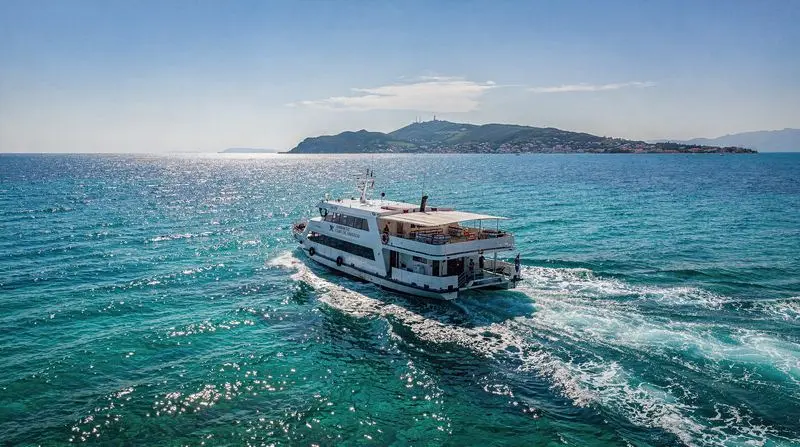
Saranda to Corfu by ferry: The most popular and most dramatic crossing. Finikas Lines and Ionian Cruises both operate the route; crossings take 45 minutes and cost approximately EUR 18–22 one-way per person (EUR 35–40 return). Multiple daily sailings in summer; reduced schedule in winter. Book online or at the ferry terminals in Saranda or Corfu Old Town.
Land crossing at Kakavia: The Kakavia border crossing (open 24 hours) connects Gjirokastra (Albania) with Ioannina (Greece) by road. Shared taxis run the route; it’s a 2.5–3 hour journey from Gjirokastra to Ioannina. This is the best option if you want to visit northwest Greek mainland before or after Albania.
Land crossing at Kapshtica/Krystallopigi: The northeastern crossing connects Korce (Albania) with Florina/Thessaloniki (Greece). Useful if your Greek itinerary focuses on northern Greece or Macedonia rather than Corfu.
The 10-Day Itinerary: Albania First, Corfu Second
Days 1-2: Tirana
Arrive in Tirana and spend two days exploring Albania’s capital. The National History Museum gives essential context for Albanian history; BunkArt 2 documents the communist era; the Blloku neighbourhood and Pazari i Ri market reveal the city’s contemporary energy.
Join a guided Tirana walking tour on Day 1 for immediate historical context — understanding Albania’s communist history and the post-1991 transformation makes everything else on the trip more comprehensible.
Evening: join the Tirana food tour for a comprehensive introduction to Albanian culinary culture before heading south.
See the 3-day Tirana itinerary for a more detailed city guide.
Day 3: Berat — UNESCO City of a Thousand Windows
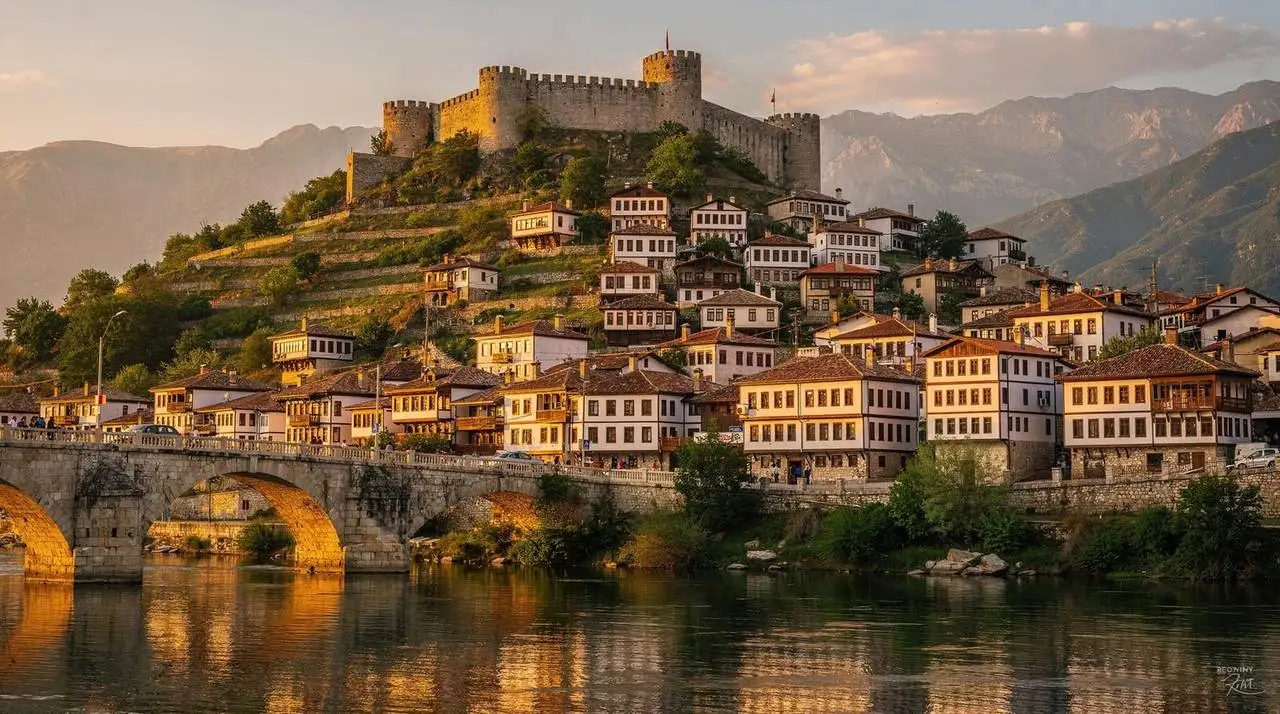
Morning bus from Tirana to Berat (2 hours, 400 lekë). Spend the afternoon and evening in the UNESCO city: Kalaja castle, the Onufri Museum with its extraordinary 16th-century icons, the Mangalem old town, and the sunset view from the Gorica quarter across the Osum River.
Berat is one of the most beautiful small cities in the Balkans — genuinely on a level with the famous Adriatic towns of Croatia or Montenegro, at a fraction of the cost.
Day 4: Berat to Gjirokastra
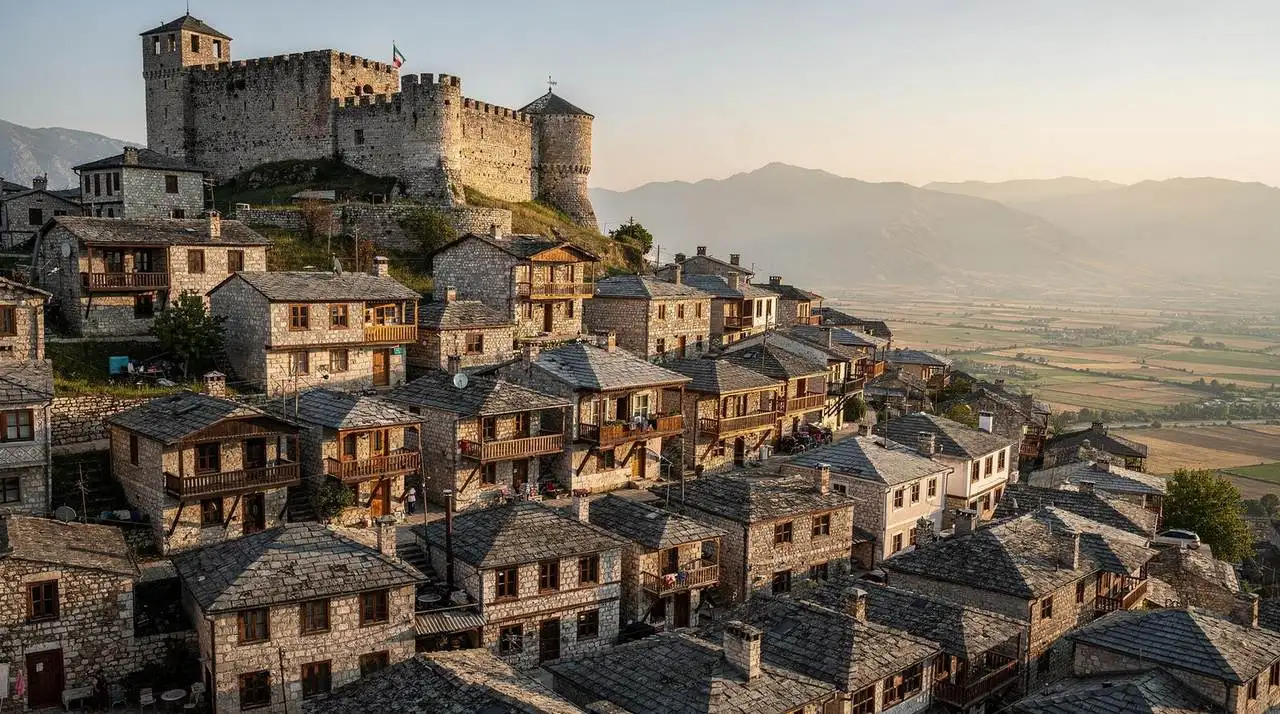
Bus or shared taxi to Gjirokastra (2.5–3 hours). Afternoon in the stone UNESCO city: the castle with its captured US Air Force jet, the Zekate House tower mansion, and the old bazaar. Join a guided Gjirokastra city tour for the best understanding of this extraordinary place.
Gjirokastra is close to the Greek border — the mountains visible to the south and east from the castle are in Greek territory. On a clear day you can occasionally see Corfu’s silhouette on the horizon.
Day 5: Blue Eye Spring and Saranda
Morning shared taxi from Gjirokastra toward Saranda (1.5 hours). Stop at the Blue Eye spring (Syri i Kaltër) — 25 km east of Saranda — before arriving. The Blue Eye is one of Albania’s most visually extraordinary natural phenomena: a vivid cobalt disc of cold karst water welling up in ancient plane forest. Entry 100 lekë.
Book a best-of-Saranda tour combining the Blue Eye, Butrint, and Ksamil — an efficient one-day option from Saranda that covers all three key highlights of the area.
Arrive in Saranda by early afternoon. Check into your hotel (Saranda faces Corfu directly; a sea-view room looking toward the Greek island makes a fitting final Albanian night). Seafood dinner on the promenade with Corfu across the water.
Day 6: Butrint and Ksamil — Albania’s Finest
Morning at Butrint (1,000 lekë) — the UNESCO archaeological site of layered Greek, Roman, Byzantine, and Venetian history on a forested promontory. Allow 2 hours. Then to Ksamil for Albania’s finest beach: three offshore islands, Ionian-clear water, and a beautiful final Albanian beach afternoon.
Return to Saranda for an early dinner and prepare for the Corfu ferry crossing tomorrow.
Day 7: The Crossing — Saranda to Corfu
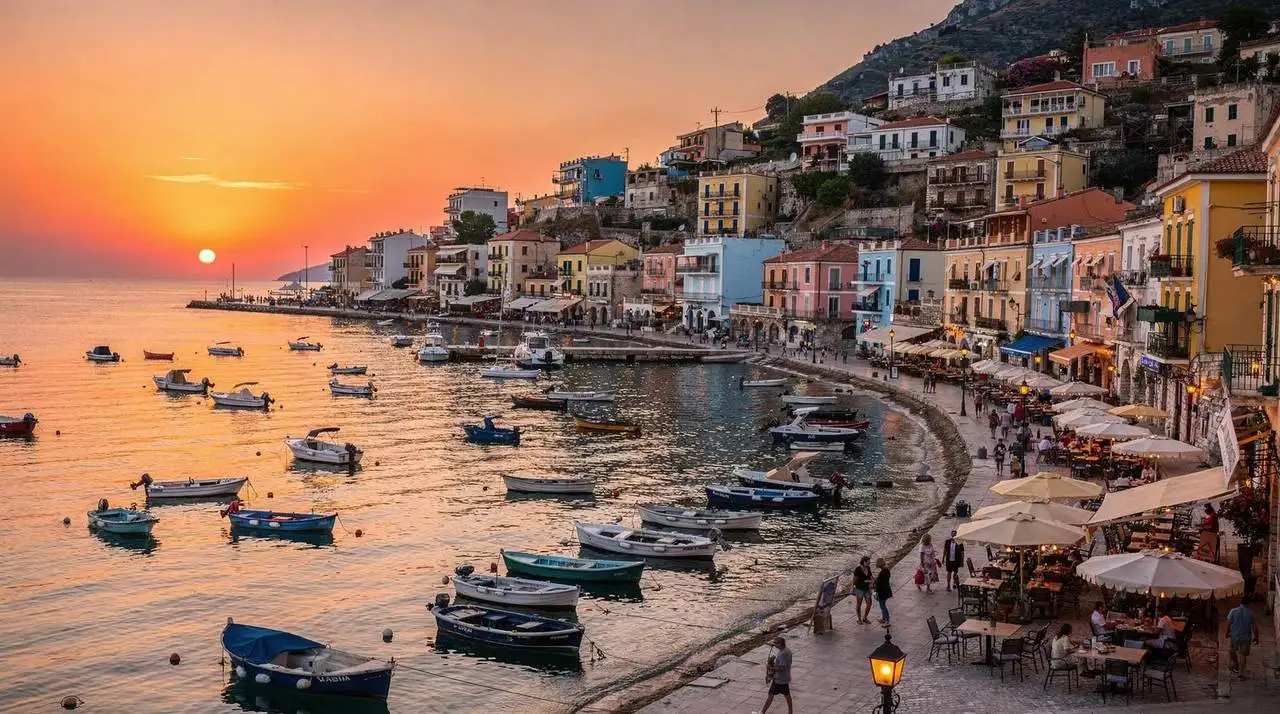
Board the morning ferry from Saranda to Corfu — 45 minutes across one of the world’s great straits. The crossing itself is scenic: Saranda diminishes behind you, the Albanian mountains rise above the town, and Corfu’s green northern tip approaches across the blue water.
Book a day trip from Saranda to Corfu Town as a preview visit — if you’re spending multiple days in Corfu, this tour lets you see the highlights of Corfu Old Town with a guide before returning to Saranda for a final night.
Corfu Town is a UNESCO World Heritage Site — the most architecturally distinguished city in the Ionian Islands, with its extraordinary mixture of Venetian arcades, French neoclassical administrative buildings from the Napoleonic period, and British colonial infrastructure from the 19th century. The two Venetian fortresses (Old Fortress and New Fortress), the Liston promenade (modelled on the Rue de Rivoli in Paris), and the narrow Venetian lanes of the Campiello district are all unmissable.
Check into your Corfu accommodation. The contrast between Corfu and Saranda — both on the same narrow strait, 45 minutes apart by fast ferry — is immediately striking: Corfu is more expensive, more developed, more tourist infrastructure, but also more architecturally elaborate and set in a lush green island landscape.
Days 8-9: Corfu — The Island
Corfu rewards slow exploration. Beyond the UNESCO-listed Old Town, the island offers:
The Achilleion Palace — the extraordinary cliff-top neoclassical palace built by Empress Elisabeth of Austria (Sisi) in 1890, later owned by Kaiser Wilhelm II. Its gardens, frescoes, and views are remarkable.
Paleokastritsa — the most dramatically beautiful beach on Corfu, with cobalt water in multiple coves beneath limestone cliffs. Visit early morning before the boats arrive.
Kanoni and Mouse Island — the postcard view of Corfu: a tiny church on a tiny islet in a lagoon, with a causeway walkable at low water.
Northern Corfu (Kassiopi, Nissaki) — quieter beaches, villages with local character, better value restaurants.
A moped rental (EUR 20–30/day) is the best way to explore Corfu independently; buses cover the main routes but are slow.
Eating in Corfu: Greek food is excellent and Corfu has some distinctive local dishes (pastitsada — beef stewed with pasta in spiced tomato sauce; sofrito — veal in white wine and garlic sauce) that differ from mainland Greek cooking. Budget EUR 25–40 per person for dinner with wine at a good local restaurant.
Day 10: Onward or Departure
From Corfu you can: fly home (Corfu Airport, CFU, has direct flights to most European cities); take the ferry to the Greek mainland (Igoumenitsa, 90 minutes); or continue to other Ionian Islands (Kefalonia, Ithaca, Lefkada by ferry). Corfu is an excellent island-hopping starting point.
The 14-Day Extended Version
With 14 days, add:
4 extra days in Albania: Extend the Albania section to include Permet and the Benja Thermal Baths (Day 5 in the 14-day version), or add the north — Shkodra, Koman Lake, and Valbona — for a fuller Albania experience. See the 14-day Albania itinerary for the full southern loop.
4 extra days in Greece: Add the Greek mainland from Corfu. Take the ferry from Corfu to Igoumenitsa, then bus to Ioannina (2 hours) — a beautiful lake city and the capital of Epirus, historically connected to Albania through the extraordinary career of Ali Pasha of Ioannina (who also appears in Albanian history at Porto Palermo and Butrint). From Ioannina you can visit the Vikos Gorge (one of Europe’s deepest canyons) and the traditional stone villages of the Zagori region, which bear striking architectural similarities to Gjirokastra.
Albania vs Greece: The Contrast
Travelling both countries consecutively makes the differences visceral rather than theoretical:
Price: Albania costs roughly 40–60% of Greece for equivalent quality. A good dinner in Saranda costs EUR 12–18 per person; the same quality in Corfu costs EUR 25–40.
Crowds: Albania outside summer is relatively uncrowded even at major sites. Corfu and the Ionian islands in summer are genuinely busy; off-season (April–May, October) is dramatically better.
Infrastructure: Greece has better tourist infrastructure — more English-speaking staff, more reliable booking systems, more predictable transport. Albania is improving fast but requires more flexibility and self-sufficiency.
Authenticity: Both countries have genuine culture, but Albania — with its shorter tourist history — often feels more authentic in its daily life. People in Gjirokastra and Berat go about their lives with less tourism overlay than comparable Greek towns.
Beaches: Both excellent. Albanian beaches (Ksamil, Dhermi, Himara) are comparable in water quality to the best Greek beaches and significantly less crowded and cheaper in summer.
Combined Albania-Greece Budget Summary
10-Day Version
| Category | Budget | Mid-range | Comfortable |
|---|---|---|---|
| Albania accommodation (6 nights) | EUR 80–110 | EUR 180–270 | EUR 360–540 |
| Greece accommodation (4 nights) | EUR 80–120 | EUR 200–320 | EUR 400–640 |
| Ferry Saranda-Corfu | EUR 18–22 | EUR 18–22 | EUR 22–30 |
| Transport (all) | EUR 30–45 | EUR 60–90 | EUR 120–200 |
| Museum entries | EUR 30–38 | EUR 30–38 | EUR 30–38 |
| Food (Albania, per day) | EUR 15–22 | EUR 30–50 | EUR 55–80 |
| Food (Greece, per day) | EUR 25–35 | EUR 45–70 | EUR 80–130 |
| Activities and tours | EUR 20–50 | EUR 80–150 | EUR 200–400 |
| Total 10 days | EUR 490–680 | EUR 1,000–1,470 | EUR 2,000–3,200 |
Prices per person. The cost contrast between the Albanian and Greek sections is significant; the combined trip averages out to mid-range European prices.
Practical Information for the Crossing
Ferry schedules: Check current schedules at Finikas Lines or Ionian Cruises websites before travelling. Summer (June–September) has the most frequent crossings; winter sailings are limited.
Border requirements: Both Albania and Greece are part of the Schengen zone (Greece since 1997; Albania from 2025 onwards) — check current entry requirements for your passport. EU/UK/US/Canadian/Australian passport holders generally have no issues with either country.
Currency change: Albania uses Albanian Lek; Greece uses EUR. Change any remaining lekë to EUR in Saranda before boarding the ferry — ATMs on Corfu dispense EUR, and Albanian lek is not exchangeable outside Albania.
Timing: The ferry to Corfu departs multiple times daily in summer. The earliest morning crossing from Saranda is typically around 8:30–9:30am, arriving in Corfu in time for a full first morning. Book tickets 1–2 days ahead in peak season.
Corfu: What to Know Before You Cross
Getting around Corfu: Corfu Town is compact and walkable. For the rest of the island, options include: local buses (cheap but slow, limited to main roads), taxis (available in town, negotiate or meter), moped or scooter rental (EUR 20–35/day, the best option for beach-hopping), or car rental (EUR 35–60/day for a small car).
Corfu Old Town: UNESCO-listed since 2007, Corfu Old Town is one of the finest examples of Mediterranean colonial architecture in the world. The two Venetian fortresses — the Old Fortress (built from the 15th century onwards, stunning sea views, entry EUR 6) and the New Fortress (16th century, the better-preserved of the two, entry EUR 4) — bracket the old town. Between them lies the Spianada (the largest square in Greece), the Liston colonnade (modelled on the Rue de Rivoli in Paris, built during French rule 1807–1814), and the narrow Campiello district — a maze of Venetian alleys, washing lines, and church bells that is one of the most evocative historic neighbourhoods in Greece.
Food on Corfu: Corfiot cuisine is more Italian-influenced than mainland Greek, reflecting the 400+ years of Venetian rule. Local specialities include pastitsada (beef or rooster stewed with pasta in spiced tomato sauce), sofrito (veal with garlic and white wine), bourdeto (spicy fish stew), and kumquat liqueur — the kumquat is Corfu’s signature fruit and appears in sweets, jams, and alcoholic drinks across the island. Restaurant prices are roughly double what you paid in Albania; a good dinner with wine: EUR 25–40 per person.
Beaches: Corfu’s best beaches are on the north and west coasts. Paleokastritsa (west coast) is the most dramatic — multiple coves of cobalt water beneath limestone cliffs, genuinely beautiful but busy in peak season. Sidari (north) has the famous Canal d’Amour — a narrow sea channel through sandstone cliffs. Agios Georgios and Agios Gordios on the west coast are long sandy beaches with a more relaxed atmosphere.
Day trips from Corfu: The island makes an excellent base for day trips. Paxos and Antipaxos (1–1.5 hours by hydrofoil) are the nearest islands, with famously clear blue water. The Albanian coast (Saranda, Butrint) is reachable by day trip ferry — a reverse version of the journey you just made.
Planning the Perfect Two-Country Route
Flying in and out: The most efficient routing is to fly into Tirana (TIA) and out from Corfu (CFU), or vice versa. Both airports have direct flights to major European hubs; the one-way routing avoids backtracking. Alternatively, fly into and out of Tirana and treat Corfu as a ferry-accessible side trip.
How much time for each country: The minimum to feel Albania is 5–6 days; 8–10 days is ideal for the southern highlights circuit. Corfu deserves a minimum of 3 nights; more if you want to explore beyond the Old Town and main beaches.
When to go: May–June and September–October are ideal for both countries. July–August is excellent weather but peak crowds and prices, especially in Corfu which receives millions of British tourists in summer. Albania is less crowded than Corfu even in August.
What to read: Before Albania, read Ismail Kadare’s “Chronicle in Stone” (set in Gjirokastra during World War II) or “Broken April” (set in the northern Albanian highlands) — both give extraordinary context for what you’ll see. For Corfu, Gerald Durrell’s “My Family and Other Animals” (set in 1930s Corfu) is charming; Lawrence Durrell’s “Prospero’s Cell” is more literary and atmospheric.
Photography: Both countries are extraordinarily photogenic. Albania’s best photo opportunities: Berat’s thousand windows at golden hour, the Koman Lake ferry in morning mist, the Blue Eye’s saturated colour, Gjirokastra Castle from below. Corfu’s best: the Old Town lanes in the blue hour just after sunset, Paleokastritsa from above, the Achilleion Palace gardens.
Alternative Routing: Greece First, Albania Second
Some travellers prefer to start in Greece and cross into Albania as the more adventurous second country:
Fly into Corfu → spend 4–5 days in Corfu → ferry to Saranda → travel north through Albania (Saranda, Gjirokastra, Blue Eye, Berat, Tirana) → fly home from Tirana.
This routing has the advantage of moving from the familiar (Greece, well-developed tourist infrastructure) to the adventurous (Albania, rawer and more surprising). The contrast on the 45-minute ferry crossing — from a developed Greek island to a small Albanian port city that still feels like it’s becoming — is particularly striking in this direction.
The disadvantage is that Albania’s south is more interesting than its north for most first-time visitors, and entering from Saranda means you reach the best of Albania (Gjirokastra, Berat) after already having spent several days in the country rather than being welcomed by them at the start.
Neither routing is wrong; both work well. Choose based on your flight availability and whether you want your trip to build toward or away from the Albanian Alps.
Comparing Albania and Corfu: A Traveller’s Perspective
The 45-minute ferry between Saranda and Corfu is one of the most dramatic short crossings in Europe. Two landscapes visible from the same boat; two histories, two languages, two currencies, two very different tourist economies — all separated by a strait you could swim in good conditions.
What Corfu has that Albania doesn’t: A fully mature tourist infrastructure — centuries of experience hosting British and Italian visitors, reliable English-language services everywhere, a well-maintained historic centre, easier booking systems, and the polish that comes from decades of tourism revenue. The Corfu Old Town, with its Venetian architecture, French colonnades, and British cricket pitch on the Spianada, is genuinely beautiful in a way that has been refined by tourist expectations.
What Albania has that Corfu doesn’t: Rawness, unpredictability, and the sense that you are somewhere that hasn’t been fully processed for export yet. The Albanian experience includes more friction (transport logistics, cash-only transactions, language gaps) but also more genuine encounter with local life. In Gjirokastra’s old town on a Tuesday morning, you are among the residents, not tourists. In Corfu Old Town on any summer day, you are among tens of thousands of tourists.
The price difference: A seafood dinner in Saranda that costs EUR 15 per person costs EUR 30–40 in Corfu. A mid-range double room in Berat or Gjirokastra costs EUR 40–70; the equivalent in Corfu is EUR 80–150 in peak season. This is not because Albanian quality is lower — the food and accommodation are genuinely excellent — but because the economics of a developing tourist industry haven’t yet pushed prices to Western European levels.
The infrastructure difference: Corfu has better roads, more reliable electricity, better mobile coverage, and a more dependable booking and service ecosystem. Albania is improving in all these areas but remains less consistent. Travellers who value reliability and convenience will find Corfu easier; travellers who value discovery and are comfortable with uncertainty will find Albania more rewarding.
The Albania-Greece Ferry: Everything You Need to Know
Operators: Two main ferry companies serve the Saranda-Corfu crossing: Finikas Lines and Ionian Cruises. Both are reliable; the journey time is the same (approximately 45 minutes on the fast ferry). Ticket prices are similar between operators.
Booking: Online booking is available at both operators’ websites (search “Finikas Lines Saranda” or “Ionian Cruises Saranda”). In summer, book 1–3 days ahead for popular departure times. Off-season, same-day purchase is usually possible at the terminal.
The Corfu terminal: Saranda’s ferry terminal is on the waterfront, a 5-minute walk from the centre. The terminal has basic facilities. Arrive 30–45 minutes before departure for check-in.
What to bring on the crossing: If you’re checking out of your Saranda accommodation before the crossing, you’ll have your luggage. The ferry has indoor and outdoor seating; outdoor deck space is more pleasant in good weather. Bring water and snacks if the crossing is at an inconvenient meal time.
On arrival in Corfu: The Corfu ferry terminal is in the New Port (Neos Limenas), approximately 1 km from the Corfu Old Town. Buses, taxis, and walking all work; taxis to the Old Town cost approximately EUR 5.
Return options from Corfu: From Corfu airport (CFU), direct flights to London, Amsterdam, Brussels, Rome, Munich, and many other European cities operate in summer. The airport is a 10-minute taxi from the Old Town (approximately EUR 15). Corfu also connects by ferry to the Greek mainland (Igoumenitsa, 90 minutes) and to Paxos (1.5 hours) for further Greek island exploration.
Extending Into Mainland Greece
From Corfu, the Greek mainland (Igoumenitsa) is just 90 minutes by ferry. Onward options from Igoumenitsa:
Ioannina (2 hours by bus): A beautiful lake city with a well-preserved old town, a famous bazaar, and the extraordinary island in the centre of the lake where Ali Pasha of Ioannina (who also appears in Albanian history at Porto Palermo and Gjirokastra) was finally killed by Ottoman forces in 1822. The Vikos Gorge (one of Europe’s deepest canyons) is 30 km from Ioannina.
Zagori villages (3 hours from Ioannina): A region of stone villages and monasteries in the Pindus mountains, architecturally strikingly similar to Gjirokastra — the same Ottoman-era stone building tradition appears on both sides of the border. A fascinating comparison to what you saw in Albania.
Thessaloniki (5 hours by bus from Ioannina): Greece’s second city, with Byzantine churches, Roman ruins, excellent food, and a vibrant contemporary culture. Connects onward by train or bus to the rest of Greece or to North Macedonia (see the Balkans combined itinerary).
Money, Visas, and Practical Cross-Border Tips
Withdraw enough lekë for the Albanian section before crossing — Albanian currency is not exchangeable in Greece, so spend or convert it in Saranda before boarding the ferry. See the Albania currency and money guide for ATM networks and typical exchange rates. Both countries are generally straightforward for EU, UK, US, Canadian, and Australian passport holders; the Albania visa requirements guide covers Albanian entry specifics, including the Schengen-alignment changes that have simplified cross-border travel in recent years.
If you’re combining this trip with more of the Balkans rather than continuing into mainland Greece, the Balkans combined itinerary and the Albania and North Macedonia itinerary both use Albania as a hub for a wider regional loop, and are worth comparing against this Greece-focused version before you commit to a route.
Connectivity Across the Border
Mobile data plans rarely cover both countries cleanly — an Albanian SIM won’t roam usefully in Greece, and vice versa. The simplest solution is an eSIM covering both destinations, activated before departure so you’re not scrambling for a physical SIM at the ferry terminal; see the Albania eSIM guide for providers that cover multi-country Balkan and Mediterranean routes. If you’d rather stick with a physical Albanian SIM, budget for a short data gap on Corfu itself and rely on hotel wifi until you’re back on Albanian coverage.
A Closer Look at the Kakavia and Kapshtica Crossings
If your route runs through the Gjirokastra-Ioannina land crossing rather than the ferry, a little extra planning helps. The Kakavia crossing operates 24 hours but queues build during midday in peak summer, particularly for vehicles; travelling early morning or after 4pm avoids the worst of it. Shared taxis waiting on both sides of the border are the standard way to complete the crossing without a rental car, and drivers are generally used to tourists — agree the fare before setting off rather than after arrival. The Kapshtica-Krystallopigi crossing further north serves travellers heading toward Thessaloniki or North Macedonia rather than Corfu, and sees noticeably less tourist traffic, which can mean faster processing but also less English spoken at the checkpoint itself.
Rental cars complicate land crossings more than the ferry does: confirm explicitly with your Albanian rental company that Greece is covered before relying on the Kakavia route, since many budget agencies restrict vehicles to Albanian territory only. Reputable international agencies operating from Tirana Airport are generally more flexible on cross-border coverage than small local operators, though they typically charge a premium for it.
Packing for Two Climates and Two Currencies
Albania and Greece share a Mediterranean climate on this route, so packing doesn’t need to change dramatically between countries — but budget for the price step-up on the Greek side: pack for value in Albania (where a good dinner costs a third of Corfu prices) and expect to spend more freely once you cross. The Albania packing list covers the Albanian leg; bring a day bag suitable for the ferry crossing, since luggage handling on the Saranda-Corfu boats is more informal than an airport.
Frequently asked questions about Albania and Greece Combined
Which direction is better: Albania first or Greece first?
Both work well, but starting in Albania and finishing in Corfu builds naturally from rawer, cheaper travel toward a more polished, relaxing finale — a pleasant arc for most travellers. Starting in Corfu and finishing in Albania front-loads comfort and back-loads adventure, which suits travellers who want the “discovery” phase of the trip to build momentum right up to departure. Neither is wrong; base the decision on your flight availability.
Do I need to book the Saranda-Corfu ferry in advance?
In summer (June–September), book 1–2 days ahead for popular morning departures, especially if travelling as a group. Off-season, same-day tickets at the terminal are usually fine, but schedules are reduced, so check sailing times the day before regardless of season.
Is 10 days enough, or should I do the 14-day version?
Ten days covers a satisfying core of both countries — the Albanian south and central Corfu. Fourteen days is worth it if you want either a deeper Albania (adding Permet and the north) or genuine time on the Greek mainland (Ioannina, the Vikos Gorge, Zagori). If you can only spare 10 days, prioritise depth in one country over rushing both.