Photography Spots in Albania: A Visual Guide to Europe’s Hidden Gem
Albania is one of Europe’s great photographic undiscoveries. The country packs extraordinary visual diversity into a compact geography: Ottoman stone cities that look like film sets, turquoise Ionian water of impossible clarity, communist-era murals painted in psychedelic color across grey apartment blocks, ancient ruins emerging from lakeside forests, mountain gorges that dwarf the humans walking through them. All of this, with a fraction of the crowds that would be present at comparable locations in more established destinations.
For photographers — from casual social media users to serious travel photographers — Albania offers something increasingly rare: iconic imagery that has not yet been photographed to death. The compositions available here are genuinely fresh, the light in the Mediterranean south is extraordinary, and the human subjects — in markets, cafes, and traditional villages — are typically relaxed and welcoming rather than wary of cameras.
This guide covers the locations that consistently produce the strongest images, with practical information on when to visit and what to look for.
| Best overall light | Golden hour, first/last 90 minutes of daylight |
| Best season | April-May and September-October |
| Drone rules | Registration + permits required, restricted near coast/military zones |
| Top single shot | Ksamil islands from the headland above the beach |
| Cost to shoot | Free at most spots; guided walking tours from around EUR 25-35 |
Ksamil: Caribbean Turquoise in Europe
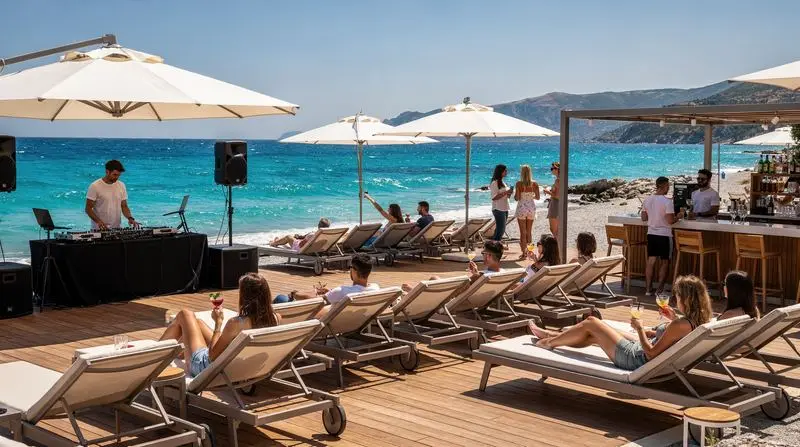
Ksamil, in the far south of Albania near Saranda, is the country’s most photographed single location — and it earns the attention. The combination of small offshore islands, shallow turquoise water connecting them to the shore, and the backdrop of Albanian coastal hills creates a visual that looks convincingly tropical. The water’s extraordinary clarity and the specific combination of depth gradients (shallow turquoise over sandy shallows, deep blue in the channels) make every overhead shot or wide composition sing.
Best shots at Ksamil:
- The view from the headland above the main beach looking back at the islands
- Water-level wide angles from the shallows between the beach and the nearest island
- The water taxi boats against the turquoise background
- Aerial perspective (drone flights require CAA permit — check current regulations)
- Morning light (before 9am) before the crowds arrive
Best time: June and September for emptier beaches and similar light quality to July-August. Golden hour at Ksamil (around 7-7:30pm in summer) is outstanding.
Access: See our Ksamil travel guide for transport details.
Book a guided Tirana walking tour to discover the city’s most photogenic murals, communist architecture, and colorful neighborhoods with a local guide who knows the best angles and contexts.
Gjirokastra: Stone Houses and Mountain Drama
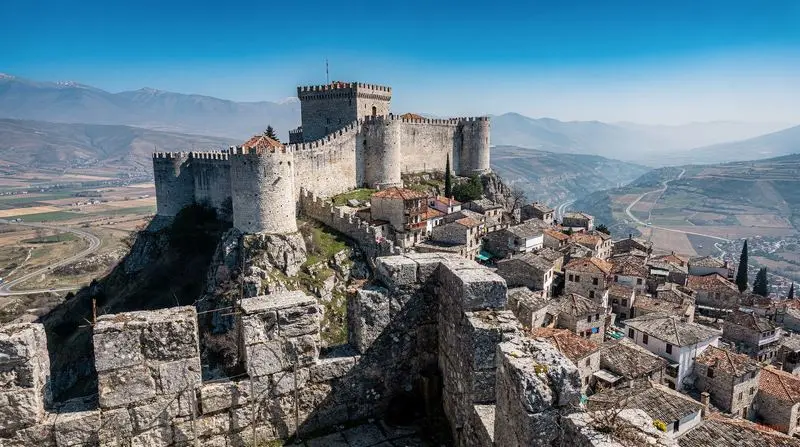
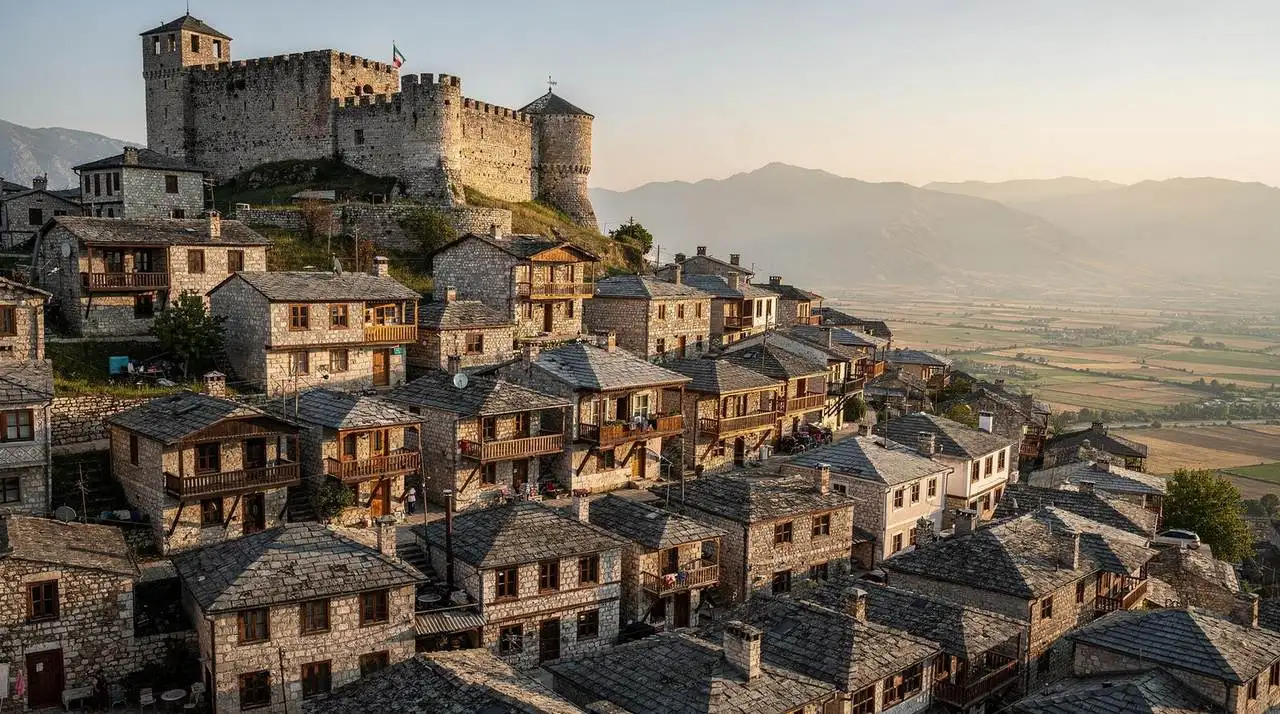
Gjirokastra is one of the most photographically distinctive cities in the Balkans. The combination of grey schist stone houses climbing impossibly steep hillsides toward the massive castle, the narrow alleys with overhanging upper floors, and the backdrop of the Drino Valley creates compositions that feel both timeless and specific — there is nowhere else in Europe that looks quite like this.
Best shots at Gjirokastra:
-
The castle at dusk: Photograph from the old bazaar area looking up to the castle as the sky turns. The castle is illuminated at night — the late blue hour before full darkness is outstanding.
-
The old bazaar rooftop view: From the upper storey of the bazaar restaurants, you look across a sea of grey stone roofs toward the castle walls.
-
Narrow alleyways in early morning: The steeply ascending stone alleys in the residential areas above the bazaar are most atmospheric in morning light, before noon flattens the shadow detail that defines them.
-
Looking down from the castle: The castle ramparts provide bird’s-eye views over the stone-roofed city and the valley beyond. This is one of the finest landscape views in Albania.
-
Door and window details: The wooden doorways, iron-hinged gates, and organic window arrangements of the old houses are endlessly photogenic at close range.
Best time: April-May and September-October for best light and manageable temperatures. Gjirokastra in light snow (occasional in January-February) looks extraordinary but requires weather luck.
Berat: The City of a Thousand Windows
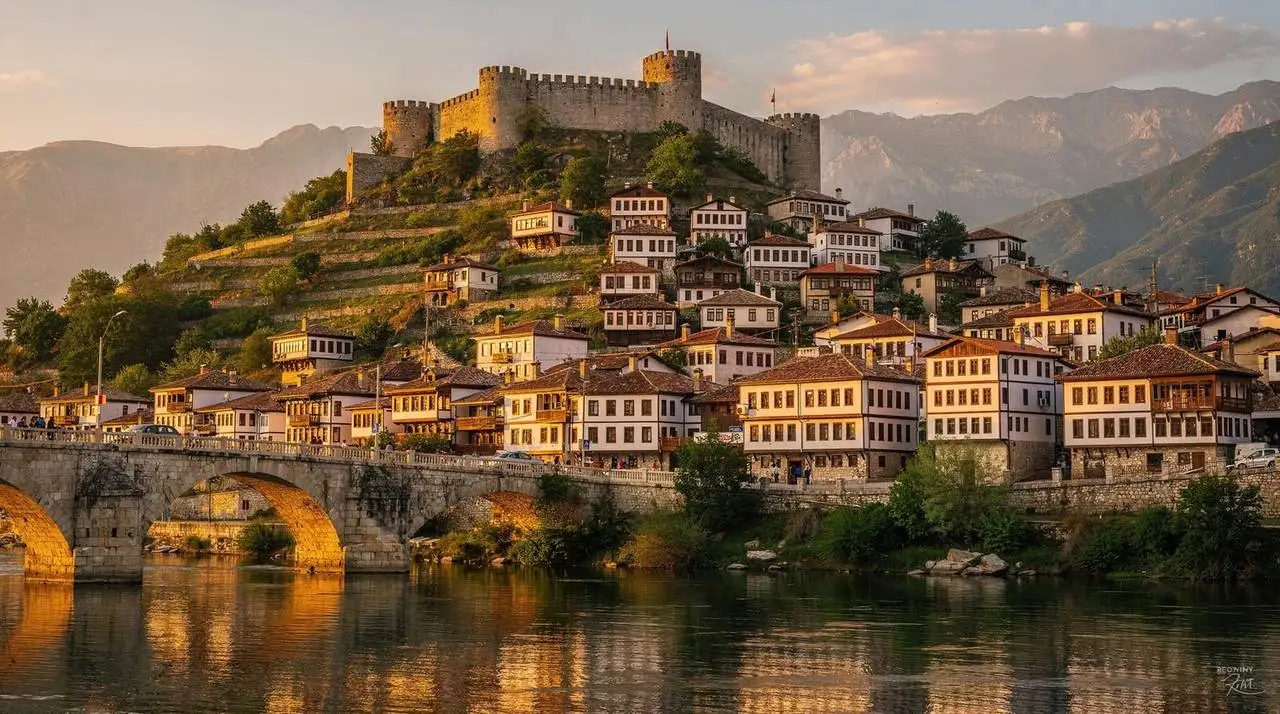
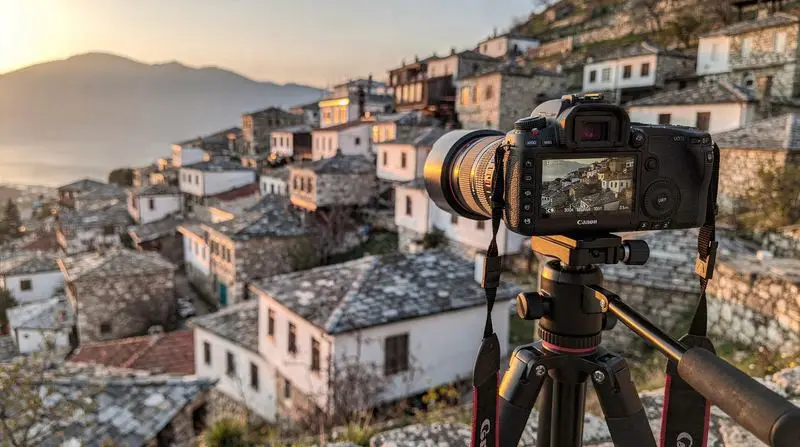
Berat’s signature image — the tiered Ottoman houses on the hillside with their large, symmetrical windows — has become one of Albania’s most recognizable visuals. The nickname “City of a Thousand Windows” is apt and the photograph that earns it is taken from across the Osum River, looking northwest toward Mangalem quarter with the castle crowning the hill.
Best shots at Berat:
-
The classic Mangalem view from across the Osum River: The ideal vantage point is from the Gorica side, looking across the river bridge toward the white-washed houses stacked above it with the castle at the top. This works at multiple times of day but is finest in the two hours before sunset when the light catches the windows directly.
-
Inside Kalaja castle: The views from the castle walls over both the city below and the surrounding valley are outstanding. The castle churches with their frescoes also provide interior photography opportunities.
-
The bridge (Ura e Goricës): The old Ottoman footbridge across the Osum River is a beautiful structure in its own right, and the reflections in the river below make for strong water-reflection compositions in calm conditions.
-
Mangalem alleyways: The narrow lanes within the Mangalem quarter, with overhanging houses and cobblestone surfaces, provide classic old-town compositions.
-
Window details: The famous stacked windows of Berat — large wooden frames filling the facade of traditional houses — are best photographed in late afternoon light when the sun illuminates them from the west.
Best time: Spring for the Osum River at its fullest and most reflective. September for excellent light with fewer visitors than August.
If you would rather see both stone cities without driving yourself, a guided day trip to Berat and Gjirokaster from Tirana covers the two UNESCO towns in one go, though you will have less control over golden-hour timing.
Koman Lake: The Journey IS the Picture
Lake Koman in northern Albania is reached by a two-hour ferry journey through one of the most dramatic gorge landscapes in Europe. The Drin River has been dammed to form a narrow, sinuous reservoir that winds between cliffs rising hundreds of meters on both sides — the water below emerald-green, the limestone walls almost vertical, the sky a strip of blue above. The ferry journey itself, rather than any specific destination, is the photographic experience.
Best shots on the Koman ferry:
- The gorge walls in morning light on the early ferry (departs around 9am)
- Reflections in the still water in the early sections before the wind picks up
- The small villages that cling to the cliffs above the waterline
- Other passengers — the ferry carries locals as well as tourists, and the mix of people using this remote route is compelling
- The vegetation details: sub-tropical plants growing from the limestone in spring and summer
Logistics: The Koman-Fierza ferry runs once daily (usually mornings) in each direction. The journey takes 2-2.5 hours each way. Most travelers use this as part of a circuit: Shkodra to Koman by bus or taxi, Koman to Fierza by ferry, then road to Valbona. A rental car can be transported on the ferry.
Gjipe Beach: Ionian Secret
Gjipe Beach, accessible only by a 45-minute hike down a river gorge from the main road near Himara, or by boat from Himara or Dhermi, is one of the most photogenic natural settings in Albania. Where the river gorge meets the Ionian Sea, a crescent of pebble beach backed by towering limestone cliffs creates a composition of extraordinary natural architecture.
Best shots at Gjipe:
- The gorge from within, looking toward the sea with the beach as foreground
- The beach from above, if you can find a safe high viewpoint on the cliff
- The boat arrival perspective — approaching Gjipe by boat from the sea, the gorge opening is dramatic
- The color contrast between the dark cliff shadows and the turquoise water
Getting there: Hike 45 minutes down the Gjipe Canyon from the road (marked, easy terrain), or take a boat from Himara. See the boat tour options for the Riviera.
Tirana: Communist Murals and Urban Contrast
Tirana is less obviously photogenic than the landscape destinations but offers rich material for urban photographers and those interested in the aesthetics of political history.
Best shots in Tirana:
-
The colorful apartment blocks: Mayor Edi Rama’s early-2000s project of painting Tirana’s drab communist-era apartment blocks in bold colors and geometric patterns is most visible in certain neighborhoods. The most concentrated areas are in the inner-ring districts.
-
Skanderbeg Square: The vast square with its Skanderbeg equestrian statue, the National History Museum mosaic facade, and the Et’hem Bey Mosque creates a compositional collision of Ottoman, fascist, and communist architectural styles that is unique in Europe.
-
The Pyramid: The former Hoxha mausoleum/conference center — now being repurposed as a youth and tech hub — is a fascinating brutalist structure with photographic angles from multiple approaches.
-
Bunk’Art 1 interiors: Inside the nuclear bunker museum, the long concrete corridors, original communist-era furniture, and atmospheric lighting create strong interior photography. Flash is generally discouraged; bring a lens fast enough for available light.
-
The Blloku district at night: The bar terraces in the former communist elite enclave, now packed with young Albanians enjoying freedoms their parents did not have, photograph well at the blue hour when ambient light balances with artificial.
The Albanian Alps: Mountain Grandeur
The Albanian Alps — particularly the area around Valbona and Theth — offer mountain photography of the highest caliber. The peaks of the Bjeshket e Namuna (Accursed Mountains) rise above 2,500 meters, with vertiginous limestone faces, glacial valleys, and traditional stone-roofed villages that have barely changed in a century.
Best shots in the Alps:
- Valbona Valley at dawn: the peaks catching first light above the forest
- Theth village with its distinctive stone buildings and the isolation of the valley
- The Theth waterfall (Grunas Waterfall) — a spectacular cascade accessible by short hike
- The Blood Feud Tower (Kulla) in Theth — a stone lockhouse where families sheltered during blood feuds, a powerful documentary subject
- The hiking trail connecting Theth and Valbona, one of the most scenic in Europe
Season: May through September. August is peak season with many hikers; June and early July have snow still on higher peaks and exceptional vegetation. September offers golden autumn light.
Lake Ohrid: Water and Mountain
The Albanian shore of Lake Ohrid near Pogradec offers its own distinctive visual palette: a large freshwater lake of extraordinary clarity reflecting mountains and sky, framed by the National Park of Drilon’s riverside vegetation.
Best shots at Ohrid:
- The lake surface reflections in calm morning conditions
- Fishermen on the lake in traditional wooden boats
- The springs at Drilon National Park, where crystal-clear water emerges from the ground into natural pools
Practical Photography Tips for Albania
Lighting: Albania’s Mediterranean south has the same intense, directional light as Greece and Italy. Shoot during the golden hours (first and last 90 minutes of daylight) for the best results on stone and coastal subjects. Midday light is harsh — use it for water photography where the sun’s angle maximizes the turquoise color.
Drones: Drone photography in Albania requires registration and, for certain areas, permits from the Albanian Civil Aviation Authority. Coastal areas near military installations (Porto Palermo, parts of the Riviera) have restricted airspace. Research current regulations before flying.
Photographing people: Albanians are generally relaxed about being photographed, but normal courtesy applies — ask before photographing individuals at close range, particularly older people and children. In rural areas, be sensitive to the fact that photography of private dwellings or family situations may feel intrusive.
Gear considerations: Albanian mountain terrain and beach environments both create dust exposure issues. Bring sensor-cleaning equipment and keep cameras covered when not shooting in dusty conditions. Humidity on the coast is not extreme but be aware of salt spray near the shore.
Mobile photography: The iPhone and modern Android cameras handle Albanian coastal light well. Shooting in RAW (available on newer phones) gives more editing flexibility for the high-contrast scenarios — bright sea against dark cliffs, lit facades against dark alleys — that are common.
Seasonal Light Planner
Timing shapes an Albania photography trip more than any single location choice. This is a rough guide to what each season delivers:
| Season | Light quality | Crowds | Best for |
|---|---|---|---|
| April-May | Soft, clear, wildflowers in the Alps | Low-moderate | Gjirokastra, Berat, Albanian Alps |
| June-August | Harsh midday, excellent golden hour | High, especially coast | Ksamil, Koman ferry, Riviera |
| September-October | Warm, clear, autumn tones | Moderate | Coastal towns, Lake Ohrid, cities |
| November-March | Flat but atmospheric, occasional snow | Very low | Gjirokastra/Berat in snow, Tirana interiors |
Coastal Light South of Saranda
Beyond Ksamil, the stretch of coast toward Himara and the Llogara Pass offers dramatic photography that fewer visitors reach. The Llogara Pass road, descending in switchbacks from pine forest to Ionian coastline, produces some of the most striking landscape shots in the country — the combination of mountain and sea in a single frame is rare in the Mediterranean. Late afternoon light, with the sun dropping toward the water, is the strongest window here.
Himara’s old town, stacked on the hillside above its own bay, rewards the same approach as Gjirokastra and Berat: shoot from across the bay or from the castle district at golden hour for the best perspective on the stone architecture against the sea.
Guided Photography Options
For visitors who want structured access to the best angles and local context rather than self-guided exploration, photography-focused workshops run in several of the cities covered here, typically pairing a local photographer’s knowledge of light and timing with cultural context on the sites themselves. For a broader set of practical shooting tips gathered from travelers who have covered the country extensively, see the Albania photography tips blog post.
For a comprehensive visual journey through Albania’s highlights, combine the UNESCO cities of Berat and Gjirokaster with the coastal beauty of Ksamil and the Riviera, the dramatic landscapes of the Albanian Alps, and the fascinating communist-era urban photography available in Tirana. Albania repays unhurried, curious photography — slow down, arrive early, and the images will come.
Frequently Asked Questions About Photography in Albania
What is the single best photo spot in Albania?
Ksamil, photographed from the headland above the main beach looking out toward the islands, is Albania’s most reliably spectacular single shot — the turquoise-to-deep-blue color gradient and island composition read as tropical rather than Mediterranean. For architecture, the classic Mangalem view of Berat across the Osum River is the closest rival.
Do I need a drone permit to photograph Albania from the air?
Yes, in most cases. Drone photography requires registration with the Albanian Civil Aviation Authority, and certain coastal areas near military installations are restricted airspace entirely. Check current rules before flying — see the drone rules in Albania guide for the current process.