Where to Stay in Gjirokastra: The Old Town Guide
Gjirokastra is one of the most architecturally distinctive cities in the Balkans — a UNESCO World Heritage Site whose old town rises up a steep hillside in a series of grey-stone tower houses that seem to grow directly from the rock itself. It is sometimes called the “City of Stone” (Qyteti i Gurit), and the description is apt: the houses are built from the same limestone as the mountain they stand on, giving the old town an organic unity that is genuinely extraordinary.
For visitors, where you stay in Gjirokastra is more important than in almost any other Albanian destination. The difference between a room in the old town and a room in the modern lower city is the difference between waking up inside a living heritage site and waking up somewhere that happens to be near one. The guidance here is clear and consistent: stay in the old town.
| Where | Old Town (Palorto or bazaar area) |
| Cost | Around EUR 40-90/night in season |
| Time needed | At least 2 full days |
| Getting there | Furgon from Tirana, around 4-5 hours, EUR 10 |
| Best time | May-June or September-October |
Old-town rooms are the ones to secure first, especially for May, June, September and October. Check the exact location of a listing before paying, since a room in the modern lower city is a different stay altogether, and read the cancellation terms. You can filter for Palorto and bazaar-area stays through Booking.com listings for Gjirokastra.
The Old Town (Lagja e Vjetër): The Only Real Choice
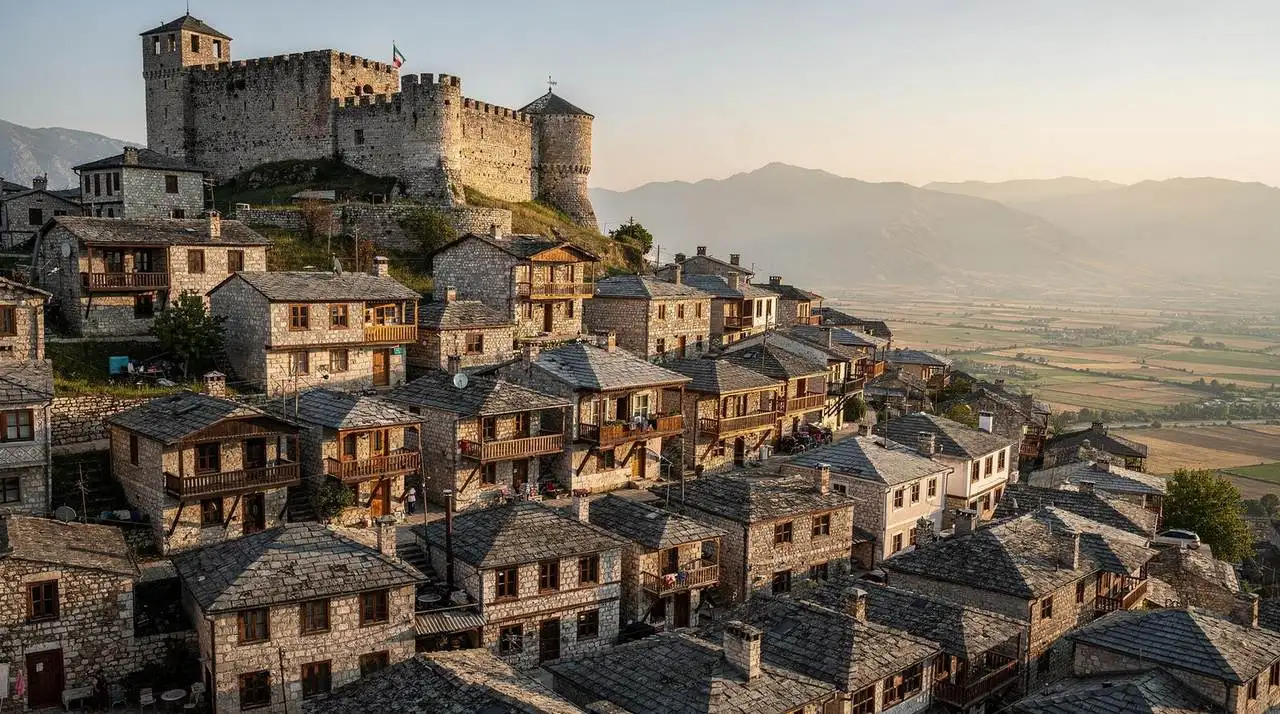
The old town of Gjirokastra occupies the upper slopes of the hill, clustering around and below the massive castle that dominates the skyline. The architecture here is unique even within Albania: the tower houses (kulla) were built in the 17th and 18th centuries by powerful Albanian beys and merchants, using stone-slate roofs and multiple fortified stories that reflect both prestige and the political insecurity of the era. The houses are large by the standards of the time, with characteristic wooden interiors that contrast with the imposing exterior stonework.
Walking the old town lanes is a genuinely memorable experience — the light on the grey stone changes through the day, the castle looms above with the mountains beyond it, and the narrow cobbled streets curve in ways that make navigation feel exploratory rather than systematic. The city is built on such steep terrain that some lanes are essentially staircases, and the views from upper-level terraces over the valley below are remarkable.
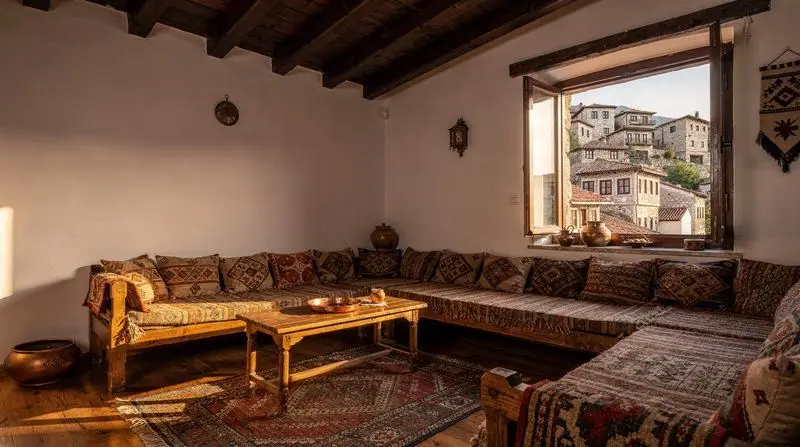
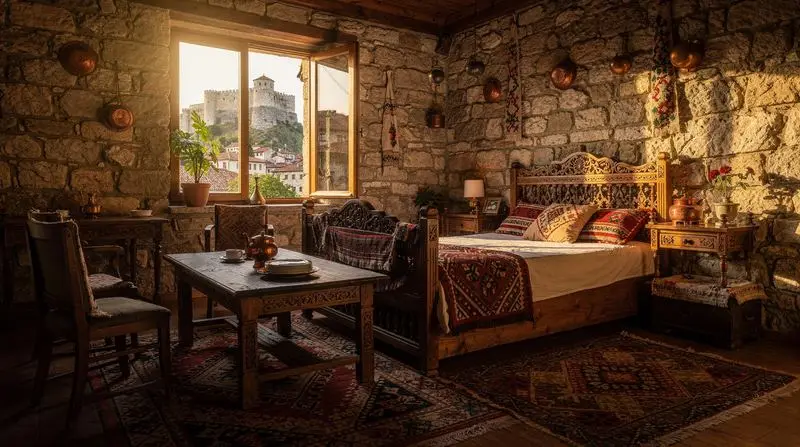
Accommodation within the old town is concentrated in several dozen guesthouses and boutique hotels that have been created from converted kulla houses. These conversions vary in quality and approach: the best preserve the original interior features — carved wooden ceilings, traditional hearth areas, and the specific room layouts of the kulla tradition — while adding modern bathrooms and reliable air conditioning. The least careful conversions have gutted interiors for generic hotel fittings while retaining the stone exterior.
Seek out properties where the hosts emphasise interior authenticity and can tell you something about the history of the specific house. The best Gjirokastra guesthouses are run by families who have owned the property for generations, and the hospitality reflects genuine pride in the heritage they are sharing.
Price range: EUR 40-90 per night in the main season (April through October). The upper end of this range covers beautifully converted houses with private bathrooms, terrace access with castle views, and breakfasts that include local specialties — locally produced cheese, honey from mountain hives, homemade jam, and bread from the nearby bakery. The lower end covers simpler rooms in smaller guesthouses that may share bathrooms.
In winter (November through March), prices drop to EUR 25-55 and the city is at its most atmospheric and least crowded — the grey stone in winter mist, the almost empty lanes, and the castle illuminated against a dark sky create a mood that summer tourists rarely experience.
Proximity to the Castle
The castle of Gjirokastra is the dominant feature of the city and a world-class historical site in its own right. Inside the massive walls (which are among the largest surviving Ottoman military fortifications in the Balkans) you will find the National Weapons Museum, the remains of a Cold War-era American military aircraft that was forced down in Albania in 1957, a theatre for the National Folk Festival, and extraordinary panoramic views over the Drino Valley below.
The castle entry fee is approximately EUR 4-6 per person. Allow two to three hours for a thorough visit — the walls are extensive, the museum is well-organized, and the views from different points of the fortifications reward slow exploration rather than a quick circuit.
Most old-town accommodation is within 10-15 minutes’ walk of the castle entrance, and staying in a house directly below the castle walls — several guesthouses occupy this position — gives you the dual advantage of proximity and the visual drama of having the fortress looming above your terrace.
Palorto Neighbourhood: The Best Address in the Old Town
Within the old town, the Palorto neighbourhood — the upper section of lanes closest to the castle — is considered the most historically significant and the most visually impressive. This is where the largest and best-preserved kulla houses are concentrated, and where you will find the most atmospheric guesthouses.
Staying in Palorto puts you at the top of the old town lanes, which means walking uphill to return to your accommodation from the bazaar and lower town areas. For most visitors this is a minor inconvenience well outweighed by the setting. However, if you have significant mobility concerns, consider accommodation lower in the old town where the terrain is less demanding.
The Palorto area is quietest in the mornings, before day visitors arrive. This is the best time to walk the lanes alone — the echo of footsteps on cobblestone, the occasional view down through a gap in the houses to the valley far below, the smell of coffee from guesthouse kitchens — gives you the old town in something close to its unhurried, everyday self.
The Bazaar Area: Lower Old Town Options
The old town’s traditional bazaar (çarshia) occupies the lower portion of the hillside, where the cobbled streets widen slightly and the commercial character of 18th and 19th-century Gjirokastra is still evident. Several guesthouses and smaller hotels are located in and around the bazaar area, offering old-town character at slightly lower prices than the Palorto quarter above.
This zone is also where the best traditional restaurants are concentrated — an advantage for guests who want to eat well without walking far in the evenings. The bazaar area restaurants serve traditional southern Albanian food: byrek with local cheese, slow-cooked lamb, fresh salads with olive oil from the nearby Permet valley.
Prices in the bazaar zone: EUR 35-70 per night, somewhat lower than Palorto for equivalent facilities.
The New Town: What to Avoid
The modern lower city of Gjirokastra, which developed primarily during the communist era and after, extends in the valley below the old town. This area has standard hotels and guesthouses that are functional and affordable (EUR 25-40 per night) but entirely missing the character that makes Gjirokastra worth visiting. The walk uphill to the old town from the lower city is steep enough to be tiring on a hot day.
Unless you genuinely need parking (the old town is not accessible by car), there is no good reason to stay in the new town. The price savings are modest relative to the experience you are giving up, and the old-town guesthouses at EUR 40-55 are genuinely affordable.
Seasonal Booking Advice
Gjirokastra does not have the extreme peak-season pressure of the coastal resorts, but July and August still require advance booking for the best old-town properties. The National Folk Festival (held every four or five years in Gjirokastra, most recently in 2023 and expected again around 2028) brings enormous demand for accommodation — check dates if your visit falls in a festival year.
The finest times to visit — and the easiest to book — are May-June and September-October. The weather is excellent, the light is beautiful on the stone, and the tourist volumes are comfortable rather than oppressive. Spring brings wildflowers on the slopes above the city; autumn brings a golden quality to the light and the mountain foliage changing on the ridges visible from the castle.
- July-August: Book 4-6 weeks ahead for the best old-town guesthouses
- May-June, September-October: Book 2-3 weeks ahead
- November-March: Book a week ahead; confirm guesthouses are open
Activities and Day Trips from Gjirokastra
The city rewards at least two full days. Beyond the castle and old town walks, the Skenduli House and the Zekate House (both privately maintained kulla houses open to visitors) give an extraordinary interior view of how these tower houses functioned as domestic spaces. The Zekate House, with its hidden underground tunnel connecting cellars to an escape route, is particularly remarkable — a glimpse into the genuine insecurity that made fortified domestic architecture necessary. Entry is EUR 2-3 per person at each house.
The Gjirokaster National Park and the nearby Blue Eye (Syri i Kaltër) spring — one of the most unusual natural phenomena in Albania, a deep pool of impossibly blue water emerging from underground — is 25 kilometres from the city and easily combined with a half-day visit to the area.
For a guided experience of the city, this Gjirokastra Old Town and Castle guided tour covers both the major historic houses and the castle with a local expert guide — particularly valuable in a city where the history is multilayered and some of the best details are easy to miss without context. The castle tour alone benefits greatly from a guide who can explain the American aircraft and the Cold War context. Cost approximately EUR 20-30 per person.
For visitors who want to combine Gjirokastra with the Blue Eye spring in one organized day:
This combined Gjirokastra and Blue Eye day tour from Saranda pairs the city’s historic streets with the remarkable natural spring — an efficient combination for visitors based on the southern coast who want to experience the city without committing to an overnight stay. Cost approximately EUR 30-50 per person.
The Surrounding Landscape: Zagoria and Mountain Villages
The landscape around Gjirokastra is dramatically beautiful — the Drino Valley, flanked by mountain ridges on both sides, has the quality of a natural amphitheatre. Several village day trips reward exploration by car or organised tour.
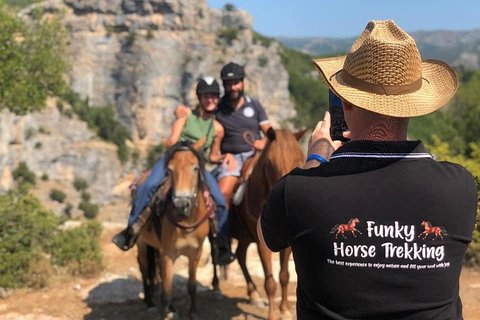
The Zagoria region, east of Gjirokastra in the mountains toward the Greek border, is one of the least-visited parts of southern Albania — a landscape of traditional villages, Ottoman bridges, and canyon rivers that sees very few international tourists. The 4x4 tours into Zagoria from Gjirokastra provide access to terrain that is otherwise difficult to reach.
This Zagoria 4x4 safari tour from Gjirokastra is an excellent contrast to the architectural history focus of the city itself — a day of off-road mountain driving, river crossings, and village stops in a part of Albania that very few visitors explore. Cost approximately EUR 45-70 per person.
Gjirokastra as a Southern Albania Pivot
Gjirokastra is a natural stopping point on routes between the Albanian Riviera and the interior. From the city, Saranda is about 60 kilometres south on a road that improves each year — a comfortable 1.5-hour drive. Berat is roughly 120 kilometres north (2.5-3 hours). A logical southern Albania itinerary uses Gjirokastra as a central pivot point, with the Riviera as the beach component and Berat as the second UNESCO city component.
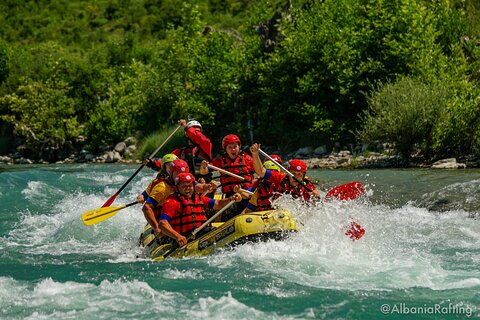
The Permet valley — known for its thermal baths, local wine, and rafting on the Vjosa River — is approximately 70 kilometres northeast, making it a natural add-on to a Gjirokastra visit for visitors who have time. See the thermal baths guide and wine tasting guide for Permet area activities.
Booking Platforms
Booking.com has a decent selection of Gjirokastra old-town properties, and many of the better guesthouses are listed there. However, as with Berat, some of the most atmospheric family-run houses are found on Airbnb or through direct contact.
When you reach out to guesthouses directly — WhatsApp contact information is often listed on Google Maps even for properties without formal websites — ask about:
- Whether your specific room has en-suite bathroom or shared facilities
- Whether breakfast is included and what it typically consists of
- Whether there is air conditioning or a fan (important for July-August visits)
- Parking options if you are travelling by car (old town lanes are pedestrian only)
- The view from your specific room — castle-facing rooms are available at most Palorto guesthouses and are worth requesting explicitly
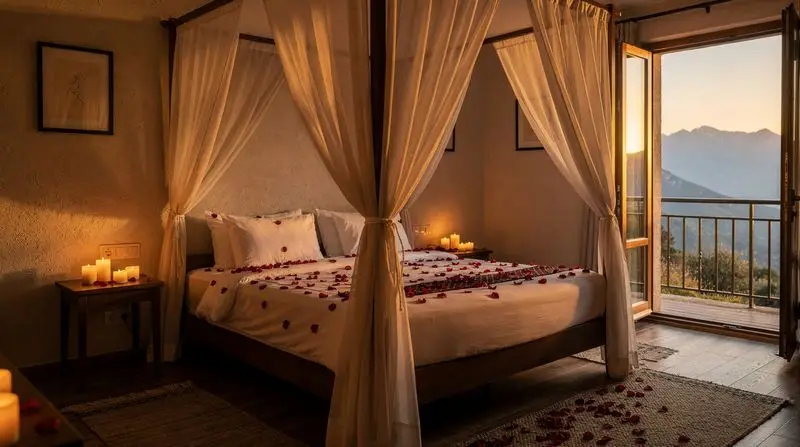
For context on why the Ottoman houses of Gjirokastra and Berat rank among Albania’s most romantic accommodation, see the couples guide.
For visitors planning a broader southern Albania loop, see the boutique hotels guide for options across the region.
Food in Gjirokastra
The restaurants in and around the old town bazaar serve traditional southern Albanian food at prices that remain genuinely affordable — a full dinner of local specialties costs EUR 8-15 per person at most restaurants, and the quality is often excellent.
Look for: slow-cooked lamb (one of the specialties of the region), the local variant of byrek (made with slightly different proportions than the Tirana version, with more cheese and a more substantial pastry), and fresh salads with locally produced olive oil. The Permet valley wine is available at most restaurants that stock Albanian wine — ask specifically for it.
The bazaar cafes are excellent for mid-morning coffee with a view of the old town activity. An espresso in a stone-floored bazaar cafe, watching the morning light shift on the grey stone streets outside, is one of the simple pleasures that makes the Gjirokastra experience coherent rather than purely museum-like.
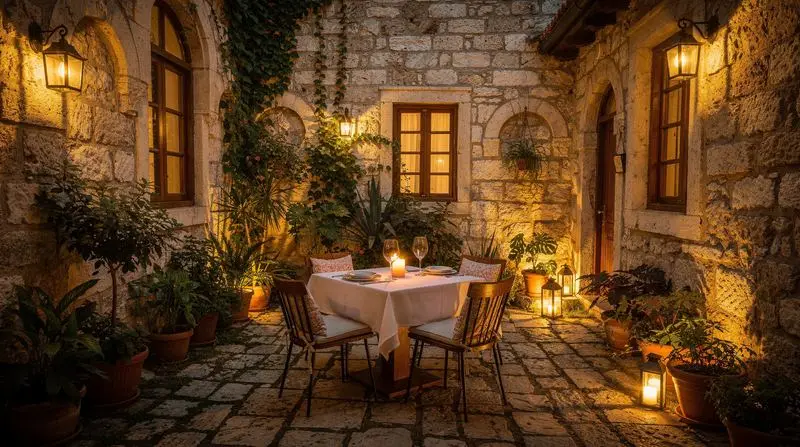
Guesthouse dinners: The communal dinner at an old-town guesthouse, where guests from different countries share a table and hosts serve whatever they have prepared that evening, is often the most memorable meal of a Gjirokastra visit. Several guesthouses serve dinner by arrangement for both guests and outside visitors — ask when you book.
Gjirokastra vs. Berat: Which to Choose
Both Gjirokastra and Berat are UNESCO-listed Ottoman cities with extraordinary guesthouse accommodation in historic buildings. The question of which to prioritise (or whether to visit both) is one of the most common planning questions in southern Albania.
Choose Gjirokastra if: You are drawn to dramatic, austere architecture, the castle is a priority, and you want the deeper historical layers (the American plane, the communist birthplace, the Kadare connection). The city is also better positioned for day trips to the Blue Eye, Permet, and the Zagoria villages.
Choose Berat if: Warmth and prettiness over drama is your preference, the river setting and reflected whitewashed houses appeal more than grey stone, and you want more options for eating and activities within the city itself.
Visit both if: Your itinerary has the time — the two cities are sufficiently different that visiting both is genuinely worthwhile and not repetitive. The most common southern Albania circuit includes one night in each, treating them as complementary rather than competing experiences.
The drive between Gjirokastra and Berat is approximately 120 kilometres and takes 2.5-3 hours. Most visitors cover this route from north to south (Berat then Gjirokastra) on the way to the Riviera, or south to north on the return.
Getting to Gjirokastra
From Tirana: The most common approach is by road through the Vjosa Valley — approximately 230 kilometres, 3-3.5 hours by car. Furgons run daily from Tirana’s southern bus terminal to Gjirokastra (EUR 10, approximately 4-5 hours with stops). The road passes through Tepelena, where the Vjosa and Drino rivers meet in a setting that Napoleon’s general de Vaubois described as one of the finest in the whole of his campaigns.
From Saranda: 60 kilometres north on the SH4 national road, 1-1.5 hours by car. This is one of the most straightforward drives in southern Albania — well-maintained road, regular improvements. A private taxi from Saranda to Gjirokastra costs EUR 25-40. Shared taxis and furgons run regularly, particularly in summer.
From the Greek border (Kakavija): The border crossing is 28 kilometres south of Gjirokastra, making the city a natural first Albanian stop for travellers arriving from Greece by road. The crossing is open 24 hours.
Photography in Gjirokastra
The grey stone of Gjirokastra is notoriously difficult to photograph well in harsh midday light. The best photography conditions are:
Early morning (7-9am): The light is soft, the city is quiet, and the stone takes on a warm golden tone rather than its midday grey. Walking the Palorto lanes before other visitors arrive — with the castle illuminated above and mist sometimes in the valley below — gives the best available version of the city.
Late afternoon (5-7pm): The low sun catches the western faces of the tower houses and the castle walls with directional light that shows the texture of the stone. The castle at sunset, with the mountains of the Drino Valley in the background, is one of the classic Albanian landscape photographs.
Overcast days: The diffuse light of an overcast sky is often better for the grey stone than bright sun. The city has a more naturally atmospheric quality on overcast days that the photography reflects well.
From the road below the old town looking up — particularly from the area near the Ethnographic Museum — you get the classic panoramic view of the kulla houses climbing the hill toward the castle. This is one of the most recognisable views in Albanian travel photography.
Gjirokastra Practical Notes
ATMs: Available in the new town and in the old town bazaar area. Stock up before venturing to the castle quarter, where there are no ATMs.
Parking: The new town has car parking. The old town lanes are pedestrian only. Most guesthouses can advise on the nearest parking to their specific location.
Walking the lanes: The cobblestone streets are steep and can be slippery when wet. Footwear with grip is recommended, particularly after rain.
Weather: Gjirokastra can be very hot in July and August (35+ degrees in the valley below) but the altitude of the old town (around 300 metres above sea level) means evenings are cooler than the coast. Winter brings genuine cold and the occasional light snow that transforms the grey stone city into something extraordinary.
Frequently asked questions about Where to Stay in Gjirokastra
Is Gjirokastra worth visiting if I’ve already been to Berat? Yes — the two UNESCO cities are different enough that visiting both is genuinely worthwhile, not repetitive. Gjirokastra’s grey stone architecture and dramatic castle feel austere and historic where Berat feels warm and riverside; see the Gjirokastra vs. Berat comparison above for the full breakdown.
How many nights should I spend in the Gjirokastra old town? Two full days covers the castle, the Skenduli and Zekate houses, and unhurried lane walking without rushing. A single overnight works if you’re combining it with the Blue Eye spring or a Riviera transit, but the city rewards a slower pace than a quick stopover allows.