Where to Stay on the Albanian Riviera: A Guide to Himara and Beyond
The Albanian Riviera stretches roughly 100 kilometres from Vlora in the north to Saranda in the south, with the Ceraunian mountain range pressing the road into dramatic coastal switchbacks and revealing a series of beaches, coves, and resort villages at every turn. Choosing where to base yourself on the Riviera is one of the most consequential accommodation decisions you will make in Albania — the right choice gives you access to the best beaches and enough infrastructure to be comfortable; the wrong choice leaves you either over-committed to one small cove or stranded somewhere inconvenient.
Himara is the best all-round base. This guide explains why, and also covers when the alternatives — Dhermi, Jale, Palase, and the smaller coves — might serve you better. For those arriving from the north via Vlora, see the Vlora accommodation guide first to understand the gateway city context.
| Where | Himara town, castle hill, or nearby coves |
| Cost | Around EUR 40-120/night depending on zone and season |
| Getting there | Furgon from Vlora or Saranda, around 1-1.5 hours |
| Best time | June or September for value |
| Booking | 4-8 weeks ahead for the best July-August properties |
The July and August properties in Himara go first, so settle on a zone early: the town beach, the castle hill or one of the nearby coves. Check how far each place is from the sea and whether the road to it is steep, then favour a free-cancellation rate while your plans can still shift. You can compare rooms and cancellation terms in Himara listings on Booking.com.
Himara: The Riviera’s Best Base
Himara is a small town (population around 4,000) that sits between two beaches on the central Albanian Riviera, roughly halfway between Vlora to the north and Saranda to the south. It has been inhabited continuously since antiquity — there is a Byzantine castle on the hill above, Greek-speaking communities have existed here for centuries, and the modern town has a self-sufficient character that most other Riviera villages lack.
For visitors, Himara’s key advantage is having enough infrastructure without the overwhelming crowd of Saranda or the transient character of smaller beach spots. There are genuine supermarkets, multiple restaurants serving both Albanian and local Greek-influenced cuisine, a pharmacy, a post office, and reliable taxi and bus connections north to Vlora and south to Saranda.
The beaches directly accessible from Himara town are good but not exceptional by Riviera standards. The real attraction is using Himara as a mobile base: from here, the great Riviera beaches — Gjipe, Drymades, Palase, Livadhi — are all within 20-40 kilometres, accessible by car or organised excursion.
Accommodation in Himara: A wide range exists, from basic guesthouses (EUR 30-50) to well-equipped mid-range hotels (EUR 55-100) and a growing number of boutique properties with pools (EUR 90-150). In peak season, Himara accommodation costs less than comparable quality in Saranda and significantly less than Dhermi to the north.
The best Himara hotels are positioned either on or near the town beach (for convenient swimming) or on the castle hill (for panoramic views). The town center hotels are functional but lack the setting of either alternative.
Himara Town Beach: Swimming at the Door
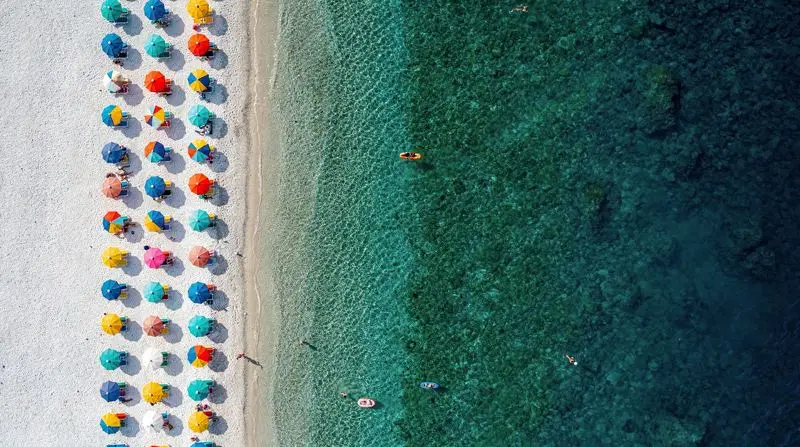
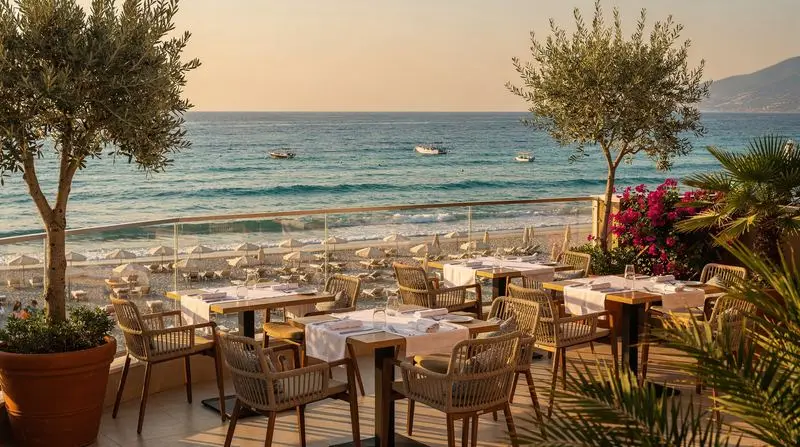
The main Himara town beach curves gently below the seafront area, with a mix of free public beach and paid sunbed areas. This is a proper working beach — not a showpiece like Ksamil, but consistently pleasant, with clear water and enough facilities to spend a full day without needing to travel anywhere.
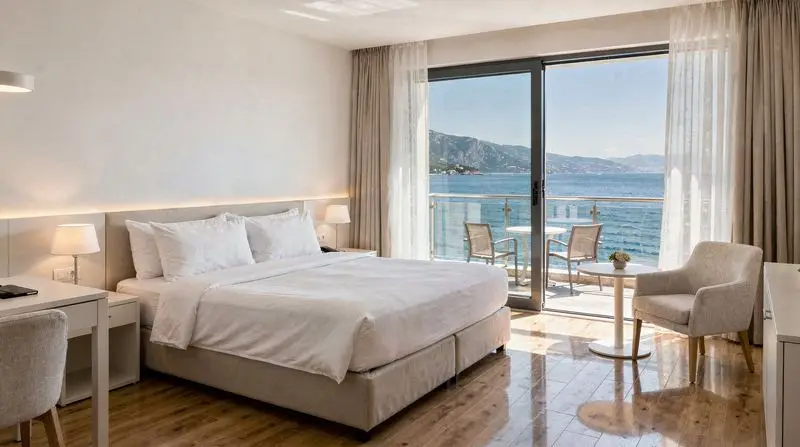
For accommodation on or immediately behind this beach, expect EUR 50-90 per night in peak season for mid-range hotels and EUR 80-120 for the better boutique properties. Properties with balconies facing the sea represent the best value in Himara — the combination of immediate beach access and Ionian views at prices substantially below the Saranda promenade equivalent is the defining appeal of basing yourself here.
In shoulder season (June and September), prices in the beach hotel zone fall to EUR 35-65, making Himara one of the best-value coastal bases in Albania. The beaches are almost as pleasant in early June as in July, and considerably less crowded.
Himara Castle Area: Views Over the Town
The Byzantine castle on the hill above Himara town is one of the better-preserved fortresses on the Albanian coast, with walls enclosing a partially inhabited village. A handful of guesthouses and small boutique properties have established themselves on the castle slopes and in the lanes of the old hilltop village.
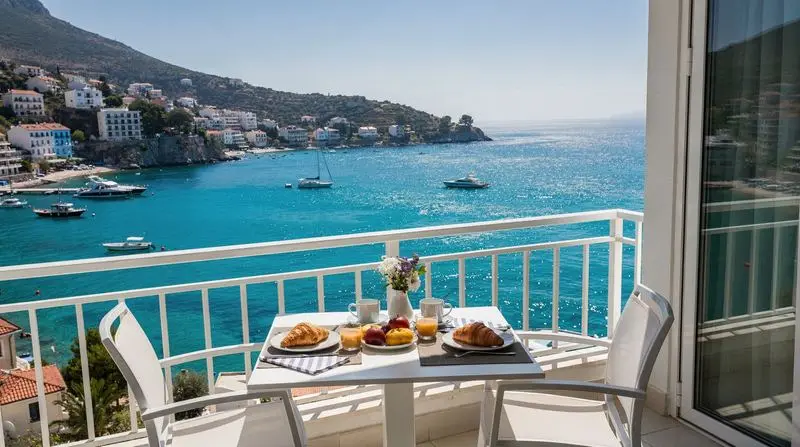
Staying here costs EUR 40-75 per night — somewhat lower than beachfront hotels — and provides a dramatically different experience. Morning coffee on a terrace looking down over the town and bay, with the sea visible below and the mountains framing the view, is the kind of atmosphere that a beach hotel cannot replicate.
The castle area is a 15-20 minute walk down to the town beach. For guests who want to swim multiple times daily, this may feel like too much in July heat; for those who want one structured beach session per day and prefer atmosphere over convenience, it is an excellent choice.
Dhermi: The Upscale Option
Dhermi sits 40 kilometres north of Himara, where the road descends from the Llogaraja Pass in a series of switchbacks to a long beach of coarse sand and pebble. It is the most developed and most fashionable of the Albanian Riviera beaches — the destination of choice for young Albanians and increasingly for European visitors who want a more polished experience alongside the natural beauty.
The beach clubs at Dhermi are among the best on the Riviera, with proper bars, DJ sets, and sunbed setups that rival similar venues in Greece or Croatia. The village above the beach (the old hilltop Dhermi rather than the beachfront strip) has a quieter, more traditional character.
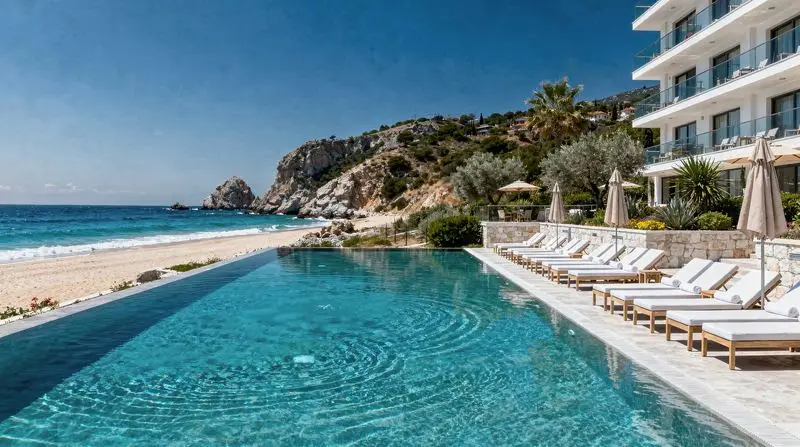
Accommodation in Dhermi: Expect to pay EUR 80-160 per night in peak season for the better beach-adjacent properties. The Dhermi area has attracted investment in proper boutique hotels and villas at a higher level than most of the Riviera, and the best of these properties — with infinity pools, private terraces, and well-designed rooms — genuinely justify the premium.
For a detailed breakdown of Dhermi accommodation, see the dedicated Dhermi where-to-stay guide.
Jale: The Bohemian Cove
Jale is a small bay south of Dhermi, accessed by a winding road off the main coastal highway. It has developed a character distinctly its own: backpacker-friendly, musically eclectic, known for beach bars that stay open late and a social atmosphere that attracts a younger, more international crowd than either Dhermi or Himara.
Accommodation in Jale leans toward the simple end: campsites, basic bungalows, small guesthouses, and a few hostels. Prices are lower than Dhermi — EUR 25-60 in peak season for a private room — and the trade-off is amenities rather than experience. The beach at Jale is beautiful in a way that compensates for any roughness in the facilities.
Jale suits backpackers and adventurous travellers who want the Riviera experience without the pretension of Dhermi or the infrastructure pressure of Saranda. It is not suited to families with young children, anyone who requires reliable air conditioning, or visitors who want a smooth booking process — much of Jale’s accommodation is best arranged on arrival or through informal channels.
The social energy at Jale is concentrated in the evenings, with beach parties and live music that can run past 2am. If you are a light sleeper, choose accommodation at the edge of the beach area rather than at its center.
Palase and Drymades: The Quieter Coves
Palase and the adjacent Drymades Beach occupy a stretch of coast about 20 kilometres south of Dhermi. These are among the most consistently beautiful and least crowded beach areas on the Riviera — long shingle beaches with clear water and a dramatically mountainous backdrop.
Accommodation here is limited: a handful of small hotels and beach camps operate in season, but the infrastructure is minimal and advance booking is genuinely important. Expect EUR 40-70 for basic beach accommodation, somewhat more for the few small hotels with private bathrooms and air conditioning.
The advantage of Palase and Drymades is relative quiet — even in high summer, these beaches feel less pressured than Dhermi or Ksamil. The disadvantage is the limited choice and the need to have your own transport or be comfortable with the irregular local transport. Most visitors treat Drymades and Palase as day trips from Dhermi or Himara rather than independent bases.
Gjipe Beach: Remote Accommodation
Gjipe — accessible only on foot or by boat — has a single accommodation option: a basic beach camp that operates in summer, with hammocks and simple mattresses under basic shelters. This is for adventurous travellers only; the experience of falling asleep on the most dramatic cove on the Riviera is genuinely special, but the amenities are minimal and the practical arrangements require some advance research.
The gorge walk to Gjipe takes 30-40 minutes from the road, passing through a spectacular limestone canyon before emerging onto the pebble beach. Most visitors access Gjipe as a day trip by boat rather than staying overnight.
Activities from Himara
The best way to explore the full length of the Riviera from a Himara base is by boat. Several operators in Himara run daily coastal excursions that cover the major coves — including Gjipe, Drymades, and beyond — with swimming stops and lunch provided.
This Himara Riviera boat trip with beach stops is one of the most popular day activities on the Albanian coast, covering several beaches including Gjipe by water — the best way to reach that otherwise inaccessible cove. The tour typically departs around 9am and returns mid-afternoon, with two or three swimming stops and a lunch break at a remote beach. Cost approximately EUR 25-35 per person.
For the sea caves that characterise this section of coastline — the limestone headlands have been carved into extensive cave systems at water level — there are dedicated cave boat tours that focus specifically on this geological feature:
This Himara sea caves boat tour takes smaller vessels into the cave systems that larger boats cannot enter, exploring the network of caverns and sea arches that line the coastline between Himara and Gjipe. An extraordinary experience on a morning with calm seas.
For visitors interested in kayaking the same coastline under their own power, the Porto Palermo area — where the Italians built a submarine base in the bay below the Ottoman castle — is a particularly striking destination:
This Porto Palermo kayak and SUP tour combines paddling through the sea caves below the castle with views up to the Ottoman fortifications — a genuinely memorable combination of historical and natural interest from the water. Cost approximately EUR 30-45 per person.
Llogaraja National Park: The Mountain Above the Beach
The Llogaraja National Park sits above Dhermi at over 1,000 metres altitude — the pine forest on the pass provides a dramatic contrast to the sun-baked beaches below. On clear days from the pass viewpoints, you can see across to the island of Corfu to the south and the Adriatic coast to the north.
From Himara, the Llogaraja Pass is 40 kilometres north by road. A half-day trip combining the forest walk and viewpoints with a swim at Dhermi on the way back is one of the better day trips from a Himara base. A private taxi to the pass and back (with two hours there) costs approximately EUR 30-45 from Himara.
The Riviera day trip from Vlora that covers the full coastal highway from the Llogaraja Pass southward is also offered as an organised tour and gives a useful orientation of the whole stretch before you commit to a specific base.
Porto Palermo and the Southern Riviera
Between Himara and Saranda, the road passes Porto Palermo Bay — dominated by an Ottoman castle on a promontory and surrounded by clear water. The Italians built a submarine base here during the Second World War, and the Albanians later used it for their own naval vessels during the Cold War. The ruins of these installations, combined with the castle and the exceptionally clear water, make Porto Palermo one of the most interesting single stops on the entire Riviera.
From Himara, Porto Palermo is about 15 kilometres south — a 20-minute drive. Most visitors stop on the way between Himara and Saranda rather than making a dedicated trip, but the kayak tours from this base are specifically oriented around the Porto Palermo geography and justify a dedicated half-day.
Getting Around the Riviera from Himara
The SH8 coastal road — the main artery of the Riviera — connects all the major beaches but is known for its dramatic curves and variable road surface. Having a rental car or motorcycle greatly expands your flexibility; without one, you are dependent on the furgons that run between the main towns or on expensive private taxis for beach-to-beach movement.
Furgons run regularly between Vlora, Himara, and Saranda, stopping at the main junctions. They do not generally stop at every beach cove — for places like Gjipe or Drymades, you typically walk from the junction or arrange a private taxi. A shared taxi from Himara to Saranda costs EUR 10-15 for the whole car and takes about an hour; a seat in a shared furgon costs EUR 5-7.
For north-south journeys along the Riviera, the morning furgon schedule works well; afternoon services are less reliable. The drive from Vlora to Saranda takes 2.5-3 hours non-stop but can take much longer if you are stopping at beaches.
Car rental is possible in Tirana and Vlora, and a number of Himara guesthouses can arrange local car hire for their guests. Having your own vehicle for the Riviera transforms the experience — the difference between waiting for a furgon at a junction and pulling off the road spontaneously at a beautiful cove is the difference between a good Riviera trip and an exceptional one.
Food and Restaurants in Himara
Himara’s Greek-Albanian heritage means the food here has a slightly different character from elsewhere in Albania. Olive oil is produced locally from ancient groves, and the influence of Greek culinary tradition (particularly in the use of seafood, oregano, and olive oil) gives Himara’s better restaurants a distinctive flavour.
The restaurants on the main beach promenade and near the town square serve both Albanian standards (byrek, tave kosi, grilled meats) and fresh fish from the daily catch. A full sit-down dinner of fresh grilled fish, salad, bread, and local wine costs EUR 12-20 per person at most beachfront restaurants — more expensive than Tirana, less expensive than Dhermi at peak.
For budget eating, the bakeries in the town center provide excellent byrek and bread from early morning. A coffee and byrek breakfast costs EUR 1.50-2.50 — the same as across Albania, and a daily ritual worth establishing.
Seasonal Pricing Summary
Accommodation across the Albanian Riviera follows a similar seasonal pattern regardless of the specific location:
- July-August: Full peak rates. Book 4-8 weeks ahead for the better properties.
- June and September: 30-40 percent lower than peak. Excellent weather, manageable crowds.
- May and October: 50-60 percent lower than peak. The beaches are quieter, some facilities close.
- November-April: Most beach accommodation closed; a few town properties in Himara remain open year-round.
Himara town properties generally offer better shoulder-season and off-season value than the smaller cove villages, whose economics depend almost entirely on July and August.
Booking Platforms for Himara
Booking.com has a reasonable selection of Himara hotels and some guesthouses. Airbnb is productive for apartment rentals and some family-run guesthouses that do not appear on larger platforms. For the smaller village guesthouses between Himara and Saranda, direct contact via WhatsApp (numbers listed on Google Maps) is often the most practical approach, particularly for late-season travel when some properties have closed for the year.
When booking Himara accommodation, confirm:
- Whether air conditioning is installed (not all properties have it, and July temperatures can reach 35 degrees)
- Whether parking is available if you are travelling by car
- Which beach the property is closest to — Himara town has two distinct beach areas, and some properties listed as “beachfront” are closer to one than the other
Riviera Bases at a Glance
| Base | Peak price | Infrastructure | Best for |
|---|---|---|---|
| Himara | EUR 40-120 | Good, self-sufficient town | All-round flexible base |
| Dhermi | EUR 80-160 | Beach clubs, boutique | Beach-club atmosphere |
| Saranda | EUR 60-130 | Maximum, ferry to Corfu | Widest options, Butrint access |
| Jale | EUR 25-60 | Minimal | Backpackers, bohemian scene |
Comparison: Himara vs. Dhermi vs. Saranda
Choose Himara if: You want a proper town base with infrastructure, lower prices than peak Riviera destinations, and the flexibility to visit multiple beaches by car or boat without being committed to one spot.
Choose Dhermi if: You prioritise beach club atmosphere, boutique hotel quality, and are willing to pay EUR 100-180 for peak season accommodation in exchange for the Riviera’s most fashionable beach.
Choose Saranda if: You want maximum infrastructure, access to Butrint and Gjirokastra day trips, ferry connections to Corfu, and the widest range of accommodation and restaurants at all budget levels. See the Saranda accommodation guide for full detail.
For visitors covering the whole of southern Albania, the budget accommodation guide gives the full picture of costs from the mountains to the coast.
See also the where to stay in Vlora guide for the northern Riviera gateway, and the best beaches in Albania guide for an overview of which specific beaches are worth planning around.
Frequently asked questions about Where to Stay on the Albanian Riviera
Do I need a car to base myself in Himara? It helps considerably but isn’t essential. Furgons connect Himara to Vlora and Saranda regularly, and boat tours reach Gjipe and the sea caves without a car, but reaching Drymades, Palase, or the Llogaraja Pass on your own schedule really benefits from a rental.
Is Himara or Dhermi better for a first Riviera visit? Himara is the safer first choice for most visitors — genuine town infrastructure, lower prices, and the flexibility to day-trip to Dhermi, Gjipe, and Porto Palermo without committing to one small cove. Choose Dhermi instead if beach-club atmosphere and boutique polish matter more to you than flexibility.