Albanian Customs and Etiquette: What Every Traveler Should Know
Albania is one of Europe’s most distinctive cultural experiences. The country has been shaped by ancient Illyrian traditions, five centuries of Ottoman rule, decades of strict communist isolation, and a rapid, sometimes chaotic embrace of modernity since 1990. The result is a social culture that is unlike anywhere else — deeply traditional in some respects, surprisingly modern in others, and defined by a code of hospitality that genuinely sets it apart from the rest of Europe.
Understanding a few key customs turns a good visit into a great one. These are not abstract cultural notes — they are practical knowledge that shapes daily interactions, from how you confirm a bus is leaving to how you respond when someone insists on buying you coffee.
| Head movement | Nod = no; head shake = yes (opposite of Western norms) |
| Tipping | around 10% at restaurants; round up taxis |
| Coffee | Central to social life; accept invitations graciously |
| Dress | Casual generally; cover shoulders/knees at religious sites |
| Greeting | Handshake for men; cheek-kiss common among women/friends |
Besa: The Albanian Code of Honor
The single most important concept in Albanian culture is besa — a word usually translated as “word of honor” or “pledge of faith,” but which carries a weight that no single English phrase captures. Besa is the fundamental social contract: if an Albanian gives you their word, it is sacred. If an Albanian takes you under their protection as a guest, your safety and wellbeing become their personal responsibility.
The hospitality you encounter in Albania — strangers inviting you for coffee, guesthouse hosts loading your table with food well beyond the stated meal, locals going far out of their way to help you find a destination — all flows from this tradition. You are a guest. In Albanian culture, the guest is almost sacred, and mistreating a guest is a profound social transgression that carries its own community consequences.
For travelers, the practical implication is: accept hospitality graciously. If someone insists on buying you a coffee, a refusal is sometimes taken as a mild offense. A warm acceptance, a genuine thank-you, and a reciprocation where possible (offering the next coffee, a small gift) is the appropriate response.
Besa explains much of what makes Albania distinctive as a travel destination. The warmth you experience is not performed for tourism — it is the expression of a deeply embedded cultural value that Albanian people have maintained through extraordinary historical upheaval.
The Yes/No Head Movement Reversal
This is the most practically important cultural fact for first-time visitors to Albania: head movements for yes and no are the opposite of what Western travelers expect.
- Nodding your head up and down means NO in Albania
- Shaking your head side to side means YES in Albania
This is not a myth or exaggeration — it is genuinely how Albanians communicate non-verbal agreement and disagreement, and it catches every first-timer completely off guard. You ask “Is the bus leaving soon?” and the driver nods confidently. You relax — only to discover the nod meant it is not leaving for another hour.
The reversal is deeply unconscious for Albanians. In a mixed context — tourists around, or an Albanian who has spent time abroad — people sometimes switch to Western conventions, which only adds to the confusion. When you genuinely need to confirm something important, back up the head movement with a verbal “Po?” (yes?) or “Jo?” (no?).
After a day in Albania, most visitors adapt. After two days, you barely notice. But the first 24 hours produce entertaining misunderstandings.
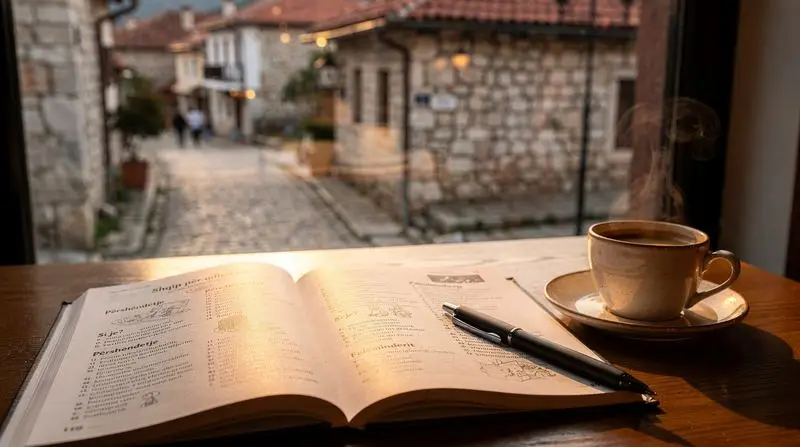
If you want a head start, the Albanian phrasebook gives you the short words to pair with every gesture, and the things to know before visiting Albania page collects other first-day surprises in one place.
Coffee Culture
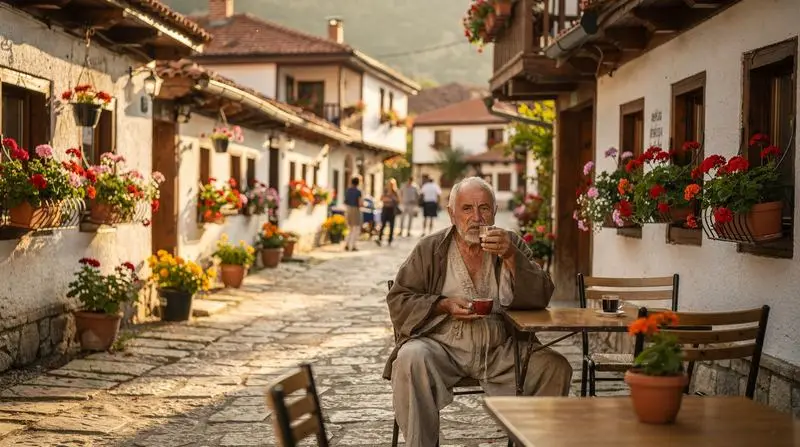
Coffee is the engine of Albanian social life. The espresso culture runs deep — borrowed from Italy via decades of (banned but watched) Italian television. Every significant interaction, negotiation, friendship, and encounter is conducted over coffee. Albania has a higher per-capita coffee shop density than almost any European country, and sitting over an espresso for two hours is a completely standard social activity.
If someone offers you a coffee, accept. Refusing a coffee invitation without a very good reason is a mild social slight. If you truly cannot accept, apologize warmly.
Coffee shops are for lingering. No one will bring you the bill early. No one will hover. You sit as long as you like; paying when you are ready to leave is standard.
Albanian coffee culture is explored in more depth in the Albanian coffee culture guide, which covers the different types of coffee, the social rituals, and the role of the cafe as Albania’s informal parliament.
Raki: The Social Spirit
Raki (sometimes spelled “rakia”) is the traditional Albanian spirit, distilled from grapes, and is the evening counterpart to the morning espresso. Raki is offered at the start of meals, during visits, and as a gesture of welcome at guesthouses. Declining politely is entirely fine for those who do not drink alcohol — say “Nuk pi alkool” (I do not drink alcohol) and it will be respected without awkwardness.
If you do drink, accepting a glass of raki from a host is a social gesture of respect. Refusing a host’s raki when you could otherwise drink it is the kind of mild social slight that Albanian hospitality culture notices. The raki is usually homemade, often very good, and always an expression of pride.
For a comprehensive overview of raki culture, production, and how to drink it, see the Albania raki guide.
Evenings out often involve a drink, so the drinking and nightlife rules are worth a read, and the Albanian food guide explains what usually arrives on the table alongside it.
Hospitality in Private Homes and Guesthouses
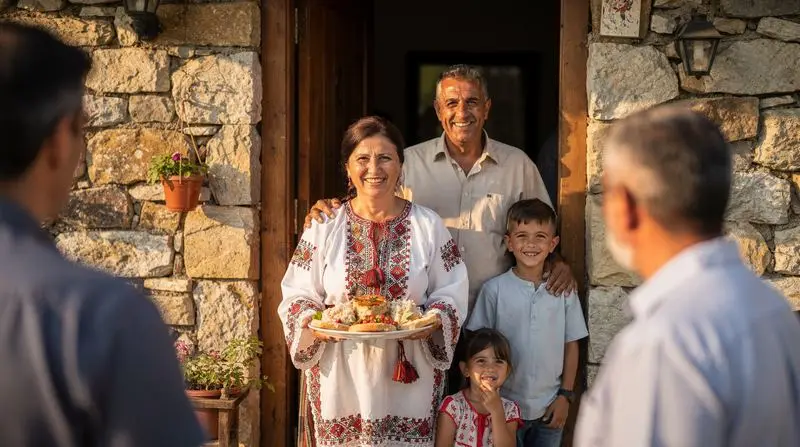
If you are hosted in an Albanian home or family guesthouse, expect generous hospitality that can be overwhelming in its scale. Albanian hosts take pride in providing abundance — tables laden with home-cooked food, refilled glasses, second helpings pressed upon you before you have finished the first. This is not imposition; it is the highest expression of hosting culture.
How to respond:
- Accept food and drink graciously, even if you cannot finish everything
- Compliment the food sincerely — Albanians are proud cooks and the compliment matters
- Do not be the first to leave the table before the host signals the meal is concluded
- A small gift for the host — wine, chocolates, something from your home country — is appreciated but not expected
Photography in homes: Always ask before photographing family members, elderly people, or private family settings. Most Albanians are happy to be photographed when asked with a smile, but the question matters.
Religious Tolerance and Faith
Albania is remarkable for its religious harmony. The country’s population is roughly 60 percent Muslim (predominantly Sunni and Bektashi), 20 percent Orthodox Christian, 10 percent Catholic, and a significant non-practicing or atheist population (a legacy of Hoxha’s 1967 ban on all religion). In practice, Albanians often describe their religion as simply “Albanian” — national identity far outweighs religious identity.
This means you will not encounter religious tension or pressure related to your own faith or lack of it. Mosques, churches, and Bektashi tekkes often sit within a few streets of each other without friction. Albania’s religious pluralism is genuine and something Albanians are quietly proud of.
When visiting religious sites:
- Cover shoulders and knees when entering mosques or Orthodox churches
- Remove shoes when entering mosques
- Ask before photographing inside places of worship
- Behave quietly and respectfully
The mosque and church visiting guide goes into more detail on what to expect at each type of site, and the Berat and Gjirokastra pages are good places to see this religious mix in practice.
Meeting, Greeting, and Social Norms
Greetings between acquaintances typically involve a handshake for men meeting men, and often a cheek-kiss (one or two cheeks) for women greeting either gender and men who know each other well. For initial encounters with strangers, a handshake and “Mirëdita” (good day) is appropriate.
Eye contact during conversation is considered respectful and attentive. Looking away or down can read as disinterest or evasiveness.
Personal space: Albanians stand closer in conversation than Northern Europeans typically do. This is normal and not intrusive — adapt rather than step back.
Punctuality: Social punctuality is relaxed in Albania. Dinner at 20:00 may mean 20:30 or later. Business and formal appointments are generally more punctual.
Complimenting children: Traditional Albanian belief holds that excessive compliments to children can invite bad luck (the evil eye concept, or “syri keq”). Some older Albanians will touch the child or make a protective gesture after a compliment. Do not be alarmed — simply tone down effusive compliments in traditional settings.
Tipping
Tipping is appreciated but operates differently from Northern European or North American norms.
Restaurants: 10 percent is a generous and well-received tip. Rounding up the bill is common for smaller amounts. Service is rarely included in the bill — check if “shërbimi” is listed.
Taxis: Rounding up the fare is normal. Adding EUR 1-2 on top of the metered or Bolt fare for good service.
Guesthouse hosts: A cash tip at the end of your stay, particularly if the host has cooked meals, gone out of their way for you, or arranged connections, is very appreciated. EUR 5-15 per stay, depending on length and quality of service.
Guides: EUR 10-20 per day for local guides, more for exceptional service on multi-day treks.
For a fuller picture of how tipping works in different situations, see the Albania tipping guide, and for general spending context the Albania currency and money guide is a useful companion.
Dress Code
Albania is a relatively secular society and dress expectations are generally casual. There is no requirement to dress conservatively for general travel. However:
- Religious sites: Cover up when visiting mosques and Orthodox churches
- Mountain villages: Modest dress is appropriate in conservative communities
- Beaches: Standard beach attire is perfectly normal at the Riviera resorts
Evening dress in Tirana: The Blloku district has some smart restaurants and bars where smart-casual fits the atmosphere. This is preference, not requirement.
Taking Photographs
Most Albanians are happy to be photographed when asked with a friendly manner and a genuine smile. Photographing people without asking — particularly in markets, rural areas, or religious contexts — is rude and will be received as such.
Military and police installations: Do not photograph military facilities, police stations, or border control posts. This is legally sensitive and will cause unnecessary confrontation.
Communist-era sites: Generally fine to photograph — the bunkers, old murals, and communist architecture are part of Albanian heritage and Albanians are generally comfortable with their history being documented.
Market and street life: Photographing everyday Albanian life — the vegetable market, old men playing chess, a tea house in a small town — is generally accepted. The same rule applies: eye contact and a questioning gesture gets a nod or a wave away before you take the shot.
More ideas on where to point your camera are in the photography spots guide, and the drone rules page covers what to keep in mind if you fly one.
The Role of Elders
Albanian society maintains a strong tradition of respect for elders that is immediately observable:
Seating: In social settings, the most senior person in the room is typically given the seat of honor — the best chair, the head of the table, the prime position facing the room’s entrance. If you are the guest, you may be given this position instead.
Greetings: When an elder enters a room, younger people typically stand. As a guest you may or may not be expected to do this, but the gesture is noticed and appreciated.
Asking elders for advice: In traditional settings, decisions of significance are discussed with older family members. An Albanian friend saying “I need to check with my father/grandfather” before committing to something is not evasion — it is appropriate cultural process.
Social Invitations and Obligations
Albanian social invitations carry genuine weight. When someone invites you to their home, to a family event, or to join a meal, they mean it sincerely. Albanians do not issue social invitations as empty pleasantries.
Accepting an invitation: If you accept, you are expected to show up. Last-minute cancellations are taken seriously.
Declining an invitation: Decline warmly and with a genuine reason if you must. Declining without explanation is less acceptable than in many Western cultures.
What to bring: If invited to an Albanian home for a meal, bring something — a bottle of wine, chocolates, flowers, or a small gift from your home country. Arriving empty-handed is not catastrophic (hospitality is offered regardless) but bringing something is appreciated.
Punctuality: Social occasions operate on flexible time. If told dinner is at 20:00, arriving at 20:15-20:30 is entirely normal.
Gift Giving Culture
When visiting Albanian homes or staying with families, gifts express appreciation and acknowledge hospitality:
What Albanians appreciate:
- Distinctive items from your home country or region
- Quality chocolate, cookies, or sweets
- Good wine
- Small toys or books for children if there are children in the household
Timing: Gifts are typically given when you arrive or when you leave, not both. Presenting something when you first arrive at a guesthouse is a natural gesture; giving something at the end of your stay acknowledges the hospitality you received.
Blood Feud: The Historical Reality
Many outdated guidebooks raise the blood feud (gjakmarrja) as a safety concern for tourists. The honest assessment: the blood feud tradition is an almost entirely historical institution that continues in extremely isolated form in some rural northern highland communities involving specific families in disputes with complex histories. It is entirely unrelated to tourism and has no bearing on visitor safety whatsoever.
The blood feud’s relevance to a traveler in Albania is zero. It belongs in the same category as other historical customs that people still read about but almost never witness.
For a wider view of how safe Albania feels day to day, the Albania safety guide and the communist history guide give helpful context.
Photography Etiquette
Beyond the basic rule of asking before photographing people, some specific guidance:
Religious ceremonies: If you happen upon a Muslim prayer gathering, an Orthodox service, or a Bektashi ceremony, photography should be entirely avoided unless explicitly invited. Attending respectfully as an observer is fine; photographing is not.
Private property: Albanian mountain guesthouses and family homes have significant visual appeal. Ask before pointing a camera at the house or the family inside. Most will agree, many will pose happily, but the asking is essential.
Experiencing Albania’s Cultural Richness
One of the best ways to deepen your cultural understanding of Albania while meeting locals and other travelers is through an organized food or cultural tour. Tirana food tours cover not just the dishes but the cultural context behind Albanian eating traditions, the coffee ritual, and the role of food in Albanian hospitality.
For a broader introduction to Tirana’s social and cultural landscape, Tirana walking tours contextualize the city’s history, communist heritage, and contemporary culture in a way that makes everything you subsequently experience richer.
Final Note
The overwhelming experience of first-time visitors to Albania is of a country that is warmer, more welcoming, and more hospitable than its reputation suggested. The cultural quirks — the reversed yes/no, the relentless coffee offers, the overloaded dinner tables — are expressions of a culture that takes genuine pride in how it treats guests. Enter into the spirit of it, and Albania will be one of the warmest experiences of your travels.
For language basics to back up your cultural knowledge, see the Albania language guide. For safety context around all social situations, see the Albania safety guide.
Albanian hospitality culture is one of the most genuine and affecting experiences of traveling here. Approaching it with curiosity and respect — participating in the coffee rituals, accepting the raki, learning the greetings, asking about the family — rewards you with connections that feel more meaningful than the transactional tourism that characterizes many popular destinations. Albania gives significantly more to visitors who bring cultural curiosity alongside their camera.
Solo visitors in particular may find the solo travel guide and the common mistakes to avoid a helpful next read, and the Tirana destination page is a natural place to start putting all of this into practice.
Etiquette on the Road and in Transit
Furgon and bus travel has its own small set of customs worth knowing. Boarding order is informal — there is rarely a queue in the Western sense, and squeezing in politely alongside other passengers is normal rather than rude. Offering your seat to an elderly passenger or someone carrying a child is expected and noticed positively. When a furgon fills up, drivers sometimes wait for one or two more passengers before departing even if a rough departure time was quoted; patience rather than visible frustration is the appropriate response, and asking “kur nisemi?” (when do we leave?) is a perfectly normal question to ask.
The buses and furgons guide explains how these shared rides work in practice.
Common First-Timer Mix-Ups
Beyond the head-nod reversal, a handful of smaller misunderstandings catch nearly every first-time visitor at some point:
Interpreting silence as rudeness. Albanians can be direct and unadorned in speech compared to some Western conversational styles — a blunt “no” or a short answer is not intended as coldness, just efficiency.
Misreading the pace of hospitality. A guesthouse host who seems to be constantly bringing more food is not testing your capacity; refusing further helpings with a warm “faleminderit, jam ngopur” (thank you, I’m full) is entirely acceptable and expected once you’ve genuinely eaten enough.
Assuming a closed shop is permanently closed. Many small businesses, especially outside Tirana, keep informal hours or close for an afternoon break. A closed door in the early afternoon often reopens later rather than signalling the business is shut for good.
Confusing formality levels. Albanian social interactions shift quickly from formal to warmly informal once a connection is made — don’t be surprised if a shopkeeper or guesthouse host who was reserved on day one is inviting you for coffee by day two.
Frequently Asked Questions About Albanian Customs and Etiquette
Why do Albanians nod for no and shake their head for yes?
This is a genuine and long-standing Albanian (and broader Balkan) non-verbal convention, not a myth — nodding up and down means “no,” and shaking the head side to side means “yes,” the reverse of most Western body language. It catches every first-time visitor off guard for the first day or two. When something matters — confirming a bus departure or a price — back up the head movement with a verbal “po” (yes) or “jo” (no).
Is tipping expected in Albania?
Tipping is appreciated rather than strictly expected. Around 10 percent at restaurants is generous and well-received; rounding up is common for smaller bills, taxis, and casual services. Guesthouse hosts who cook meals or go out of their way appreciate a cash tip of EUR 5-15 at the end of a stay. It is not a rigid obligation, but it is noticed and valued.
What should I know about Albanian hospitality before visiting?
The core concept is besa — a code of honour and hospitality that makes guests almost sacred. Expect genuine warmth: coffee offers, generous meals, and locals going out of their way to help. Accepting hospitality graciously, complimenting food sincerely, and reciprocating where possible (offering the next coffee, bringing a small gift) are the appropriate responses. Refusing hospitality outright can read as a mild social slight, so a warm acceptance is usually the better choice even if you can only manage a small amount.