Albanian Language for Travelers: What to Know Before You Go
Albanian (Shqip) is one of Europe’s most linguistically isolated languages — an Indo-European language with no close relatives, spoken by around seven million people in Albania, Kosovo, and Albanian communities across North Macedonia, Greece, and the diaspora. It is not related to any neighboring language, which means your Greek, Slavic, Romanian, or Italian vocabulary provides essentially no shortcuts.
The good news: you do not need to learn Albanian to travel here. English is widely spoken in tourist areas, Italian fills the gap where English does not reach, and Albanians are enormously forgiving of any linguistic limitations. The better news: even a handful of Albanian phrases dramatically changes how locals respond to you. The effort is noticed, valued, and rewarded with warmer hospitality.
This guide covers how much English is spoken, the role of Italian, pronunciation basics, and all the phrases you need for a comfortable and rewarding trip.
| Official language | Albanian (Shqip) |
| Useful second language | Italian, especially outside Tirana |
| English in tourist areas | Widely spoken, especially under 40 |
| One phrase worth learning | Faleminderit (thank you) |
| Learning curve | Steep — no close relatives to other languages |
How Much English Is Spoken?
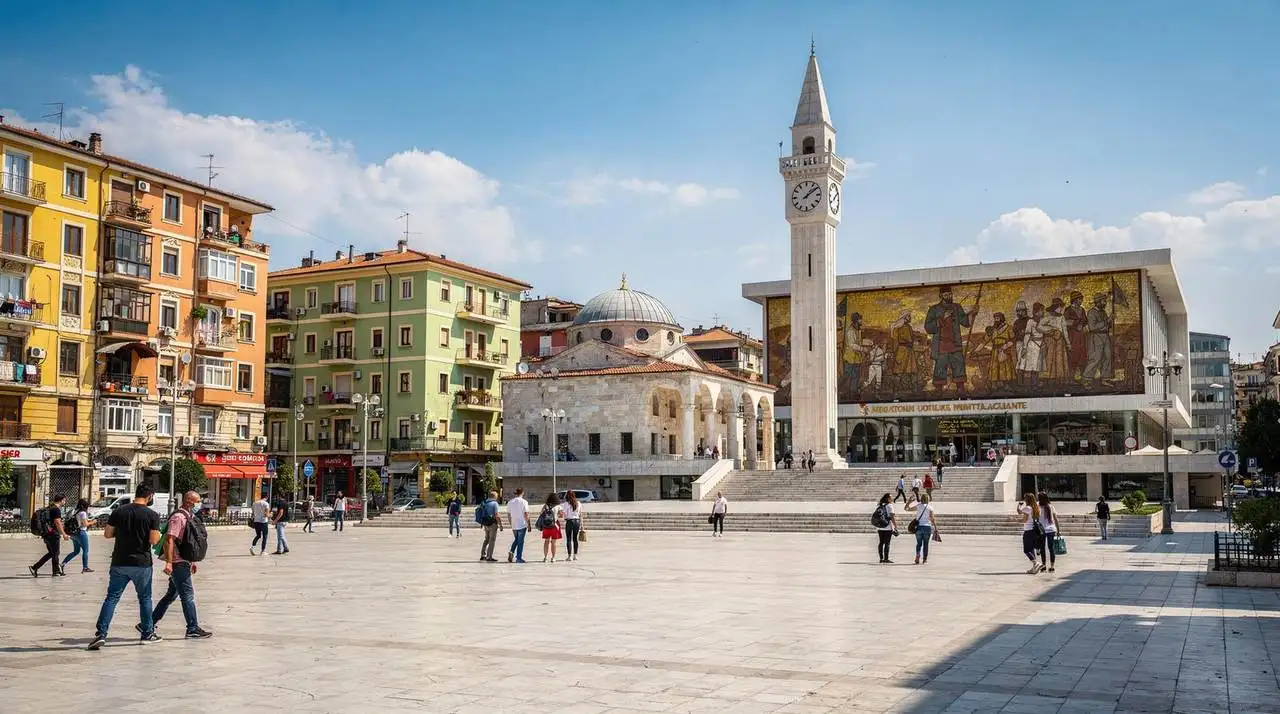
Tirana: English is widely spoken, particularly among people under 40. Hotel and guesthouse staff, tour operators, restaurant staff in the Blloku area, and most people working in the tourist industry communicate effectively in English.
Tourist destinations (Berat, Gjirokastra, Saranda, Shkodra): Good English in the hospitality industry; more variable among older residents and small shop owners.
Mountain guesthouses (Theth, Valbona): The guesthouse owners are usually English-speaking or have a family member who is — they have adapted to international trekkers. But the closer you get to daily village life, the less English you encounter.
Rural areas and small towns: Limited English. Italian, gestures, a phone translation app, and goodwill get you further here.
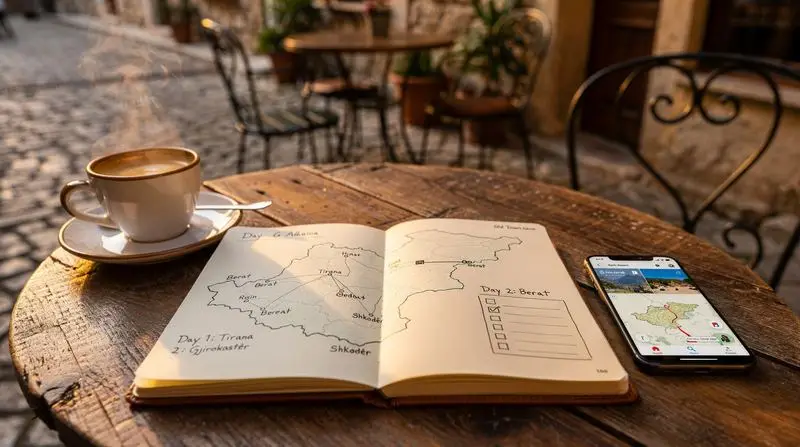
Useful tip: Download Google Translate with Albanian and Italian offline packs before you arrive. The camera translation feature is useful for menus and signs in local restaurants.
If you are still planning the practical side of the trip, the Albania eSIM guide and the Albania SIM card guide explain how to stay connected, which matters because a translation app is only useful with data or an offline pack.
Italian as the Second Language
Here is something that surprises most visitors: Italian is often more useful than English outside Tirana, particularly with older Albanians and in the south of the country.
During the communist era, Albanians famously tuned into Italian television broadcasts despite official prohibition. RAI 1 and RAI 2 were received across much of Albania, and an entire generation effectively learned Italian by watching TV. Combined with the large Albanian immigrant community that formed in Italy during the 1990s — many families have members who lived and worked in Italy — Italian is genuinely embedded in Albanian life.
If you speak Italian at a basic level, using it in Albania often opens doors more readily than English. Older shopkeepers, taxi drivers, and restaurant owners who might struggle with English may light up when addressed in Italian.
Pronunciation Guide
Albanian has a few sounds that do not exist in English. The basics:
- ë — an unstressed neutral vowel, like the “a” in “about” or the “e” in “taken”
- ç — pronounced like “ch” in “church”
- gj — like “dy” or “dge” in British English (similar to “dude” compressed)
- ll — a dark, thick “l” sound, further back in the mouth than English “l”
- q — something between “k” and “ch” — a soft palatal sound
- rr — rolled “r” (like Spanish double-r)
- sh — like “sh” in “shoe” (exactly the same)
- xh — like “j” in “judge”
- zh — like the “s” in “measure” or the “j” in French “jour”
- dh — voiced “th” like in “the” (not the sharp “th” in “thin”)
- th — unvoiced “th” like in “thin”
Do not panic about perfect pronunciation — Albanians are enthusiastic about any attempt and will help you cheerfully. Mispronunciation is expected from foreigners and treated with warmth rather than impatience.
Essential Albanian Phrases
Greetings and Basics
- Hello — Mirëdita (meer-DEE-ta) — the formal daytime greeting
- Hello (informal) — Ç’kemi (ch’KEM-i) — literally “how are things”
- Good morning — Mirëmëngjes (meer-uh-MUEN-yes)
- Good evening — Mirëmbrëma (meer-uh-M’BRE-ma)
- Goodbye — Mirupafshim (meer-oo-PAF-sheem) — formal; or “Bye” which Albanians use informally
- Please — Ju lutem (yoo LOO-tem)
- Thank you — Faleminderit (fal-eh-min-DER-it) — a long but satisfying word; locals are always delighted when tourists say it correctly
- You’re welcome — S’ka gjë (ska DZHEH) — literally “it’s nothing”
- Yes — Po (poh)
- No — Jo (yoh)
- Sorry / Excuse me — Më fal (muh FAL)
The Albanian Head Nod Reversal — Critical Knowledge
This is essential. In Albania, the head movements for yes and no are the opposite of what Western travelers expect:
- Head nod (up-down) = NO
- Head shake (side-to-side) = YES
This catches every first-time visitor off guard. You ask “Is this the road to Berat?” and the driver nods — you assume yes, but it means no. The reversal is deeply ingrained and entirely unconscious for Albanians. Be aware of this when interpreting any non-verbal response. When in doubt, follow up with a verbal “Po?” or “Jo?” to confirm. The Albania customs and etiquette guide covers this and other cultural quirks.
Numbers
- 1 — një (nyuh)
- 2 — dy (doo)
- 3 — tre (treh)
- 4 — katër (KAH-tuhr)
- 5 — pesë (PEH-suh)
- 6 — gjashtë (DYASH-tuh)
- 7 — shtatë (SHTAH-tuh)
- 8 — tetë (TEH-tuh)
- 9 — nëntë (NUN-tuh)
- 10 — dhjetë (DHYEH-tuh)
- 20 — njëzet (nyuh-ZET)
- 50 — pesëdhjetë (pehs-uh-DHYETUH)
- 100 — njëqind (nyuh-CHIND)
- 1,000 — njëmijë (nyuh-MEE-yuh)
Getting Around
- Where is…? — Ku është…? (koo EHSHt)
- How much does it cost? — Sa kushton? (sah koosh-TOHN)
- Bus — autobus
- Taxi — taksi
- Airport — aeroporti
- Hotel — hotel
- Train station — stacioni i trenit
- Left — majtas (MY-tas)
- Right — djathtas (DYATH-tas)
- Straight ahead — drejt (dreyt)
Food and Eating
- Restaurant — restorant
- Menu — menu (same as English)
- Water — ujë (oo-YUH)
- Coffee — kafe (KAH-feh)
- Beer — birrë (BEER-uh)
- Wine — verë (VEH-ruh)
- Bread — bukë (BOO-kuh)
- Fish — peshk (peshk)
- Meat — mish (meesh)
- Vegetarian — vegjetarian (similar to English)
- The bill, please — Llogarinë, ju lutem (lyoh-gah-REE-nuh, yoo LOO-tem)
- Delicious! — Shumë i mirë! (shoo-MUH ee MEE-ruh) — literally “very good”
- One coffee, please — Një kafe, ju lutem
Emergencies
- Help! — Ndihmë! (N-DEEM-uh)
- I need a doctor — Kam nevojë për mjek (kam neh-VOH-yuh puhr myehk)
- Call the police — Thirrni policinë (THEER-nee po-LEE-tsee-nuh)
- Hospital — spitali (spee-TAH-lee)
- I don’t understand — Nuk kuptoj (nook koop-TOY)
- Do you speak English? — Flisni anglisht? (FLEES-nee AHN-gleesht)
- Where is the pharmacy? — Ku është farmacia?
Phrases for ordering and paying come in handy in many places, from a seaside taverna to the best restaurants in Tirana. If tipping at the end of a meal leaves you unsure, the tipping guide for Albania covers what is usual, and the Albanian food guide helps you recognise dishes on a menu.
Cultural Notes on Language
Albanians are patient with language learners. Unlike some cultures where fumbled language attempts meet impatience, Albanians genuinely warm to tourists who try. Even a stumbled “Faleminderit” after a meal produces visible delight.
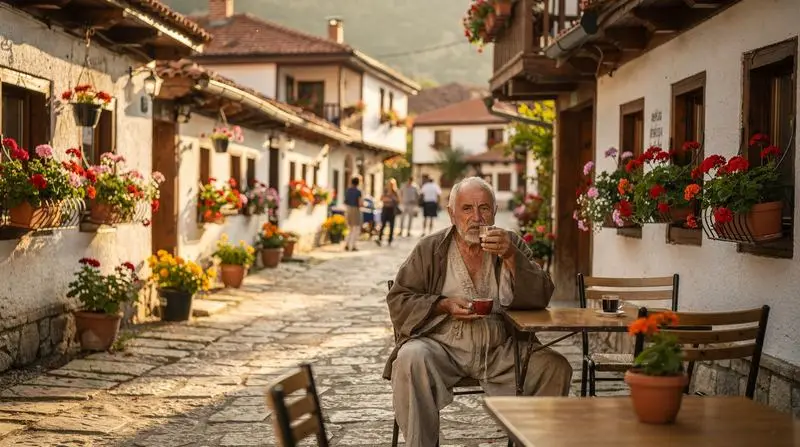
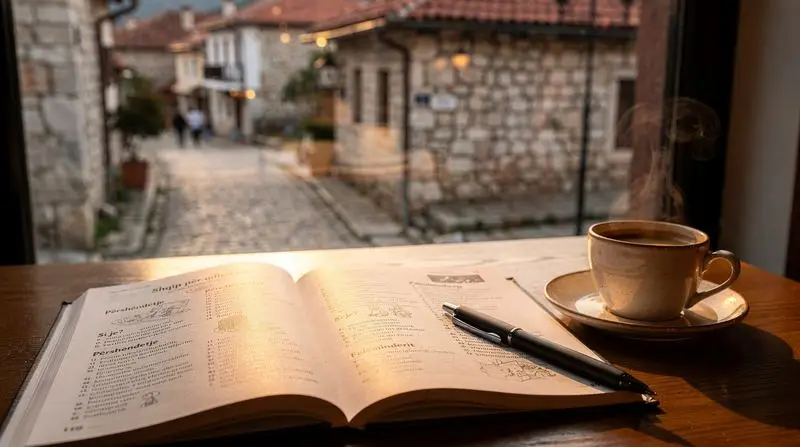
Coffee and language: Much of Albanian social life happens over an espresso. Sitting in a local cafe and attempting conversation with your phone translator plus a few Albanian words can cover considerable ground.
The word for Albania: Albanians call their country “Shqipëria” (sh-chip-EH-ria) and themselves “Shqiptarë” (sh-chip-TAH-ruh). The name Albania is a foreign invention. Using “Shqipëria” when referring to the country makes a very positive impression.
Respect and titles: Older Albanians appreciate being addressed respectfully. Using “Zoti” (Mr.) or “Zonja” (Mrs.) followed by a surname is courteous in formal situations.
Using Albanian in Social Situations
At a cafe: Ordering with “Një kafe, ju lutem” produces visible delight. Following up with “Faleminderit” when it arrives seals the interaction perfectly.
At a restaurant: “Menuja, ju lutem” (the menu, please) works. “Ishte shumë i mirë” (it was very good) at the end of the meal is enormously appreciated by the cook.
Greeting strangers: In small towns and villages, making eye contact and saying “Mirëdita” when passing people is standard courtesy and produces warm responses.
Bargaining in markets: “Sa kushton?” (how much?) is your key phrase. If you want to negotiate, a smile and silence after the first quote often invites a revised offer without needing more words.
When you are lost: “Ku është [destination]?” often produces directions in Albanian that you cannot follow, but Albanians are generally willing to walk you partway there rather than watch you stay lost.
Common Phrases for Transport
If you are using furgons and buses, these phrases help enormously:
- Is this the bus to Berat? — Ky është autobusi për Beratin? (approximate — just say the destination name and hold up your fingers for the count)
- One ticket to… — Një biletë për… (nyuh bee-LEH-tuh puhr)
- When does it leave? — Kur niset? (koor NEE-set)
- Where is the bus station? — Ku është terminali i autobusit?
For the Bolt app and ride-hailing, you do not need Albanian — the app handles everything. See the best apps for Albania guide.
Useful Phrases for Guesthouses and Hotels
When staying in mountain guesthouses or local accommodation, these help:
- Do you have a room available? — Keni dhomë të lirë? (KEN-ee DHOH-muh tuh LEE-ruh)
- How much per night? — Sa kushton nata? (sah koosh-TOHN NAH-ta)
- Including breakfast? — Me mëngjes të përfshirë? (meh MUN-yes tuh puhr-FSHEE-ruh)
- WiFi password? — Fjalëkalimi i WiFi? (fyah-luh-kah-LEE-mee ee WiFi)
- Thank you for everything — Faleminderit për gjithçka (fal-eh-min-DER-it puhr dyeeth-CHKA)
Translation Apps and Albania
Google Translate supports Albanian and works tolerably well for common travel situations. The camera translation feature is useful for:
- Restaurant menus without English translations (most local restaurants)
- Road signs and notices
- Product labels in supermarkets
- Official documents and forms
The translation quality for Albanian is not as polished as for major European languages, but for basic comprehension it is genuinely useful. Download the Albanian language pack for offline use before you lose connectivity in mountain areas.
DeepL does not currently support Albanian. Google Translate is your best app option. Microsoft Translator also supports Albanian with similar quality.
Tours for Language and Cultural Immersion
For travelers who want to go deeper into Albanian culture and language, organized experiences provide guided access to contexts where cultural knowledge is immediately applicable.
Tirana walking tours with English-speaking local guides provide cultural context for everything you see — the language, the history, the customs — in a way that enriches every subsequent interaction during your trip.
Food and culture tours in Tirana are particularly useful for language immersion — you learn the names of dishes, the vocabulary of Albanian food culture, and the social context behind the coffee and raki rituals.
Solo travelers in particular benefit from these small exchanges, since a friendly greeting often turns into a conversation, a recommendation or an invitation. The solo travel guide and the guide for women traveling alone show how language and local contact fit into a trip on your own.
The Albanian Diaspora and Language
An interesting feature of communicating with Albanians: many have relatives who emigrated to Italy, Greece, Germany, Switzerland, or the UK. As a result, conversations can switch languages unexpectedly as people discover mutual competency. An Albanian taxi driver who speaks limited English may suddenly produce confident Italian when you mention Rome, or good German when you say Munich.
This diaspora-generated multilingualism means that persistence in looking for a common language often pays off. The person who cannot speak English may speak Italian. The restaurant owner who speaks no German may have a nephew who spent five years in Munich.
The Albanian Alphabet
Albanian has its own 36-letter alphabet, adapted from Latin script but with additional characters for its unique sounds. The alphabet is entirely phonetic — each letter represents exactly one sound, with no exceptions. This makes Albanian perfectly consistent in pronunciation once you know the sounds.
Letters unique to Albanian or with non-obvious pronunciations:
- c = “ts” (like in “cats”)
- ç = “ch” (like in “church”)
- dh = voiced “th” (like in “the”)
- ë = unstressed “uh”
- gj = palatal “dy” sound
- ll = dark “l” (back of the mouth)
- nj = “ny” (like Spanish ñ)
- q = palatal stop (between “k” and “ch”)
- rr = rolled “r”
- sh = “sh”
- th = unvoiced “th” (like in “thin”)
- xh = “j” (like in “judge”)
- zh = “zh” (like “s” in “measure”)
Understanding these lets you approximate the pronunciation of any Albanian word you see written down — useful for navigating menus, signposts, and guesthouse names.
If you plan to stay in the mountains, the guesthouses of the Albanian Alps guide and the Theth destination page describe the kind of family-run places where a few Albanian words are most appreciated.
Language and Hospitality
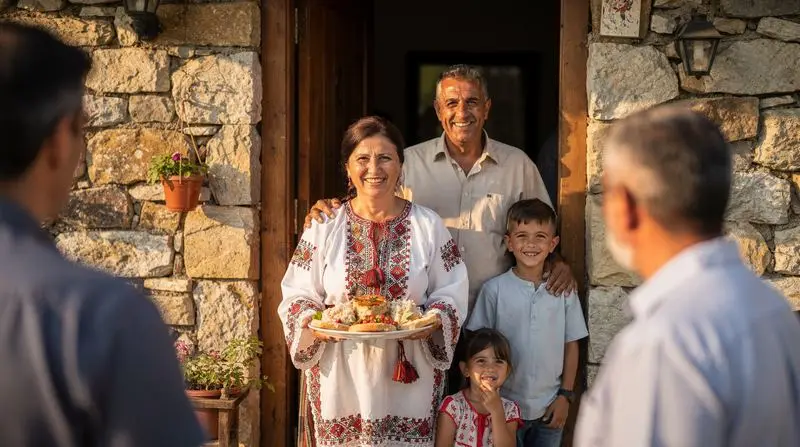
A final observation: the effort to speak Albanian, however limited, signals something beyond linguistic courtesy. It signals that you have taken the country seriously. That you did not assume Albania would simply adapt itself to your language needs. That you came as a guest who wanted to engage, not just a tourist who wanted to consume.
Albanians notice this and respond to it warmly. Your six words of Albanian — hello, goodbye, thank you, please, how much, delicious — combined with genuine curiosity and respect, will take you further in Albania than perfect linguistic competence with condescension would. The hospitality is already there. The language effort simply opens the door wider.
Gheg vs Tosk: Albania’s Two Dialects
Albanian splits into two major dialect groups: Gheg, spoken in the north (Shkodra, Tirana, the Alps) and in Kosovo, and Tosk, spoken in the south (Berat, Gjirokastra, Saranda, Vlora) and the basis of standard literary Albanian used in schools and media. The differences are noticeable — different vowel sounds, some different vocabulary — but not a barrier: any Albanian understands both, and everything you learn as a visitor works nationwide, since standard Albanian taught in schools is understood everywhere. You do not need to worry about which dialect to learn; the phrases in this guide work whether you’re in Shkodra or Saranda.
Signs, Menus and Written Albanian
Written Albanian is highly phonetic, which makes signs and menus more decodable than the spoken language might suggest once you know the alphabet basics below. Restaurant menus in tourist areas (Saranda, Ksamil, Berat, Gjirokastra, Tirana) usually include English or Italian translations; smaller village tavernas often do not, which is where a translation app camera feature earns its keep. Road signs are in Albanian only, though major routes also use standard European road symbols. See things to know before visiting Albania for wider practical context beyond language.
Frequently Asked Questions About the Albanian Language
Is Albanian hard to learn for English speakers?
Yes, relatively — it’s linguistically isolated with no close relatives, so there are no vocabulary shortcuts from other European languages. That said, the alphabet is entirely phonetic (one letter, one sound), which makes pronunciation more predictable than in English once you learn the sound rules.
Is Italian more useful than English in Albania?
In many situations outside Tirana, yes. Italian television was widely watched during the communist era and a large Albanian diaspora worked in Italy in the 1990s and 2000s, so Italian is deeply embedded, especially with people over 40 and in the south around Saranda and Vlora. If you speak both languages, try Italian first with older Albanians before switching to English.
Will I be fine in Albania with only English?
In Tirana and the main tourist towns (Saranda, Berat, Gjirokastra, Ksamil, Shkodra), yes — English is widely spoken, especially by people under 40 working in hospitality. In rural areas and older generations, English thins out and Italian or a translation app becomes more useful.
For the cultural context behind Albanian hospitality and social norms, see the Albania customs and etiquette guide. For broader travel preparation, see the Albania travel tips guide.