Money in Albania: The Complete Practical Guide
Understanding how money works in Albania before you arrive saves you from common pitfalls — the wrong exchange rates, unexpected cash-only situations, or arriving at a mountain guesthouse without Lek. This guide covers everything from exchange rates to ATM locations, when to use cards versus cash, and how euros factor into daily life.
| Currency | Albanian Lek (ALL); euros widely accepted in tourist zones |
| Exchange rate | around 100-105 ALL to EUR 1 (check before travel) |
| Best exchange | Licensed bureaux in Tirana or fee-free cards (Revolut/Wise) |
| Cash needed | around EUR 30-50/day equivalent for a mixed itinerary |
| Cards | Work in cities/hotels; cash required for furgons, markets, mountains |
The Albanian Lek (ALL)
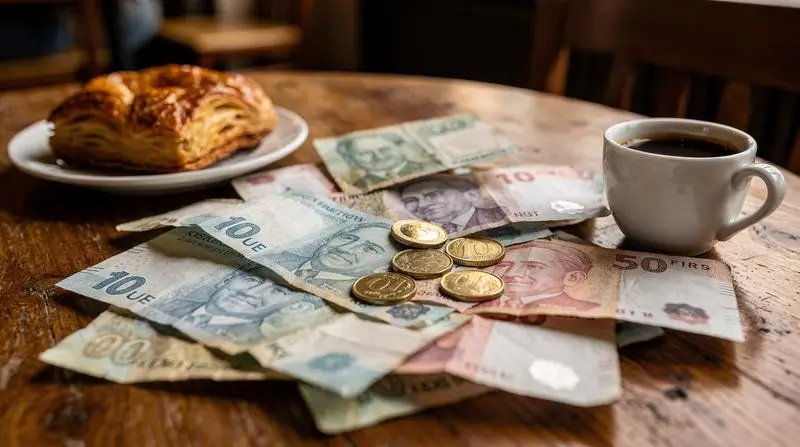
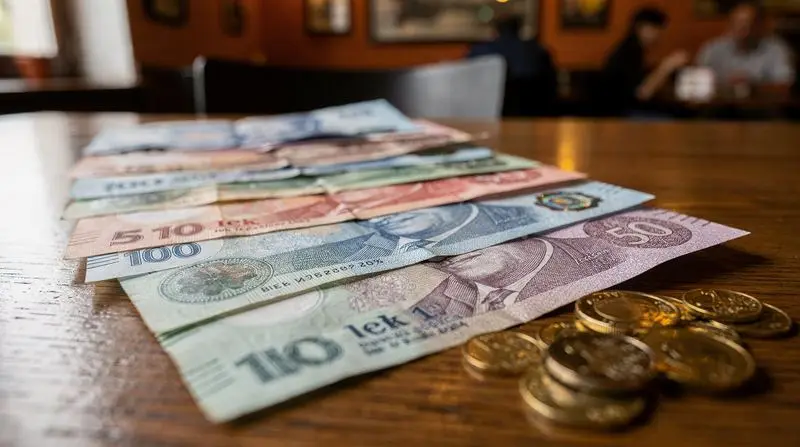
The official currency of Albania is the Albanian Lek (ISO code: ALL). The word “lek” derives from the name Alexander (as in Alexander the Great), and coins and notes circulate widely. The currency has been reasonably stable for years, tied loosely to the euro.
Exchange rate (approximate, 2025-2026):
- 1 EUR = approximately 100-105 ALL
- 1 USD = approximately 90-95 ALL
- 1 GBP = approximately 115-125 ALL
The exact rate fluctuates, so check a reliable source (Google, XE.com) before you travel. The “roughly 100 ALL to EUR 1” rule is close enough for mental arithmetic while shopping or eating.
Coins: 1, 5, 10, 20, 50, 100 ALL Notes: 200, 500, 1,000, 2,000, 5,000 ALL
The 200 and 500 ALL notes are the most useful for everyday purchases. The 5,000 ALL note (roughly EUR 50) is hard to break at small shops and kiosks — try to get smaller denominations at ATMs or exchange offices.
Using Euros in Albania
While the Lek is the official currency, euros (EUR) have a semi-official second status in tourist areas:
- Hotels and guesthouses in tourist zones routinely quote prices and accept payment in euros, particularly in Saranda, Tirana, Berat, and the Riviera
- Tour operators and organized activities typically price in euros
- Restaurants in tourist areas often accept euros but may give change in Lek
- Local markets, furgons, small shops, and cafes almost universally prefer or require Lek
US dollars and British pounds are harder to use directly but can be exchanged easily. The euro is far more practical to carry as a second currency.
ATMs in Albania
ATMs are widely available throughout Albania, with a few important caveats:
Where ATMs are reliable:
- Central Tirana (multiple machines everywhere)
- Tirana Airport (arrivals hall)
- Durres, Shkodra, Berat, Saranda, Vlora, Gjirokastra city centers
- Main Riviera resort towns (Himara, Dhermi, Ksamil — though with less redundancy)
Where ATMs are scarce:
- Mountain villages (Theth, Valbona, remote highlands)
- Small coastal coves and villages off the main road
- Rural interior towns
Practical advice: Before heading to mountain areas or remote destinations, withdraw enough cash in Tirana, Shkodra, or the nearest city. Mountain guesthouses rarely accept cards, and even when they claim to, connectivity for card machines can be unreliable. This is critical for anyone doing the Albanian Alps section.
ATM withdrawal limits are typically 30,000-50,000 ALL per transaction (roughly EUR 300-500). If you need more, do two transactions.
ATM fees: Albanian banks generally charge 1-2 percent or a flat fee per withdrawal (around 200-400 ALL). Some accounts (Revolut, Wise, Charles Schwab, Starling) waive or minimize these fees — use them if you have one.
Currency Exchange
Best exchange rates are generally found at:
- Licensed exchange offices (biro këmbimi) in Tirana and larger cities — these typically offer rates close to the mid-market rate with minimal commission
- The Tirana bazaar area has several competing exchange offices; rates are competitive
Avoid:
- Hotel exchange desks (convenient but poor rates, typically 3-5 percent below mid-market)
- Airport exchange booths (the worst rates of all)
- Unlicensed money changers on the street
What currency to bring for exchange: Euros are the easiest and give the best rates. US dollars are also exchangeable everywhere. British pounds are exchangeable in Tirana and main cities but not always in smaller towns.
How much to bring: For a week’s travel on a mid-range budget, arriving with EUR 150-200 in cash gives you comfortable flexibility while you find your first ATM. More if you are heading directly to mountain areas.
Debit and Credit Cards
Card acceptance has improved significantly but is still far from universal:
Where cards work reliably:
- Hotels (all categories) in cities and tourist areas
- Larger restaurants in Tirana and resort towns
- Supermarkets in cities
- Tirana Airport shops and services
- Car rental agencies
Where cash is required:
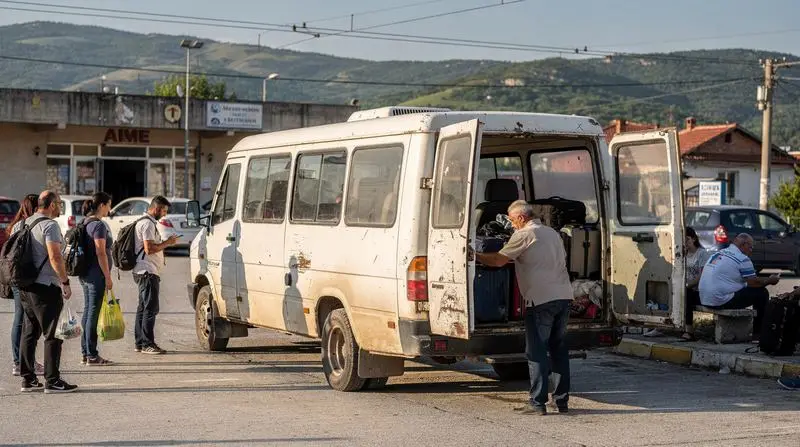
- Furgons and local buses (always cash only) — see the buses and furgons guide
- Small cafes and local restaurants
- Street food vendors and markets
- Mountain guesthouses
- Smaller guesthouses in coastal villages
- Small shops, kiosks, and pharmacies outside cities
Card types accepted: Visa and Mastercard are most widely accepted. American Express has limited acceptance. Contactless payment is available at some terminals in Tirana and resort towns.
Safety: Card skimming exists in Albania as it does everywhere. Use ATMs attached to banks rather than standalone machines where possible. Monitor your bank account during travel.
Recommended Money Strategy
The most practical approach for most travelers:
- Arrive with EUR 100-200 in cash for immediate expenses (transport from airport, first meal, tips)
- Exchange a portion at a licensed bureau in Tirana for Lek — enough for your first few days
- Use ATMs to top up Lek as needed, particularly before rural or mountain sections
- Use your card in cities, hotels, and established restaurants to reduce the cash you need to carry
- Keep a small reserve of euros for emergencies and for paying guesthouses that prefer euros
Total cash to plan for: Budget around EUR 30-50 per day in cash needs for a typical mixed itinerary. Adjust up if heading deep into the mountains (more cash-reliant), down if mostly in Tirana (more card-friendly).
For a complete breakdown of daily costs in Albania, see the Albania travel budget guide.
Tipping and Small Denominations
Albanian culture around tipping is described in the customs and etiquette guide, but the practical money note: tipping in cash, in Lek, is always appropriate and well-received. Have a regular supply of 100 and 200 ALL notes for tipping restaurant staff, rounding up taxi fares, and leaving a note for guesthouse hosts.
Breaking 500 ALL notes is usually fine at restaurants. Breaking 1,000 ALL notes can be tricky at small shops — ask before handing one over.
Useful Apps for Money Management in Albania
Revolut and Wise: Both work in Albania with very competitive exchange rates and low or zero foreign ATM fees. Strongly recommended for budget-conscious travelers. Top up in your home currency and the app converts at the mid-market rate.
Google Pay and Apple Pay: Acceptance is limited but growing in Tirana. Do not rely on it outside the capital.
XE Currency: Good app for quick exchange rate checks on the go.
Safety for Cash Carrying
Albania is safe and petty theft is relatively rare, but standard money safety applies:
- Carry your day’s spending money in a pocket or accessible wallet
- Keep larger cash reserves and your passport in a money belt or secure inside pocket
- Do not flash large amounts of cash in public
- Be aware of your wallet in crowded areas (bus stations, markets)
The risk level is low, but building good habits costs nothing. See the Albania safety guide for the full picture on crime and security.
Bargaining
Light bargaining is acceptable at markets and bazaars, particularly for souvenirs, produce, and handicrafts. It is not the norm in restaurants, shops with marked prices, or established businesses. If you want to negotiate, do so politely — the Albanian hospitality code means aggressive haggling feels culturally jarring and tends not to produce better results anyway.
Albanian Banking System
Understanding the Albanian banking system helps travelers manage money more efficiently:
Local banks: The main retail banks include Raiffeisen Bank Albania, Credins Bank, OTP Albania, Tirana Bank, and Banka Kombetare Tregtare. All operate ATMs in towns and cities. ATMs from Raiffeisen and Credins Bank are the most widely distributed and have the most reliable international card acceptance.
ATM machine language: Most ATMs offer Albanian and English language options. Select English immediately on approach.
ATM withdrawal failure: Occasionally, Albanian ATMs refuse international cards due to network issues or security holds by your home bank. Always try a different ATM before assuming your card is the problem. Having a backup card (or a Revolut alongside your main bank card) prevents the rare scenario of being completely unable to withdraw.
Foreign Exchange: The Full Picture
The difference between the best and worst exchange rates available in Albania can be 3-5 percent on the mid-market rate. Over the course of a trip with several hundred euros to exchange, this adds up to a meaningful amount.
Best rates available:
- Licensed exchange bureaux (biro këmbimi) in Tirana city center
- ATM withdrawals with a zero-fee card (Revolut, Wise, Starling, Charles Schwab) at the mid-market rate
Worst rates:
- Tirana Airport exchange booths — 3-5 percent worse than city center
- Currency exchange at border crossings
- Some hotel exchange desks at smaller properties
The euro premium: Exchanging euros into Albanian Lek always gives better rates than exchanging British pounds, US dollars, or other currencies. If coming from the UK and wanting to optimize, consider converting some GBP to EUR before departure (Wise or Revolut make this cheap) and then exchanging EUR to ALL in Albania.
Booking Tours and Activities: Paying in Advance
For organized tours and experiences, payment is typically made in euros, either cash or card depending on the operator. Pre-booking through platforms like GetYourGuide for Albania activities handles payment securely in advance and often in your home currency, which removes the cash logistics for larger bookings.
For smaller local tours and drivers, payment is typically cash on the day in Lek or euros. If you would rather not handle cash straight after landing, you can pre-book a private Tirana airport transfer and pay online before you arrive.
Paying Bills in Mixed Currency Environments
Some Albanian establishments accept both euros and Lek but quote prices in one currency:
Price quoted in euros, paying in Lek: The proprietor will apply an exchange rate, usually at a slight discount to the official rate. You can pay in Lek at their stated rate (convenient, slightly suboptimal) or pay in euros directly.
Price quoted in Lek, paying in euros: Ask beforehand: “Can I pay in euros?” and “What rate will you use?” A rough mental calculation against the 100 ALL = 1 EUR benchmark tells you immediately whether their rate is fair.
Always know the approximate cost before ordering. Asking for prices in advance eliminates ambiguity about which currency applies and what the total will be.
Managing Money as a Long-Stay Visitor
For digital nomads or travelers spending a month or more in Albania:
Money transfer options: Wise bank transfer to Albanian bank accounts is the most cost-effective method for transferring funds from abroad. Revolut is increasingly accepted. Western Union cash pickup is the fallback.
Cost of living planning: A comfortable single person’s monthly budget in Tirana runs EUR 800-1,200. This covers accommodation, food, data, transport, and some leisure. See the Albania digital nomads guide for the full breakdown.
Gift Economy and Reciprocity
One aspect of Albanian money culture that surprises many visitors: the expectation of reciprocity in hospitality. When an Albanian pays for your coffee, there is an implicit understanding that you will reciprocate in some form — paying for the next coffee, bringing a gift for the host, or simply expressing genuine gratitude. This is not a formal transaction but a social contract.
A genuine “Faleminderit shumë” (thank you very much) and a reciprocation where possible acknowledges the cultural logic of the exchange. This hospitality economy is part of what makes Albania remarkable — and it is entirely genuine, not a performance for tourists.
Money for Digital Nomads and Long-Stay Visitors
For visitors staying weeks or months rather than days, the money picture shifts slightly. See the Albania digital nomads guide for the fuller cost-of-living breakdown, but the currency-specific points worth flagging: Wise bank transfers are the most cost-effective way to move funds into Albania for rent or larger purchases, monthly Airbnb and apartment payments are often quoted and settled in euros even when daily spending is in Lek, and opening a local bank account without a residence permit is difficult — most long-stay visitors simply manage with a foreign card plus cash rather than pursuing local banking.
A Simple First-Week Money Plan
Putting the above advice into a concrete sequence for the first few days:
- On arrival: Withdraw 10,000-15,000 ALL from an airport or city ATM using a fee-free card if you have one.
- First evening: Exchange a small amount of any leftover home-currency cash at a licensed Tirana bureau, if needed, for smaller-denomination notes.
- Before leaving for rural or mountain areas: Top up cash to a comfortable buffer — mountain guesthouses and furgons will not accept cards.
- Throughout the trip: Use cards in cities and established restaurants to reduce how much cash you carry day to day, reserving Lek for markets, transport, and smaller establishments.
This sequence removes most of the friction that catches first-time visitors off guard — arriving at a Theth guesthouse with only a card, or discovering a furgon driver won’t accept euros for a 400 Lek fare. Building this into your first day, rather than treating it as an afterthought once problems arise, is the single habit that prevents most Albania money frustrations.
Regional Differences in Cash Reliance
Money habits vary meaningfully by region, and adjusting your cash buffer accordingly avoids both under- and over-carrying:
Tirana and Durres: Card-friendly. A moderate cash buffer (EUR 20-30 equivalent per day) covers gaps.
Berat, Gjirokastra, Shkodra, Saranda: Mixed. Hotels and larger restaurants take cards; old-town guesthouses, small cafes, and markets are cash-only. Budget EUR 30-40 per day in cash.
Riviera villages and mountain areas (Theth, Valbona): Cash-dependent. Budget EUR 40-60 per day in cash and withdraw before you arrive — the nearest reliable ATM may be an hour or more away.
Frequently Asked Questions About Money in Albania
Can I survive on card only in Albania? No, not comfortably. Transport (furgons), markets, small cafes, and mountain guesthouses are cash-only. You need Albanian Lek for daily travel.
Is it safe to carry cash in Albania? Yes. Albania has low theft rates. Use a money belt for large amounts; keep daily cash in an accessible pocket.
Do Albanian ATMs charge fees? Yes, typically 1-2% or 200-400 ALL per withdrawal. Using a fee-free card (Revolut, Wise, Starling) eliminates the home bank fee component.
Can I use cryptocurrency in Albania? Very rarely and not reliably. A small number of Tirana businesses accept Bitcoin or stablecoins, but this is entirely marginal. Cash and cards are your practical tools.
For more on daily spending, see the Albania travel budget guide and the Albania travel tips guide.