Albania’s Communist History: The Complete Guide to Dark Tourism and Historical Sites
No country in Europe carries the physical weight of its communist past more visibly than Albania. Travel anywhere across this small Balkan nation and you will encounter the legacy of Enver Hoxha’s 46-year reign: hundreds of thousands of concrete bunkers dotting beaches, mountain passes, farmland, and city suburbs; surveillance state architecture still embedded in city centers; museums that have turned the machinery of repression into some of the continent’s most affecting historical experiences.
This guide covers the history, context, and must-visit sites for anyone drawn to understanding one of Europe’s most isolated and extreme communist regimes — and the country that has done the most honest, unflinching work of confronting and curating that legacy.
| Essential sites | Bunk’Art 1 & 2, House of Leaves, the Pyramid |
| Where | Tirana (all main museums), Gjirokastra, Spaç (remote) |
| Time needed | 1-2 days for Tirana sites, extra day for Gjirokastra |
| Entry fees | around 500-1,000 ALL per site |
| Best season | Spring or autumn — summer heat makes outdoor sites uncomfortable |
Understanding the Hoxha Regime
The Rise of Enver Hoxha
Enver Hoxha came to power in 1944 as the leader of the communist National Liberation Movement that drove out German occupiers at the end of World War II. What followed was one of the most extreme communist experiments in the world. Albania under Hoxha was not simply a one-party state — it became the world’s first officially atheist country in 1967, demolished or repurposed every mosque, church, and synagogue, collectivized all agriculture, banned private vehicles, outlawed private enterprise, and constructed an internal surveillance state of extraordinary reach.
Hoxha’s rule lasted from 1944 until his death in 1985 — longer than any other European communist leader. He presided over a country of approximately 3 million people that was, by the 1980s, more hermetically sealed from the outside world than North Korea.
The Paranoia of Isolation
What makes Albanian communism particularly distinct — and particularly visible in the landscape — was its paranoid isolationism. Albania broke with Yugoslavia in 1948, with the Soviet Union in 1961 (after Khrushchev’s de-Stalinization), and with China in 1978. At various points, Albania was simultaneously hostile to capitalism, Western Europe, the United States, Yugoslavia, the Soviet Union, and China — essentially at odds with the entire world.
This isolation produced the bunkers. Convinced that invasion was perpetually imminent from one or several hostile powers, Hoxha ordered the construction of over 175,000 concrete bunkers across the country between roughly 1967 and 1986. The country had approximately one bunker for every 4 citizens. The cost of this construction program consumed resources that might otherwise have gone to housing, schools, hospitals, and infrastructure — leaving an already poor country even more underdeveloped while building a defense system that was never needed.
The Sigurimi: Albania’s Secret Police
The Sigurimi — the State Security Service — was the instrument of internal repression. Established in 1944 and modeled initially on the Soviet KGB, the Sigurimi monitored every Albanian. Informants were embedded in workplaces, neighborhoods, and families. Letters were opened, conversations noted, any expression of doubt or dissent tracked. Those identified as enemies of the state were imprisoned, executed, or sent to labor camps.
The most notorious of these camps was Spaç, in the northern mountains — a copper mine where political prisoners worked in brutal conditions. Thousands passed through Spaç over the decades of communist rule; many did not emerge alive. The camp is accessible today for visitors willing to make the drive into the mountains east of Shkodra.
The headquarters of the Sigurimi in Tirana, a villa formerly belonging to Italian interests, is today the House of Leaves — the most important museum for understanding the machinery of the surveillance state.
The 175,000 Bunkers
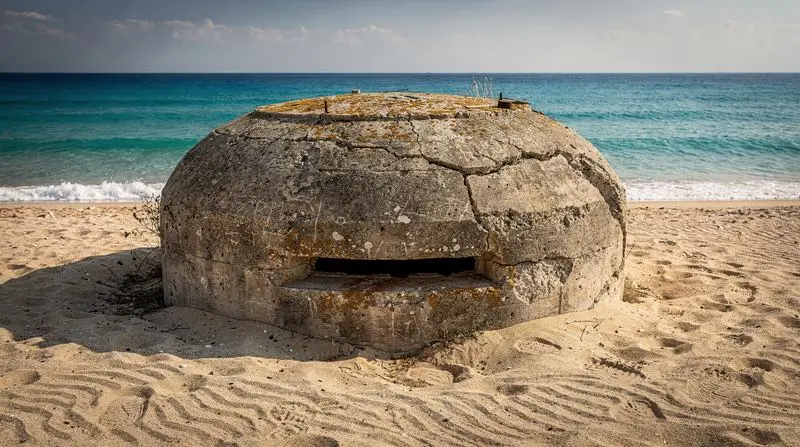
The bunkers are the most immediately visible remnant of the Hoxha era. They appear everywhere: half-buried in the sand on Riviera beaches, crumbling in olive groves near Berat, perched on mountain ridges visible from the Llogara Pass road, clustered in the suburbs of Tirana, positioned at road junctions in every town and village.
Each bunker was designed to be bomb-proof and machine-gun resistant. The standard model — the QZ bunker or “pilbox” — was a small domed concrete structure with a firing slit, barely large enough for one or two soldiers. Larger variants housed artillery, command posts, or underground bunker complexes stretching across multiple rooms.
The most dramatic of the large underground complexes is the one now operating as Bunk’Art 1 — a complete tunneled facility built beneath Mount Dajti to serve as the regime’s government survival bunker in the event of nuclear attack or invasion. Five stories of tunnels, meeting rooms, communications infrastructure, and accommodation that could house the Albanian politburo through a war — built at enormous expense, never used, and now opened as the country’s most extraordinary communist history museum.
Bunkers Repurposed
What has happened to the bunkers over the three decades since communism’s collapse in 1991 tells you much about Albanian ingenuity and dark humor. Many have been repurposed as:
- Cafes and bars (particularly in beach areas)
- Art installations and murals
- Storage spaces for farmers and shepherds
- Tiny retail kiosks
- Canvas for street art and political murals
Some have been officially converted as part of artistic projects. The most famous is a series of bunkers along the Sazan island and Karaburun coastline. On beaches near Durres and along the Riviera, bunkers serve as casual sunbathing spots, social gathering points, and occasionally makeshift changing rooms. The dark history does not preclude practical reuse — it is a very Albanian combination of pragmatism and black humor.
Bunk’Art 1: The Nuclear Bunker Under Dajti Mountain
Bunk’Art 1 is the most dramatically sited communist history museum in Albania and one of the most unusual historical experiences in the Balkans. Located inside the mountain above Tirana — accessible by cable car from the Dajti cable car station — it occupies a vast underground complex originally built between 1978 and 1986 as the emergency government bunker for the Albanian leadership.
The complex has 106 rooms spread across five underground floors, connected by tunnels and built to withstand a nuclear strike. It was intended to house Enver Hoxha, his Politburo, and essential government staff during the war that Hoxha was perpetually convinced was coming. The construction consumed enormous resources. It was used exactly once as an actual shelter — briefly, during the political unrest of 1991 — before the regime’s collapse.
The Tirana Communist Albania tour including Bunk’Art Museum is an excellent way to visit Bunk’Art 1 with contextual interpretation, combining the underground bunker with other key sites in a single guided day.
Today, the museum uses the original rooms and tunnels to display the full history of Albanian communism from 1944 to 1991, with permanent exhibitions covering:
- The partisan war against German and Italian occupation (1941-44)
- The consolidation of communist power under Hoxha (1944-54)
- The period of Soviet alliance and break (1954-61)
- The Sino-Albanian partnership and break (1961-78)
- The years of total isolation (1978-85)
- The Hoxha succession and regime collapse (1985-91)
The atmosphere underground — cold concrete tunnels, preserved meeting rooms with original furniture, archive photographs, personal testimonies — creates an immersive experience unlike a conventional museum. Allow at least 2-3 hours for Bunk’Art 1. The cable car ride up Dajti Mountain provides views over Tirana and is a worthwhile experience in itself.
Bunk’Art 2: The Sigurimi in the Heart of Tirana
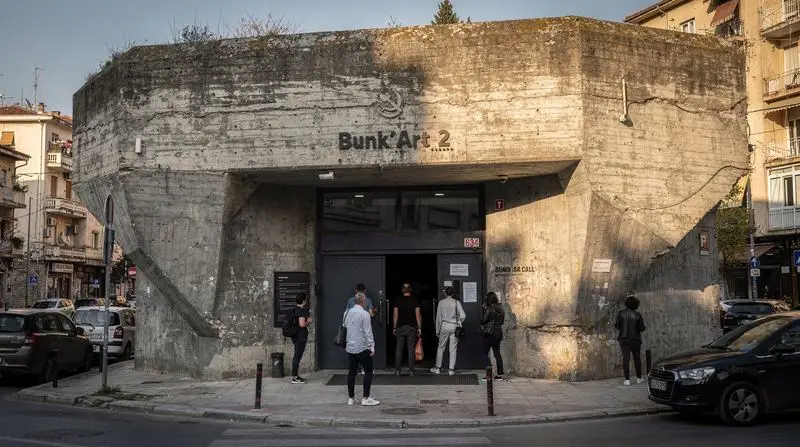
While Bunk’Art 1 documents national history in a remote mountain setting, Bunk’Art 2 tells a more intimate and arguably more disturbing story in the center of Tirana. Located beneath the Ministry of Internal Affairs building on Skanderbeg Square — in a nuclear shelter built for government ministry staff — it focuses specifically on the history of the Albanian state’s violence against its own people.
The exhibitions cover:
- The communist takeover and elimination of political opponents (1944-46)
- The labor camps and their conditions — Spaç and others
- The persecution of religious figures following the 1967 declaration of atheism
- Internal purges within the Party itself
- The regulation of daily life and the network of informants
- The political rehabilitation processes after 1991
Personal testimonies and documents from the Sigurimi archives run throughout the museum. Many visitors find Bunk’Art 2 even more affecting than Bunk’Art 1, precisely because it deals with intimate human stories rather than political abstraction. The location — beneath the very government building that administered much of this repression — adds a disquieting layer of context.
Bunk’Art 2 is centrally located and easy to combine with other Tirana sights. It requires approximately 1.5-2 hours. Entry fees for both Bunk’Art museums are modest (typically 800-1,000 ALL per site).
House of Leaves: Albania’s Museum of Secret Surveillance
The House of Leaves (Shtëpia e Gjetheve) is perhaps the most unsettling of Tirana’s communist history museums. Located in a suburban villa in central Tirana — not far from the Blloku district — it occupies the building that served as the Sigurimi’s primary facility for technical surveillance operations.
This was the building where phone lines were tapped, cameras were monitored, mail was opened and resealed, and the enormous apparatus of electronic and physical surveillance that pervaded Albanian life was coordinated. The museum presents the actual equipment used — wire-tapping devices, hidden cameras, recording equipment, surveillance vehicles — alongside reconstructed scenarios showing how surveillance was conducted in practice.
Perhaps most disturbing is the documentation of the scale: by some estimates, a significant fraction of the Albanian population served as informants at some point, creating a web of mutual surveillance that atomized social trust and extended Sigurimi reach into every corner of Albanian life.
The museum opened in 2017 and has become one of Tirana’s most visited attractions. It is compact but dense — every room contains artifacts, documents, and testimony that rewards slow, careful attention. Allow 1.5-2 hours. Audio guides are available in English.
The House of Leaves is within walking distance of the Blloku district, making it easy to combine with a visit to the Pyramid and a walk through the former communist elite neighborhoods. See the Tirana destination guide for logistical details.
The Pyramid of Tirana
The Pyramid of Tirana — the glass and marble pyramid visible from several points in the central city — has an unusual history that reflects the contradictions of post-communist Albania. Built in 1988 as a mausoleum and museum for Enver Hoxha following his death in 1985, it was designed by his daughter Pranvera Hoxha and her architect husband. At the time of construction it was the most expensive building ever built in Albania.
After the communist regime’s collapse in 1991, the Pyramid was repurposed several times: as a NATO base during the Kosovo conflict, as a nightclub, as a television broadcast facility. For years it deteriorated, became a canvas for graffiti, and was a popular — somewhat illicit — destination for young Albanians who climbed the sloping marble exterior for views of the city.
A major renovation completed in 2022 transformed the Pyramid into TUMO Tirana — a free digital education center for young Albanians aged 12-18 — while preserving the exterior and creating public terraces accessible to all. The renovation was deliberately designed to not erase the building’s history but to repurpose it for a new generation, making it one of the more thoughtful acts of architectural reconciliation with the communist past.
The Pyramid is free to enter and visit at ground level. The renovation has made it an architectural attraction that represents Albania’s negotiation with its history as much as it does the history itself. Day trips from Tirana can be planned around the Pyramid and other central city sites.
Gjirokastra: The City Born From Communist History
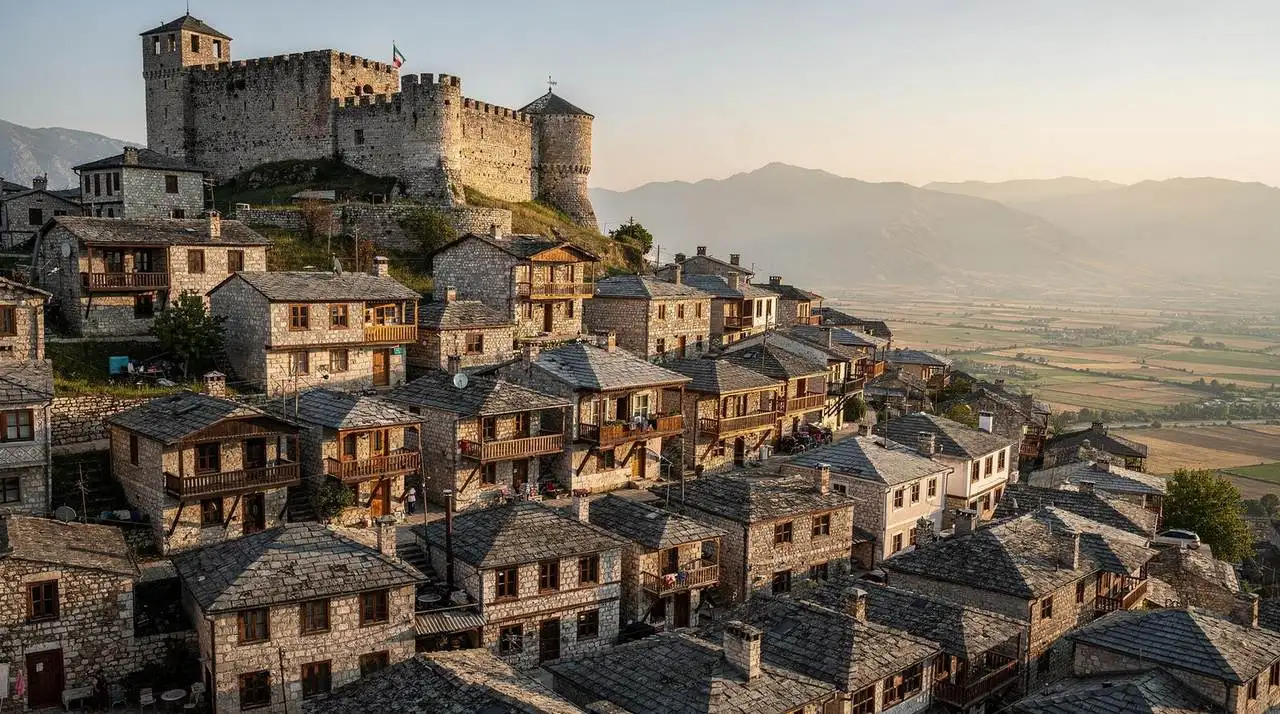
Gjirokastra holds a particular place in Albanian communist history: it was Enver Hoxha’s birthplace. The family home — a traditional Ottoman tower house in the old town — was preserved as a museum during the communist era and remains a significant site. The Gjirokastra old town, already a remarkable UNESCO-listed Ottoman stone city, carries additional layers of communist-era preservation and architecture.
The Gjirokastra castle served as a prison and execution site during the communist period. The castle museum now documents both medieval and communist-era history, and the cold stone rooms where prisoners were held are accessible to visitors.
The town’s National Museum of Armaments — housed in the castle — includes a captured American spy plane, one of several aircraft incidents in Albanian airspace during the cold war that Hoxha used for propaganda purposes. Gjirokastra rewards at least one full day for anyone interested in the intersection of Ottoman architecture and communist history.
Spaç Prison Camp
Spaç is the most physically remote and emotionally raw site in Albanian dark tourism. Located in the mountains east of Shkodra in the Mirdita region, it was a political prison and forced labor camp that operated from 1968 to 1991. Prisoners — intellectuals, political dissidents, religious figures, those accused of anti-state activity — worked in a copper mine in conditions of systematic deprivation.
Spaç housed prisoners from across Albania’s long period of communist rule. In 1973 there was a significant prisoner revolt — one of the very few acts of collective resistance during the Hoxha years — which was suppressed with force. The camp has never been formally converted into a museum; it remains a ruin in a remote mountain valley, accessible by a long and rough mountain road.
Visiting Spaç requires a vehicle with good clearance and some navigational persistence. There are no facilities, no interpretation, no guided services — just the ruins of the mine buildings, the cell blocks, and the physical evidence of what happened there. For visitors who want to engage with history beyond polished museum curation, Spaç is powerfully affecting precisely because of its raw state.
The drive from Shkodra takes approximately 2-2.5 hours each way. It is best visited as part of a dedicated day trip with a vehicle, ideally with some research into the camp’s history beforehand to provide your own context.
Communist Architecture in Tirana
Beyond the dedicated museums, Tirana’s urban fabric carries the imprint of communist-era planning and construction throughout:
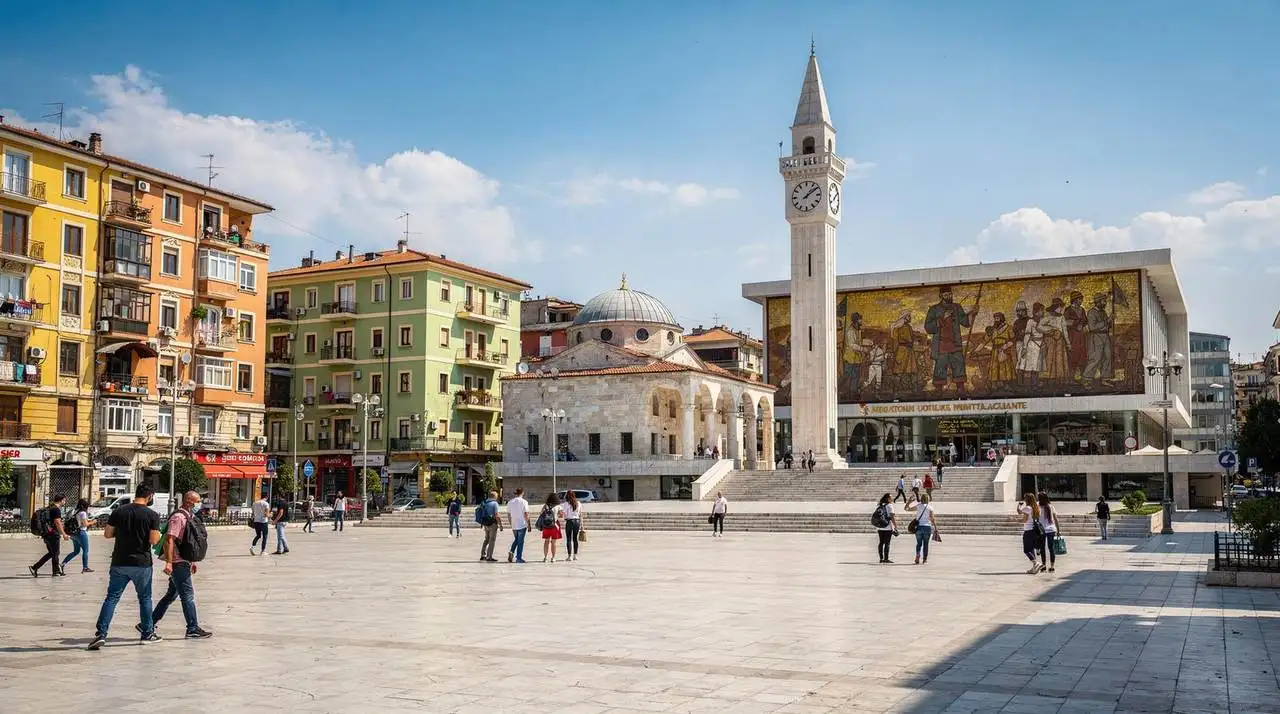
The Grand Boulevard: The central axis of Tirana — running from Skanderbeg Square to the university and beyond — was laid out on Stalinist planning principles, with wide monumental boulevards flanked by symmetrical buildings. The National History Museum on Skanderbeg Square carries a massive mosaic mural on its facade depicting Albanian historical progress in the heroic communist style.
The Blloku District: The neighborhood that was closed to ordinary Albanians during the communist period — reserved for Politburo members and their families — is now Tirana’s trendiest area. Hoxha’s personal villa, a relatively modest structure by the standards of other communist leaders’ residences, remains on one of the Blloku side streets. Its former status as forbidden space, visible from outside but inaccessible to ordinary Albanians, became a symbol of communist privilege and hypocrisy.
Tower of Tirana (Sky Tower): The Tirana Sky Tower — the most visible building on Tirana’s skyline — was originally the television transmission tower, a piece of Soviet-influenced infrastructure. The surrounding area was developed during and after the communist era.
The Palace of Culture: Adjacent to Skanderbeg Square, the Palace of Culture was built with Soviet assistance in the late 1950s and early 1960s as a showcase of communist cultural achievement — before Albania’s break with the Soviet Union. It remains in operation as a theatre, opera, and cultural venue, its Stalinist classical architecture unchanged.
Planning Your Communist History Tour of Albania
A logical multi-day itinerary for visitors specifically interested in communist history:
Day 1 — Tirana Central Sites: House of Leaves (morning), Pyramid of Tirana (midday), Bunk’Art 2 (afternoon), walk through Blloku noting the Hoxha villa. End with dinner in Blloku.
Day 2 — Bunk’Art 1 and Dajti Mountain: Take the Dajti cable car, spend the morning and early afternoon in Bunk’Art 1. Afternoon back in Tirana for Skanderbeg Square and the National History Museum mosaic.
Day 3 — Gjirokastra: Full day in Gjirokastra — Hoxha birthplace, castle and museum, old town. Overnight in Gjirokastra recommended.
Day 4 — Return via Berat or Permet: Stop at Berat’s castle for communist-era murals and the Onufri museum (housed in a former church repurposed under communism), then return to Tirana.
For Spaç, add a separate day trip from Shkodra on a dedicated northern Albania extension.
The Communist Albania guided tour from Tirana covers the key Tirana sites in a single day with expert historical interpretation — a good option for visitors with limited time who want maximum context.
The Legacy and Contemporary Reckoning
Albania’s relationship with its communist past is active and ongoing. The opening of the Sigurimi archives — begun in the 2000s — continues to reveal the extent of surveillance and to identify informants, sometimes including prominent contemporary figures. This ongoing revelation process has been painful and politically contested.
The country has not had a single comprehensive transitional justice process but has managed its past through a combination of museum-building, archive opening, and the physical repurposing of sites. The result is a more dispersed but arguably more honest engagement with history than the clean breaks attempted elsewhere: bunkers stand uncleaned on beaches, Spaç rots in its valley, and the Pyramid became a school rather than being demolished.
For visitors, this ongoing engagement with history is part of what makes Albania’s communist history tourism distinctive. These are not sanitized heritage attractions but active sites of national memory and reckoning — which gives them an emotional weight that a conventional museum cannot manufacture. The Albania dark tourism guide covers additional sites and planning advice.
Practical Information
Bunk’Art 1: Located on Dajti Mountain, accessed via the Dajti Express cable car. Open Tuesday-Sunday approximately 09:00-17:00. Entry approximately 800 ALL. Cable car operates from 09:00 to near sunset.
Bunk’Art 2: Located on Skanderbeg Square (below the Ministry of Internal Affairs). Open Tuesday-Sunday approximately 09:00-17:00. Entry approximately 1,000 ALL.
House of Leaves: Central Tirana, near the Blloku district. Open Tuesday-Sunday approximately 09:00-17:00. Entry approximately 500 ALL. Audio guides available in English.
Gjirokastra Castle: Open daily approximately 09:00-18:00. Entry includes the castle and armaments museum.
Best season: Spring and autumn. July-August heat makes extended outdoor historical exploration uncomfortable. Winter visits are possible but some sites have reduced hours.
Combined tickets: Bunk’Art 1 and 2 occasionally offer combined ticket discounts — check current information on arrival.
Frequently Asked Questions About Communist History in Albania
How many bunkers did Albania build under communism?
Albania built approximately 175,000 concrete bunkers between 1967 and 1986 under Enver Hoxha’s orders — roughly one bunker for every four citizens. The program consumed enormous national resources and was justified by Hoxha’s conviction that Albania faced imminent invasion. The bunkers were never used for their intended military purpose. Today they appear across the entire country, from beaches to mountain tops, and many have been repurposed as cafes, storage spaces, and art installations.
What is the best museum for understanding Albanian communism?
Bunk’Art 1 and the House of Leaves are the two most important sites. Bunk’Art 1 offers comprehensive national historical coverage in a dramatically atmospheric setting inside an actual nuclear bunker. The House of Leaves is more focused and more intimate, dealing specifically with the Sigurimi’s surveillance apparatus and its effect on individual lives. Both are essential; together they provide a rounded understanding of the regime’s political and human dimensions. Bunk’Art 2 in central Tirana adds important material on the regime’s violence against its own citizens.
Was Enver Hoxha worse than other communist leaders?
Hoxha’s regime was among the most repressive in the communist world by several measures: the totality of isolation (breaking with Yugoslavia, the USSR, and China in succession), the declaration of state atheism and destruction of all places of worship, the extraordinary density of surveillance, and the per capita rate of political imprisonment. By the late 1970s, Albania had effectively cut itself off from the entire world. The personal cult around Hoxha was extreme even by communist standards. Albania’s per capita imprisonment rate for political crimes was among the highest in the Eastern Bloc throughout his rule.
Can you visit Spaç Prison Camp?
Yes, Spaç is accessible to independent visitors with a vehicle. It is located in the mountains east of Shkodra and requires approximately 2-2.5 hours driving from Shkodra on a rough mountain road. There is no formal visitor facility, no admission fee, and no interpretation on-site — it is a ruin. Visitors should bring their own historical research and reading before visiting. The remote, unmediated quality is part of what makes it such a powerful site for those prepared to seek it out.
Where is Hoxha’s villa in Tirana?
Enver Hoxha’s personal villa is located in the Blloku district of Tirana, on a side street in the former restricted zone. The building is not open to the public as a formal attraction, but its exterior can be viewed and its location is well-known. It is a modest, relatively unremarkable building — which has itself been noted as significant, as Hoxha cultivated a public image of personal austerity while the regime maintained absolute control over national resources.
How much time should I budget for communist history sites in Tirana?
A full day covers House of Leaves (1.5-2 hours), the Pyramid (30-45 minutes), and Bunk’Art 2 (1.5-2 hours) comfortably, all within walking distance of central Tirana and Blloku. Bunk’Art 1 on Dajti Mountain needs a separate half-day given the cable car journey — combine it with the mountain views for a fuller morning or afternoon.
Are Albania’s communist history sites appropriate for children?
House of Leaves and Bunk’Art 2 deal with genuinely disturbing subject matter — surveillance, imprisonment, and political violence — and are better suited to teenagers and adults who can process that content. Bunk’Art 1’s broader national history and the Pyramid’s architecture-focused story are more accessible for younger children, particularly when paired with the Dajti cable car ride, which most kids enjoy regardless of the historical content inside the mountain.
Communist History Sites Outside Tirana and Gjirokastra
Beyond the capital and Gjirokastra, communist-era traces appear throughout the country in less formalized ways. Bunkers dot the coastline near Durres and along the Albanian Riviera, many repurposed as beach bars or simply left as curiosities half-buried in sand. Berat’s castle contains communist-era murals and a former church repurposed under the regime, visible alongside the Onufri Museum’s Byzantine icons — a striking juxtaposition of eras within a single site. These are not dedicated museums, but for visitors already touring these towns for other reasons, a few minutes of attention to the communist-era layer adds meaningful context at no extra cost in time.
Reading and Preparing Before You Go
Because on-site interpretation at some locations (particularly Spaç) is minimal, visitors who read even a short overview beforehand get considerably more out of the experience. Blendi Fevziu’s biography of Enver Hoxha and Ismail Kadare’s fiction (much of it written under and reflecting on the regime) are widely available starting points in English translation. The Albania dark tourism guide on this site provides additional context and site recommendations for visitors specifically interested in this period of Albanian history.
Talking to Albanians About the Communist Period
Many Albanians over the age of 45 lived through significant portions of the Hoxha regime, and reactions to questions about the period vary widely — some are open and eager to share personal or family history, while others prefer not to revisit it. A respectful approach is to let locals lead the conversation rather than probing directly, and to remember that guesthouse owners and guides who do discuss it are often sharing genuinely difficult personal or family experiences. Guided tours with licensed historical guides, several of which are linked throughout this page, offer a lower-pressure way to engage with the period’s history without putting individual Albanians in the position of relitigating personal trauma for a tourist’s curiosity.
Photography Guidelines at Communist History Sites
Photography is generally permitted and encouraged inside Bunk’Art 1, Bunk’Art 2, and the House of Leaves, and all three museums are popular for their atmospheric, almost dystopian interior architecture. Flash photography is typically restricted near archival documents and photographs to protect them from light damage. At Spaç, there are no restrictions given the site’s unmanaged state, though visitors should treat the ruins with the same respect as any site connected to real human suffering. Drone photography requires separate permits under Albanian law and is generally not permitted near government buildings or former military sites — see the drone rules Albania guide if you plan to use one at any of these sites, and note that several communist-era locations, including Bunk’Art 2’s location beneath a ministry building, fall under stricter restrictions than typical tourist sites — check current rules before bringing any drone equipment into central Tirana, and be aware that unauthorized use near government buildings can lead to equipment confiscation.
Which Sites to Prioritize by Time Available
| Time available | Recommended sites |
|---|---|
| Half day | House of Leaves + the Pyramid (both central Tirana) |
| Full day | Add Bunk’Art 2, or swap for Bunk’Art 1 via Dajti cable car |
| 2-3 days | Add Gjirokastra (castle prison, Hoxha birthplace) |
| 4+ days | Add Spaç Prison Camp (remote, requires a vehicle) |
Combining Communist History with the Rest of Albania
Communist history sites integrate naturally with a standard Albania itinerary rather than requiring a dedicated trip. Day trips from Tirana can pair a morning at Bunk’Art 1 with an afternoon at Kruja Castle, or House of Leaves with a walk through Tirana’s Blloku district and the Pyramid. In the south, Gjirokastra’s castle prison and Hoxha’s birthplace fit naturally alongside the city’s UNESCO-listed old town — no detour required, since the castle is the city’s central attraction regardless of historical interest.