Albania Border Crossings: The Complete Guide
Albania shares land borders with four countries — Greece to the south, Montenegro to the northwest, Kosovo to the northeast, and North Macedonia to the east. There are 22 official land border crossings, though not all are open to non-nationals or to vehicles. Understanding which crossings to use, what documents you need, and how to avoid long queues can make or break a road trip through the western Balkans.
This guide covers all major crossings with practical detail: location, hours, wait times, which nationalities can use them, vehicle requirements, and special considerations for each.
| Busiest crossings | Kakavija (Greece), Muriqan (Montenegro), Morina (Kosovo), Qafe Thane (North Macedonia) |
| Documents | Passport/EU ID, vehicle papers, Green Card insurance |
| Peak wait times | Up to 3-6h in July-August, especially Morina and Kakavija |
| Best crossing window | 05:00-09:00 or 21:00-24:00 |
| Insurance if needed | around EUR 15-30 for two weeks, purchased at the border |
Documents Needed at Albanian Border Crossings
For all travelers:
- Valid passport OR national ID card (for EU/EEA/Western Balkans citizens in most cases)
- Albania’s visa situation: most nationalities need no visa. See the Albania visa requirements guide for the complete list.
For drivers and vehicle owners:
- Vehicle registration document (logbook)
- Driving licence (EU licences fully accepted; international driving permit recommended for non-EU)
- Green Card (international motor vehicle insurance certificate) — see section below
- Vehicle roadworthiness certificate (MOT/TÜV equivalent for long-stay visitors)
For rental cars:
- Rental agreement explicitly stating the vehicle is permitted to cross into Albania
- Many major European rental companies (Hertz, Europcar, Avis) allow Albania crossings but require advance notification and may charge a fee
- Budget and online rental companies often prohibit or restrict Albania crossings — read the fine print carefully before renting
Green Card Insurance for Driving in Albania
The Green Card (Carta Verde) is an internationally recognized insurance certificate confirming that your vehicle has at least third-party liability insurance valid in the destination country. Albania is a member of the Green Card system.
If your insurer’s Green Card covers Albania: Great. Confirm Albania is listed on the reverse of your Green Card document. Most comprehensive European policies include Albania.
If Albania is not listed on your Green Card: You can purchase short-term Albanian third-party insurance at every land border crossing. Booths selling insurance are visible as you approach the crossing. Coverage costs approximately EUR 15-30 for two weeks depending on vehicle type.
What to expect at the border insurance booths: These are legitimate operations, not scams. Officers will check your vehicle plates, issue a printed certificate, and take payment in euros or Albanian Lek. Keep this document with your vehicle papers throughout your stay.
Albania-Greece Border Crossings
The Albania-Greece border runs roughly 282 km through mountainous terrain. Six official crossings exist, though two are the primary ones used by tourists.
Kakavija (Kakavia) — Main Southern Crossing
Location: On the E853 highway connecting Gjirokastër (Albania) to Ioannina (Greece). This is the most heavily used crossing for road travel between Albania and Greece.
Hours: Open 24/7
Wait times: Can be 30 minutes to 4 hours in peak summer season (July-August). Weekend crossings (particularly Friday evening southbound and Sunday evening northbound) are worst. Winter crossings are fast — under 30 minutes typically.
Practical notes: Fuel up before crossing — Albanian fuel is cheaper than Greek. Duty-free shops on the Albanian side. Albanian border police are generally efficient. Greek side has been streamlined in recent years. This is the recommended crossing for travel between Gjirokastër, Saranda, and northern Greece.
Kapshticë (Kapshtice) / Krystallopigi — Eastern Greece Crossing
Location: Connects Korçë (Albania) to Florina region (Greece). The E90 corridor.
Hours: Open 24/7
Wait times: Generally shorter than Kakavija. 30-90 minutes in summer.
Practical notes: Good crossing for travel between Korçë, Pogradec, and Ohrid (North Macedonia) combined with northern Greece. Less tourist traffic than Kakavija.
Tre Urat (Tre Urat) / Mertziani
Location: A secondary crossing south of Kakavija, near Përmet.
Hours: Open daily, typically 08:00-20:00 (check current status before use)
Wait times: Generally short
Practical notes: Suitable for travel to and from the Permet/Gjirokastër area when Kakavija is heavily congested. Road quality on the Albanian approach has improved.
Other Albania-Greece Crossings
- Qafe Bote (Qafë Botë): Remote mountain crossing. Used mainly by locals. Limited hours. Not recommended for tourist use without local knowledge.
- Konispol: Coastal crossing near Saranda. Used for travel between Saranda and the Epirus coast of Greece. Check current operating hours.
- Çarshovë: Remote crossing with limited hours. Not recommended for standard tourist use.
Albania-Montenegro Border Crossings
The Albania-Montenegro border is approximately 172 km, much of it through dramatic mountain terrain around Lake Shkodra and the Accursed Mountains.
Muriqan (Muriqan/Sukobin) — Main Northwestern Crossing
Location: Flat lowland crossing on the E762 near Shkodra and Lake Shkodra, connecting to Ulcinj and the Montenegrin coast.
Hours: Open 24/7
Wait times: Peak summer (July-August) queues can reach 1-3 hours. The Montenegrin Riviera draws huge traffic. Off-season: 10-20 minutes.
Practical notes: This is the main crossing for the popular Shkodra to Ulcinj coastal route. The nearby Lake Shkodra area makes this crossing scenic. Summer backpacker traffic is heavy.
Hani i Hotit (Han i Hotit)
Location: Mountain crossing north of Shkodra on the main Shkodra-Podgorica highway (E762).
Hours: Open 24/7
Wait times: Longer than Muriqan in peak summer as this is on the Podgorica axis. 1-4 hours possible in July-August.
Practical notes: Main road connection to Podgorica (Montenegro’s capital) and onward to Sarajevo and Belgrade. Better infrastructure than some crossings. The Hani i Hotit crossing has undergone significant modernization.
Vermosh (Vermosh/Gusinje Area)
Location: Remote northern mountain crossing, connection between Vermosh valley (Albania) and Gusinje (Montenegro).
Hours: Seasonal; check current status before planning
Wait times: Minimal — very low traffic
Practical notes: For adventurous travelers and hikers in the Prokletije/Accursed Mountains. Spectacular scenery. Not suitable for low-clearance vehicles in some conditions.
Albania-Kosovo Border Crossings
Kosovo and Albania share a 112 km border through the high mountain terrain of the Bjeshkët e Namuna (Accursed Mountains). This is the busiest border in terms of diaspora traffic — the Albanian and Kosovar Albanian populations are culturally and familially intertwined.
Morina (Morinë)
Location: Main highway crossing on the Shkodra-Prizren route (SH1/M9). The most trafficked crossing between Albania and Kosovo.
Hours: Open 24/7
Wait times: Can be very long during Kosovo diaspora return periods (late July to mid-August, when diaspora from Western Europe drive through Albania to Kosovo). Queues of 3-6 hours have been reported in peak season. Off-season: 15-30 minutes.
Practical notes: The primary crossing and direct route between Tirana and Pristina. Albanian side is generally faster than Kosovar side. Peak season queues are infamous — plan to cross early morning (05:00-08:00) or late evening (22:00-01:00) to minimize waiting.
Qafe Prush (Qafë Prush)
Location: Mountain crossing north of the main Morina axis, connecting northern Albania to southwest Kosovo near Dragash.
Hours: Open daily (check current times)
Wait times: Much shorter than Morina — a useful alternative when Morina is gridlocked
Practical notes: Road quality on the Albanian approach through Tropoja is variable. Stunning scenery. Worth using if you have the flexibility and appropriate vehicle.
Qafe Morines and Other Minor Crossings
Several smaller crossings exist between Albania and Kosovo for local traffic. Non-residents should use Morina or Qafe Prush.
Albania-North Macedonia Border Crossings
The Albania-North Macedonia border runs 191 km, largely along the ridge east of the Ohrid and Prespa lakes region — shared territory of great natural beauty.
Qafe Thane (Qafë Thanë / Kafasan)
Location: Main crossing on the Pogradec-Ohrid corridor, one of the most scenic in the Balkans. Lake Ohrid visible from the crossing area.
Hours: Open 24/7
Wait times: Moderate — 30-90 minutes in summer. Manageable year-round.
Practical notes: The primary crossing for Ohrid access from Albania. Lake Ohrid and the town of Ohrid (a UNESCO World Heritage Site) are directly accessible from this crossing. Road quality is good on both sides.
Blato (Blato/Lin)
Location: Alternative lake crossing, slightly south of Qafe Thane.
Hours: Limited — typically 08:00-20:00
Practical notes: Less used than Qafe Thane. Can be a useful alternative if that crossing is backed up. Scenic Lake Ohrid views throughout.
Tushemisht (Tushemisht/Sveti Naum)
Location: Extreme south end of Lake Ohrid, near the Sveti Naum monastery (North Macedonian side).
Hours: Open (check current times)
Practical notes: Beautiful location. Used for access to the Sveti Naum area and Galicica National Park.
Stenje (Stenje/Prespa)
Location: Lake Prespa crossing, remote and scenic.
Hours: Limited hours; check current status
Practical notes: For the Prespa Lakes area, a transboundary nature area shared by Albania, North Macedonia, and Greece. Little tourist traffic.
Gorica / Debar Crossing
Location: Northern crossing connecting northern Albania (Peshkopi area) with western North Macedonia (Debar).
Hours: Open 24/7
Practical notes: Used for travel to/from Tetovo, Skopje, and northern North Macedonia. Less scenic but practical for northern routes.
Border Crossing Tips and Practical Advice
Timing your crossing:
- Early morning (05:00-09:00) is consistently the best time at all crossings — officials are fresh, traffic is low
- Late evening (21:00-24:00) is the second best window
- Avoid Sunday afternoon/evening crossings at Kakavija and Muriqan during July-August
- Friday evening crossings at Morina during peak diaspora season can be extraordinary queues
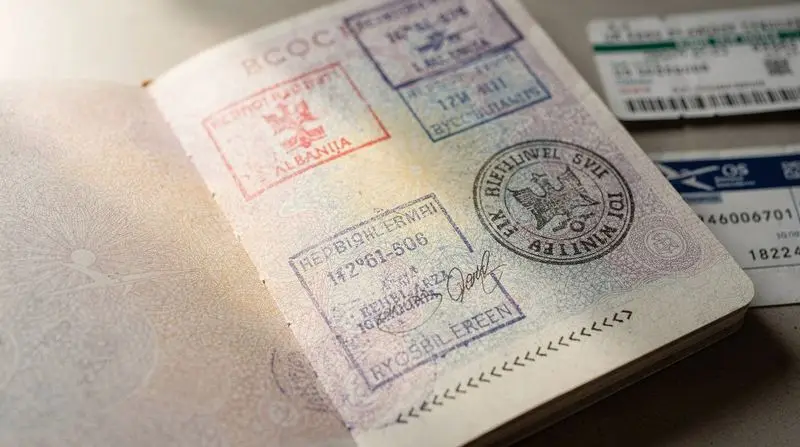
What happens at the crossing: Albanian border crossings are straightforward. You stop, present documents (passport/ID, vehicle papers, insurance), officers check the documents and may briefly look in the vehicle, stamps are applied, and you proceed. Thorough searches are rare for tourist-standard vehicles. Border officials are generally professional and efficient.
Declaring items: Usual customs declarations apply. Quantities over standard limits (alcohol, cigarettes, cash over EUR 10,000) require declaration. See the Albania customs and etiquette guide for full customs details.
Mobile data at borders: Signal can be weak at remote mountain crossings. Download offline maps before arriving at borders. The Albania eSIM guide covers data roaming rules for the region.
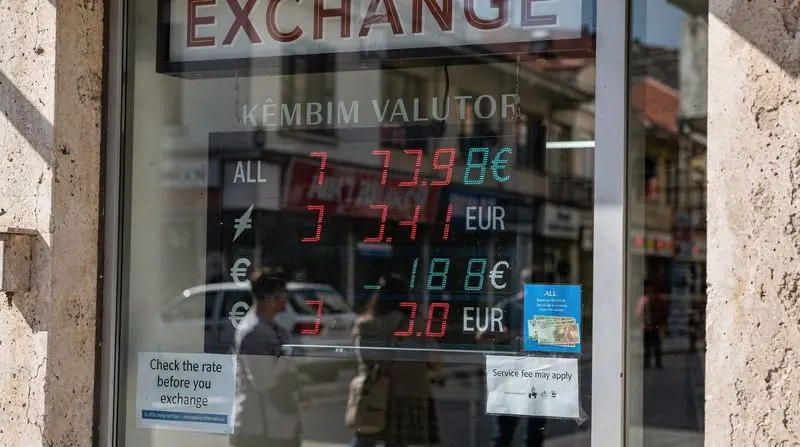
Currency at borders: Bring some Albanian Lek or euros. Border zone fuel stations, insurance vendors, and small shops accept both. ATMs are available at major crossings (Kakavija, Muriqan, Hani i Hotit).
Fuel and supplies before crossing: Fuel is cheaper in Albania than in Greece, Montenegro, and Kosovo. Fill your tank before leaving Albania at any crossing to the south or west. If entering Albania, note that fuel quality at border zone stations is generally fine.
Vehicle checks at the border: Officers may inspect vehicles for prohibited goods. Standard customs limits apply (tobacco, alcohol, cash). Large quantities of goods unusual for personal use may prompt questions. See the Albania customs and etiquette guide for details on customs rules.
Airport transfers on arrival: For visitors flying into Tirana rather than driving, a pre-booked transfer removes arrival logistics entirely:
Tirana airport transfer to city centerNight crossings: Major crossings (Kakavija, Muriqan, Hani i Hotit, Morina) are staffed 24 hours and can be less busy at night. Smaller crossings may have reduced staffing after 20:00. Always verify opening hours for less-used crossings before planning a late crossing.
Photography at border crossings: Do not photograph border facilities, officers, or infrastructure without explicit permission. This applies especially to military-adjacent crossings. Put the camera away before you reach the checkpoint and keep it away until you are clearly through.
Traveling with pets: Crossing into Albania with a pet requires a valid EU Pet Passport (or equivalent), proof of rabies vaccination, and microchip identification. Requirements are broadly aligned with EU standards as part of Albania’s accession process. Consult your vet and the Albanian customs authority before travel with animals.
Organized day trips crossing borders: For visitors curious about crossing into neighboring countries without driving, organized tours handle all the logistics:
Day trip from Saranda to Corfu (Greece) Day tour from Tirana to North Macedonia and OhridWhat to Expect During Your First Albanian Border Crossing
For travelers entering Albania for the first time, a brief walk-through of the typical experience helps set expectations.
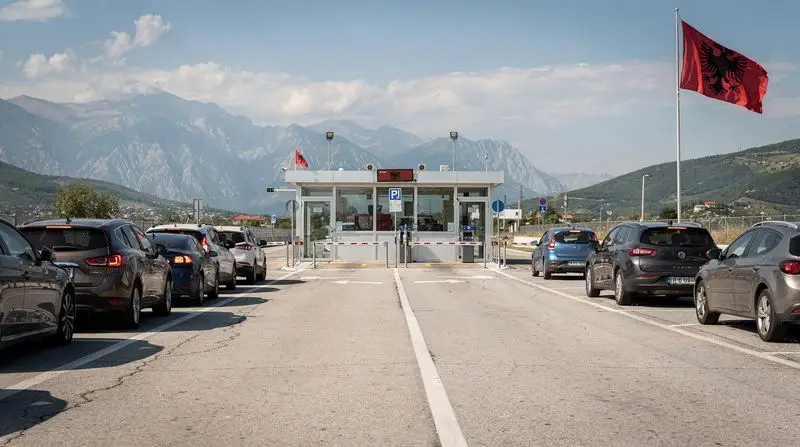
Approach: You join the vehicle queue (or pedestrian queue if on foot or using public transport). Signs at major crossings are in Albanian and English. Wait your turn.
At the checkpoint: An officer approaches or you pull up to the window. You present your documents — passport (or EU ID card), vehicle registration (if driving). The officer checks the passport photo against your face, scans the document, and may check visa status (Albanian entry conditions differ by nationality — the Albania visa requirements guide covers this fully).
Vehicle inspection: Most tourist vehicles receive a cursory check or none at all. Occasionally the boot (trunk) is opened for a brief look. This is standard — do not be alarmed and comply calmly.
Insurance: If you did not arrange insurance before arrival, you will be directed to the insurance booth after the passport check. Pay, receive your certificate, return to the main checkpoint to proceed.
Exit stamp on the way out: When leaving Albania, you present documents again for exit processing. Your passport receives an exit stamp. Make sure any dates on your authorized stay have not been exceeded.
If there is a problem: Issues are rare for legitimate tourists. If there is a question about your documents or entry eligibility, remain calm, polite, and patient. An interpreter can be requested. Embassy contact numbers are your backup if a serious issue arises.
Crossing Back: Re-Entry Considerations
If you plan to leave Albania and re-enter (for example, crossing to Corfu for a day and returning), be aware of your authorized stay duration. Most nationalities receive a 90-day visa-free period upon entry. A day trip to Greece and back does not reset this clock — the 90 days run from first entry.
If your stay will involve multiple entries (entering, crossing to Kosovo for a few days, returning to Albania), the total days spent in Albania across all entries counts toward the 90-day limit.
The 90-day limit is within a 180-day period — so you cannot simply leave and re-enter to get a fresh 90 days. Check the specific rules for your nationality as bilateral agreements vary.
The Western Balkans Travel Zone
An important consideration for multi-country Balkans itineraries: Kosovo, Albania, North Macedonia, and Serbia are part of an ongoing discussion about a “Common Regional Market” or “Western Balkans Schengen” that would simplify cross-border movement between these non-EU countries.
As of 2025-2026, this arrangement is partially in place for citizens of the participating countries but has limited practical impact for external (non-Balkans) tourists. Each crossing still requires passport processing. However, the trend is toward simplified crossings over time as regional integration deepens.
For the latest on cross-border arrangements between Western Balkans countries, check travel advisory updates close to your trip date.
Emergency Contacts at Border Areas
If you encounter a serious problem at or near a border crossing:
Albanian police emergency: 129 Ambulance: 127 Fire: 128 Tourist police (Tirana): Available through central police number
For non-emergency consular matters, your country’s embassy in Tirana is the appropriate contact. Major embassies present in Tirana include those of the UK, USA, Germany, Italy, France, and EU member states. See your foreign ministry’s travel information page for emergency contact numbers before travel.
Unofficial assistance for non-emergency situations: Having translation via Google Translate or a local SIM card (see Albania eSIM guide) prevents most minor misunderstandings at border points.
Driving Across Multiple Balkans Borders on One Trip
Many travelers to Albania are doing a broader Balkans road trip. Here is how the Albania crossings fit into multi-country driving itineraries:
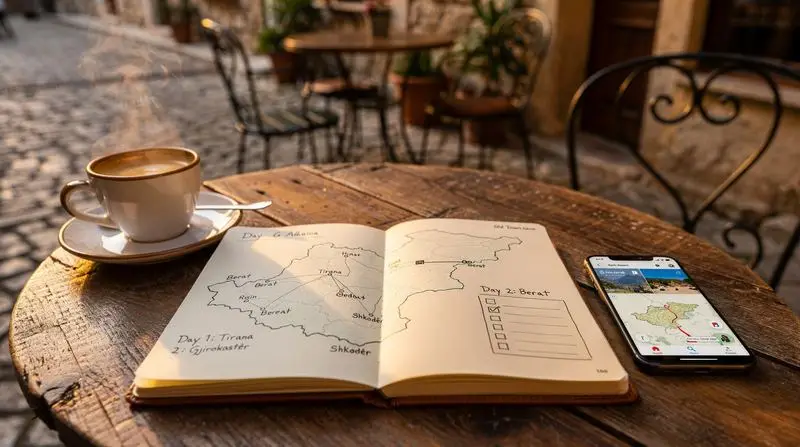
The classic Adriatic loop: Enter Albania from Montenegro at Muriqan (Shkodra-Ulcinj direction). Drive south through Tirana, Berat, Gjirokastër, Saranda. Exit to Greece via Kakavija heading toward Ioannina and Epirus. Re-enter the Balkans via Kosovo at Morina on the return leg.
The Lake Ohrid circuit: Enter Albania from North Macedonia at Qafë Thanë after visiting Ohrid. Drive west to Tirana. Exit to Kosovo via Morina to continue to Pristina. A compact triangle covering three countries.
The trans-Balkans north-south: Cross into Albania from Kosovo at Morina heading south. Drive the full length of Albania (SH1 and SH4) from Bajram Curri in the north to Kakavija exit in the south. This is a full-day drive of approximately 8-10 hours but covers remarkable landscape variety.
The border crossing count: Traveling Albania as part of a broader loop can involve 2-4 border crossings. Each requires the same document checks, and insurance (Green Card or purchased at the border) must cover each country. Check insurance validity for all countries on your route before departure.
Albanian Border Crossing Infrastructure: What Has Improved
Investment in border crossing facilities has been significant in recent years:
New customs lanes: Major crossings like Kakavija and Muriqan have been widened. Additional lanes for EU/European document holders at some crossings.
IT systems: Albanian customs has implemented digital scanning systems that speed document processing. The visible queues are now often at vehicle inspection lanes rather than document processing.
Physical facilities: Border zone rest stops, restaurants, and toilet facilities have improved at major crossings. Kakavija and Muriqan both have reasonable facilities for waiting in queues.
What has not changed: Rural mountain crossings remain basic. Staff levels at smaller crossings can be thin. Night-time operations at secondary crossings may be reduced-capacity.
Frequently Asked Questions About Albania Border Crossings
What is the easiest border crossing from Greece to Albania?
Kakavija on the E853 is the main and most practical crossing for southbound travelers from Greece. It connects Ioannina (Greece) to Gjirokastër and Saranda (Albania) and is open 24 hours. Expect possible queues in summer.
Do I need a Green Card for driving into Albania?
Yes, you need proof of valid third-party insurance covering Albania. Check if Albania appears on your existing Green Card. If not, purchase temporary Albanian insurance at the border crossing — available at every major entry point for approximately EUR 15-30.
Can EU citizens use their ID card (not passport) to enter Albania?
Yes, most EU and EEA nationals can enter Albania on a valid national identity card. Check the Albania visa requirements guide for your specific nationality’s rules.
Which Albania border crossing has the shortest wait times?
In peak summer, Qafe Thane (to North Macedonia) and Tre Urat (to Greece) tend to have shorter waits than Kakavija or Muriqan. For Kosovo, Qafe Prush is less congested than Morina. Off-season, all crossings move quickly.
Can I rent a car in Albania and take it across the border?
Some Albanian rental companies allow cross-border travel, particularly into Kosovo and North Macedonia. International rentals from EU companies have variable policies. Always confirm explicitly in writing before renting, as taking an unauthorized rental car across a border can result in confiscation. See the car rental Albania guide for how to arrange this when booking.
What happens if I overstay my 90-day limit in Albania?
Overstaying triggers fines and can complicate future entry to Albania and the wider Schengen-adjacent region. The 90 days run within a rolling 180-day period from your first entry, and day trips to Corfu or Kosovo do not reset the clock. Track your days carefully if your itinerary involves multiple entries — the Albania visa requirements guide has the full rules by nationality.
Do I need to declare cash at Albanian border crossings?
Yes. Amounts over EUR 10,000 (or equivalent) must be declared when entering or leaving Albania, whether in cash or negotiable instruments. This is standard EU-aligned customs practice, and Albanian border officials process declarations routinely. See the Albania customs and etiquette guide for the full list of items requiring declaration.
Border Crossings by Traveler Type
Different travel styles hit different friction points at Albanian borders. This breaks down what matters most for each.
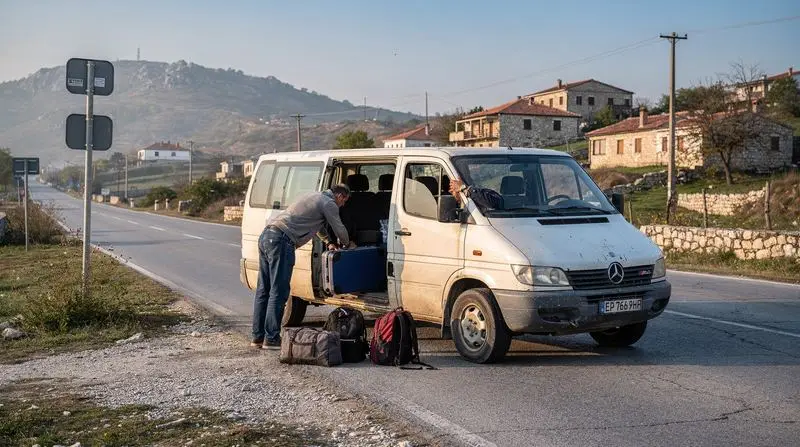
Backpackers on buses/furgons: Border formalities are handled as part of the journey — the bus or furgon stops, everyone disembarks briefly for passport checks, then continues. No separate action is needed beyond having your passport ready. See the Albania backpacking guide for how this fits into a wider Balkans route.
Self-drivers with a rental car: The most document-heavy category. Confirm cross-border permission in writing from your rental agency before departure, carry the Green Card or be ready to purchase temporary insurance, and budget extra time at Kakavija or Morina in peak season. The car rental Albania guide covers what to arrange before you leave the rental desk.
Day-trippers to Greece or North Macedonia: For a single day trip (Corfu, Ohrid), a passport and awareness of your 90-day count is generally all that is needed — no vehicle paperwork if you are on foot or using an organized tour.
Hikers crossing on foot or via minor mountain passes: Crossings like Vermosh or Qafe Prush see minimal tourist traffic and correspondingly informal processing, but hours can be limited or seasonal — always verify current status locally before planning a route around one.
Cruise passengers and day visitors from Corfu: Crossing by ferry rather than land involves a different process at the port of Saranda, though the same 90-day rule and passport requirements apply. If you plan several short hops between Corfu and Saranda over your stay, keep a mental tally of days spent in Albania — the ferry to Greece guide covers the crossing schedule and what to expect at the port itself.
Group tour participants: If you are joining an organized multi-day tour that crosses into Kosovo, Montenegro, or North Macedonia as part of the itinerary, the tour operator typically handles all border logistics and simply asks you to have your passport ready — no independent preparation is required beyond that.
What to Do If Your Documents Are Questioned
If a border officer raises a question about your passport, visa status, or entry eligibility, the standard advice applies: remain calm, polite, and cooperative. Most issues at Albanian crossings are resolved quickly through routine clarification rather than genuine problems. If a language barrier complicates things, politely ask whether an English-speaking colleague or interpreter is available — this is a normal and accepted request. Keep a photo of your passport’s data page and any relevant visa documentation saved separately (cloud storage or a second device) in case the physical document is temporarily held for processing.
Border Crossing Wait Times at a Glance
Peak-season wait times vary significantly by crossing and time of day. This comparison covers the four busiest crossings tourists actually use.
| Crossing | Country | Peak summer wait | Off-season wait |
|---|---|---|---|
| Kakavija | Greece | 30min-4h | Under 30min |
| Muriqan | Montenegro | 1-3h | 10-20min |
| Morina | Kosovo | 3-6h (diaspora season) | 15-30min |
| Qafe Thane | North Macedonia | 30-90min | Fast year-round |