Trains in Albania: The Honest Guide
Let’s be direct from the start: if you are planning to travel around Albania by train the way you might tour Switzerland, Italy, or even neighboring Montenegro, you will be deeply disappointed. Albania has one of the most limited and poorly developed rail networks in Europe. The golden age of Albanian railways — such as it was — is decades past, and most of the network that once existed has been abandoned, left to deteriorate, or stripped for parts.
This guide tells you exactly what does and does not exist, what the trains that do operate are actually like, what rehabilitation projects are underway, and — critically — what transport alternatives you should actually use instead. For the full picture on travel without a car, see the Albania public transport guide.
| Functional passenger lines | 2 (Shkodra-Lac, Elbasan-Durres) |
| Practical use for tourists | Almost none |
| Real alternative | Bus and furgon (shared minibus) network |
| Under construction | Tirana-Durres EU-funded rehabilitation |
| Ticket cost when trains run | Under EUR 2 per journey |
The History of Albanian Railways
Albania’s railway history is both fascinating and tragic. The country built its first railway lines relatively late, starting in earnest under the communist government of Enver Hoxha from the late 1940s onward. In a country that had zero railways before World War II, the communist regime constructed approximately 720 km of track over several decades — an achievement, if measured purely by kilometre count.
The catch: Albanian railways were built to the narrowest possible standards, using light-weight track and minimal infrastructure. Trains were slow, capacity was low, and maintenance was chronically underfunded even during the communist era. Ordinary citizens used the trains because there was no alternative — private car ownership was illegal until 1990.
After the collapse of communism in 1991 and the chaos of the 1990s, the rail network fell apart rapidly. Track was stolen for scrap metal. Stations were abandoned. Services collapsed. Today, only a fraction of the 1990 network remains operational in any meaningful sense.
What Actually Operates Today
The Shkodra-Lac Line
The most consistently operating route in Albania runs roughly 40 km from Shkodra to Lac (connecting onward to Lezhë). This line offers:
Service: One or two trains per day in each direction. Schedule is subject to change — check locally before relying on this route.
Journey time: Approximately 1-1.5 hours for the Shkodra-Lac journey. The trains are slow; the line passes through the Shkodra lowlands.
Practical use: Almost none for tourists. The furgon from Shkodra to Tirana (via Lac and Lezhë) is faster, more frequent, and departs when you want it to. Virtually no tourist uses this train. It serves a small number of local commuters.
The trains themselves: Elderly rolling stock, often diesel multiple units from decades past. Comfortable enough for the short journey. Air conditioning is not guaranteed.
The Elbasan-Rrogozhina-Durres Line
This line connects Elbasan in central Albania to the coast at Durres, passing through the Rrogozhina junction. It is theoretically the more substantial route as it connects an inland city to the main port.
Service: Very limited. Frequency varies and may be as low as one service per day. Operational status should be verified locally as schedules have changed repeatedly in recent years.
Journey time: Approximately 1.5-2 hours from Elbasan to Durres
The Rrogozhina junction: Rrogozhina sits on the main Tirana-Durres-Elbasan route and theoretically allows rail connections to multiple cities. In practice, connections are poorly timed and waiting times are long.
Practical use for tourists: Minimal. The bus from Elbasan to Tirana and Durres is faster, more frequent, and more convenient from central locations.
The Tirana-Durres Line: The EU Rehabilitation Project
The most significant railway news in Albania is the ongoing EU-funded rehabilitation of the Tirana-Durres corridor. This approximately 38 km line was Albania’s busiest route historically and the one with the clearest economic case for revival.
Current status (as of 2025-2026): Works have been contracted and partially commenced. The EU has committed funding through the Western Balkans Investment Framework. However, infrastructure rehabilitation projects in Albania have a well-documented history of delays. The timeline has shifted multiple times.
When completed: The rehabilitated Tirana-Durres line is designed to cut journey time to approximately 25-30 minutes (versus around 1.5-2 hours by congested road during peak times). The capacity and frequency would be meaningfully useful for commuters and visitors.
Honest assessment: Until construction is complete and services officially inaugurated, do not base travel plans on this line. Check current status through Albanian transport news sources or the Albanian Railways website (HSH — Hekurudha Shqipërisë) before your trip.
Why this matters: Tirana and Durres are Albania’s two most visited cities — the capital and the main beach resort respectively. A functioning fast rail connection would genuinely improve travel in Albania. For now, the bus and furgon remain the practical options.
Albanian Railways (HSH): Institutional Reality
HSH (Hekurudha Shqipërisë) is the state-owned entity managing Albania’s railway infrastructure and operations. It has faced chronic financial difficulties, inadequate government funding, and the challenge of maintaining aging infrastructure on a minimal budget.
Website: The HSH website exists and sometimes lists timetables, but information is not always current. Local inquiry at a station or bus terminal is more reliable than any online resource for confirming whether a service actually runs.
Tickets: When trains do run, tickets are very cheap — the fare from Shkodra to Lac is a few hundred ALL, less than EUR 2. Tickets are purchased at the station window.
Staff: Station staff are generally helpful. Stations in Tirana and Shkodra maintain some staffing even when services are limited.
Why Albanian Trains Never Developed Properly
Several factors conspired to prevent Albanian railways from reaching their potential:
Communist-era isolation: Albania under Hoxha became the most isolated country in Europe after 1961, cutting ties with both the Soviet Union and China. No investment from abroad, no technology transfers, no integration with European rail networks.
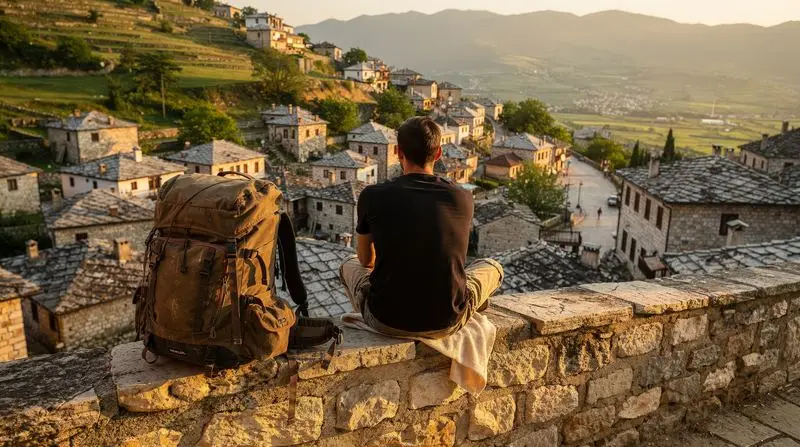
Geographic challenges: Albania is a mountainous country. Building railways through the Albanian Alps and the internal mountain ranges requires tunnels, viaducts, and engineering investment. The Albania backpacking guide has practical advice on navigating mountain areas without a car. Even wealthy countries struggle with this — poor communist Albania had no chance of building the required infrastructure.
Car culture post-1990: When Albanians could finally own cars in the 1990s, they embraced car ownership passionately. The cultural aspiration became car ownership, not public transport. This has persisted.
Underinvestment: No Albanian government has made railways a funding priority. Roads have absorbed the vast majority of transport investment, with EU funding supporting the Trans-Adriatic and trans-Balkan road corridors.
Minibus competition: The furgon (shared minibus) network filled the gap that trains vacated. It is flexible, frequent, and serves smaller settlements that rail never reached. See the Albania public transport guide for the full picture on furgons.
What to Actually Use Instead of Trains
The honest answer is this: do not plan your Albania itinerary around trains. Plan it around the actual transport network that functions.
Buses (urban and intercity): Larger vehicles serving main corridors — Tirana to Shkodra, Tirana to Vlora, Tirana to Saranda, Tirana to Korce. Comfortable, reliable, affordable.
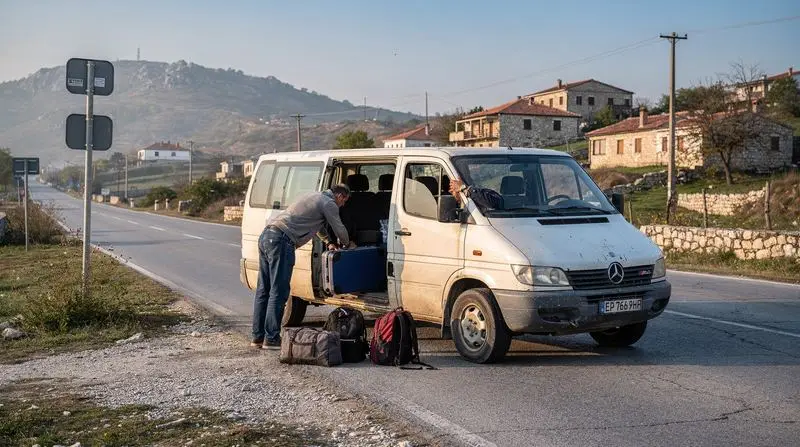
Furgons: The backbone of Albanian travel. Shared minivans that serve virtually every town and village. They leave when full rather than to a fixed schedule. Very cheap — typically 300-800 ALL for regional trips.
Private taxi or rental car: For flexibility in remote areas. Essential for mountain treks, remote beaches, and scenic detours off the main routes. See the Albania driving guide for rental car tips.
Ferry: Albania has coastal ferry services from Durres to Bari and Ancona (Italy). Lake Komani-Fierza ferry is one of the country’s most spectacular journeys — a narrow fjord-like lake passage in the mountains. Not rail, but extraordinary. See the Albania public transport guide for ferry details.
Bolt ride-hailing: In Tirana, Bolt (the Estonian ride-hailing app) works excellently. Metered, reliable, and eliminates taxi negotiation. The airport transfers guide covers Tirana arrival options.
For complete transport guidance, the Albania public transport guide covers all modes in detail — including tips on navigating the furgon system, booking intercity buses, and using Bolt.
For visitors who want efficient transport from the airport on arrival:
Tirana airport transferFor day trips that work beautifully in Albania’s road-based transport system:
Tirana city food tour Best of Saranda day tourWhat a Rail Enthusiast’s Detour Actually Requires
For the small but genuine niche of travelers who want to ride Albanian rail specifically for the experience, planning the detour realistically means treating it as a half-day or full-day side activity rather than transport. From Shkodra, allow a morning to reach the station, confirm the current schedule locally (online information is not reliable), ride to Lac, and return — a round trip that, including waiting time, can consume most of a day for a journey that covers barely 80 km total. This only makes sense if you are already staying in Shkodra for the Theth-Valbona hike or Alps access and have a genuinely free day to spend on the detour; it does not make sense as a special trip from Tirana.
The Rail Experience: If You Do Take a Train
For travelers who want the experience of riding Albanian rail — perhaps for the novelty, for photography, or simply to say they did it — here is what to actually expect.
Buying a ticket: Go to the station (stacioni i trenit) and speak to the ticket window staff. Prices are very low — the fare from Shkodra to Lac is a few hundred ALL, under EUR 2. Tickets are paper, handwritten or printed on basic forms in some stations. There is no online booking.
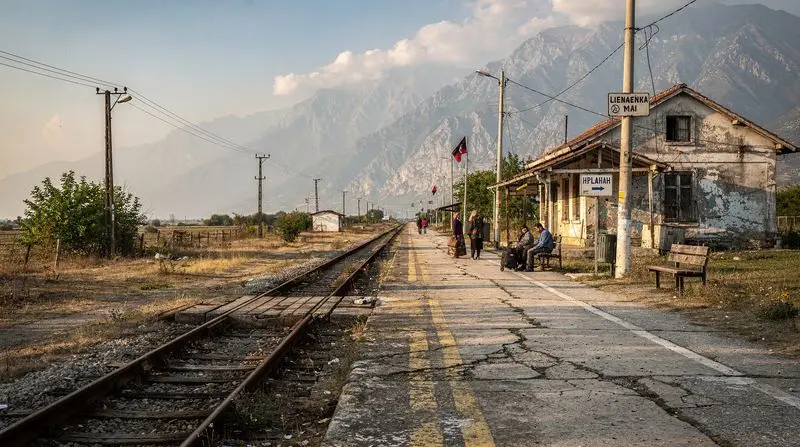
Waiting: Station waiting rooms exist but may be basic or unmaintained. Bring your own food and water. Seating on the platform may be limited.
The train itself: Expect rolling stock that is old by Western European standards — diesel multiple units or locomotive-hauled carriages from the communist era or from foreign donations. They are functional and safe but no frills. Air conditioning is the exception rather than the rule. Windows may or may not open reliably.
The journey: The Shkodra-Lac line passes through flat agricultural lowland — not the most dramatic scenery. The journey is slow. The experience is authentically and somewhat fascinatingly Albanian in a way that a furgon journey cannot quite replicate. Fellow passengers will likely be curious about a foreign traveler choosing the train and conversations may develop despite language barriers.
The punctuality reality: Albanian trains do not operate to rigorous punctuality standards. Delays of 30-60 minutes are possible. For sightseeing purposes, this is not a problem — you are not connecting to another timed service. If you have a specific onward commitment, allow ample buffer.
Other Nations’ Railway Approaches: Regional Context
Understanding Albania’s railways is easier with regional context:
Kosovo: Basically no functional passenger rail. Kosovo Railways (Trainkos) operates minimal services. The Kosovo-Serbia rail connection is politically contested and not operational for passenger use. Kosovo’s main transport is bus and furgon.
North Macedonia: Has a functional if slow rail network. The Skopje-Bitola line is the main north-south route. International connections to Serbia (Belgrade) and Greece (Thessaloniki) exist but are slow. For travelers combining North Macedonia with Albania, train is only useful for the Macedonian section.
Montenegro: Montenegro had one of Europe’s most scenic railways — the Bar-Belgrade line through dramatic mountain terrain. This line still operates but has faced funding difficulties. The Bar-Podgorica section (coastal to capital) is the most reliable. The spectacular mountain section onward to Serbia is operational but slow.
Greece: Greek rail (Hellenic Train) was significantly damaged by the 2023 Tempi disaster and has been partially suspended. Intercity services operate between major cities. Athens-Thessaloniki is the main trunk. No rail crosses into Albania.
Serbia: Rail Serbia has the most developed network in the Western Balkans. The Belgrade-Novi Sad high-speed section is impressive by regional standards. Serbia is the realistic rail hub for anyone wanting to travel the region by train — you can take trains within Serbia, then switch to buses/furgons for Albania.
Planning an Albania Trip Without Rail
The practical reality for most Albania visitors: you will not use trains. Your transport planning looks like this:
From the airport: Pre-book a transfer or use Bolt in Tirana. The Tirana airport transfers guide covers all options.
Between cities: Bus or furgon. Research departure points from your accommodation the day before travel.
Day trips: Organized tours or private drivers. For the most popular day trips:
Full-day tour from Tirana to BeratTo remote areas: Furgon to the nearest hub, then private taxi or organized hiking transfer for the final leg.
Coastal travel: Furgon and shared taxi along the Riviera. Boat for coves and beaches inaccessible by road.
This network — imperfect, flexible, cheap — gets you everywhere in Albania that is worth going. The absence of trains is genuinely not a limiting factor for any itinerary.
What Rail Restoration Would Mean for Tourism
Looking ahead, a fully rehabilitated and functioning Tirana-Durres line would change the tourism dynamic meaningfully. Currently, getting from Tirana to the beach at Durres by public transport is slow and inconvenient (bus journey through traffic, approximately 1.5-2 hours). A 25-minute rail connection would make Durres genuinely day-trippable from Tirana and reduce the pressure to hire a car.
Further potential connections — Tirana to Shkodra by rail, for example — would open the northern circuit to car-free travelers in a new way.
For now, monitor developments. By 2027-2028, the Tirana-Durres service may be operational. When it opens, the practical guidance in this article will need updating — a good sign.
The Albania public transport guide is updated when significant transport changes occur. Check it for the latest on all modes.
The Nostalgia Tourism Angle
There is a small but genuine market of travelers interested in the experience of riding railway infrastructure from the communist era — the historic carriages, the old station architecture, the atmosphere of socialist modernity now past its prime. Albanian trains offer this, authentically and cheaply.
The Tirana railway station is architecturally significant — a mid-century modernist building that was the arrival point for official state visitors during the communist period. Walking through it today is an evocative experience even without boarding a train. The Albania dark tourism guide covers other communist-era heritage sites.
If you approach Albanian rail with the mindset of industrial heritage tourism rather than practical transport, the experience reframes itself. You are not riding a train to get somewhere efficiently — you are experiencing a living (barely) piece of Albanian communist-era infrastructure, in the company of locals who actually need it, through landscape that is unchanged from the era when it was built.
For photographers and heritage travelers, this has genuine appeal. The angle of light on the old rolling stock at the Tirana station in early morning, the peeling paint on platform signage, the stationmaster’s office with its anachronistic equipment — these are subjects that reward attention.
Albanian Rail in Numbers: A Statistical Picture
For context on the scale of what remains:
- Peak network length (1980s): approximately 720 km
- Estimated operational track today: 230-270 km (in various states)
- Active passenger services: 2 lines with minimal frequency
- Annual passenger journeys: not publicly disclosed but estimated at under 1 million (compared to millions for the bus/furgon network)
- Rolling stock age: most carriages and locomotives date from the 1970s-1990s
- Average train speed: 30-50 km/h on operational routes (compared to road speeds of 70-100 km/h on good highways)
These numbers tell a clear story: Albanian rail is not a transport network in any meaningful competitive sense. It is a residual service maintained largely for social (rural access) and institutional reasons rather than as a practical alternative to road.
What Albania’s Neighbors Show Is Possible
The contrast with other small Balkan states is instructive. Slovenia — a country of similar size to Albania — has a well-maintained rail network connecting Ljubljana, Maribor, and coastal Koper, integrated into the European rail system and used by both locals and tourists. Slovenia’s railways are profitable and modern.
The difference is EU membership and decades of infrastructure investment. Slovenia entered the EU in 2004; Albania is still in accession talks. The investment trajectories have been fundamentally different.
North Macedonia and Kosovo sit closer to Albania’s situation — minimal functional rail. Montenegro’s scenic Bar-Belgrade line is an exception, funded during the Yugoslav era with World Bank money in the 1970s.
For Albania to achieve Slovenian-quality rail, the timeline is realistically decades rather than years. EU accession, the required investment frameworks, procurement processes, construction — all take time. What travelers experience in 2026 is the baseline. By 2040, the picture may look substantially different.
The Future of Albanian Railways
Despite the bleak current picture, there are genuine reasons for cautious optimism:
EU accession framework: Albania’s path toward EU membership includes infrastructure alignment requirements. Railway development is part of the Trans-European Transport Network (TEN-T) extension to the Western Balkans.
Tirana-Durres electrification: Beyond simple rehabilitation, plans exist for an electrified, higher-speed Tirana-Durres corridor. This would be genuinely transformative.
Regional rail ambitions: Longer-term planning documents include connections toward Pristina (Kosovo) and toward Skopje (North Macedonia) as part of a Balkans regional rail vision. These are decades-away ambitions, not near-term realities.
The comparison with Kosovo and North Macedonia: Neighboring Kosovo similarly lacks meaningful rail, though North Macedonia has a functioning if modest Skopje-Bitola-Thessaloniki corridor. Regionally, rail is underdeveloped. Albania is not uniquely failing — it is failing alongside its neighbors.
For travelers arriving by train from elsewhere in Europe, the nearest practical option is the Greek InterCity network to Thessaloniki or Ioannina, followed by road transport across the border into Albania.
Arriving in Albania by Train From Elsewhere in Europe
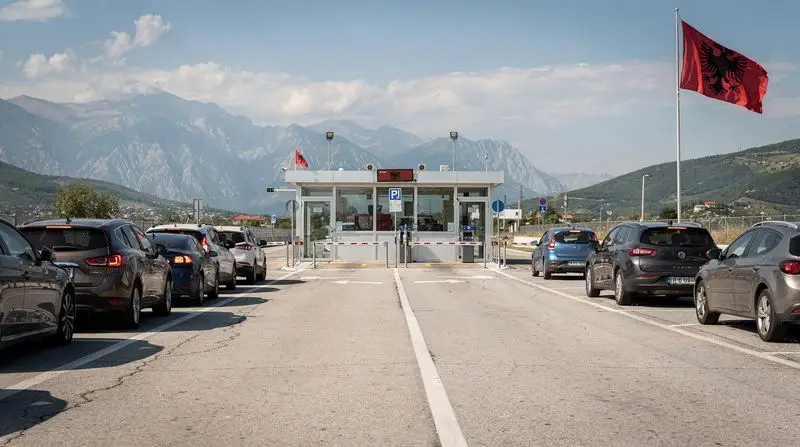
Travelers doing a wider European rail trip sometimes ask whether they can arrive in Albania by train from a neighboring country. The honest answer is no, not directly. No international rail line crosses into Albania from any neighboring country — not Greece, Montenegro, North Macedonia, or Kosovo. The nearest functioning rail terminus to Albania is on the Greek network (Ioannina has bus onward connections, and the fuller InterCity network reaches Thessaloniki) or via Serbia’s more developed network reaching toward North Macedonia. From any of these points, the final leg into Albania is by bus or private vehicle across a land border crossing. For rail enthusiasts planning a broader Balkans interrail-style trip, the realistic approach is: take trains through Serbia, Montenegro (the scenic Bar-Belgrade line), or Greece as far as the network reaches, then switch to bus for the Albania leg. Budget an extra half-day to a full day for this transition, since cross-border bus schedules do not always align neatly with rail arrival times. The border crossings Albania guide covers the specific crossing points and what documentation you need.
Comparing Rail Alternatives: Bus vs Furgon vs Rental Car
For travelers weighing up how to actually get around Albania without trains, the three real alternatives each suit different situations. Intercity buses are the most comparable to a train experience — fixed routes, scheduled departures, comfortable seating, and predictable journey times on the main corridors between Tirana, Shkodra, Vlora, and Saranda. Furgons trade some comfort and schedule predictability for far greater route coverage, reaching towns and villages that buses skip entirely, and departing more frequently since they leave when full rather than on a fixed timetable. Rental cars sacrifice the social, low-effort nature of public transport for complete flexibility — essential for reaching remote beaches, mountain trailheads, and viewpoints that no public transport serves at all. Most experienced Albania travelers end up using a combination: buses or furgons for the main city-to-city legs, and a rental car for a few days in whichever region (the Riviera, the Alps, the southern interior) rewards independent exploration most. The Albania public transport guide and the car rental Albania guide both cover their respective options in full detail.
Sample Albania Route Entirely by Bus and Furgon
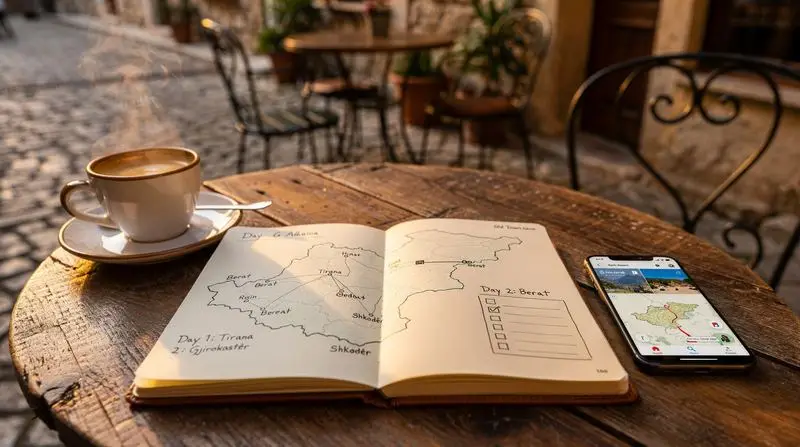
For visitors who want reassurance that a car-free, train-free Albania trip works, here is a realistic two-week route using only buses, furgons, ferries, and the occasional Bolt ride:
| Leg | Mode | Approx. time |
|---|---|---|
| Tirana Airport to Tirana | Airport bus | 30-45 min |
| Tirana to Shkodra | Intercity bus | 2-2.5 hours |
| Shkodra to Theth (via Koman ferry) | Minibus + ferry + minibus | 5-6 hours |
| Theth to Valbona | On foot (the classic hike) | 6-8 hours |
| Valbona to Tirana | Ferry + minibus, or direct minibus | 5-7 hours |
| Tirana to Berat | Furgon or bus | 2 hours |
| Berat to Saranda | Furgon (via Tirana or direct seasonal) | 4-5 hours |
| Saranda area (Ksamil, Butrint, Blue Eye) | Taxi/furgon/tours | Local |
This route covers the Alps, the UNESCO towns, and the Riviera without ever needing a train or a rental car, confirming that Albania’s absence of rail is genuinely not a barrier to a rich, well-connected itinerary.
Frequently Asked Questions About Trains in Albania
Is there a train from Tirana to Saranda?
No. There is no rail route to Saranda or anywhere on the Albanian Riviera. Travel to Saranda from Tirana is by bus (approximately 4.5-5 hours) or private vehicle via the SH8 southern highway.
Is there a train from Tirana to Shkodra?
Not a direct useful service. While rail connections technically exist through the Lac junction, they are slow, infrequent, and impractical. The bus from Tirana to Shkodra takes 2-2.5 hours and departs several times daily from the northern bus terminal.
When will the Tirana-Durres train be ready?
The EU-funded rehabilitation is ongoing but subject to delays. No confirmed completion date can be reliably stated as of 2025-2026. Check HSH or Albanian transport ministry announcements for current status before your trip.
Can I travel from Albania to Serbia or Greece by train?
No direct international rail exists. Greece has a network that reaches as far as Thessaloniki and Ioannina, but there is no rail crossing into Albania. To travel between Albania and Serbia or Greece, use road transport (bus, private vehicle) across border crossings.
Are Albanian trains safe?
The trains that operate are functional but old. Safety incidents on Albanian rail are not a particular documented concern. The more relevant issue is reliability — trains may be cancelled, delayed significantly, or simply not run according to posted schedules. Plan accordingly with backup options.