In March 2023, something remarkable happened in a small country on the Adriatic coast that most of the world’s media did not fully register. Albania’s Prime Minister Edi Rama signed the declaration creating the Vjosa Wild River National Park — the first protected area in Europe to encompass an entire wild river system, from source to sea, including all its tributaries.
This is not a minor conservation announcement. It is a historically significant decision that places Albania at the forefront of European environmental policy and protects one of the last truly wild river ecosystems on the continent. And for travelers, it opens a new dimension of Albania that relatively few people have yet discovered.
| Where | Southern Albania, near Permet, roughly 4-5hrs from Tirana |
| What to do | Swim, canyon-view, visit Benja thermal springs, birdwatch |
| Best time | Summer/early autumn for swimming, spring for birdwatching, winter for the thermal springs |
| Facilities | Minimal — no visitor centres or marked trails; base yourself in Permet |
| Combine with | Berat and Gjirokastra on a southern circuit |
What the Vjosa Actually Is
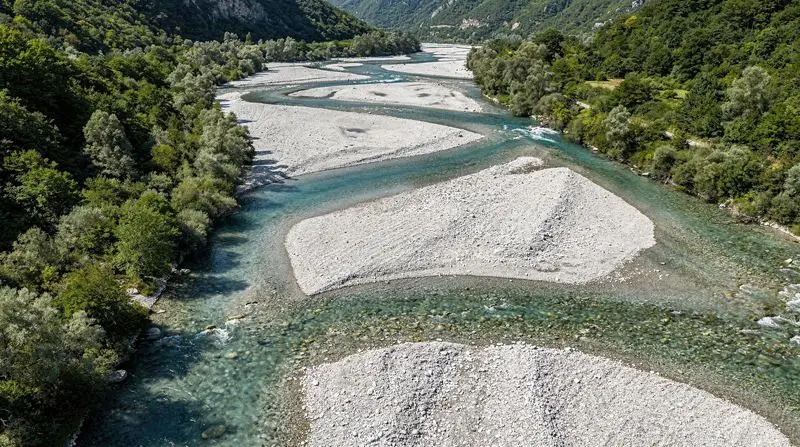
The Vjosa rises in the Pindus Mountains of Greece and flows for approximately 270 kilometers before reaching the Adriatic Sea near Vlora. It is one of the last major wild rivers in Europe — meaning it has no large dams along its course, no channelization, no major hydroelectric infrastructure. It flows as rivers have always flowed: braided channels that shift with the seasons, gravel banks that appear and disappear, floodplains that flood.
The river supports extraordinary biodiversity. Scientists working with the conservation organization EuroNatur have documented more than 1,100 species in and around the Vjosa, including fish species found nowhere else on earth. The river’s gravel banks are breeding grounds for rare bird species. Its unaltered course means it still performs the ecological functions — filtering water, moving sediment, providing habitat connectivity — that managed rivers cannot.
We visited the Vjosa near Permet in 2022, before the national park declaration, on a day that had started with a different plan entirely. We had been heading south and took a detour on a recommendation from a guesthouse owner who said, simply, “go to the river, you will understand.” We spent three hours there. We swam in water so clear that the gravel bottom three meters down was perfectly visible. A kingfisher crossed the river in front of us twice. The silence, broken only by water and insects, was profound.
Why the Declaration Matters
The Vjosa has been under threat for decades. Multiple dam projects were proposed along its course at different points, any one of which would have fundamentally altered the river system. The most recent serious threat came as recently as 2017, when plans for a hydropower dam at Pocem were advanced before a sustained campaign by environmental groups, local communities, and international organizations — including a high-profile partnership with Patagonia, whose outdoor gear customers proved a surprisingly effective advocacy force — succeeded in halting them.
The national park declaration does not simply preserve the current state of the river. It creates a legal framework that makes future dam development essentially impossible and requires the restoration of any degraded sections. It is, in the most literal sense, permanent protection.
For Albania, the decision is significant beyond conservation. It signals a deliberate choice to pursue a tourism and development model based on natural and cultural heritage rather than energy extraction. It is a bet that the Vjosa’s wildness is worth more intact than dammed — a calculation that may prove prescient as the tourism value of genuinely wild nature continues to rise globally.
What the National Park Includes
The Vjosa Wild River National Park encompasses the main river channel and all its tributaries within Albania, plus the floodplains, wetlands, and adjacent habitats along the course. The total protected area is approximately 2,700 square kilometers — a significant portion of southern Albania.
Key sections of the river include:
The upper Vjosa near Permet: The most accessible section for visitors, with swimming spots, kayaking possibilities, and the beautiful confluence with the Lengarica River canyon. This area was already becoming known to adventurous travelers before the national park declaration and is the natural starting point for a Vjosa experience.
The middle section through the Permet basin: Quieter and less-visited, with gravel banks wide enough to camp on and sections where the braided channels create small islands between the flows. Birdwatching here is exceptional in the spring.
The lower Vjosa approaching the coast: The river widens and slows as it approaches Vlora, and the delta area where it meets the Adriatic is an internationally important wetland. Less dramatic than the upper sections but ecologically significant.
The Benja Thermal Springs: The Vjosa’s Hidden Bonus
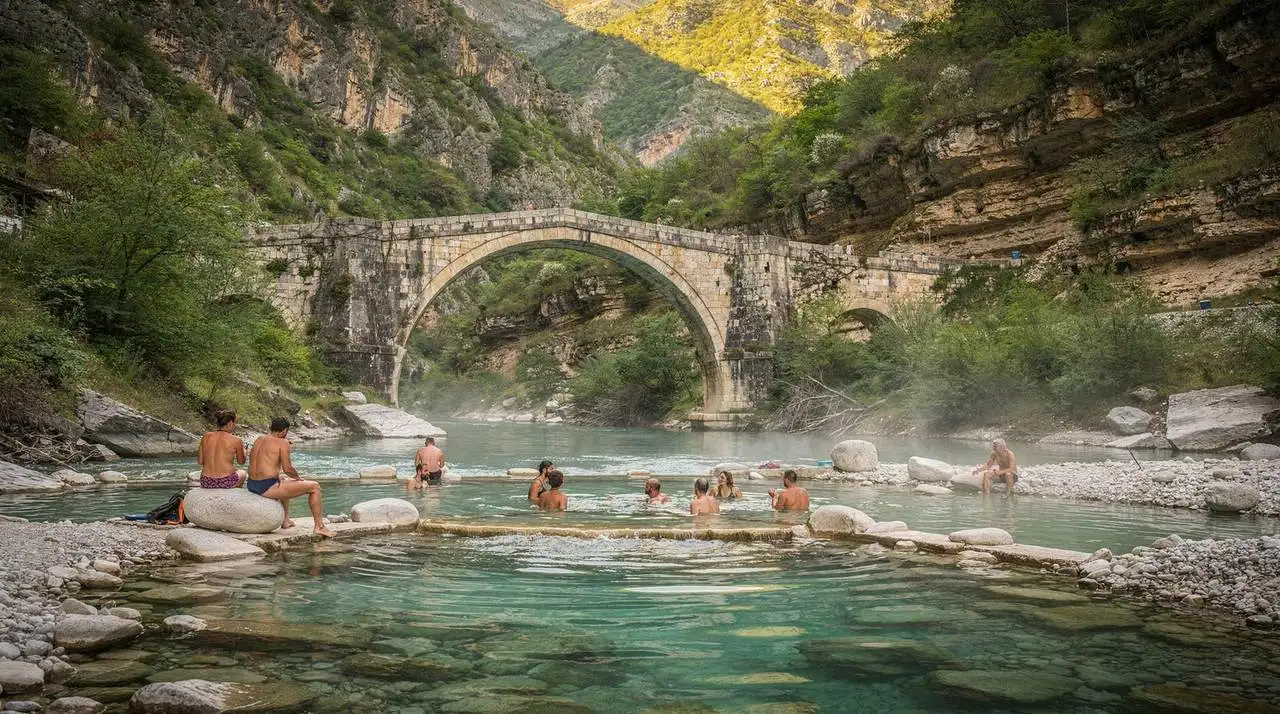
One of the most rewarding stops for visitors exploring the Vjosa near Permet is the Benja thermal springs, located in the Lengarica canyon a short distance from town. Natural hot springs emerge in a gorge setting and have been used since Ottoman times — the old stone bridge visible from the springs dates to the eighteenth century and frames the scene in a way that feels almost theatrical.
The springs maintain a consistent temperature that makes them usable year-round. In winter, when the air temperature drops and steam rises from the water, the experience is particularly atmospheric. In summer, the canyon shade keeps the area cooler than the open river nearby, and the combination of hot springs and cold swimming spots within walking distance of each other creates an unusually satisfying few hours.
A Permet Benja thermal baths tour is an excellent way to experience both the springs and the canyon scenery with some local context — particularly useful for first-time visitors who want to understand what they are looking at as much as they want to swim in it.
For Travelers: What Has Changed and What Has Not
The national park declaration does not mean the Vjosa has been developed into a tourist attraction. There are no visitor centers, no marked trails, no official swimming areas beyond what was already informally used. What the declaration does is provide legal certainty that the river will remain wild, which is both its conservation purpose and its long-term value for travelers.
For now, visiting the Vjosa means visiting Permet — the nearest town of any size to the best sections of the upper river — and making your way to the river independently or with a local guide. Permet offers accommodation ranging from simple guesthouses to small boutique hotels, and the town has a relaxed, pleasant character that reflects its position in a fertile river valley surrounded by mountains.
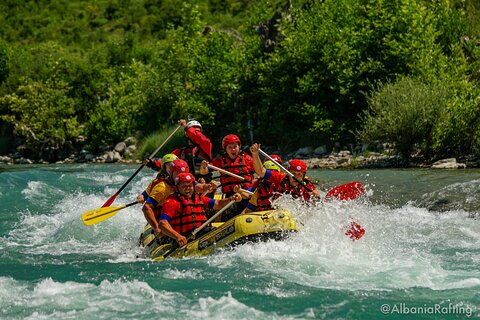
Canyoning and kayaking on the Vjosa and its tributaries is available through local operators — the river’s varying flow and the canyon sections near Permet offer experiences ranging from gentle family floats to proper whitewater depending on the season and section chosen. If you would rather book ahead, a guided rafting experience on the Vjosa River in Permet is one way to get onto the water with a local operator. Ask your accommodation in Permet to recommend current operators, as the situation changes from season to season.
Combining the Vjosa with Southern Albania
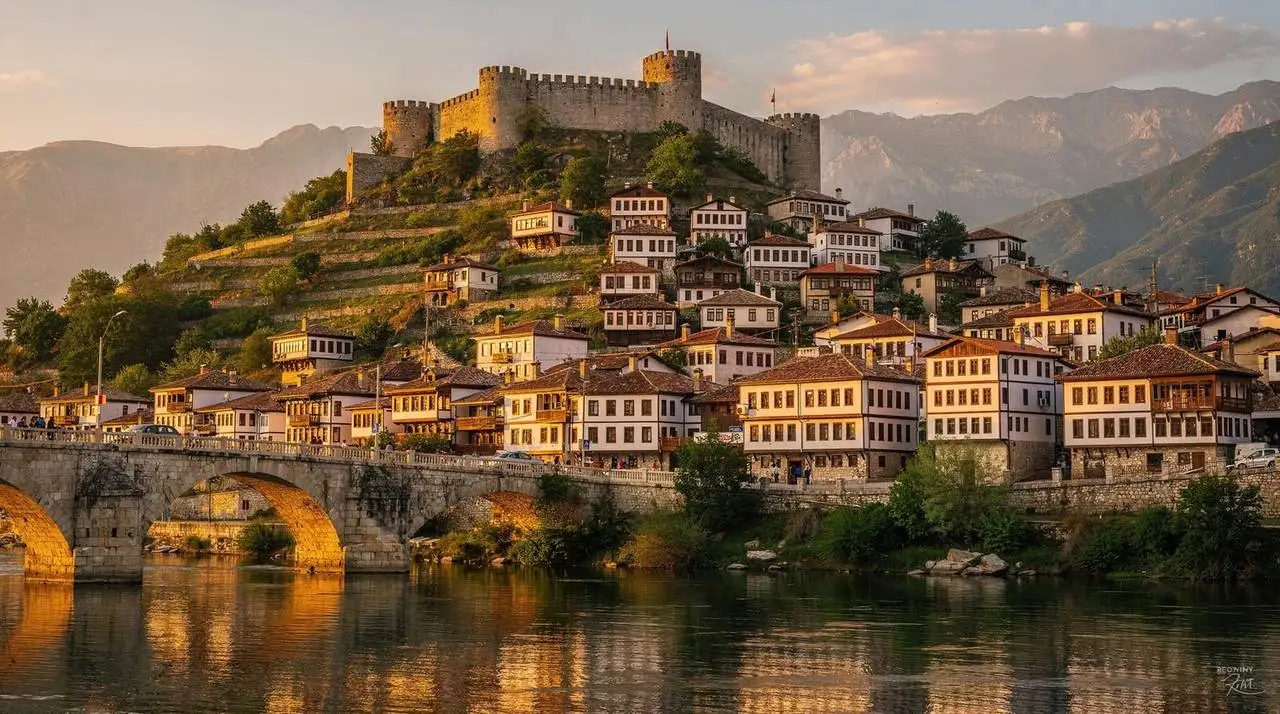
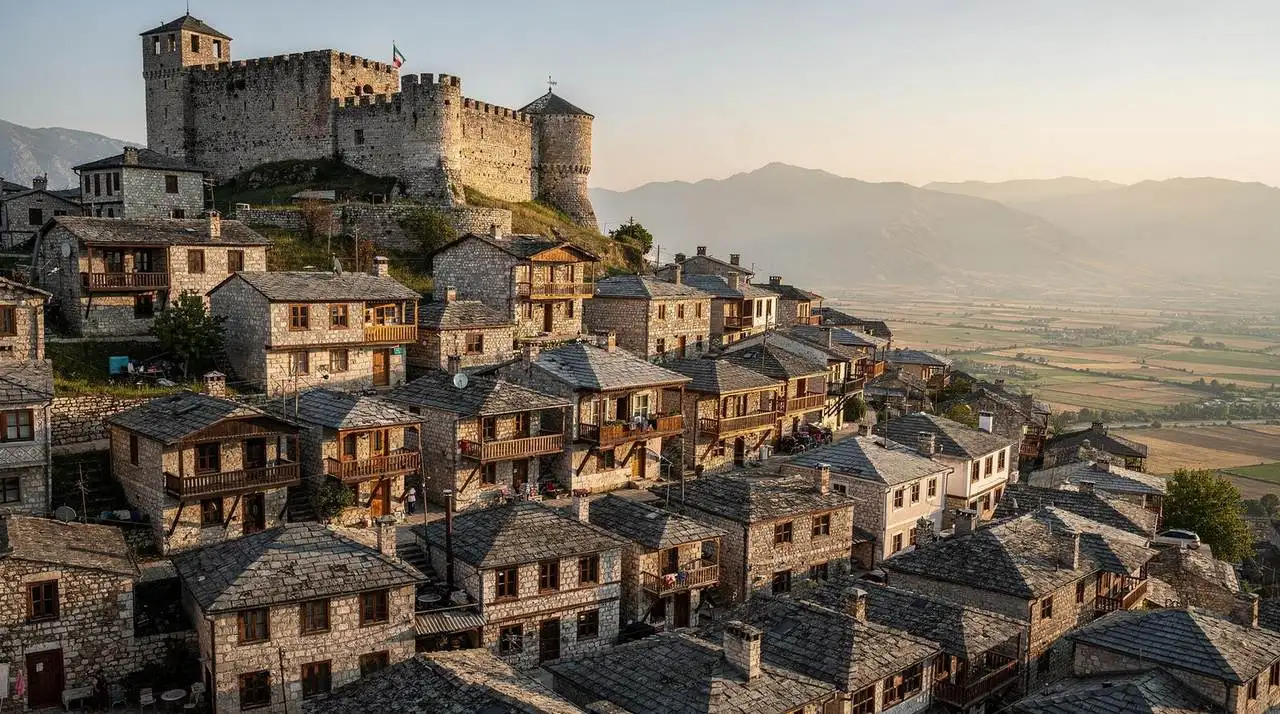
The Vjosa national park gives Permet a new significance in Albania’s travel landscape, and it fits naturally into a broader southern Albania itinerary that includes the other great historic cities of the interior. Gjirokastra, the UNESCO-listed stone city about an hour north of the Greek border, is an hour’s drive from Permet and is among the most remarkable places in the country. Berat, another UNESCO city with extraordinary Ottoman architecture, sits further north along the same valley road.
Our 7-day south Albania itinerary structures a route through all three — Berat, Permet, Gjirokastra — that works logically and efficiently without feeling rushed. The addition of a day or two on the Albanian Riviera at the end completes a south Albania circuit that combines wild nature, historic architecture, and coastline in proportions that few other countries can match.
For the practical logistics of reaching Permet from anywhere in Albania, our how to get to Albania guide covers the transport options including bus connections from Tirana and Gjirokastra.
Understanding the Conservation Context
The Vjosa National Park declaration sits within a broader pattern of Albanian environmental policy worth understanding. Albania has, somewhat surprisingly given its developing economy status, made a series of significant conservation commitments in recent years. The Buna-Velipoja wetland in the north has protected status. Discussions are ongoing about stronger protection for the Shala River canyon and sections of the Albanian Alps. The pattern suggests a genuine strategic direction rather than isolated decisions.
The practical explanation is partly international pressure — conservation organizations and EU accession requirements create real incentives for protection decisions — and partly a recognition that Albania’s natural assets are its competitive advantage in a tourism market increasingly interested in authenticity and wildness. The Vjosa’s value as a tourism destination depends entirely on it remaining wild. A dammed Vjosa is just another reservoir. A wild Vjosa is something that cannot be replicated anywhere else in Europe.
When you visit the river and spend money in Permet and the surrounding villages, you are part of making the economic case for the protection that has already been declared. The declaration creates the legal framework; visitor demand creates the economic incentive to honor it.
The Lengarica Canyon and Wider Permet Area
Beyond the main Vjosa channel, the Lengarica canyon that feeds the Benja thermal springs is worth exploring in its own right — narrow limestone walls, clear pools, and a quietness that even the springs themselves do not fully disturb. Permet sits at the centre of a genuinely underrated pocket of southern Albania, and our Korca city guide is worth reading if you are considering extending the trip further east into the wine country around Korca, which pairs naturally with a Vjosa detour for travellers with a few extra days. Closer to the river itself, our thermal baths in Albania guide covers Benja alongside Albania’s other hot springs if you want to compare options before committing to one.
Getting Active on and Around the Water
Beyond swimming, the Vjosa system is increasingly a base for more active pursuits. Our rafting in Albania guide and kayaking and SUP in Albania guide cover the current operators working the river’s gentler sections near Permet. For visitors who prefer to stay dry, the birdwatching in Albania guide has more detail on the species that draw naturalists to the middle Vjosa’s gravel banks in spring.
The Wider Conservation Picture
The Vjosa declaration has also shifted how nature-focused travel across Albania is framed more broadly. Our hidden gems in Albania guide situates the Vjosa alongside the country’s other under-the-radar spots, several of which have seen similar, if less dramatic, growth in attention in recent years as Albania’s tourism strategy leans further into its natural assets rather than competing purely on beach infrastructure. It is a genuinely different value proposition from the Riviera-focused marketing that dominates most Albania coverage, and one we think deserves more attention than it currently gets.
Camping Along the River
For visitors with their own transport and gear, wild camping on the Vjosa’s gravel banks has long been an informal tradition, and it remains one of the more memorable ways to experience the river’s wildness overnight. Our wild camping in Albania guide covers the practicalities and etiquette, and the more general camping in Albania guide is useful if you want a slightly more organised site instead.
Reporting from Tirana: The Domestic Response
When we spoke to Albanians in Tirana about the Vjosa declaration after it was announced, the responses were striking in their range. Some people were proud and excited — they understood that their country had done something historically significant. Others were more ambivalent, questioning whether the energy from the dams might have been more immediately valuable to a developing economy. A few had not heard about it at all.
This range of responses is part of what makes the declaration meaningful rather than merely symbolic. It was a genuine choice with genuine costs and genuine debate attached to it. The Albanian government made it anyway. That deserves acknowledgment, and it shapes what visiting the Vjosa means.
When to Go
The Vjosa is most dramatically accessible in summer and early autumn, when water levels are lower, swimming is possible, and the gravel banks are exposed. Spring brings higher water and the best birdwatching — the flooded floodplains attract species that are rarely seen in Albania at other times of year. Winter transforms the river into something more powerful and less approachable but visually extraordinary if you are prepared for cold conditions. The Benja thermal springs are actually at their most enjoyable in winter, when the contrast between the hot water and cold air is most satisfying.
Permet is a reasonable four to five hour drive from Tirana, passing through Berat or taking the eastern route through Gjirokastra. It is the kind of detour that adds significantly to an Albania itinerary without requiring a separate trip. From Saranda on the coast, Permet is roughly two hours inland — easily combined with a south Albania trip.
Go to the Vjosa. Swim in water that has been running wild for longer than any boundary on any map. That is the national park’s gift to you, and the river’s.