Inside the Transformed Pyramid of Tirana
There is a building in the centre of Tirana that Albanians have argued about for three decades. It was built as a mausoleum for Enver Hoxha, the dictator who ruled Albania with iron isolation for over forty years. It became a museum. Then a NATO headquarters during the Kosovo crisis. Then a television station. Then it sat half-derelict for years while politicians debated whether to demolish it or preserve it, while its concrete slopes became a climbing frame for the city’s teenagers and a canvas for its graffiti artists.
We visited the Pyramid in February 2024, not long after its latest and most ambitious reinvention. The transformation is remarkable. And the conversation it has opened about memory, history, and what a city owes its past is one of the most interesting things happening in Tirana right now.
| Where | Bulevardi Deshmoret e Kombit, central Tirana |
| Cost | Free to enter, climb, and view exhibitions |
| Time needed | 30-60 minutes for a relaxed visit |
| Best time | Weekday mornings for a quieter rooftop climb |
| Combine with | Skanderbeg Square, the Blloku, BunkArt 2 |
A Brief History of the Most Controversial Building in Albania
The Pyramid was designed by Enver Hoxha’s daughter Pranvera Hoxha and her husband Klement Kolaneci, completed in 1988, two years after the dictator’s death. It was intended to be the centrepiece of a cult of personality that Hoxha had spent decades constructing — a monument to a man who had sealed Albania off from the rest of the world, who had planted over 170,000 concrete bunkers across the country, who had imprisoned and executed political opponents by the thousands.
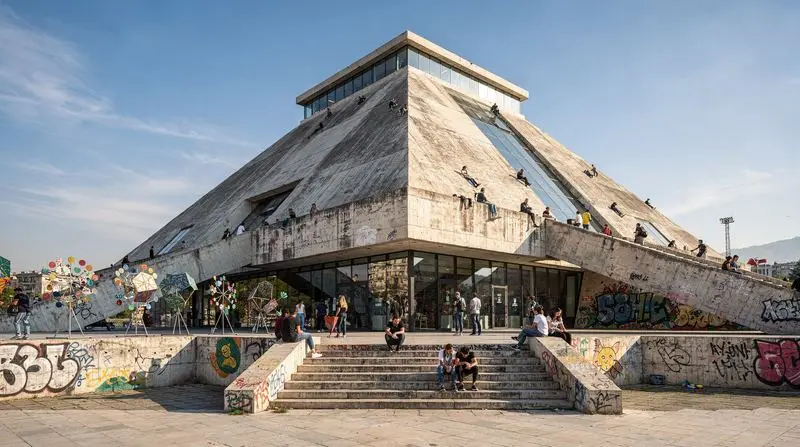
The building itself is an extraordinary piece of late-communist architecture. A stepped pyramid of white marble and glass rising from a large plaza, it sits at the intersection of two of Tirana’s main boulevards with an aggressive monumentality that is hard to ignore. For visitors arriving from Skanderbeg Square, it announces itself unmistakably: this building was built to intimidate and impress in equal measure.
After 1991, when communism collapsed and Albanians tore down Hoxha’s statue in Skanderbeg Square, the Pyramid lost its purpose but kept its presence. Various proposals over the years — demolition, conversion to a luxury hotel, transformation into parliament buildings — came and went without resolution. The city’s young people, in the meantime, simply adopted it as their own, skating and climbing its sloped sides with an irreverence that felt, in its way, like the most appropriate response possible.
Understanding the Context: The BunkArt Museums
Before visiting the Pyramid, we strongly recommend spending time at the BunkArt museums, which give you the full context of Hoxha’s regime that makes the Pyramid’s transformation meaningful. A communist Albania tour with BunkArt museum visit covers both the historical background and the underground bunker itself, giving you the frame you need to understand what you see at the Pyramid.
Walking through the BunkArt tunnels — the vast underground command facility built under Tirana’s mountains for the regime’s leadership to survive nuclear war — and then standing under the Pyramid’s slopes puts you inside the physical logic of a regime that built both in total seriousness. The scale of the paranoia, the resources devoted to it, and the human cost of sustaining it all become more tangible when you see them in physical form.
What the Pyramid Is Now
The latest transformation, completed by Dutch architecture firm MVRDV working with local partners, has reinvented the Pyramid as TUMO Tirana — a free technology and creative education centre for young people, part of the Armenian-founded TUMO network that runs coding, design, film, and music programmes across the Caucasus and beyond.
The approach to the renovation is deliberately provocative in the best way. Rather than hiding the building’s communist-era origins, the architects have exposed and celebrated the concrete structure, adding external staircases that zigzag up the slopes and opening the interior to flood it with natural light through a new glass atrium. The original marble cladding, much of it damaged over the decades, has been preserved where possible and replaced where necessary. The overall effect is neither museum piece nor complete erasure — something more interesting than either.
We arrived on a Tuesday morning and found the building busy with teenagers moving between workshop spaces. One group was working on graphic design projects. Another was in a music production room. The energy was genuine — these were not kids going through the motions of an after-school programme. They were absorbed.
Climbing the Slopes: The View That Everyone Talks About
The external staircases that now run up the Pyramid’s concrete slopes have become one of Tirana’s most photographed experiences, and justifiably so. The climb is not particularly strenuous — the Pyramid is about thirty-five metres tall at its apex — but the view from the top delivers a genuine surprise.
From the peak, you look out over central Tirana with the Dajti mountain range forming a dramatic backdrop to the east. The city sprawls in every direction, a mix of communist-era apartment blocks, Ottoman-influenced bazaar architecture, and the aggressively contemporary towers that have gone up in the last decade. On a clear day in winter, with the mountains still holding snow, the panorama is genuinely beautiful.
We spent about twenty minutes at the top. A group of local teenagers were up there ahead of us, sitting on the concrete and photographing each other with the city spread below. This, we thought, was exactly right. The dictator’s monument, climbed freely by the generation that inherited everything he left behind.
This view makes more sense after a guided Tirana walking tour that gives you the city geography first — knowing which neighbourhood is which, where the Blloku lies, why the Gran Boulevard runs the direction it does, transforms the view from the Pyramid top from an interesting cityscape into a legible story about how Tirana was designed and how it has changed.
The Interior Spaces
The ground floor and several upper levels of the Pyramid are open to the public beyond the TUMO spaces. A large central hall hosts rotating exhibitions — during our visit, there was a photography exhibition documenting everyday Albanian life in the 1980s, using images taken by amateur photographers during the communist era. These photographs, many of them never displayed publicly before, showed the texture of life under Hoxha’s regime: factory workers, collective farm harvests, children in school uniforms, Sunday markets, family portraits taken with obvious pride.
The exhibition was curated carefully, avoiding both nostalgia and sensationalism. It simply showed what daily life looked like, and left visitors to draw their own conclusions about what that life meant for the people living it.
A small cafe on the ground floor serves coffee and light snacks. It is a reasonable place to stop and absorb what you have just seen — both the building itself and whatever exhibition is currently on. The coffee is good, the prices are Tirana-standard (low by Western European measures), and the space has enough atmosphere to justify lingering.
Combining the Pyramid with the Rest of Tirana
The Pyramid is best experienced as part of a broader Tirana cultural day rather than in isolation. A logical route: start at Skanderbeg Square to understand the central geography, walk the Grand Boulevard to the Pyramid, climb to the top, visit the current exhibition, then walk to the Blloku neighbourhood for lunch and afternoon cafes.
From the Blloku, the New Bazaar (Pazari i Ri) is a ten-minute walk and is worth an hour for its restored market spaces, food stalls, and general energy. The Albanian food guide covers what to look for in the market — the cheese, the herbs, the seasonal produce — if you want to shop as well as browse.
For the full cultural immersion, add a BunkArt visit either before or after the Pyramid. BunkArt 2, which is closer to the centre, documents the internal security apparatus — the surveillance networks and political prison system — that operated from the building next to it. Walking out of BunkArt 2 and then walking to the Pyramid, seeing the two in the same afternoon, is one of the more affecting Tirana sequences available.
Photographing the Pyramid
The Pyramid has become one of the most photographed structures in Tirana, and for good reason — the geometry of the staircases against the concrete slopes photographs well at almost any hour, though the golden light of late afternoon is our preference. Our photography spots in Albania guide covers this and several other Tirana angles worth building into a city walk if photography is part of why you travel. Drone photography is a separate question in central Tirana, where restrictions apply; check our drone rules in Albania guide before you attempt anything more ambitious than a handheld shot from the rooftop.
Museums Worth Pairing With the Pyramid
Tirana has developed a strong cluster of museums that reward a visit alongside the Pyramid, and we would build a full day around several of them rather than treating the Pyramid in isolation. Our museums in Albania guide covers the National History Museum on Skanderbeg Square, which gives you the longer historical arc that the Pyramid’s twentieth-century story sits inside. For the architectural angle specifically, the historical sites in Albania guide puts the Pyramid alongside the country’s older monuments and explains why its late-communist design is unusual even within that context.
The Architecture Debate in Context
The MVRDV renovation of the Pyramid sits within a broader conversation happening across post-communist Europe about what to do with monumental architecture built to serve regimes that no longer exist. Some cities have chosen demolition. Others have chosen preservation-as-museum, freezing the building as a historical artifact behind glass. Tirana’s choice — active reuse that keeps the building’s original form visible while filling it with an entirely new function — is arguably the most interesting of the three approaches, because it refuses to let the building either disappear or calcify into a static monument. Whether you find this approach convincing or uncomfortably light-touch on a genuinely dark history is, we think, a question worth sitting with rather than resolving quickly, and it is part of what makes a visit to the Pyramid more than a photo opportunity.
A Day of Tirana Culture
If the Pyramid is your anchor for the day, our free things to do in Albania guide has several other no-cost stops in Tirana worth stacking around it, since the Pyramid’s own free entry sets a useful tone for a budget-friendly cultural day. For visitors staying nearby, the where to stay in Tirana guide linked below covers the Blloku and Skanderbeg Square areas specifically, both an easy walk from the Pyramid’s base.
The Debate That Has Not Ended
Not everyone in Albania is happy with what has happened to the Pyramid. Some critics argue that transforming Hoxha’s monument into a vibrant, forward-looking space for young people inadvertently softens the memory of what he represented. Others feel that demolition would have been the more honest response — that preserving the building in any form continues to give it a presence it does not deserve.
We spoke to several Albanians about this during our visit to Tirana. The responses were genuinely divided along generational lines. Older Albanians who lived through the Hoxha era tended to have stronger feelings — mostly that the building should not exist in any form. Younger Albanians, including the TUMO students we talked to, were broadly positive about the transformation, and several pointed out that the building’s history was not hidden or erased — the exhibitions inside made it explicitly present.
One young woman studying graphic design at TUMO put it to us this way: “My grandparents had to live under that man. Now I come here to learn animation. I think that is a better use of the building than leaving it to fall apart.”
We did not have a clean answer to offer, and we do not think one exists. What the Pyramid represents now is a city grappling honestly with its past — not through denial or simple condemnation, but through the genuinely difficult work of figuring out what to do with the physical objects that history leaves behind.
Visiting the Pyramid: Practical Details
The Pyramid is centrally located on Bulevardi Deshmoret e Kombit, about ten minutes’ walk from Skanderbeg Square. It is free to enter and explore, including climbing the external staircases to the top. TUMO’s educational spaces are not open to general visitors during programme hours, but the exhibitions, common areas, and cafe are accessible.
There is no specific visiting hour requirement — we arrived mid-morning on a weekday and had no difficulty getting in. Weekends may be busier, particularly for the rooftop climb. Plan thirty minutes to an hour for a relaxed visit, longer if there is a substantial exhibition on.
Combine the Pyramid with the nearby National History Museum, the Blloku neighbourhood, and a walk along the Grand Park for a full day of Tirana culture. Our where to stay in Tirana guide covers accommodation options across different budgets and neighbourhoods if you are planning your base.
Why It Is Worth Going
The Pyramid of Tirana is not a conventional tourist sight. It does not have the immediate visual drama of the Berat citadel or the archaeological weight of Butrint. What it has is something rarer: genuine contemporary relevance. It is a place where the past and the present are in active conversation, where a city is making choices about its own identity in real time.
For visitors who want to understand Albania beyond its beaches and scenery — who are interested in how countries emerge from difficult histories and build something new — the Pyramid is one of the most thought-provoking places in the country. We left with more questions than we arrived with, and that, for us, is the mark of a visit worth making.
Tirana continues to surprise us every time we go back. The Pyramid is just the latest reason why.