Best Restaurants in Korca: Dining in Albania’s Cultural Capital
Korca has a food culture unlike any other city in Albania. The combination of altitude (869 metres), French urban heritage, a thriving brewery tradition, a strong intellectual and artistic self-consciousness, and the distinctive culinary traditions of eastern Albania creates a restaurant scene that is genuinely different from the coastal and southern cities that dominate Albanian tourism.
The city is known nationally as the “City of Serenades” and Albania’s cultural capital — the first Albanian-language school opened here in 1887, and the sense of local pride in education, arts, and distinctiveness permeates the social fabric. The restaurant scene reflects this cultural confidence: Korca eats better than its size and geographic remoteness would suggest, and the combination of local specialities, brewery culture, and boulevard cafe life makes it one of Albania’s most rewarding cities for food and drink.
The regional kitchen of eastern Albania — shaped by the mountain plateau climate, the Ottoman culinary heritage, the strong dairy and lamb farming traditions, and specific local preparations that exist nowhere else in the country — finds its best expression in Korca. Lakror, petanik, sheqerpare, and the local bakllava are foods that belong specifically here, prepared by families and bakeries that have maintained the recipes across generations.
| Where to eat | Old bazaar for lakror, boulevard for the evening promenade |
| Typical cost | Around EUR 8-15/person for a full meal |
| Don’t miss | Lakror, Korça Beer Garden, boulevard cafes |
| Best time | Late July/early August for the Beer Festival (book far ahead) |
| Altitude note | 869m — evenings are cool even in summer |
The Korça Brewery: Beer, History, and Garden Dining
The Korça Brewery (Birra Korça) is not just the most famous food and drink product associated with the city — it is a cultural institution, a point of local identity, and the venue for one of Albania’s best dining experiences.
The brewery was founded in 1928 by Gjergj Ciço, an Albanian who had learned brewing in Romania. It survived nationalisation under communism, privatisation after 1991, and eventual acquisition by Heineken International, maintaining throughout a reputation as Albania’s finest domestic beer. Drinking Korca beer in Korca — fresh from the brewery tanks — is the same pleasure as drinking Czech beer in Prague or Belgian beer in Brussels: the beer and the place are inseparable.
For the definitive Korca brewery experience: this Korca Brewery Tour with Traditional Beer Tasting takes participants through the brewing facility, explains the history of Albanian brewing and the Korca brand’s cultural significance, and includes multiple tastings of the various Korça beer styles. Book ahead — capacity is limited, particularly in summer. The tour runs approximately 90 minutes and is one of the most enjoyable structured activities in eastern Albania.
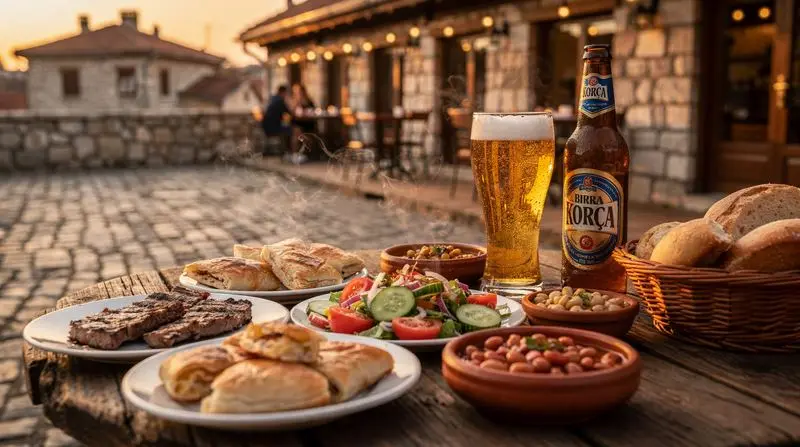
The Korca Beer Garden adjacent to the brewery serves cold beer and traditional Albanian grilled food in an open-air setting. Large communal tables, live music on weekend evenings, and the brewery building illuminated behind the garden create an atmosphere that is distinctive and genuinely festive, particularly in summer when the outside temperature at this altitude makes outdoor dining extremely pleasant. This is the best place in Korca to drink beer — the source.
The Old Bazaar and Lakror
The old bazaar (pazari i vjetër) is the heart of Korca’s food culture and the place to encounter the local specialities that define eastern Albanian cooking. The covered market and surrounding lanes contain bakeries, pastry shops, and traditional food stalls that maintain preparations with roots in the Ottoman period.
Lakror is Korca’s most distinctive local dish — a layered savoury pastry using thin filo and various fillings (cheese, leeks, nettles in spring, or meat) that differs from the standard byrek in its preparation and its connection to the specific baking traditions of this region. The lakror here is not the same as anywhere else in Albania; it is made by hands that have made it their whole lives, and the difference is detectable.
Petanik is another eastern Albanian specialty — a flatbread preparation with specific local identity. Ask at the bazaar bakeries what they have fresh; the answer on any given day reflects what the ovens produced that morning, and the freshest preparations are always superior.
Sheqerpare — syrup-soaked semolina cakes with a dense, sweet centre and a slightly caramelised surface — is the standard local dessert and a direct descendant of Ottoman confectionery. The Korca versions, made by the bazaar pastry shops using recipes that predate the communist period, are excellent.
Bakllava in Korca is made with local walnuts from the surrounding valleys and a sugar syrup that is lighter and less sweet than the Greek or Turkish versions. The result is a more delicate baklava with a more pronounced walnut flavour. Several bazaar pastry shops have been producing the same recipe for decades.
For a walking introduction to the bazaar in the context of the city’s cultural heritage: this Korce Walking Tour with Old Bazaar and Cathedral covers the bazaar food culture alongside the architectural and historical significance of the surrounding old city area.
Boulevard Restaurants and the Evening Promenade
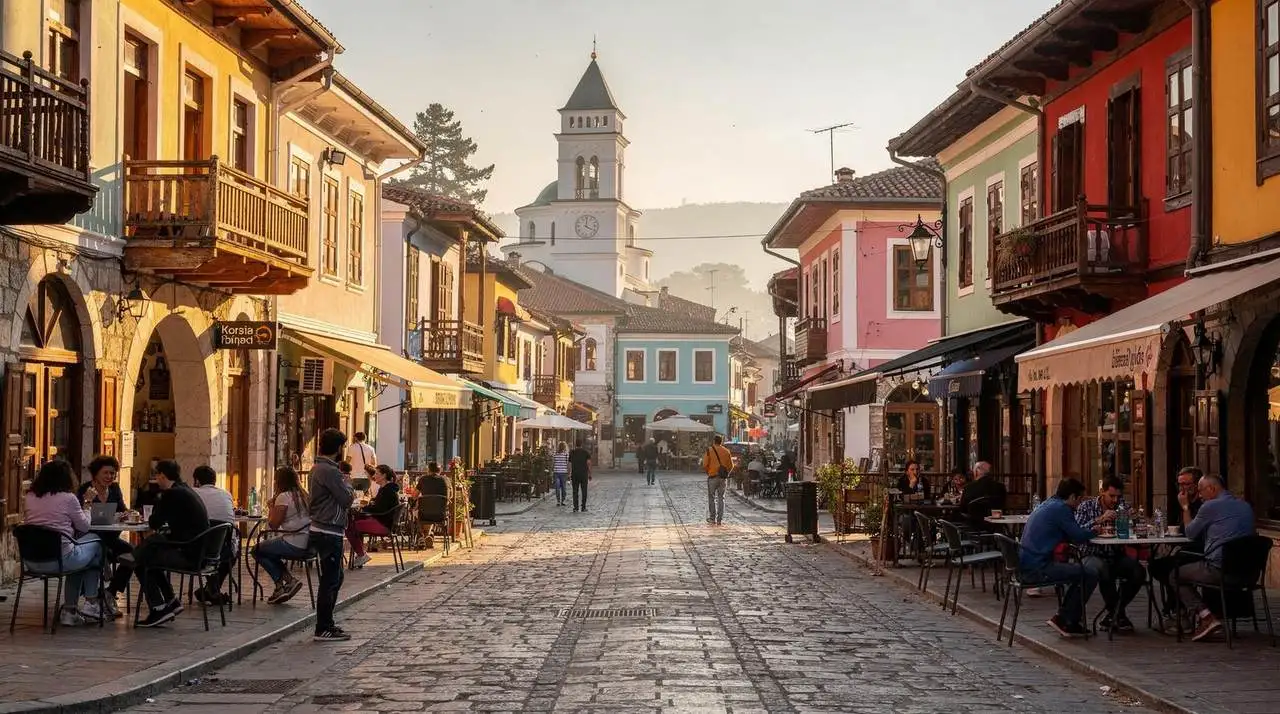
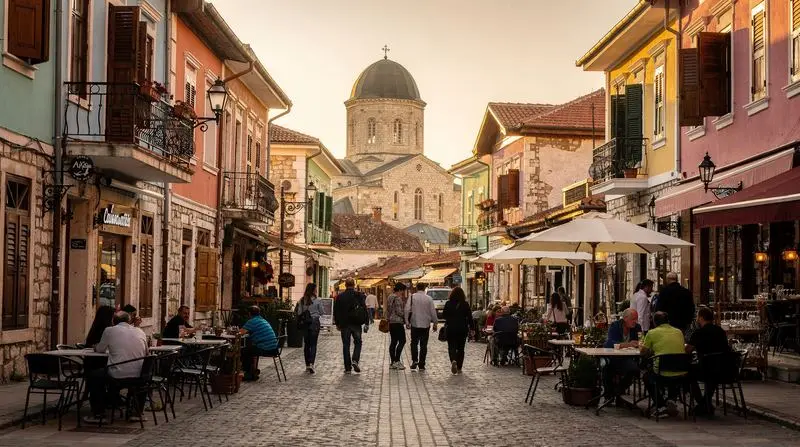
Boulevard Republika — Korca’s French-planned main boulevard — is lined with restaurants and cafes that come alive in the late afternoon and dominate the evening. The boulevard restaurants offer standard Albanian menus with regional specialities, and the setting — broad, plane tree-lined pavements, the evening promenade culture of the xhiro, the mountain air cooling pleasantly after sunset — gives ordinary food an extraordinary context.
The better boulevard restaurants serve regional eastern Albanian cooking: stuffed peppers (speca të mbushura) with rice and meat, lamb preparations that reflect the plateau’s sheep-farming tradition, and dairy-forward starters (the local white cheese and sheep’s milk yogurt are exceptional).
Restorant Era on the boulevard is consistently recommended by local Albanians as the best traditional restaurant in Korca. The menu changes with the season — genuine seasonal cooking rather than a fixed menu that ignores what is available — and the lamb preparations in particular are very good. Budget EUR 8-15 per person for a full meal.
The evening dining culture at boulevard restaurants starts late by Western European standards — Albanian dinner is 8pm onward, with the main service running 9-11pm. The long Albanian dinner — multiple courses, no hurry, conversation between courses, rakija at the end — is one of the country’s finest social rituals, and Korca’s boulevard restaurants are among the best places to experience it.
Dairy: Korca’s Secret Food Treasure
Eastern Albania’s dairy tradition is one of the finest in the country, and Korca is its urban expression. The mountain plateau surrounding the city supports extensive sheep and cow farming, and the cheese and yogurt from these farms represent some of the best dairy products in Albania.
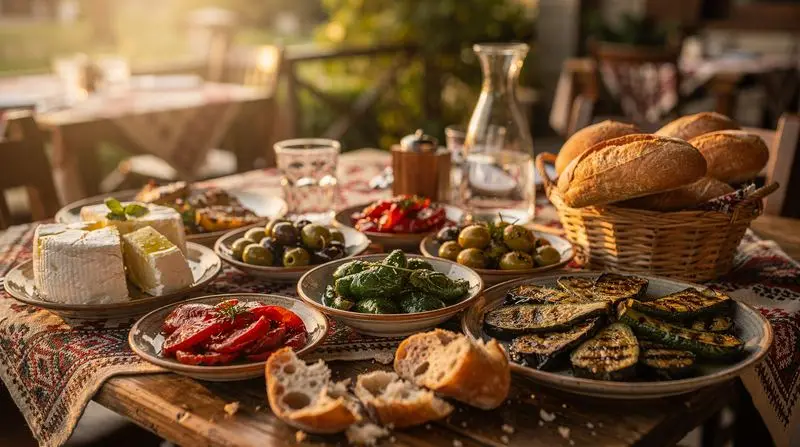
Djath i bardhë (white cheese, similar to feta but milder and creamier) appears as a starter at every traditional Korca restaurant. The best versions have a freshness that packaged feta cannot approximate — made that morning, delivered daily, served simply with olive oil and bread.
Kos (strained yogurt) is thick, slightly tangy, and versatile. It appears as a breakfast item with local honey, as a side with meat dishes, and as the base of the famous tave kosi (lamb baked with yogurt and eggs). The Korca version of tave kosi, made with highland lamb and local yogurt, is among the best in Albania.
Gjizë (fresh white cottage cheese) is used in both sweet and savoury preparations. In the lakror and certain pastry fillings, the freshness of the local gjizë makes a perceptible difference to the final product.
Wine and Local Drinks
While Korca is famous for its beer, the city also has access to good eastern Albanian wines, particularly from the Elbasan and Berat wine corridors to the west. Several Korca restaurants maintain decent Albanian wine lists.
The local grape variety Shesh i Zi (black shesh) produces a medium-bodied red that pairs well with the lamb and meat preparations that dominate the eastern Albanian menu. Shesh i Bardhe, the white counterpart, is lighter and works with the dairy-forward dishes.
Raki is taken seriously in Korca — the local grape raki from the surrounding valleys is a genuine artisanal product when sourced from traditional producers. Asking for the house raki at a traditional restaurant typically produces an unmarked bottle of very good quality spirit.
Korca beer on draught is available at all the city’s cafes and most restaurants. The standard pale lager is the primary offer; the brewery produces additional styles available at the beer garden and on draught at selected establishments.
The Beer Festival: Korca’s Annual Food and Drink Event
The Korca Beer Festival — held annually in late July or early August — transforms the city into one of Albania’s most festive destinations. Live music, street food, beer flowing from the brewery, and the gathering of Albanians from across the country and the diaspora create an atmosphere that is among the most joyful in Albanian social life.
During the festival, outdoor eating and drinking spaces proliferate across the city, and the regular restaurant capacity doubles or triples. Street food — grilled meats, byrek, and local pastries — fills the pedestrian areas. The festival typically runs for several days and occupies the city’s main squares and the area around the brewery.
If your visit coincides with the Beer Festival, accommodation must be booked months in advance and prices at all establishments rise significantly. The festival is worth planning around for the atmosphere and the unique experience of Korca at its most celebratory.
Breakfast and Cafe Culture
Korca’s breakfast culture is built around the bazaar byrek shops and the boulevard cafes. Arriving at the bazaar area by 8am catches the fresh byrek coming from the oven — spinach, cheese, and meat versions, all excellent.
The boulevard cafes open from around 7:30am and serve the strongest and most carefully prepared coffee in eastern Albania. Korca’s coffee tradition is one of the city’s lesser-known but genuinely excellent qualities — the beans are roasted at local roasteries rather than purchased from national brands, and the espresso standards are very high.
A morning coffee on the boulevard, watching the city come to life before the day’s heat builds, is one of the finest simple pleasures Korca offers. The combination of the French-planned boulevard, the mountain air, and a genuinely good espresso sets a tone for the day that few Albanian experiences can match.
Budget Eating in Korca
Korca is very affordable. Budget eating options:
Bazaar byrek and pastry: EUR 1-3 for breakfast, including coffee.
Market lunch: The covered market area has prepared food stalls serving full lunches for EUR 3-5.
Traditional restaurants: Full meals with local specialities, wine or beer, and dessert cost EUR 8-15 per person.
Beer garden: Cold beer and grilled food at the brewery garden costs EUR 5-10 per person for a casual meal.
The Albania travel budget guide covers Korca in the eastern Albania section and confirms it as one of the most affordable cities in the country for both accommodation and dining.
A Half-Day Food Walk Through Korça
For visitors with limited time, a structured half-day covers the essential Korça food experience efficiently. Start with breakfast at a bazaar byrek shop around 8am, catching the ovens at their freshest. Spend the mid-morning walking the Old Bazaar, tasting honey, cheese, and bakllava at the stalls, and buying whatever looks best for later. Have lunch at Restorant Era or a boulevard traditional restaurant, ordering the seasonal lamb dish. Spend the afternoon at the brewery tour if timing allows, or simply at the Beer Garden for a cold Korça beer. Finish with dinner on the boulevard as the evening xhiro begins, ideally trying tavë kosi if you have not already.
This sequence takes a full day rather than a strict half-day once the brewery tour and unhurried meals are factored in, but it captures Korça’s food identity — bazaar tradition, brewery culture, and boulevard social life — in a single, well-paced visit. Combined with the Korça city guide for the broader historical and architectural context, it gives a complete introduction to the city.
What to Buy and Take Home
The Korca food shopping list for visitors taking home edible souvenirs:
- Local honey from the surrounding mountain valleys
- Korca bakllava from the bazaar pastry shops (well-wrapped, it travels several days)
- Korca beer in bottles from the brewery shop
- Local coffee from the bazaar roasteries
The bazaar is the best source for all of these; the local supermarkets carry the standard commercial versions but the artisanal products from the market are significantly better.
Getting to Korça and Eating Along the Way
Korça sits in Albania’s eastern highlands, roughly three hours from Tirana by road and closer still to the North Macedonian border, which makes it a natural stop for travellers entering or leaving Albania overland from the east. Furgons connect Korça with Tirana, Pogradec, and other eastern towns regularly. Travellers arriving from Tirana often stop in the Elbasan or Librazhd area en route, where roadside restaurants serve competent but unremarkable Albanian standards — worth knowing so you can save your appetite for Korça itself rather than filling up along the way.
The French Connection: How History Shaped the Food Scene
Korca’s unusual food culture cannot be fully understood without reference to the French military administration that occupied the city during World War I. The French presence — from 1916 to 1920 — left physical traces in the boulevard planning and architectural style, but also cultural traces in the food habits that have persisted across a century.
The French concept of the boulevard cafe — a formal public space for social eating and drinking, distinct from private domestic dining — was genuinely new to Albanian social culture when the French arrived, and Korca adopted it with enthusiasm. The idea that a city’s social life should happen outdoors at tables on a broad, tree-lined avenue is not Albanian in origin; it is French. But Korca made it entirely its own, and the boulevard cafe culture that resulted is now inseparable from the city’s identity.
More concretely, French influence on Albanian cooking in Korca is harder to trace but occasionally visible in the relative sophistication of the city’s restaurant menus compared with other Albanian provincial centres, in the preference for quality ingredients over simple quantity, and in the cafe tradition of offering food with the coffee culture rather than treating eating and coffee as entirely separate activities.
The Korca city guide covers the French historical context in full, explaining how the boulevard came to be designed as it was and what the French period meant for Korca’s subsequent cultural development.
Seasonal Eating in Korca
Korca’s altitude and mountain plateau setting create a food seasonality that is more pronounced than in coastal or lowland Albania. The city’s market and the farms supplying its restaurants follow a genuine seasonal calendar that produces measurably different food experiences in different months.
Spring (April-May): The first wild greens — nettles, sorrel, wild garlic, and the alpine meadow herbs that thrive in the highland climate — begin appearing in market stalls and as seasonal specials at traditional restaurants. Spring lamb, born in late winter, is available from April onward. The first strawberries and early soft fruit from the plateau farms appear in May.
Summer (June-September): Full produce season. The vegetable gardens of the Korca plateau — known for producing excellent tomatoes, peppers, aubergines, and courgettes in the long cool days at altitude — supply the restaurants with a quality of summer vegetables that the hot, fast-ripening coastal climate cannot match. The stuffed pepper (speca të mbushura) is at its best when the peppers are from the plateau harvest.
Autumn (October-November): Mushrooms from the surrounding forests supplement the restaurant menus. Walnuts from the valley orchards are harvested in October — the same walnuts that the bazaar bakeries use for the local bakllava. The apple and pear harvest from the plateau orchards produces fruit that appears as dessert ingredients and in the local raki production.
Winter (December-March): The preserved and stored foods of the Albanian highland tradition — dried beans, pickled vegetables, cured meats, stored root vegetables — dominate the winter menu at traditional restaurants. Winter Korca dining is hearty rather than light, oriented toward foods that provide warmth and substance for the mountain winter.
Korca’s Food Scene Compared to Berat and Gjirokastra
Eastern Albania’s cooking is distinct enough from the southern and central traditions that a comparison helps set expectations.
| Korça | Berat | Gjirokastra | |
|---|---|---|---|
| Signature dish | Lakror | Tavë Berat | Fergese |
| Drink identity | Birra Korça (beer) | Local wine | Raki |
| Setting | French-planned boulevard | Riverside/castle views | Old Bazaar |
| Price level | Very affordable | Affordable | Affordable |
Combining Korça with either city makes for a good eastern-to-southern Albania food route; the Korça city guide and best restaurants Berat guide give the fuller pictures of each.
Vegetarian Eating in Korça
Eastern Albania’s dairy-forward cooking gives vegetarians solid options: djath i bardhë with olive oil, gjizë-filled lakror and byrek variants, stuffed peppers without meat on request, and the boulevard salads. Sheqerpare and bakllava are milk- and egg-based but meat-free. Strict vegans will find the pervasive dairy the main challenge, though the bazaar’s produce stalls support self-catering well.
The Korca Embroidery and Textile Craft Markets
The bazaar’s textile tradition — Korca embroidery in the distinctive geometric patterns of the regional tradition — is worth mentioning in a food guide because the best textile and craft shopping in the bazaar area is in the same lanes as the food shopping, and combining both creates a more complete experience of the old market than either alone provides.
The geometric embroidery on white cloth, using red and black thread in the traditional Korca pattern, is sold both as finished domestic textiles (cushion covers, table cloths, decorative pieces) and as raw cloth for those who want to see the production rather than just the product. The best pieces are genuinely handmade and the quality is exceptional.
Walking through the bazaar with attention to both the food stalls and the textile shops — and stopping for coffee at one of the bazaar cafes that serve freshly roasted beans from the in-house roastery — creates a two-hour experience that covers the essential character of Korca’s most authentic commercial district.
Frequently Asked Questions About Restaurants in Korca
What is Korca’s signature local dish?
Lakror — a layered savoury pastry with various local fillings, made differently from standard Albanian byrek — is the most distinctive Korca food product. Sheqerpare (syrup-soaked semolina cakes) and the local version of bakllava made with regional walnuts are the essential sweet specialities. The tave kosi (lamb baked with local yogurt) is the main course that best represents the eastern Albanian cooking tradition at its finest.
How many days should I spend eating my way through Korça?
One full day covers the essentials — bazaar breakfast, Old Bazaar tasting walk, boulevard lunch, and Beer Garden or brewery tour — but two days allows a more relaxed pace, including a Voskopoja or Pogradec day trip with a Korça dinner to return to each evening.
Does Korça’s food scene change much outside the Beer Festival period?
Yes, noticeably. Outside the festival window, the boulevard and bazaar are calmer and more affordable, and the pace of dining is closer to Korça’s everyday rhythm than the festival’s heightened energy. Both versions are worth experiencing, but travellers who dislike crowds should plan around the festival dates rather than during them.
Where is the best place to drink Korca beer in Korca?
The Korca Beer Garden adjacent to the brewery is the definitive answer — fresh from the source, in the shadow of the building that produces it. For a brewery tour with formal tasting, the brewery tour with beer tasting provides the full experience. On the boulevard in the evening, any cafe that serves draught Korca is excellent — the combination of the beer, the mountain air, and the xhiro promenade is hard to improve on.
Are Korca restaurants expensive?
No — Korca is one of Albania’s most affordable cities for dining. Full traditional meals cost EUR 8-15 per person. The beer garden and boulevard cafes are even more affordable. The absence of a large international tourist economy keeps prices at genuine local levels. A day of eating well in Korca — byrek breakfast, traditional lunch, beers at the garden, dinner on the boulevard — costs EUR 20-30 per person including all drinks.
Is Korca food different from other Albanian cities?
Yes, distinctly so. Eastern Albanian cooking is different from coastal Albanian cooking in its emphasis on mountain dairy (sheep’s milk cheese and yogurt), highland lamb, preserved and stored seasonal produce, and specific pastry traditions (lakror, petanik, sheqerpare) that do not exist elsewhere in the country. The Ottoman culinary heritage is more pronounced in Korca than in most Albanian cities, visible in the pastry tradition and in the coffee culture. The Albanian food guide explains the regional variations in more detail.
When is the best time to eat at Korca boulevard restaurants?
The boulevard comes alive from around 6pm as the evening xhiro begins. Cafes fill for coffee and beer from 6-8pm. Restaurant dinner service begins around 8pm with the peak at 9-10:30pm. The cool mountain evenings even in July and August make outdoor boulevard dining genuinely comfortable. Breakfast at a boulevard cafe (7:30-9:30am) catches the quiet before the city fully wakes and is excellent for coffee quality and atmosphere.
Can I visit Korça as a food day trip from Pogradec or Voskopoja?
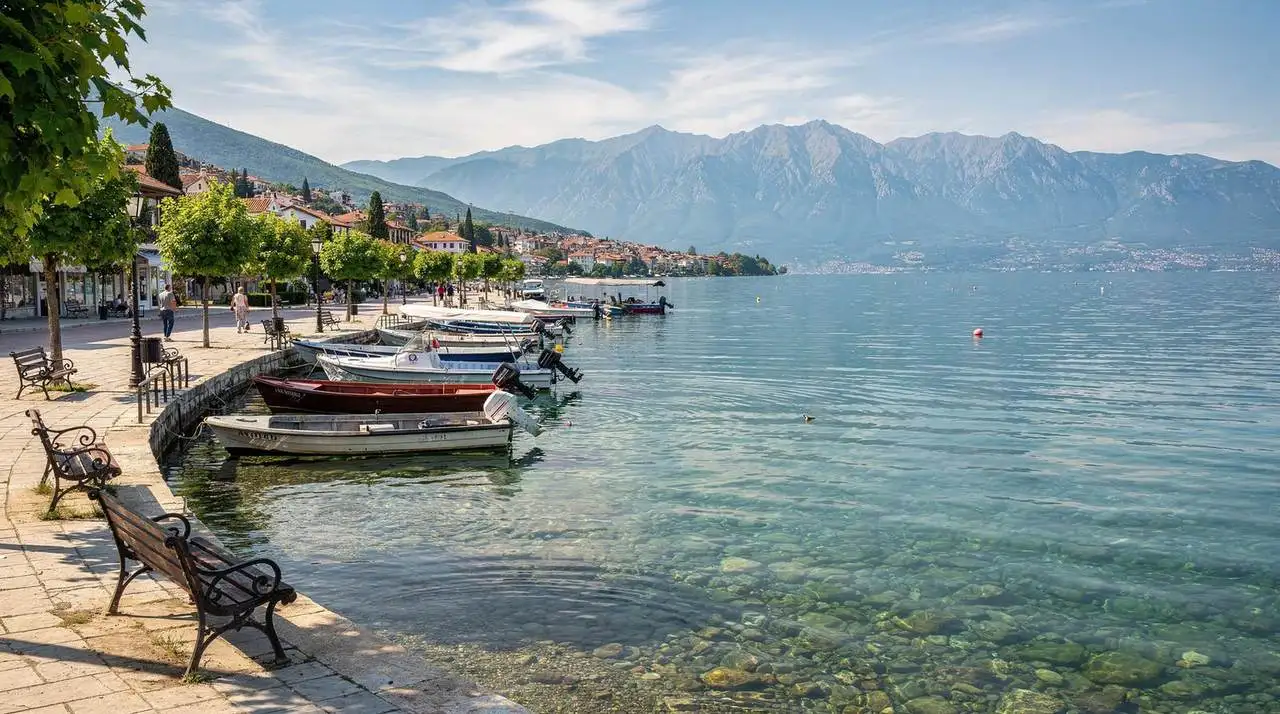
Yes. Pogradec on Lake Ohrid is about 40 minutes away and Voskopoja in the mountains above Korça is around 30 minutes, and both are commonly combined with a Korça lunch or dinner as part of an eastern Albania day. Many visitors base themselves in Korça and use it as the food hub for both destinations.
What is the best souvenir food to bring home from Korça?
Bottled Korça beer, local honey from the surrounding valleys, and well-wrapped bakllava from the bazaar pastry shops travel best and represent the city’s food identity most distinctly. Local coffee from the bazaar roasteries is also a good, less fragile option for a longer journey home.